CityTour AI

Trier self-guided walking tour

Trier: Two Millennia in One Walk

Explore the 'Second Rome' on a casual stroll through Germany's oldest city. From the towering Porta Nigra to the birthplace of Karl Marx, you'll see how Roman ruins, medieval markets, and revolutionary history blend into a vibrant modern town. It’s a journey through 2,000 years of architecture and local legends along the Moselle.

Audio tourSelf-guidediOS & Android
103minutes
3.6 kmdistance
10stops
Audio guideFormat
Trier: Two Millennia in One Walk
Berthold Werner / CC BY-SA 3.0

Stops on this route

This tour works well for first-time visitors, weekend trips, and travelers who want to explore Trier without a fixed tour time.

Route map for Trier walking tour
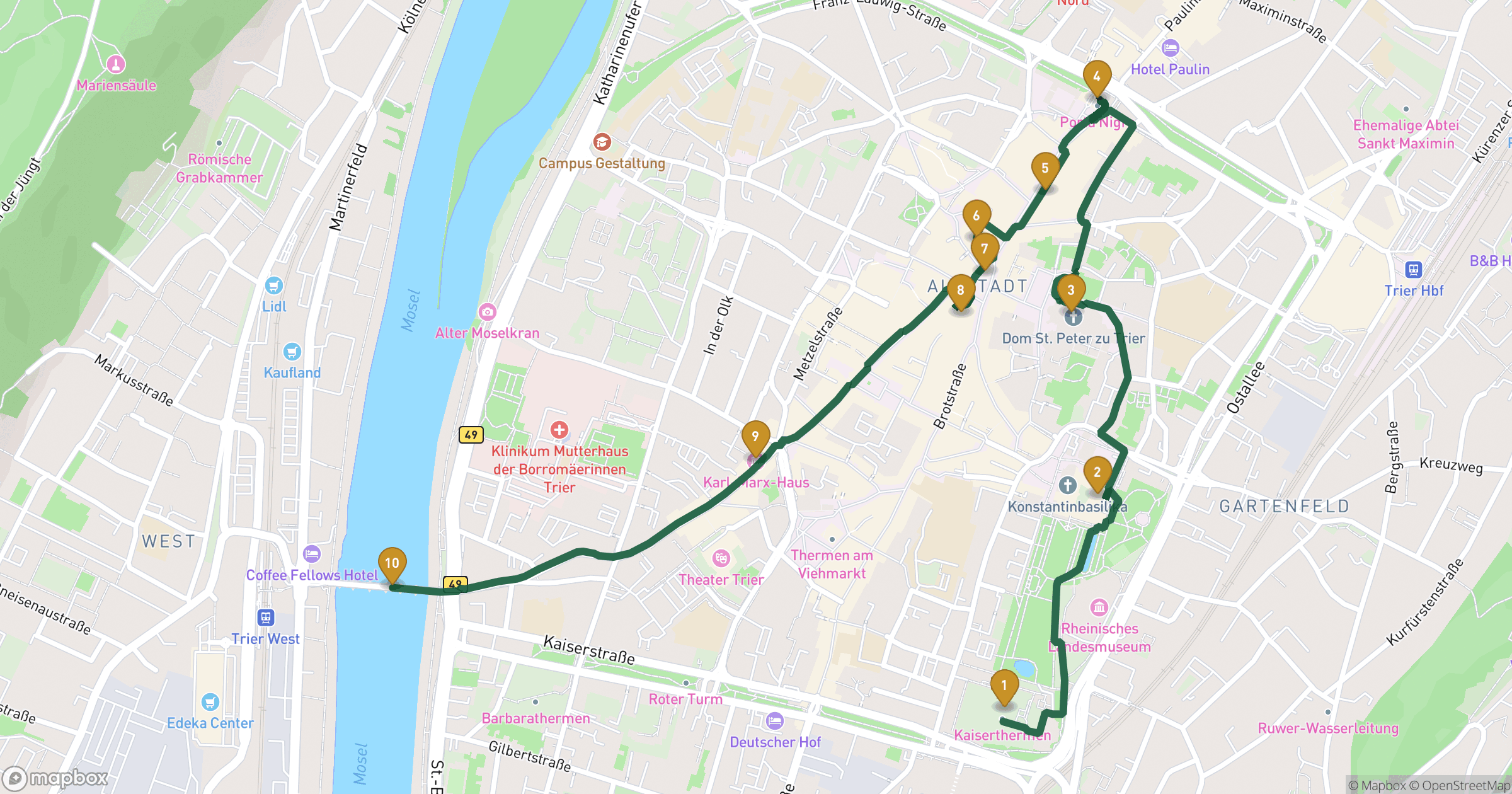
Map for Trier walking tour with 10 stops
The static map shows the tour route with Trier Imperial Baths, Electoral Palace, Cathedral of Trier, Porta Nigra, and 6 more stops.

Stops along the route

All stops on this self-guided tour at a glance.

  1. Trier Imperial Baths in Trier
    Berthold Werner / Public domain

    1Trier Imperial BathsBuilding

    The Kaiserthermen showcase an ambitious Roman imperial bath project that was never finished as intended. Begun around 300 AD under Emperor Constantius Chlorus, work stopped abruptly in 316 AD before the site was converted into barracks for the imperial guard. Today, visitors can still explore the subterranean network of service tunnels and sophisticated sewer channels.

    Wikidata

  2. Electoral Palace in Trier
    Berthold Werner / Public domain

    2Electoral PalaceCastle

    The Electoral Palace illustrates the sharp architectural contrast between delicate 18th-century Rococo and ancient Roman brickwork. Archbishop-Elector Johann IX Philipp von Walderdorff commissioned Johannes Seiz to design the ornate south wing directly beside Constantine's 4th-century throne room. Surviving Baroque gardens feature mythological statues carved by Ferdinand Tietz.

    Architect: Johannes Seiz · Style: Renaissance architecture · Wikidata

  3. Cathedral of Trier in Trier
    Berthold Werner / CC BY-SA 3.0

    3Cathedral of TrierChurch

    Trier Cathedral traces an architectural lineage directly back to a Roman palace associated with Saint Helena. The north facade preserves original Roman brickwork from a massive complex built after Constantine's conversion to Christianity. After a devastating Viking raid in 882, rebuilding produced the four-tower Romanesque westwork copied across Europe.

    Built: 1235 · Architect: Nikolaus Rosiny · Style: Romanesque architecture · Named after: Saint Peter · Wikidata

  4. Porta Nigra in Trier
    Thomas Wolf, www.foto-tw.de / CC BY-SA 3.0 de

    4Porta NigraCastle

    The Porta Nigra stands as a towering Roman gate preserved through its medieval transformation into a sacred sanctuary. Construction began around 170 AD but was never fully finished, leaving its sandstone blocks rough and unpolished. The gate survived stone-scavenging because the hermit monk Simeon lived inside the ruins, prompting its conversion into stacked churches after 1035.

    Built: 180 · Style: ancient Roman architecture · Wikidata

  5. Dreikönigenhaus (Trier) in Trier
    Berthold Werner / Public domain

    5Dreikönigenhaus (Trier)Attraction

    The Dreikönigenhaus reveals how wealthy medieval families fortified their urban dwellings against 13th-century unrest. Its original main doorway sits securely on the second floor, once accessible only via a retractable wooden ladder. Colorful restored decorative motifs ring the upper-story arched windows, matching the original medieval design.

    Style: Romanesque architecture · Wikidata

  6. Judengasse in Trier
    User:Stefan Kühn / CC BY-SA 3.0

    6JudengasseSquare

    The Judengasse preserves the dense layout of Trier's medieval Jewish quarter dating back to records from 1066. Judengasse 2 features a cellar built in 1235 and a facade from 1311, representing one of Germany's oldest documented Jewish residences. The vibrant 60-house community was brutally expelled during the Black Death in 1349.

    Wikidata

  7. Hauptmarkt in Trier
    Joachim_Hofmann / CC BY-SA 2.0

    7HauptmarktSquare

    The Hauptmarkt forms the historic marketplace defined by civic pride and public symbols established in 958. Its Market Cross rests on an ancient Roman granite pillar that medieval authorities repurposed as a public pillory. The square also features the 1595 Petrusbrunnen fountain, carved with personified virtues and whimsical animals like monkeys and geese.

    Wikidata

  8. St. Gangolf's church in Trier
    RomkeHoekstra / CC BY-SA 3.0

    8St. Gangolf's church

    St. Gangolf's church represents the civic ambition of Trier's medieval merchant class, discreetly hidden behind perimeter houses. Accessible only through a small gateway off the square, it stood in direct symbolic competition with the Archbishop's towering cathedral. The late Gothic parish interior features slender stained windows and soaring ribbed vaulting.

    Style: Gothic architecture · Wikidata

  9. Karl-Marx-House museum in Trier
    Sathvik / CC BY-SA 3.0

    9Karl-Marx-House museum

    The Karl-Marx-House is a 1727 Baroque townhouse where the influential political philosopher was born on May 5, 1818. The building was seized by the Nazi regime in 1933 and operated as a propaganda printing office before opening as a museum in 1947. On display inside are Marx's personal reading armchair and a portrait bust sculpted by his own great-grandson.

    Built: 1947 · Wikidata

  10. Roman Bridge in Trier
    Spon.teeve / CC BY-SA 4.0

    10Roman Bridge

    The Römerbrücke spans the Moselle as an enduring feat of ancient Roman river engineering. Nine massive stone pillars dating to the 2nd century AD were founded directly on the riverbed using watertight cofferdams. Archaeologists estimate that nearly one million offering coins tossed for good luck lie buried in the silt below.

    Wikidata

Download the app

This public page shows a preview. The full route, all content, and navigation are available in CityTour AI.

Cities nearby

Discover self-guided tours in nearby cities.

Frequently asked questions

The key answers before you start.

Is this a self-guided audio tour?

Yes. In the CityTour AI app (iOS and Android), this is a self-guided audio tour for Trier — start anytime, at your own pace, with map, stops, and audio narration.

What will you see on this tour?

On this tour you'll see, among others, Trier Imperial Baths, Electoral Palace, Cathedral of Trier, Porta Nigra, Dreikönigenhaus (Trier), Judengasse and more sights.

Where does the tour start?

The route starts at Trier Imperial Baths and ends at Roman Bridge. You can start anytime — the app guides you to the first stop.

How long does the tour take?

About 103 minutes for 10 stops — at your own pace, with breaks whenever you like.

How much does the tour cost?

This tour costs 15 credits. The exact price depends on the pack you buy and your country — roughly $5.

Is it an outdoor tour — are entry tickets included?

Yes, it's an outdoor tour: the sights are viewed from the outside. Entry tickets are not included, and step-free access cannot be guaranteed.

Is the audio guide available in my language?

The tour and audio guide are available in English, Deutsch, Français, Español, Italiano and 9 more languages. You pick your language in the app.

Can I use the tour offline?

Yes. Tours can be used offline.

Can I ask the AI questions along the way?

Yes. At every stop you can ask the AI directly if you want to know more or didn't understand something.