CityTour AI

Halle (Saale) self-guided walking tour

Salt, Pride, and Quirky Tales: A Walk Through Halle

Discover Halle beyond the clichés on a tour ranging from Baroque splendor to the Fab Four. We stroll through Handel's birthplace, admire Italian Renaissance flair at the Stadtgottesacker, and learn why a donkey is bedded on roses here. A humorous look at a city that breathes history without losing its sense of the curious.

Audio tourSelf-guidediOS & Android
103minutes
4.0 kmdistance
11stops
Audio guideFormat
Salt, Pride, and Quirky Tales: A Walk Through Halle
eugen-de / CC BY-SA 3.0

Stops on this route

This tour works well for first-time visitors, weekend trips, and travelers who want to explore Halle (Saale) without a fixed tour time.

Route map for Halle (Saale) walking tour
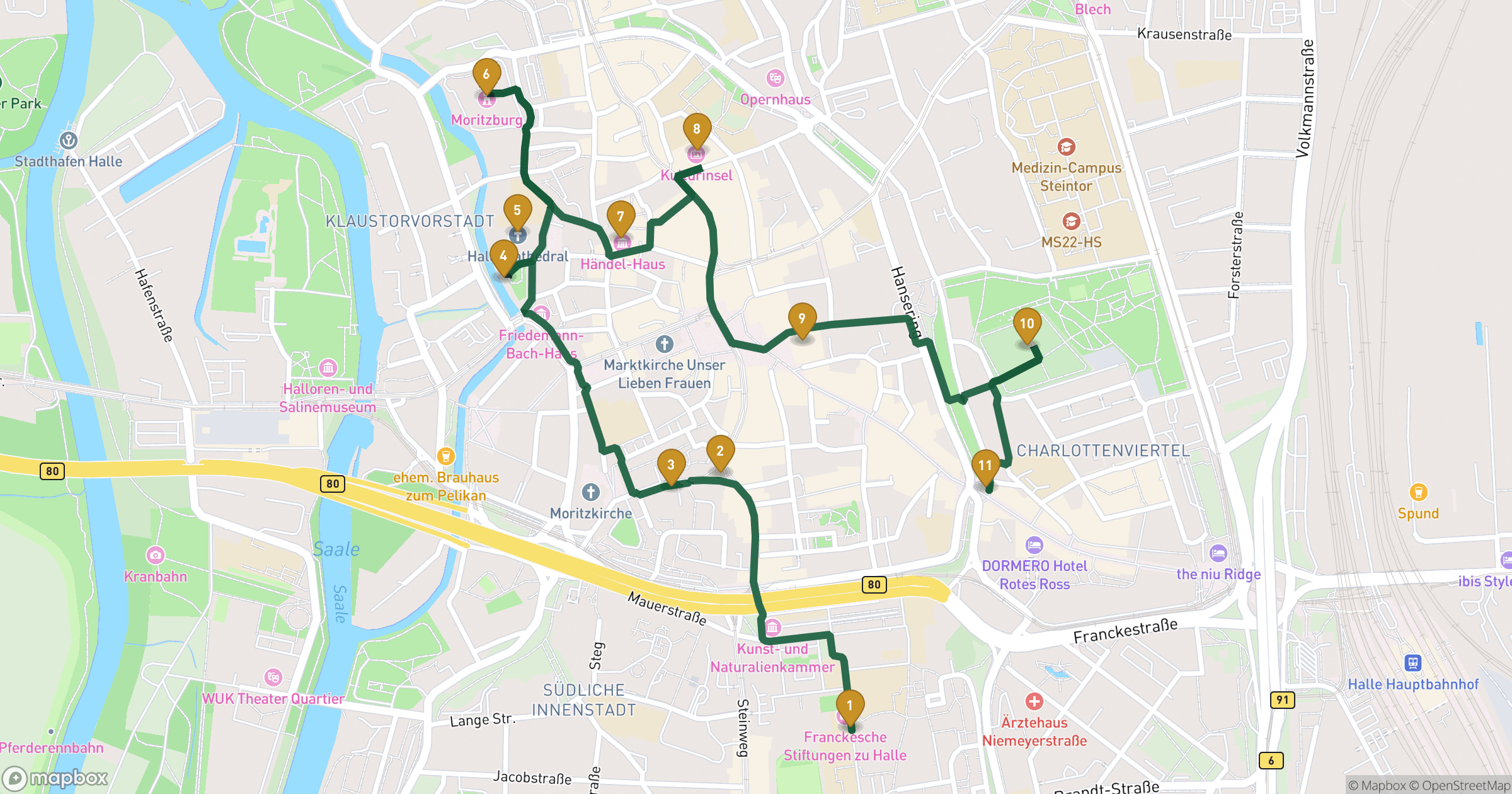
Map for Halle (Saale) walking tour with 11 stops
The static map shows the tour route with Francke Foundations, Eselsbrunnen, Beatles-Museum Halle, Neue Residenz, and 7 more stops.

Stops along the route

All stops on this self-guided tour at a glance.

  1. Francke Foundations in Halle (Saale)
    eugen-de / CC BY-SA 3.0

    1Francke FoundationsAttraction

    The Franckesche Stiftungen grew out of a modest educational experiment funded by pocket change. In 1695, theologian August Hermann Francke discovered four talers and sixteen groschen in an alms box and established a school for the poor. Today the site features Europe's largest half-timbered residential building alongside an eighteenth-century rooftop cabinet of curiosities.

    Built: 1695 · Wikidata

  2. Eselsbrunnen in Halle (Saale)
    paul muster / CC BY 3.0

    2EselsbrunnenMonument

    The Eselsbrunnen on the Alter Markt celebrates an amusing logistical misunderstanding involving an unsuspecting beast of burden. Completed by sculptor Heinrich Keiling in 1913, it commemorates a miller's donkey that trotted over rose petals meant for Emperor Otto I. The bronze Art Nouveau monument made headlines again in 2015 when thieves sawed off the animal's tail.

    Wikidata

  3. Beatles-Museum Halle in Halle (Saale)
    paul muster | https://web.archive.org/web/20161102061931/http://www.panoramio.com/photo/110615710 / CC BY 3.0

    3Beatles-Museum Halle

    The Beatles-Museum Halle presents the world's oldest and most extensive public collection dedicated to the Fab Four. Collector Rainer Moers began gathering memorabilia in 1964, eventually relocating his massive archive to this baroque town house in 2000. Around 3,500 items are showcased across three floors, representing only a fifth of the total holdings.

    Wikidata

  4. Neue Residenz in Halle (Saale)
    OmiTs / CC BY-SA 3.0

    4Neue ResidenzCastle

    The Neue Residenz reflects the grand Mediterranean ambitions of Cardinal Albrecht von Brandenburg on the banks of the Saale. Construction of the four-winged early Renaissance complex began in 1531 while Albrecht was the second-most powerful figure in the Holy Roman Empire. He financed lavish building projects like this through the sale of indulgences, enraging Martin Luther.

    Wikidata

  5. Halle Cathedral in Halle (Saale)
    A.Savin / FAL

    5Halle CathedralChurch

    The Hallescher Dom is an architectural puzzle: a cathedral completely devoid of towers. Originally completed around 1330 as a Dominican friary church, it was transformed in the sixteenth century by Cardinal Albrecht into the showcase for over 20,000 relics. Lucas Cranach the Elder and his workshop were commissioned to furnish sixteen altars containing 140 paintings.

    Architect: Bastian Binder · Style: Gothic architecture · Height: 18 m · Named after: Paul the Apostle · Wikidata

  6. Moritzburg in Halle (Saale)
    DerHallenser / CC BY-SA 4.0

    6MoritzburgCastle

    The Moritzburg stands as a late Gothic fortress erected by the Archbishops of Magdeburg to keep rebellious locals in line. Nineteen-year-old Archbishop Ernst von Wettin laid the foundation stone in 1484, though the castle was largely ruined during the Thirty Years' War. Spanish architects Nieto Sobejano capped the ancient walls with a modern folded aluminum roof between 2005 and 2008.

    Built: 2000 · Architect: Conrad Pflüger · Wikidata

  7. Händel-Haus in Halle (Saale)
    DerHallenser / CC BY-SA 4.0

    7Händel-HausMuseum

    The Händel-Haus marks the birthplace of composer George Frideric Handel, who lived here before moving to London to write for the British Crown. The composer's father Georg, a court surgeon, acquired this Renaissance property, where the musician was born in 1685. Restorations removed modern shop windows to reveal its historic facade, which conceals an original Renaissance paneled room.

    Named after: George Frideric Handel · Wikidata

  8. Kulturinsel in Halle (Saale)
    Photo: Andreas Praefcke; Self-photographed / CC BY 3.0

    8KulturinselTheatre

    The Kulturinsel Halle forms a theatrical labyrinth assembled from eight historic buildings in the city center. Its core originated as the Kaiser-Säle complex in 1891, which housed the tavern Strieses Biertunnel, an establishment that still operates today. In 1980, theater director Peter Sodann and his ensemble transformed an abandoned cinema on the site into their own performance venue.

    Wikidata

  9. Ratshof in Halle (Saale)
    Ralf Lotys (Sicherlich) / CC BY 3.0

    9RatshofBuilding

    The Ratshof owes its prominent position on the market square to wartime destruction and post-war planning decisions. Designed by city architect Wilhelm Jost in 1929, the brick building was hidden behind the medieval Old Town Hall until bomb damage led to the older structure's demolition in 1948. A massive corner tower and an entrance flanked by four monumental columns define its exterior.

    Built: 1929 · Architect: Wilhelm Jost · Style: Neoclassicalism … · Wikidata

  10. Stadtgottesacker in Halle (Saale)
    Jwaller / CC BY-SA 3.0

    10StadtgottesackerBuilding

    The Stadtgottesacker brings Italian Renaissance cemetery design north of the Alps. Established from 1557 after Cardinal Albrecht ordered city burials moved outside the walls, the graveyard was enclosed by architect Nickel Hoffmann with 94 vaulted arcades. Nineteenth-century workers filled in its deep crypts with soil, and around 50 of the original 92 stonemason marks remain visible.

    Built: 1557 · Wikidata

  11. Leipziger Turm in Halle (Saale)
    Tilman2007 / CC BY-SA 4.0

    11Leipziger TurmTower

    The Leipziger Turm stands isolated beside modern tram lines as the last substantial remnant of Halle's medieval fortifications. Erected in the mid-fifteenth century near the Galgtor, the stone tower features defensive walls that measure 2.8 meters thick near the base. A Renaissance dome with slate dormers and a copper lantern was added in 1573 alongside a public clockwork mechanism.

    Wikidata

Download the app

This public page shows a preview. The full route, all content, and navigation are available in CityTour AI.

Cities nearby

Discover self-guided tours in nearby cities.

Frequently asked questions

The key answers before you start.

Is this a self-guided audio tour?

Yes. In the CityTour AI app (iOS and Android), this is a self-guided audio tour for Halle (Saale) — start anytime, at your own pace, with map, stops, and audio narration.

What will you see on this tour?

On this tour you'll see, among others, Francke Foundations, Eselsbrunnen, Beatles-Museum Halle, Neue Residenz, Halle Cathedral, Moritzburg and more sights.

Where does the tour start?

The route starts at Francke Foundations and ends at Leipziger Turm. You can start anytime — the app guides you to the first stop.

How long does the tour take?

About 103 minutes for 11 stops — at your own pace, with breaks whenever you like.

How much does the tour cost?

This tour costs 15 credits. The exact price depends on the pack you buy and your country — roughly $5.

Is it an outdoor tour — are entry tickets included?

Yes, it's an outdoor tour: the sights are viewed from the outside. Entry tickets are not included, and step-free access cannot be guaranteed.

Is the audio guide available in my language?

The tour and audio guide are available in English, Deutsch, Français, Español, Italiano and 9 more languages. You pick your language in the app.

Can I use the tour offline?

Yes. Tours can be used offline.

Can I ask the AI questions along the way?

Yes. At every stop you can ask the AI directly if you want to know more or didn't understand something.