CityTour AI

Wernigerode self-guided walking tour

Timber Frames and Hidden Tales of Wernigerode

Discover the 'Colorful City on the Harz' through its most iconic timber-framed treasures and quirky architectural oddities. This walk takes you from a 16th-century coffee house to a mill that leans further than the Tower of Pisa, uncovering the social history and local legends hidden in the wood-carved facades. You will experience the charm of medieval squares and the fascinating stories of the people who shaped this mountain town.

Audio tourSelf-guidediOS & Android
56minutes
1.3 kmdistance
8stops
Audio guideFormat
Timber Frames and Hidden Tales of Wernigerode
Christian Reinboth / CC BY-SA 4.0

Stops on this route

This tour works well for first-time visitors, weekend trips, and travelers who want to explore Wernigerode without a fixed tour time.

Route map for Wernigerode walking tour
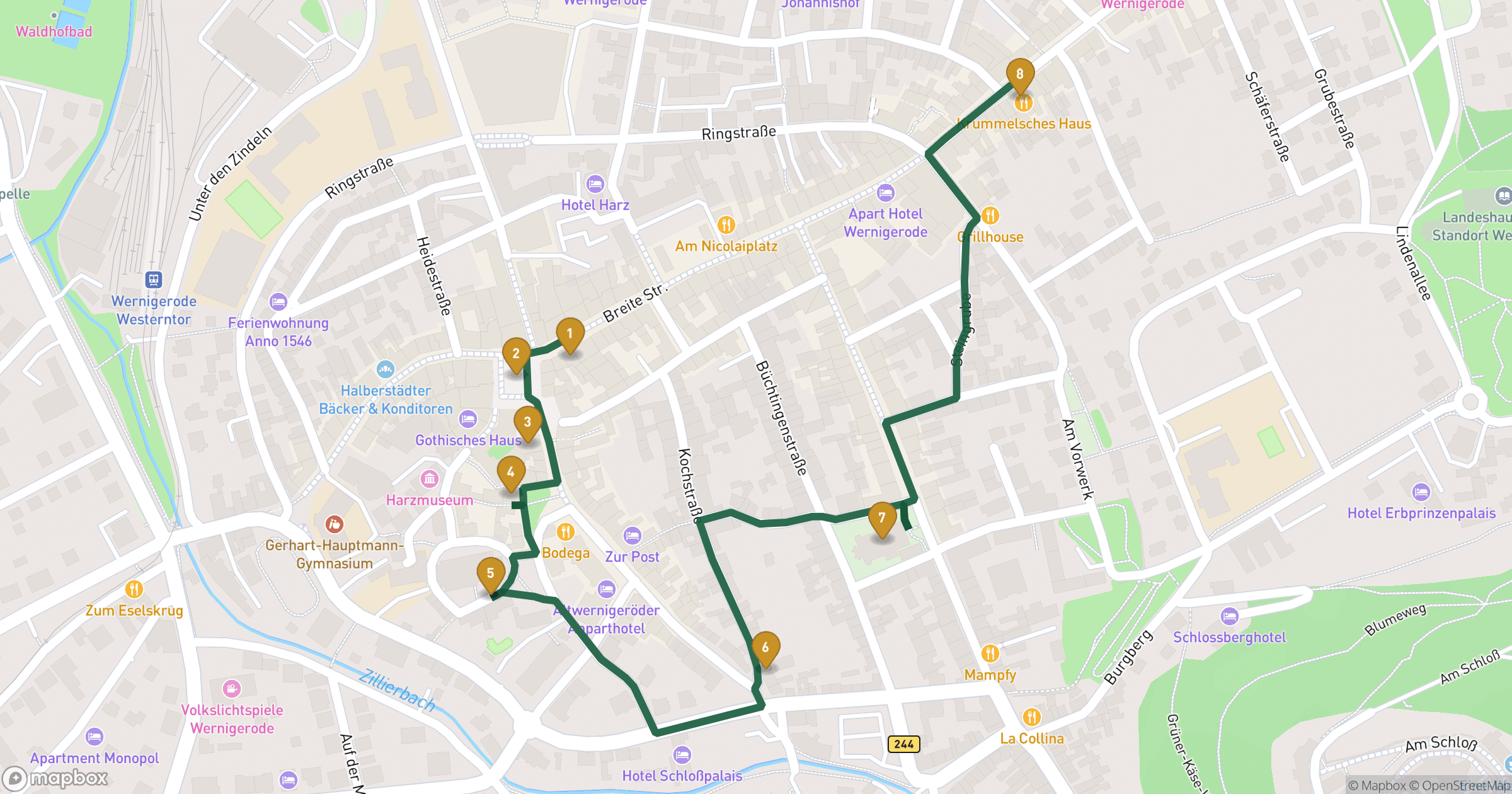
Map for Wernigerode walking tour with 8 stops
The static map shows the tour route with Café Wien, benefactor well, Town hall Wernigerode, Schiefes Haus, and 4 more stops.

Stops along the route

All stops on this self-guided tour at a glance.

  1. Café Wien in Wernigerode
    H. Zell / CC BY-SA 3.0

    1Café Wien

    Café Wien pairs its timber-framed origins from 1583 with tales of prominent historical visitors. Having survived the devastating fire of 1751, the spot inspired poet Hermann Löns in 1907 to dub Wernigerode The Colorful City on the Harz. Wilhelm Hauer turned it into a pastry shop in 1897, and the current name was adopted in the 1950s after Austrian coffeehouse culture.

    Built: 1583 · Wikidata

  2. benefactor well in Wernigerode
    PantheraLeo1359531 / CC BY 4.0

    2benefactor wellAttraction

    The Benefactor Well on the market square commemorates the citizens who contributed funds and service to the community. Cast in iron in 1848 by the Ilsenburg foundry, this neo-Gothic monument features pointed arches and delicate finials. Its intricate details preserve the names of local officials and donors who secured public welfare and essential water supplies.

    Built: 1848 · Wikidata

  3. Town hall Wernigerode in Wernigerode
    Klugschnacker / CC BY-SA 3.0

    3Town hall WernigerodeAttraction

    City Hall began in 1420 under Count Heinrich as a playhouse designed for dancing and Shrove Tuesday festivities. Master carpenter Thomas Hilleborch completed the facade carvings in the late 1490s, depicting jesters, drinkers, and Morris dancers with the May Queen. The town administration converted the building for governance and court trials during the mid-16th century.

    Wikidata

  4. Schiefes Haus in Wernigerode
    Christian Reinboth / CC BY-SA 4.0

    4Schiefes HausMuseum

    The Leaning House tilts twice as steeply as the Leaning Tower of Pisa due to its origins as a cloth fulling mill built in 1680. Diverted water from the Zillierbach and rhythmic mill hammers caused one side of the foundation to sink more than 60 centimeters. Municipal workers used the building until the 1970s, requiring custom upright walls inside to combat dizziness.

    Built: 1680 · Wikidata

  5. Oberpfarrkirchhof in Wernigerode
    Gliwi / CC0

    5OberpfarrkirchhofBuilding

    The Oberpfarrkirchhof occupies a rise known as the Klint, chosen by early settlers to remain safe above valley floods. Enclosing the elite parish church of St. Sylvestri, this quiet space functioned as the town cemetery until the mid-19th century. Today, preserved timber-framed residences around the square mark the shift from medieval architecture to decorative Baroque.

    Wikidata

  6. Kleinstes Haus in Wernigerode
    Heinz K. S. / CC BY-SA 4.0

    6Kleinstes HausBuilding

    The Smallest House was squeezed into a 2.95-meter gap between two adjoining properties in 1792. Needy builders dispensed with erecting dedicated side walls, resulting in a low entrance doorway standing just 1.70 meters high. Records reveal that up to eleven residents occupied this single-room dwelling at once before private occupancy finally ended in 1976.

    Built: 1792 · Wikidata

  7. Our Lady Church in Wernigerode
    Aagnverglaser / CC BY 4.0

    7Our Lady Church

    Our Lady Church reveals an unusual pairing of architectural styles brought about by historic financial troubles. Following the fire of 1751, Danish royalty helped finance a Baroque rebuilding, but an 1891 neo-Gothic overhaul halted after funds ran out for everything except the ornate spire. In 2022, the deconsecrated structure reopened as the Konzerthaus Liebfrauen.

    Built: 1756 · Style: baroque architecture · Wikidata

  8. Krummelsches Haus in Wernigerode
    Edelmauswaldgeist / CC0

    8Krummelsches HausBuilding

    The Krummelsches Haus, constructed in 1674 for grain merchant Henricus Krummel, features woodwork that blankets the front beams in reliefs. Window panels depict allegorical continents, though the woodcarver mistakenly swapped the name labels for Africa and America. Between 1906 and 1952, the municipality intervened repeatedly to prevent owners from selling the facade.

    Built: 1674 · Wikidata

Download the app

This public page shows a preview. The full route, all content, and navigation are available in CityTour AI.

Cities nearby

Discover self-guided tours in nearby cities.

Frequently asked questions

The key answers before you start.

Is this a self-guided audio tour?

Yes. In the CityTour AI app (iOS and Android), this is a self-guided audio tour for Wernigerode — start anytime, at your own pace, with map, stops, and audio narration.

What will you see on this tour?

On this tour you'll see, among others, Café Wien, benefactor well, Town hall Wernigerode, Schiefes Haus, Oberpfarrkirchhof, Kleinstes Haus and more sights.

Where does the tour start?

The route starts at Café Wien and ends at Krummelsches Haus. You can start anytime — the app guides you to the first stop.

How long does the tour take?

About 56 minutes for 8 stops — at your own pace, with breaks whenever you like.

How much does the tour cost?

This tour costs 8 credits. The exact price depends on the pack you buy and your country — roughly $3.

Is it an outdoor tour — are entry tickets included?

Yes, it's an outdoor tour: the sights are viewed from the outside. Entry tickets are not included, and step-free access cannot be guaranteed.

Is the audio guide available in my language?

The tour and audio guide are available in English, Deutsch, Français, Español, Italiano and 9 more languages. You pick your language in the app.

Can I use the tour offline?

Yes. Tours can be used offline.

Can I ask the AI questions along the way?

Yes. At every stop you can ask the AI directly if you want to know more or didn't understand something.