CityTour AI

Chemnitz self-guided walking tour

Chemnitz: Saxony's Manchester in Transition

Experience the fascinating transformation from "Saxon Manchester" to a modern Capital of Culture on this diverse city walk. Discover monumental industrial heritage, impressive GDR architecture, and hidden natural wonders like a petrified forest in the heart of the city. This tour combines the raw history of factories with the relaxed atmosphere of green oases.

Audio tourSelf-guidediOS & Android
186minutes
8.0 kmdistance
18stops
Audio guideFormat
Chemnitz: Saxony's Manchester in Transition
Aagnverglaser / CC BY-SA 3.0 de

Stops on this route

This tour works well for first-time visitors, weekend trips, and travelers who want to explore Chemnitz without a fixed tour time.

Route map for Chemnitz walking tour
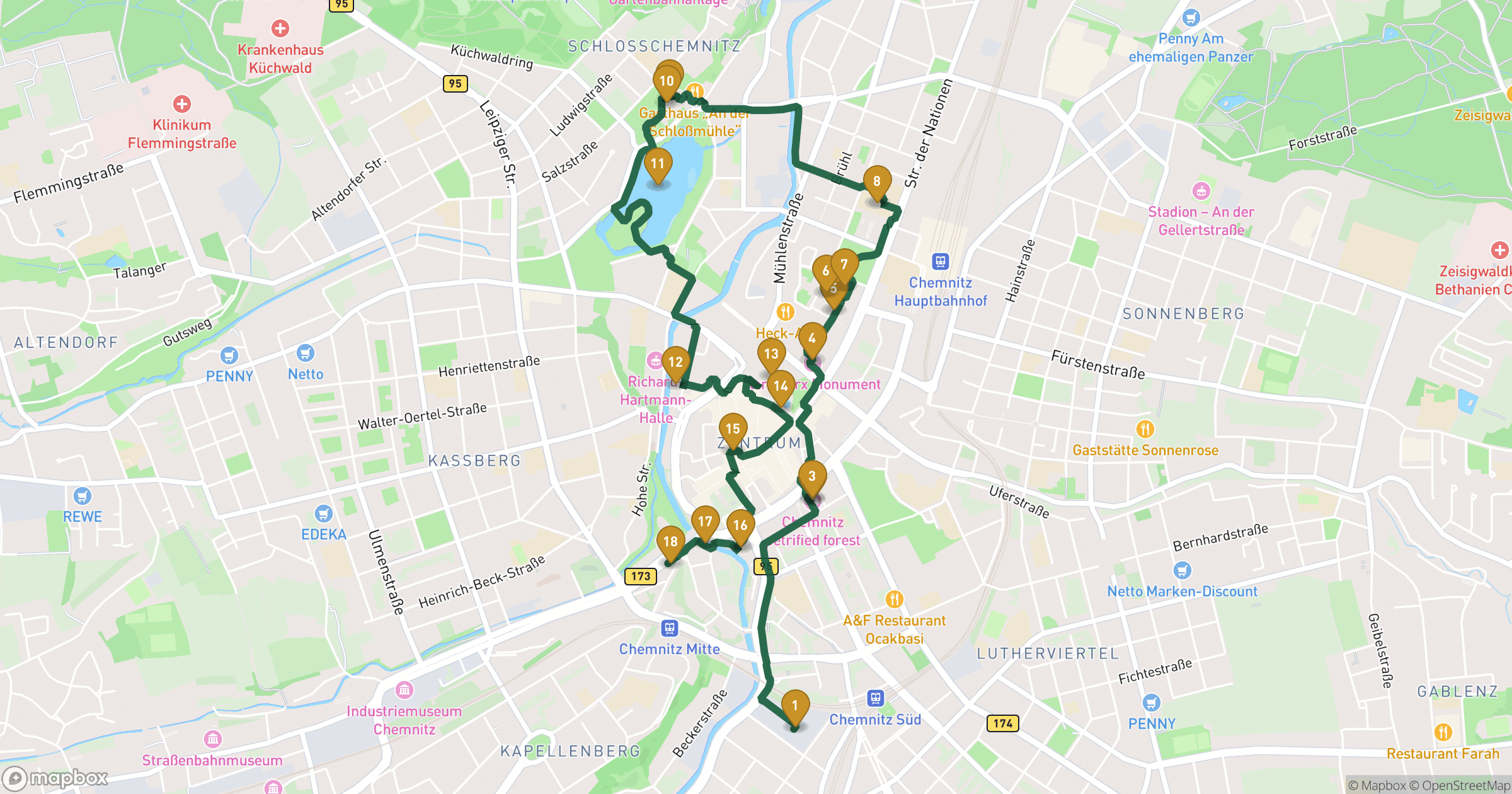
Map for Chemnitz walking tour with 18 stops
The static map shows the tour route with Wirkbau, DAStietz, Chemnitz petrified forest, Karl Marx Monument, and 14 more stops.

Stops along the route

All stops on this self-guided tour at a glance.

  1. Wirkbau in Chemnitz
    Aagnverglaser / CC BY-SA 3.0 de

    1WirkbauBuilding

    The Wirkbau complex embodies the industrial transformation of Chemnitz through the lens of its striking architecture. Architect Erich Basarke designed its clock tower in the early 1920s to rise above the chimneys of competing factories. Once the heart of textile machine manufacturer Schubert & Salzer, the former factory now houses tech start-ups and creative agencies.

    Wikidata

  2. DAStietz in Chemnitz
    Aagnverglaser / CC BY-SA 3.0 de

    2DAStietzBuilding

    DAStietz presents a grand twentieth-century department store defined by ambition, wartime tragedy, and renewal. Built in 1913 by Wilhelm Kreis, it was forcibly closed by the National Socialists in 1938, and director Hermann Fürstenheim was shot by SA men during the November pogroms. Since 2004, the restored building with its spacious atrium has served as a cultural hub.

    Built: 1913 · Wikidata

  3. Chemnitz petrified forest in Chemnitz
    SchiDD / CC BY-SA 3.0

    3Chemnitz petrified forestAttraction

    The Petrified Forest inside DAStietz reveals an ancient natural wonder preserved in stone. An eruption of the Zeisigwald volcano buried an entire forest in ash nearly 290 million years ago, creating European records in plant fossil size. In 1751, gemstone inspector David Frenzel needed a team of 28 horses to haul a massive 100-hundredweight trunk from here to Dresden.

    Wikidata

  4. Karl Marx Monument in Chemnitz
    Velvet / CC BY-SA 4.0

    4Karl Marx Monument

    The Karl Marx Monument centers on the massive bronze head that came to symbolize Chemnitz. Unveiled in 1971, Soviet sculptor Lev Kerbel submitted seventeen proposals before officials chose a seven-meter portrait bust over a full figure. Behind it stands the former SED district headquarters displaying the slogan 'Workers of all countries unite!' in four languages.

    Built: 1971 · Height: 13 m · Wikidata

  5. König-Albert-Museum in Chemnitz
    Dguendel / CC BY 4.0

    5König-Albert-Museum

    The König-Albert-Museum on Theaterplatz showcases the cultural pride of the city at the height of its industrial boom. Designed by Richard Möbius, the monumental structure was completed in 1909 using distinctive Red Granite of Mittweida. King Friedrich August III attended the opening on September 1, 1909, mingling freely with locals instead of observing strict royal protocol.

    Named after: Albert I of Saxony · Wikidata

  6. Chemnitz Opera in Chemnitz
    Reinhard aus Sachsen; Reinhard Höll; Original uploader was Reinhard aus Sachsen at de.wikipedia. (Original text: Selbst fotografiert am 27. Mai 2005). / CC BY-SA 3.0

    6Chemnitz OperaTheatre

    Opernhaus Chemnitz highlights the modern theater heritage and human stories behind the city's performing arts. Opened in 1909 alongside the neighboring museum, the house was led for over thirty years by Austrian director Carl Riha, who preserved artistic freedom here from 1957 to 1989. Notable director Harry Kupfer also worked as head director before his global career.

    Built: 1909 · Architect: Richard Möbius · Wikidata

  7. St. Petri church in Chemnitz
    Reinhard aus Sachsen; Reinhard Höll; Self-photographed / CC BY-SA 3.0

    7St. Petri church

    St. Petri Church stands as an imposing neo-Gothic landmark with deep ties to the local manufacturing era. Constructed between 1885 and 1888, its iron roof truss was manufactured by the Königin-Marien-Hütte industrial foundry. Sculptor Werner Stein created the main portal relief, and the tower's golden cross was hoisted into place above the nave in 1887.

    Built: 1888 · Style: Gothic Revival · Named after: Saint Peter · Wikidata

  8. Alte Aktienspinnerei in Chemnitz
    Torstenww / CC BY-SA 4.0

    8Alte AktienspinnereiBuilding

    The Alte Aktienspinnerei illustrates how a deserted textile plant became a centerpiece for modern academic life. Thousands of spindles once rattled inside this monumental brick complex, helping cement the city's reputation as the Saxon Manchester. Today, the preserved clinker facade encloses Saxony's most modern university library, built from steel and glass.

  9. Schlosskirche Chemnitz in Chemnitz
    Tobias Luksch / CC BY-SA 3.0

    9Schlosskirche ChemnitzChurch

    The Schloßkirche St. Marien preserves late-Gothic architecture and celebrated Renaissance artwork on the Schloßberg. Master builder Andreas Günther of Komotau completed the hall church expansion around 1525, introducing Bohemian structural influences into Saxony. Inside sits the 1499 Katharinenaltar by Pankratius Grueber, alongside sculptures linked to Hans Witten.

    Named after: Mary · Wikidata

  10. Schloßbergmuseum Chemnitz in Chemnitz
    Roman Grabolle (Krtek76) / CC BY-SA 3.0

    10Schloßbergmuseum Chemnitz

    The Schloßbergmuseum occupies a twelfth-century monastery that later served as a ducal residence and leisure ground. Emperor Lothar III established the Benedictine abbey around 1136, after which master administrator Barthel Lauterbach converted the site into a hunting lodge. On display is a miniature Holy Sepulchre from around 1500, modeled on a Gothic cathedral.

    Built: 1931 · Wikidata

  11. Schloßteich in Chemnitz
    Kora27 / CC BY-SA 4.0

    11SchloßteichMonument

    The Schloßteich park offers open waters and scenic shores created by monastic enterprise. Benedictine monks from the adjacent abbey first excavated the pond during the fifteenth century as an essential fish farm for Lent. Today, visitors can rent rowboats in summer to look back across the water toward the nearby church and museum.

    Wikidata

  12. Markthalle Chemnitz in Chemnitz
    No machine-readable author provided. Hagen Graebner assumed (based on copyright claims).; No machine-readable source provided. Own work assumed (based on copyright claims). / CC BY-SA 2.5

    12Markthalle ChemnitzBuilding

    The Chemnitzer Markthalle recalls a bustling nineteenth-century trading center dubbed the belly of the city. City planning director Eduard Hechler oversaw the construction of this brick building in just eighteen months before its opening in 1891. Hydraulic elevators and direct cellar access for handcarts serviced 358 market stalls underneath a central glass nave.

    Built: 1891 · Wikidata

  13. Stadthalle Chemnitz in Chemnitz
    Reinhard Höll; Self-photographed / CC BY-SA 3.0

    13Stadthalle ChemnitzBuilding

    Stadthalle Chemnitz embodies striking East German modernism structured on a strict geometric plan. Architect Rudolf Weißer designed the complex on a triangular grid in the late 1960s, cladding the exterior in four thousand square meters of red Rochlitz porphyry. The interior foyer displays a bronze statue of Galileo Galilei created by sculptor Fritz Cremer.

    Built: 1974 · Wikidata

  14. Roter Turm in Chemnitz
    Aagnverglaser / CC BY-SA 3.0 de

    14Roter TurmTower

    The Roter Turm survives as the city's oldest structure thanks to its long service as a civic prison. Originating as a residential tower around 1150, its cells once held labor leader August Bebel as well as the folk poacher Karl Stülpner. In 1968, the local factory VEB Fettchemie Karl-Marx-Stadt modeled its classic 500-milliliter dish soap bottle on the tower's crown.

    Built: 1150 · Wikidata

  15. Rathausturm in Chemnitz
    Kora27 / CC BY-SA 3.0

    15RathausturmViewpoint

    The Rathausturm watches over the marketplace from the heart of the Old Town. Rising beside the Old Town Hall, which was rebuilt after a fire in 1466, the tower is accented by a prominent Renaissance portal. For generations, city watchmen such as Stefan Weber announced the time from the top while dressed in traditional historic garb.

  16. 16Uferstrand

    Uferstrand highlights the riverside setting where heavy industry has given way to open-air leisure. Located along the banks of the Chemnitz River, the site sits directly against old brick textile factories that once lined the working waterfront. Today, deck chairs and sandy terraces offer a view over the passing water and historic industrial walls.

  17. Falkeplatz in Chemnitz
    Tobias Luksch / CC BY-SA 3.0

    17FalkeplatzBuilding

    Falkeplatz captures the bold expressionist urban planning of the Weimar Republic era. Architect Erich Basarke gave the former Deutsche Bank building a rigorous, vertically structured facade without traditional ornamental elements. The intersection reflects how 1920s planners intentionally broke through medieval street boundaries to build a modern transport hub.

  18. Gunzenhauser Museum in Chemnitz
    Derbrauni / CC BY 4.0

    18Gunzenhauser Museum

    Museum Gunzenhauser showcases New Objectivity architecture commissioned between 1928 and 1930 for the city savings bank. City planning director Fred Otto built the facade from light travertine without decorative ornamentation to emphasize pure proportion. Since 2007, the former glass-roofed banking hall has exhibited private collections by Munich art dealer Alfred Gunzenhauser.

    Built: 2007 · Wikidata

Download the app

This public page shows a preview. The full route, all content, and navigation are available in CityTour AI.

Cities nearby

Discover self-guided tours in nearby cities.

Frequently asked questions

The key answers before you start.

Is this a self-guided audio tour?

Yes. In the CityTour AI app (iOS and Android), this is a self-guided audio tour for Chemnitz — start anytime, at your own pace, with map, stops, and audio narration.

What will you see on this tour?

On this tour you'll see, among others, Wirkbau, DAStietz, Chemnitz petrified forest, Karl Marx Monument, König-Albert-Museum, Chemnitz Opera and more sights.

Where does the tour start?

The route starts at Wirkbau and ends at Gunzenhauser Museum. You can start anytime — the app guides you to the first stop.

How long does the tour take?

About 186 minutes for 18 stops — at your own pace, with breaks whenever you like.

How much does the tour cost?

This tour costs 30 credits. The exact price depends on the pack you buy and your country — roughly $10.

Is it an outdoor tour — are entry tickets included?

Yes, it's an outdoor tour: the sights are viewed from the outside. Entry tickets are not included, and step-free access cannot be guaranteed.

Is the audio guide available in my language?

The tour and audio guide are available in English, Deutsch, Français, Español, Italiano and 9 more languages. You pick your language in the app.

Can I use the tour offline?

Yes. Tours can be used offline.

Can I ask the AI questions along the way?

Yes. At every stop you can ask the AI directly if you want to know more or didn't understand something.