CityTour AI

Dresden self-guided walking tour

Dresden’s Baroque Splendor and Royal Rebirth

Experience the grandeur of the "Florence on the Elbe" on this casual stroll through Dresden's historic heart. You'll explore opulent Baroque palaces, witness the world's largest porcelain mural, and see how a city rose from the ashes of war to reclaim its architectural soul. It’s a journey through royal ambition and meticulous reconstruction that feels like walking through a living history book.

Audio tourSelf-guidediOS & Android
102minutes
2.5 kmdistance
13stops
Audio guideFormat
Dresden’s Baroque Splendor and Royal Rebirth
Avda / CC BY-SA 3.0

Stops on this route

This tour works well for first-time visitors, weekend trips, and travelers who want to explore Dresden without a fixed tour time.

Route map for Dresden walking tour
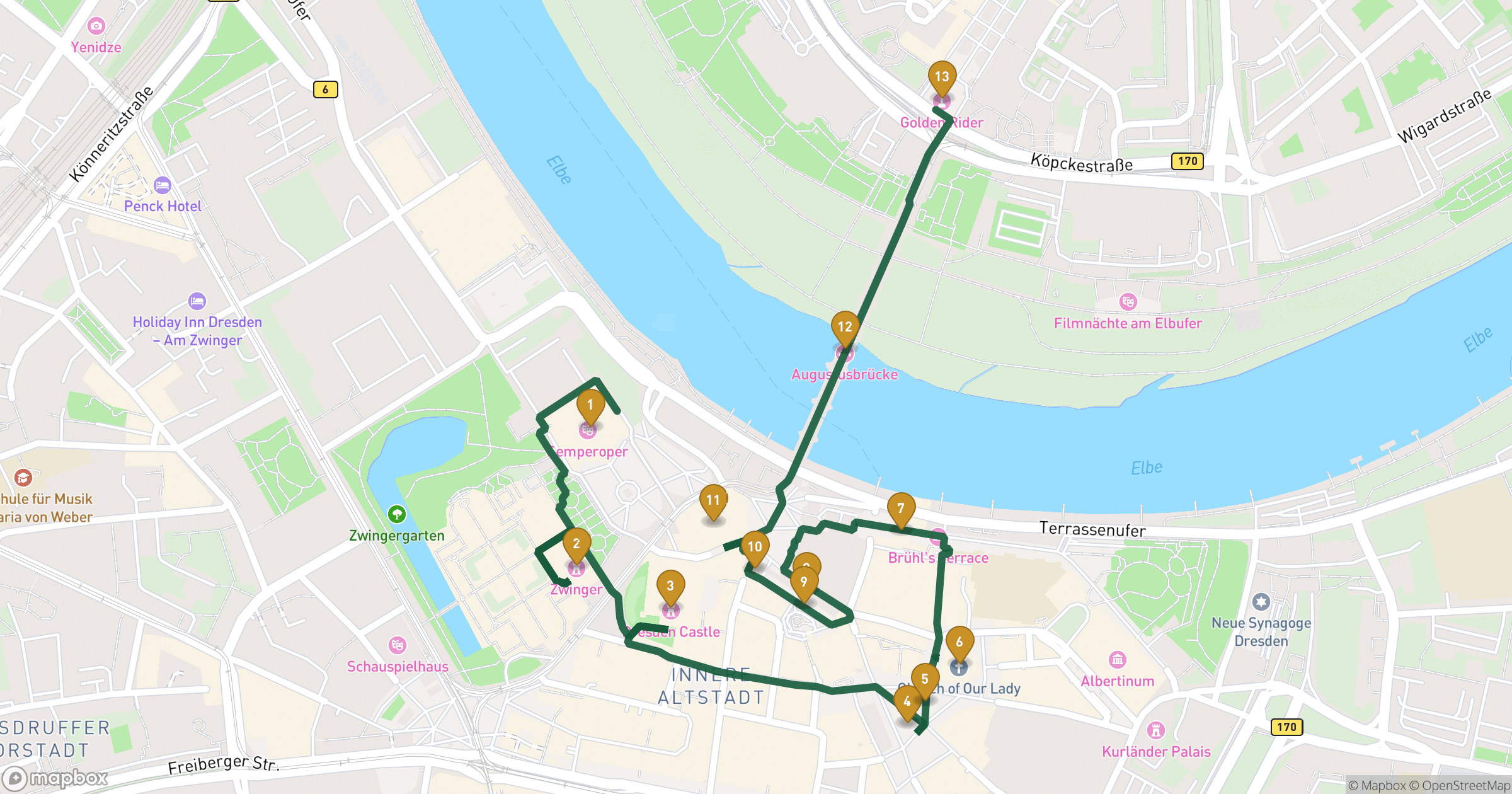
Map for Dresden walking tour with 13 stops
The static map shows the tour route with Semperoper, Zwinger, Residenzschloss Dresden, Neumarkt, and 9 more stops.

Stops along the route

All stops on this self-guided tour at a glance.

  1. Semperoper in Dresden
    Avda / CC BY-SA 3.0

    1SemperoperTheatre

    The Semperoper showcases an Italian High Renaissance exterior topped by a bronze panther quadriga carrying Dionysus and Ariadne. Architect Gottfried Semper fled into exile after the 1849 May Uprising, leaving his son Manfred to supervise construction from his father's remote plans. Rebuilt after wartime destruction, the current opera house reopened in 1985.

    Architect: Gottfried Semper · Style: Renaissance Revival architecture · Named after: Gottfried Semper · Wikidata

  2. Zwinger in Dresden
    Jörg Blobelt / CC BY-SA 4.0

    2ZwingerCastle

    The Zwinger emerged from Augustus the Strong's ambition to rival Versailles for grand festivities and shelter his orange trees. Its Glockenspiel Pavilion chimes with 40 Meissen porcelain bells alongside the secluded Nymphenbad fountain. The complex opened in 1719 for a royal wedding celebration that featured weeks of tournaments and animal hunts in the courtyard.

    Built: 1711 · Architect: Matthäus Daniel Pöppelmann · Style: baroque architecture · Named after: zwinger · Wikidata

  3. Residenzschloss Dresden in Dresden
    User:Kolossos / CC BY-SA 3.0

    3Residenzschloss DresdenCastle

    Dresden Castle served as the royal seat of Saxon electors and kings for nearly eight centuries. Its 14th-century Hausmannsturm is the complex's oldest surviving structure, tied to a legend that the ruling dynasty would collapse if its clock stopped. The reconstructed Giant's Hall interior replicates massive suits of armor and weaponry from vintage photographs.

    Architect: Matthäus Daniel Pöppelmann, Giovanni Maria Nosseni … · Style: baroque architecture … · Wikidata

  4. Neumarkt in Dresden
    CEphoto, Uwe Aranas / CC BY-SA 3.0

    4NeumarktSquare

    The Neumarkt reveals how civic action reconstructed an entire Baroque square that was flattened in 1945 and left empty under East German rule. Starting in 2001, local campaigns defeated modern glass-and-steel proposals to restore historical gabled townhouses using salvage stones. The resulting numbered quarters replicate original street lines, earning early criticism as a Baroque Disneyland.

    Wikidata

  5. Martin-Luther-Denkmal in Dresden
    Jörg Blobelt / CC BY-SA 4.0

    5Martin-Luther-DenkmalMonument

    The Martin Luther Monument stands before the Frauenkirche depicting the reformer in robes grasping a Bible. Sculptor Ernst Rietschel died in 1861 before finishing the design, requiring his students Adolf von Donndorf and Johannes Schilling to complete it for an 1885 unveiling. The bronze figure survived the 1945 firestorm relatively intact after being knocked from its pedestal.

    Wikidata

  6. Frauenkirche in Dresden
    Bybbisch94 / CC BY-SA 4.0

    6FrauenkircheChurch

    The Frauenkirche features a 12,000-ton sandstone dome designed by George Bähr, who died shortly before its completion. After collapsing during the 1945 firestorm, the ruin stood untouched for 45 years until a global campaign rebuilt it using over 3,800 original stones. The golden cross atop the dome was crafted by the son of a British pilot involved in the wartime bombing.

    Built: 1726 · Architect: George Bähr · Style: baroque architecture · Height: 91.2 m · Wikidata

  7. Brühlsche Terrasse in Dresden
    HasBS / CC BY-SA 4.0

    7Brühlsche TerrasseSquare

    Brühl's Terrace transformed Dresden's defensive ramparts into an elevated riverside promenade nicknamed the Balcony of Europe. Count Heinrich von Brühl received this military ground in the mid-18th century to create lavish private gardens before it opened publicly in 1814. Looking toward the river, visitors see the Academy of Fine Arts crowned by its glass dome, known locally as the Lemon Squeezer.

    Built: 1748 · Wikidata

  8. Fürstenzug in Dresden
    CEphoto, Uwe Aranas / CC BY-SA 3.0

    8FürstenzugMonument

    The Procession of Princes displays centuries of Wettin dynasty rulers across a 102-meter wall formed of roughly 23,000 Meissen porcelain tiles. Artist Wilhelm Walther spent years researching historical dress and painted himself among the scholars at the tail end of the parade. Built between 1904 and 1907 to replace weather-worn sgraffito, the mural survived the 1945 bombings with minimal damage.

    Built: 1870 · Height: 10.5 m · Wikidata

  9. Stallhof in Dresden
    Andraszy / CC BY-SA 4.0

    9StallhofSquare

    The Stallhof formed the palace setting for 16th-century royal jousting matches and equestrian pageantry. Its standout feature is the Langer Gang, a corridor supported by twenty Tuscan columns and decorated with scratched sgraffito plaster. Original bronze rings still cling to the stone pillars, where knights once rested their lances during tournament gatherings.

    Wikidata

  10. Georgentor in Dresden
    Hangman'sDeath / CC0

    10GeorgentorCastle

    The Georgentor was Dresden's first Renaissance structure, commissioned between 1530 and 1535 by Duke George the Bearded. Opposing the Reformation, the duke placed a Dance of Death relief and a Latin inscription declaring that death entered the world through the devil's envy. Following a 1701 fire, the gate's interior was reshaped into living apartments for Augustus the Strong.

    Wikidata

  11. Dresden Cathedral in Dresden
    Bybbisch94 / CC BY-SA 4.0

    11Dresden CathedralBuilding

    The Dresden Cathedral was built discreetly without an expansive public square to serve Catholic rulers in a staunchly Protestant city. Architect Gaetano Chiaveri lined the balustrades with 78 saint statues, each standing over three meters tall. Down in the Wettin crypt rests the heart of Augustus the Strong, sealed in a silver capsule separate from his body in Krakow.

    Built: 1800 · Architect: Gaetano Chiaveri · Style: baroque architecture · Height: 86 m · Wikidata

  12. Augustus Bridge in Dresden
    Wolfgang Pehlemann / CC BY-SA 3.0

    12Augustus Bridge

    The Augustus Bridge links the Old and New Towns while framing the famous skyline captured by Bernardo Bellotto. Completed in 1910 by Wilhelm Kreis and Theodor Klette, it disguises modern reinforced concrete beneath an exterior of traditional Saxon sandstone. This engineering feat permitted wider river arches to ease barge navigation along the Elbe.

    Built: 1907 · Height: 9 m · Named after: Augustus II the Strong · Wikidata

  13. Golden Rider in Dresden
    Hangman'sDeath / CC0

    13Golden RiderMonument

    The Golden Rider portrays Augustus the Strong astride a Lipizzaner stallion dressed in the armor of a Roman emperor. Finished in 1734 by Ludwig Wiedemann, the copper monument is coated in thin gold leaf and points northeast toward Poland, where Augustus also ruled. Dismantled and sheltered in a secret tunnel at Pillnitz Palace during 1945 air raids, it was re-erected in 1956.

    Wikidata

Download the app

This public page shows a preview. The full route, all content, and navigation are available in CityTour AI.

Cities nearby

Discover self-guided tours in nearby cities.

Frequently asked questions

The key answers before you start.

Is this a self-guided audio tour?

Yes. In the CityTour AI app (iOS and Android), this is a self-guided audio tour for Dresden — start anytime, at your own pace, with map, stops, and audio narration.

What will you see on this tour?

On this tour you'll see, among others, Semperoper, Zwinger, Residenzschloss Dresden, Neumarkt, Martin-Luther-Denkmal, Frauenkirche and more sights.

Where does the tour start?

The route starts at Semperoper and ends at Golden Rider. You can start anytime — the app guides you to the first stop.

How long does the tour take?

About 102 minutes for 13 stops — at your own pace, with breaks whenever you like.

How much does the tour cost?

This tour costs 15 credits. The exact price depends on the pack you buy and your country — roughly $5.

Is it an outdoor tour — are entry tickets included?

Yes, it's an outdoor tour: the sights are viewed from the outside. Entry tickets are not included, and step-free access cannot be guaranteed.

Is the audio guide available in my language?

The tour and audio guide are available in English, Deutsch, Français, Español, Italiano and 9 more languages. You pick your language in the app.

Can I use the tour offline?

Yes. Tours can be used offline.

Can I ask the AI questions along the way?

Yes. At every stop you can ask the AI directly if you want to know more or didn't understand something.