CityTour AI

Leipzig self-guided walking tour

Leipzig: Trade, Tunes, and the Peaceful Revolution

Explore the vibrant heart of Leipzig on a walk that bridges centuries of commerce, music, and courage. From the subterranean fortifications of the Moritzbastei to the legendary haunts of Goethe and Bach, you'll discover how this trade-fair hub transformed into the 'City of Heroes.' Experience the unique atmosphere of historic courtyards and grand squares where the sparks of the 1989 Peaceful Revolution first caught fire.

Audio tourSelf-guidediOS & Android
101minutes
2.0 kmdistance
14stops
Audio guideFormat
Leipzig: Trade, Tunes, and the Peaceful Revolution
Burkhard Mücke / CC BY-SA 4.0

Stops on this route

This tour works well for first-time visitors, weekend trips, and travelers who want to explore Leipzig without a fixed tour time.

Route map for Leipzig walking tour
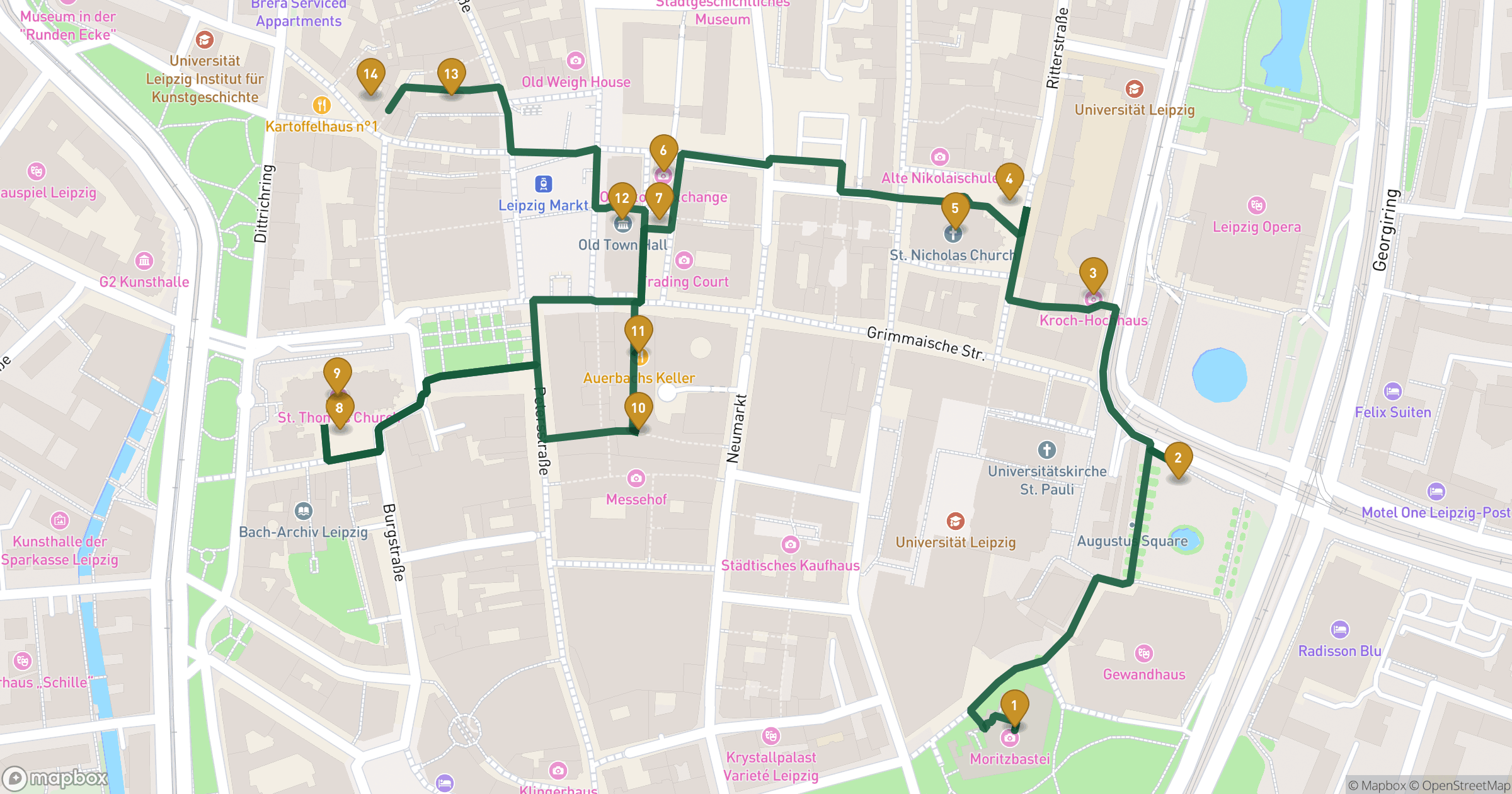
Map for Leipzig walking tour with 14 stops
The static map shows the tour route with Moritzbastei, Augustusplatz, Krochhochhaus, Nikolaisäule, and 10 more stops.

Stops along the route

All stops on this self-guided tour at a glance.

  1. Moritzbastei in Leipzig
    Magnus thorkesson / CC0

    1MoritzbasteiAttraction

    Moritzbastei stands as the only surviving bastion of the city's ancient fortifications, ordered by Elector Moritz of Saxony after the Smalkaldic War. In the 1970s, over 30,000 university students—including a young Angela Merkel—spent years clearing thousands of tons of rubble by hand to build a club. Today, its vaulted 16th-century cellars and courtyards host concerts, parties, and theater.

    Built: 1549 · Wikidata

  2. Augustusplatz in Leipzig
    Oliver Storch / CC BY-SA 3.0

    2AugustusplatzSquare

    Augustusplatz unfolds as a sprawling square framed by 20th-century history, bookended by the Opera House, Neues Gewandhaus, and the City-Hochhaus. Its name changed repeatedly over decades, switching between Augustusplatz and Karl-Marx-Platz across different political regimes until reunification in 1990. On site, the modern Paulinum glass facade mimics the university church dynamited in 1968.

    Named after: Friedrich August I of Saxony · Wikidata

  3. Krochhochhaus in Leipzig
    Flocci Nivis / CC BY 4.0

    3KrochhochhausAttraction

    The Krochhochhaus marks Leipzig’s first skyscraper, erected in 1928 as the headquarters for Jewish banker Hans Kroch. Before granting full approval, the city council permitted the top four floors to be built only as a temporary wooden mock-up to evaluate the skyline impact. The roof features two three-meter bellmen striking bells beneath the Latin inscription 'OMNIA VINCIT LABOR.'

    Built: 1927 · Height: 43 m · Wikidata

  4. Nikolaisäule in Leipzig
    Alexander Rumpel / CC BY-SA 4.0

    4NikolaisäuleMonument

    The Nikolaisäule rises outside St. Nicholas Church as a dedicated monument to the Peaceful Revolution of 1989. Its capital is crowned with palm fronds, an exact replica of the distinctive palm-style columns found inside the church sanctuary. This column marks the outdoor assembly ground where thousands gathered during the Monday Demonstrations that helped bring down the Iron Curtain.

    Wikidata

  5. St. Nicholas Church in Leipzig
    Berthold Werner / CC BY-SA 3.0

    5St. Nicholas Church

    St. Nicholas Church showcases late 18th-century Neoclassical interiors designed by Johann Carl Friedrich Dauthe, known for pale columns branching into pink palm fronds. Johann Sebastian Bach premiered his St. John Passion within these walls on Good Friday in 1724 alongside the Thomanerchor. Starting in the early 1980s, the weekly 'Prayers for Peace' held here sparked the 1989 Monday Demonstrations.

    Built: 1513 · Architect: Johann Carl Friedrich Dauthe · Style: Gothic architecture · Height: 75 m · Wikidata

  6. Old Stock Exchange in Leipzig
    Jörg Blobelt / CC BY-SA 4.0

    6Old Stock ExchangeAttraction

    The Old Stock Exchange on the Naschmarkt represents the city's oldest Baroque structure, completed in 1678 for merchants seeking a dedicated trading hall. Designed likely by Dresden court builder Johann Georg Starcke, it originally leased the ground floor for shops while hosting auctions and balls upstairs. After burning down in 1943, its exterior was meticulously restored to its 17th-century colors.

    Built: 1678 · Architect: Johann Georg Starcke · Style: baroque architecture · Wikidata

  7. Goethe-Denkmal in Leipzig
    Flocci Nivis / CC BY 4.0

    7Goethe-DenkmalMonument

    The Goethe Monument depicts Johann Wolfgang von Goethe as a spirited student during his Leipzig stay between 1765 and 1768 rather than an elderly statesman. To recreate the young poet's posture and Rococo attire without surviving student portraits, sculptor Carl Seffner modeled a 28-year-old local gymnastics teacher in theater costume. The bronze figure on its red granite pedestal clutches a book in hand.

    Built: 1903 · Wikidata

  8. New Bach monument in Leipzig
    User:Zarafa / CC BY-SA 3.0

    8New Bach monument

    The New Bach Monument stands 2.45 meters tall by St. Thomas Church, dedicated in 1908 to honor the city's long-serving cantor. Sculptor Carl Seffner captured Johann Sebastian Bach before an organ with a musical score in his right hand. Walking behind the bronze organ reveals a bas-relief depicting the old St. Thomas School, which was torn down in 1902.

    Built: 1908 · Height: 3.2 m · Wikidata

  9. St. Thomas Church in Leipzig
    Burkhard Mücke / CC BY-SA 4.0

    9St. Thomas Church

    St. Thomas Church is a late-Gothic hall church largely built between 1482 and 1496 using silver mining wealth from the Ore Mountains. Martin Luther delivered a pivotal Pentecost sermon from its pulpit in 1539 to officially introduce the Reformation to the city. Beneath its extraordinarily steep roof rests Johann Sebastian Bach, whose remains were relocated into the sanctuary in 1950.

    Built: 1401 · Architect: Constantin Lipsius, Kunz Nierade · Style: Gothic architecture · Height: 68 m · Wikidata

  10. Mädlerpassage in Leipzig
    Fred Romero from Paris, France / CC BY 2.0

    10MädlerpassageBuilding

    The Mädlerpassage is an early 20th-century shopping arcade built by luggage manufacturer Anton Mädler on the site of the demolished Auerbachs Hof. Drawing inspiration from Milan's Galleria Vittorio Emanuele II, its 75-meter main hall is illuminated by a soaring glass-and-steel ceiling. Mathieu Molitor's bronze statues of Mephistopheles, Faust, and bewildered students flank the entrance to the cellar.

    Style: historicist architecture · Wikidata

  11. Auerbachs Keller in Leipzig
    Thomas Quine / CC BY 2.0

    11Auerbachs KellerMonument

    Auerbachs Keller traces its historic wine trade back to 1438 before physician Heinrich Stromer formally established the tavern in 1530. Goethe drank here as a student in the 1760s, inspired by two cellar paintings depicting Faust riding a wine barrel through a devilish pact. Preserved beneath the arcade, visitors can explore historic rooms including the Goethe Room and the Luther Room.

    Wikidata

  12. Old City Hall in Leipzig
    Krzysztof Golik / CC BY-SA 4.0

    12Old City HallAttraction

    The Old Town Hall dominates the market square, built in 1556 by Hieronymus Lotter in just nine months. Its asymmetrical design places the octagonal stair tower distinctly to the left, framed in warm Rochlitz volcanic porphyry stone. Look above the main portal to see carved stone gaff heads of the master builders watching over the entrance, alongside a 1230 mullion on the south side.

    Built: 1556 · Style: Renaissance architecture · Wikidata

  13. Barthels Hof, Leipzig in Leipzig
    Appaloosa / CC BY-SA 3.0

    13Barthels Hof, LeipzigBuilding

    Barthels Hof survives as Leipzig's last preserved drive-through courtyard, built between 1747 and 1750 by George Werner for Gottlieb Barthel. Merchants could haul horse-drawn carts straight in from the market and exit out toward Kleine Fleischergasse without turning around. High above, original wooden crane beams remain, while the inner court houses an ornate 1523 bay window with a gilded serpent.

    Wikidata

  14. Coffe Baum in Leipzig
    Frank Vincentz / CC BY-SA 3.0

    14Coffe BaumBuilding

    Zum Arabischen Coffe Baum has operated as a historic coffee house since 1711, later serving as the gathering spot for Robert Schumann's artistic Davidsbündler circle. A 1719 relief above the doorway depicts an Ottoman man presenting a bowl of coffee to a putto under a blossoming tree. Following a major renovation reopening in 2025, its upper levels host a 16-room museum tracing coffee history.

    Wikidata

Download the app

This public page shows a preview. The full route, all content, and navigation are available in CityTour AI.

Cities nearby

Discover self-guided tours in nearby cities.

Frequently asked questions

The key answers before you start.

Is this a self-guided audio tour?

Yes. In the CityTour AI app (iOS and Android), this is a self-guided audio tour for Leipzig — start anytime, at your own pace, with map, stops, and audio narration.

What will you see on this tour?

On this tour you'll see, among others, Moritzbastei, Augustusplatz, Krochhochhaus, Nikolaisäule, St. Nicholas Church, Old Stock Exchange and more sights.

Where does the tour start?

The route starts at Moritzbastei and ends at Coffe Baum. You can start anytime — the app guides you to the first stop.

How long does the tour take?

About 101 minutes for 14 stops — at your own pace, with breaks whenever you like.

How much does the tour cost?

This tour costs 15 credits. The exact price depends on the pack you buy and your country — roughly $5.

Is it an outdoor tour — are entry tickets included?

Yes, it's an outdoor tour: the sights are viewed from the outside. Entry tickets are not included, and step-free access cannot be guaranteed.

Is the audio guide available in my language?

The tour and audio guide are available in English, Deutsch, Français, Español, Italiano and 9 more languages. You pick your language in the app.

Can I use the tour offline?

Yes. Tours can be used offline.

Can I ask the AI questions along the way?

Yes. At every stop you can ask the AI directly if you want to know more or didn't understand something.