CityTour AI

Flensburg self-guided walking tour

Flensburg: Rum, Shipowners, and Brick Romance

Join us for a relaxed stroll through the winding alleys and grand squares of Germany's northernmost city. Experience the fascinating blend of Danish coziness and German merchant tradition as we walk from the historic market square to the harbor. This tour combines the maritime history of the 'Rum City' with impressive brick architecture and hidden courtyard treasures.

Audio tourSelf-guidediOS & Android
105minutes
3.4 kmdistance
12stops
Audio guideFormat
Flensburg: Rum, Shipowners, and Brick Romance
Soenke Rahn / CC BY-SA 4.0

Stops on this route

This tour works well for first-time visitors, weekend trips, and travelers who want to explore Flensburg without a fixed tour time.

Route map for Flensburg walking tour
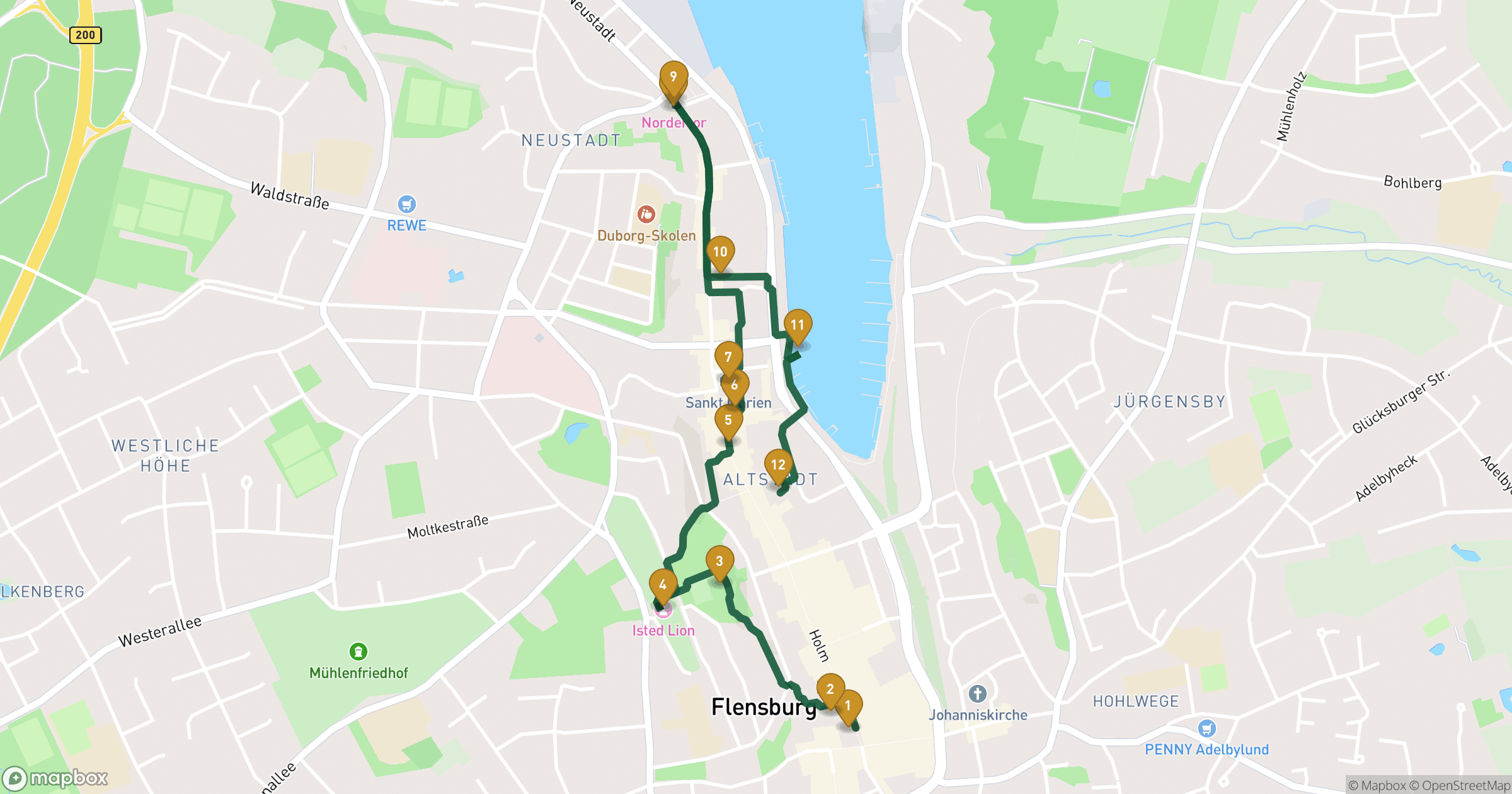
Map for Flensburg walking tour with 12 stops
The static map shows the tour route with Südermarkt, Sankt Nikolai, Heinrich-Sauermann-Haus, Idstedt-Löwe, and 8 more stops.

Stops along the route

All stops on this self-guided tour at a glance.

  1. Südermarkt in Flensburg
    Soenke Rahn / CC BY-SA 4.0

    1SüdermarktSquare

    Südermarkt marks the historic core of the old town, bordered by merchant gabled houses and leading directly into the ancient Ochsenstraße along the Holm. The Alte Apotheke on the west side displays renaissance facade elements from 1580, while its building core is even older. Laid out around 1170, the square served for centuries as a vital trade hub.

    Wikidata

  2. Sankt Nikolai in Flensburg
    VollwertBIT / CC BY-SA 2.5

    2Sankt NikolaiChurch

    St. Nikolai is a soaring Gothic hall church dedicated to the patron saint of sailors, with construction beginning around 1390. Master organ builder Arp Schnitger personally voiced the instrument's pipes in the early 18th century to master the nave's acoustics. Its late Renaissance casing was carved by Heinrich Ringeringk with lifelike figures.

    Style: Brick Gothic · Named after: Saint Nicholas · Wikidata

  3. Heinrich-Sauermann-Haus in Flensburg
    Hajotthu / CC BY-SA 4.0

    3Heinrich-Sauermann-Haus

    The Heinrich-Sauermann-Haus on Museumsberg was erected between 1900 and 1903 in the North German Renaissance style, resembling a castle above the town. Flensburg furniture manufacturer Heinrich Sauermann hauled entire parlour walls and rustic furnishings across Schleswig-Holstein on wagons to rebuild them here. The site holds a major arts and crafts collection.

    Built: 1903 · Style: Northern Renaissance · Wikidata

  4. Idstedt-Löwe in Flensburg
    Hajotthu / CC BY-SA 4.0

    4Idstedt-LöweMonument

    The Idstedt Lion in the park commemorates the 1850 Danish victory in the Battle of Idstedt. Danish sculptor Herman Wilhelm Bissen studied live lions in Paris to craft the bronze beast, which was seized by Prussia as war loot in 1867 and taken to Berlin. After decades in Copenhagen following World War II, the sculpture returned to Flensburg in 2011.

    Built: 1860 · Wikidata

  5. Große Straße in Flensburg
    Jens Junge / CC BY-SA 4.0

    5Große StraßeSquare

    Große Straße reflects the social divides of early maritime trade along the medieval Herscopstrate. The eastern waterside was nicknamed the Groschen-Seite because wealthy merchants built their warehouses there, while craftsmen settled the western 5-Pfennig-Seite. The Old Town Hall at number 1 preserved its prestigious street number during the 1881 renumbering.

    Wikidata

  6. Nordermarkt in Flensburg
    Andreas Trepte / CC BY-SA 2.5

    6NordermarktSquare

    Nordermarkt was established around 1200 and retains its maritime trading origins at the end of Große Straße. At its center stands the Neptune Fountain, sculpted in 1758 by Johannes Christoph Heinrich von Lücke. Historical arcade passages called Schrangen line the north side where bakers and butchers once sold goods near the site of the town pillory.

    Wikidata

  7. Sankt Marien in Flensburg
    A.Savin / CC BY-SA 3.0

    7Sankt MarienChurch

    Sankt Marien is a prominent brick Gothic hall church whose origins trace back to its first recorded mention in 1284. Inside stands a bronze baptismal font cast in 1591 by Michael Dibler, who hid portraits of himself and his foundry masters within the reliefs. The high altar was crafted by Jan van Groning, showing biblical scenes with dramatic depth.

    Style: Gothic architecture · Named after: Mary · Wikidata

  8. Phänomenta in Flensburg
    Michael Brandtner / CC BY-SA 3.0

    8PhänomentaMuseum

    Phänomenta occupies a historic brick warehouse sliced open by a wedge of glass, embodying hands-on experimentation. Founded in 1995 as an institute of the Europa-Universität Flensburg, it became Germany's first science center to carry that title. Founder Lutz Fiesser banished hands-off signs, introducing illusions like the Ames Room to stimulate inquiry.

    Built: 1995 · Wikidata

  9. Nordertor in Flensburg
    Soenke Rahn / CC BY-SA 3.0 de

    9NordertorAttraction

    Nordertor is Flensburg's official landmark and the final surviving gate of the city's old fortifications, built around 1595. Above its archway sit the coat of arms of Danish King Christian IV alongside the city's heraldic crest. The outer wall bears the German motto 'Friede ernährt, Unfriede verzehrt' beneath characteristic stepped gables.

    Built: 1595 · Wikidata

  10. Oluf-Samson-Gang in Flensburg
    Pelz / CC BY-SA 3.0

    10Oluf-Samson-Gang

    Oluf-Samson-Gang is a narrow alley lined with diminutive timber-framed homes constructed in the 16th century. Wealthy merchant and shipowner Oluf Samson originally built the modest residences for his workers and sailors. Over subsequent generations it gained notoriety as a harbor red-light district where women joked from windows with passing mariners.

  11. Alexandra (ship, 1908) in Flensburg
    Sönke Rahn / CC BY-SA 3.0

    11Alexandra (ship, 1908)Attraction

    Alexandra is a historic 1908 salon steamer moored in the harbor as Germany's last seagoing passenger steamship driven by an original compound engine. Volunteer ship enthusiasts rescued the Hamburg-built vessel from the scrapyard during the 1970s. The ship spent its entire working career carrying passengers across the Flensburg Fjord.

    Built: 1908 · Wikidata

  12. Westindienspeicher in Flensburg
    Sönke Rahn / CC BY-SA 3.0

    12Westindienspeicher

    The Westindienspeicher is a five-story brick warehouse erected in 1789 by merchant Andreas Christiansen, who grew wealthy trading with Saint Croix, Saint Thomas, and St. John. The building stored raw sugar, tobacco, and cocoa alongside rum barrels that supplied the local blended rum trade. A gable hoist still hangs above a stone blessing from 1789.

    Wikidata

Download the app

This public page shows a preview. The full route, all content, and navigation are available in CityTour AI.

Cities nearby

Discover self-guided tours in nearby cities.

Frequently asked questions

The key answers before you start.

Is this a self-guided audio tour?

Yes. In the CityTour AI app (iOS and Android), this is a self-guided audio tour for Flensburg — start anytime, at your own pace, with map, stops, and audio narration.

What will you see on this tour?

On this tour you'll see, among others, Südermarkt, Sankt Nikolai, Heinrich-Sauermann-Haus, Idstedt-Löwe, Große Straße, Nordermarkt and more sights.

Where does the tour start?

The route starts at Südermarkt and ends at Westindienspeicher. You can start anytime — the app guides you to the first stop.

How long does the tour take?

About 105 minutes for 12 stops — at your own pace, with breaks whenever you like.

How much does the tour cost?

This tour costs 15 credits. The exact price depends on the pack you buy and your country — roughly $5.

Is it an outdoor tour — are entry tickets included?

Yes, it's an outdoor tour: the sights are viewed from the outside. Entry tickets are not included, and step-free access cannot be guaranteed.

Is the audio guide available in my language?

The tour and audio guide are available in English, Deutsch, Français, Español, Italiano and 9 more languages. You pick your language in the app.

Can I use the tour offline?

Yes. Tours can be used offline.

Can I ask the AI questions along the way?

Yes. At every stop you can ask the AI directly if you want to know more or didn't understand something.