CityTour AI

Heide self-guided walking tour

Heide: Proud Peasant Republic and North German Vistas

Experience Heide like a local and discover the fascinating history of the former peasant republic of Dithmarschen. We walk across Germany's largest marketplace, explore hidden historic alleys, and visit the sites of the city's famous sons like Klaus Groth. This tour combines North German charm with heroic history and impressive brick architecture.

Audio tourSelf-guidediOS & Android
99minutes
2.8 kmdistance
13stops
Audio guideFormat
Heide: Proud Peasant Republic and North German Vistas
Freistern / CC0

Stops on this route

This tour works well for first-time visitors, weekend trips, and travelers who want to explore Heide without a fixed tour time.

Route map for Heide walking tour
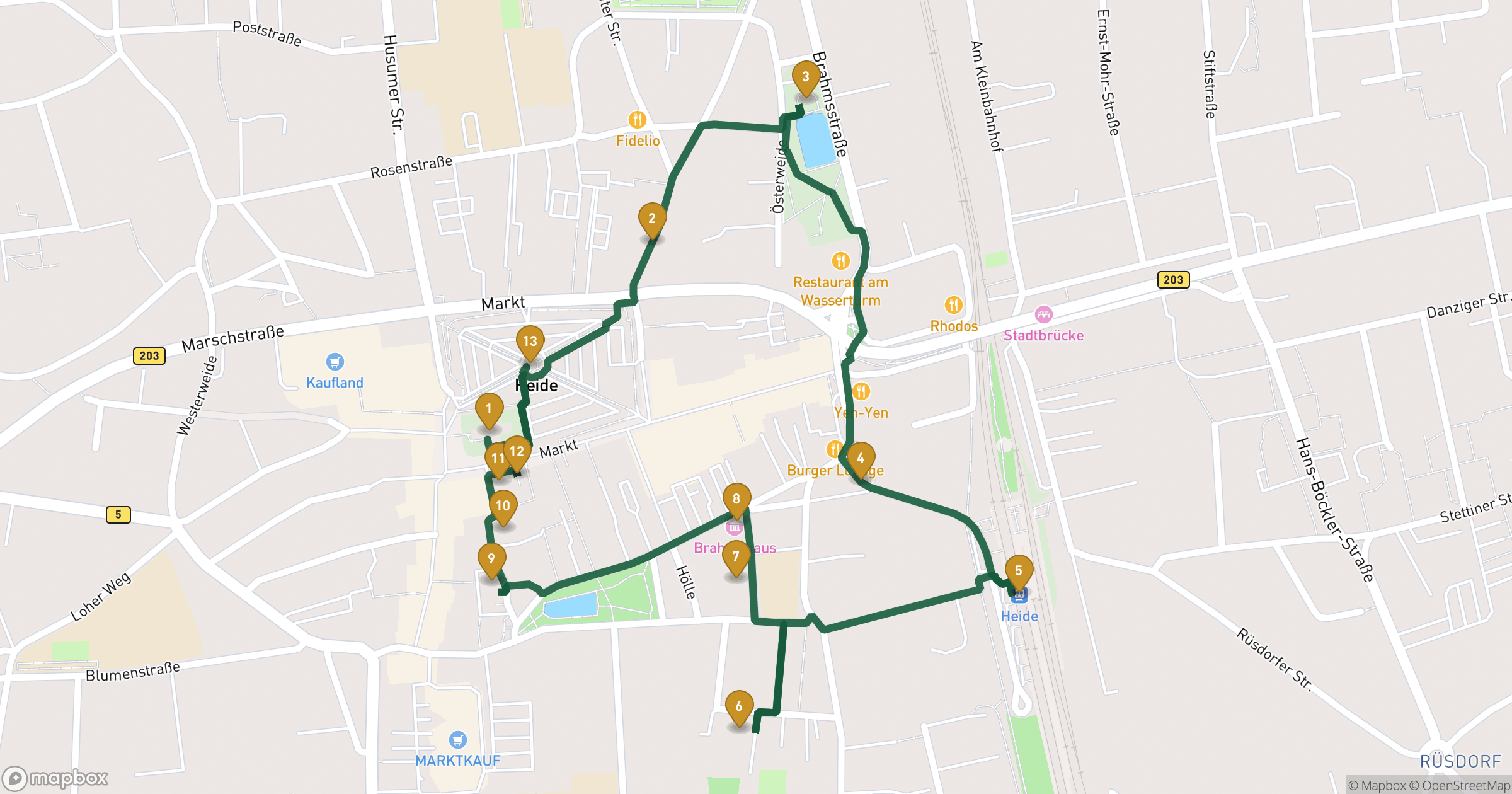
Map for Heide walking tour with 13 stops
The static map shows the tour route with Sankt Jürgen Kirche, Schuhmacherort, Wasserturm Heide, Wulf-Isebrand-Platz, and 9 more stops.

Stops along the route

All stops on this self-guided tour at a glance.

  1. Sankt Jürgen Kirche in Heide
    Gunnar Klack / CC BY-SA 4.0

    1Sankt Jürgen KircheChurch

    Sankt Jürgen Kirche sits by the town's huge market square, its late Gothic hall built as an embodiment of local independence. Erected around 1559 over earlier ruins, it honors Saint George, whose dragon-slaying legend appears across its portals and interior. Inside, an ornate altar and a bronze baptismal font reflect the resilience and wealth the town reclaimed after war.

    Named after: Saint George · Wikidata

  2. 2SchuhmacherortSquare

    Schuhmacherort is a snug, preserved street just steps from the broad marketplace, once defined by the rhythmic noise of artisan cobblers. Its restored half-timbered houses and colorful doorways stand near the area where poet Klaus Groth grew up. Now filled with independent shops and cafes, the narrow lane retains the intimate feel of working-class life from eras past.

  3. Wasserturm Heide in Heide
    Jörg Braukmann / CC BY-SA 4.0

    3Wasserturm Heide

    Standing 45 meters tall, the 1903 brick water tower highlights early municipal innovation designed by architect Wilhelm Voigt. Its upper chamber once held 225 cubic meters of water, supported by heavy brick piers visible in the facade. Today, its topmost floor hosts one of Germany's highest wedding rooms, offering views stretching into the Dithmarschen marshlands.

    Style: Romanesque art · Wikidata

  4. Wulf-Isebrand-Platz in Heide
    Gmbo 2013 / CC0

    4Wulf-Isebrand-Platz

    Wulf-Isebrand-Platz honors the local leader who defended Dithmarschen during its era as an independent peasant republic around 1500. At the Battle of Hemmingstedt, Isebrand breached the dikes to swamp the Danish royal forces under the battle cry Wahr di, Garr, de Buer de kummt. The simple town square offers a reflective space dedicated to this historic victory against the crown.

  5. Heide (Holst) station in Heide
    Hans-Rudi der Letzte / CC0

    5Heide (Holst) station

    Heide station functions as the sole junction station in Dithmarschen, serving coastal traffic toward Westerland on Sylt since 1877. Tracks 4 and 5 use an island catenary system designed to recharge modern battery-powered trains for non-electrified routes to Neumünster and Büsum. Nearby stands the former narrow-gauge railway headquarters, now reused as a youth center and music school.

    Wikidata

  6. Ballhaus Tivoli in Heide
    Freistern / CC BY-SA 4.0

    6Ballhaus Tivoli

    The Tivoli concert hall embodies the nineteenth-century trend of grand community pleasure houses named after European pleasure gardens. Established during the town's social ascent, it hosted prestigious galas, major concerts, and key political meetings. Marked by extensive window facades and decorative trimmings, the building still stages classical concerts and modern functions.

    Wikidata

  7. Klaus-Groth-Museum in Heide
    Museumsinsel-Lüttenheid2004 / CC BY-SA 4.0

    7Klaus-Groth-Museum

    The Klaus-Groth-Museum occupies a classic combined home and mill where Klaus Groth's father ran a groat-milling workshop. Here Groth spent his youth, often reciting Low German verses in the garden to refine his dialect poetry before publishing Quickborn. Opened as a museum in 1914, its central hall, or Däle, presents traditional Biedermeier-era living and workspace.

    Wikidata

  8. Brahmshaus in Heide
    Dguendel / CC BY 3.0

    8BrahmshausMuseum

    The modest Brahmshaus in Lüttenheid was the ancestral home where composer Johannes Brahms' father, Johann Jakob, grew up before moving to Hamburg. Brahms visited his relatives here frequently, famously declining elite dinner invitations to share beer and local talk with neighborhood craftsmen. Now kept by the Brahms-Gesellschaft, it hosts research and displays family artifacts.

    Wikidata

  9. 9Bürgerhaus

    Originally constructed as a private nineteenth-century home, the Bürgerhaus displays characteristic solid brickwork built to stand for generations. The restored interior now serves as the community's civic gathering place and contains the local registry office where residents marry. Preserved window profiles and masonry highlight the continuity of this enduring municipal space.

  10. 10Rathaus

    Heide's post-war town hall stands on the historic ground where the Forty-Eight regents of the Dithmarschen peasant republic once assembled. The site historically hosted open-air deliberations where local councils proclaimed the public market peace, an event echoed today by the building's bell. Its utilitarian structure continues to house mayoral business and urban planning.

  11. sog. Postelheim in Heide
    Freistern / CC0

    11sog. Postelheim

    The Postelheim is a listed brick welfare house founded through the benevolence of the civic Postel family around the turn of the century. The donor family designed the home not only to provide shelter for aging locals but also laid out an adjoining garden for fresh produce. The exterior retains finely laid masonry arches above the windows, reflecting municipal care history.

    Wikidata

  12. Altes Pastorat in Heide
    Kai Sterrat / CC BY 3.0

    12Altes Pastorat

    Adjacent to St. Jürgen, the Old Pastorate is a 1739 baroque residence topped by a prominent hipped roof. A notable nineteenth-century pastor and chronicler worked within its walls, meticulously maintaining the parish registers that recorded citizen life. Behind the symmetrical brick front lies the Pastorengarten, once used for household subsistence and now kept as a green retreat.

    Wikidata

  13. Marktplatz in Heide
    joergens.mi / CC BY-SA 3.0

    13MarktplatzAttraction

    Spanning roughly 4.7 hectares, this site forms the largest undeveloped town square in Germany, functioning until 1559 as the outdoor parliament of Dithmarschen. Here the 48 regents gathered under open skies before crowds of citizens to decide wars, treaties, and local legislation. For over 500 years it has held a Saturday market, and it hosts the winter Hohnbeere district festival.

    Wikidata

Download the app

This public page shows a preview. The full route, all content, and navigation are available in CityTour AI.

Cities nearby

Discover self-guided tours in nearby cities.

Frequently asked questions

The key answers before you start.

Is this a self-guided audio tour?

Yes. In the CityTour AI app (iOS and Android), this is a self-guided audio tour for Heide — start anytime, at your own pace, with map, stops, and audio narration.

What will you see on this tour?

On this tour you'll see, among others, Sankt Jürgen Kirche, Schuhmacherort, Wasserturm Heide, Wulf-Isebrand-Platz, Heide (Holst) station, Ballhaus Tivoli and more sights.

Where does the tour start?

The route starts at Sankt Jürgen Kirche and ends at Marktplatz. You can start anytime — the app guides you to the first stop.

How long does the tour take?

About 99 minutes for 13 stops — at your own pace, with breaks whenever you like.

How much does the tour cost?

This tour costs 15 credits. The exact price depends on the pack you buy and your country — roughly $5.

Is it an outdoor tour — are entry tickets included?

Yes, it's an outdoor tour: the sights are viewed from the outside. Entry tickets are not included, and step-free access cannot be guaranteed.

Is the audio guide available in my language?

The tour and audio guide are available in English, Deutsch, Français, Español, Italiano and 9 more languages. You pick your language in the app.

Can I use the tour offline?

Yes. Tours can be used offline.

Can I ask the AI questions along the way?

Yes. At every stop you can ask the AI directly if you want to know more or didn't understand something.