CityTour AI

Heligoland self-guided walking tour

Helgoland: Red Rocks and the Open Sea

Experience Helgoland on a relaxed tour from the windswept Oberland to the colorful lobster huts in the harbor. Discover the dramatic history of the island fortress, observe rare seabirds at the Lange Anna rock, and feel the pulse of marine research. This tour combines geological wonders with the indomitable spirit of an island that has reinvented itself time and again.

Audio tourSelf-guidediOS & Android
104minutes
4.3 kmdistance
10stops
Audio guideFormat
Helgoland: Red Rocks and the Open Sea
Kai-Uwe Fischer / CC BY-SA 3.0

Stops on this route

This tour works well for first-time visitors, weekend trips, and travelers who want to explore Heligoland without a fixed tour time.

Route map for Helgoland walking tour
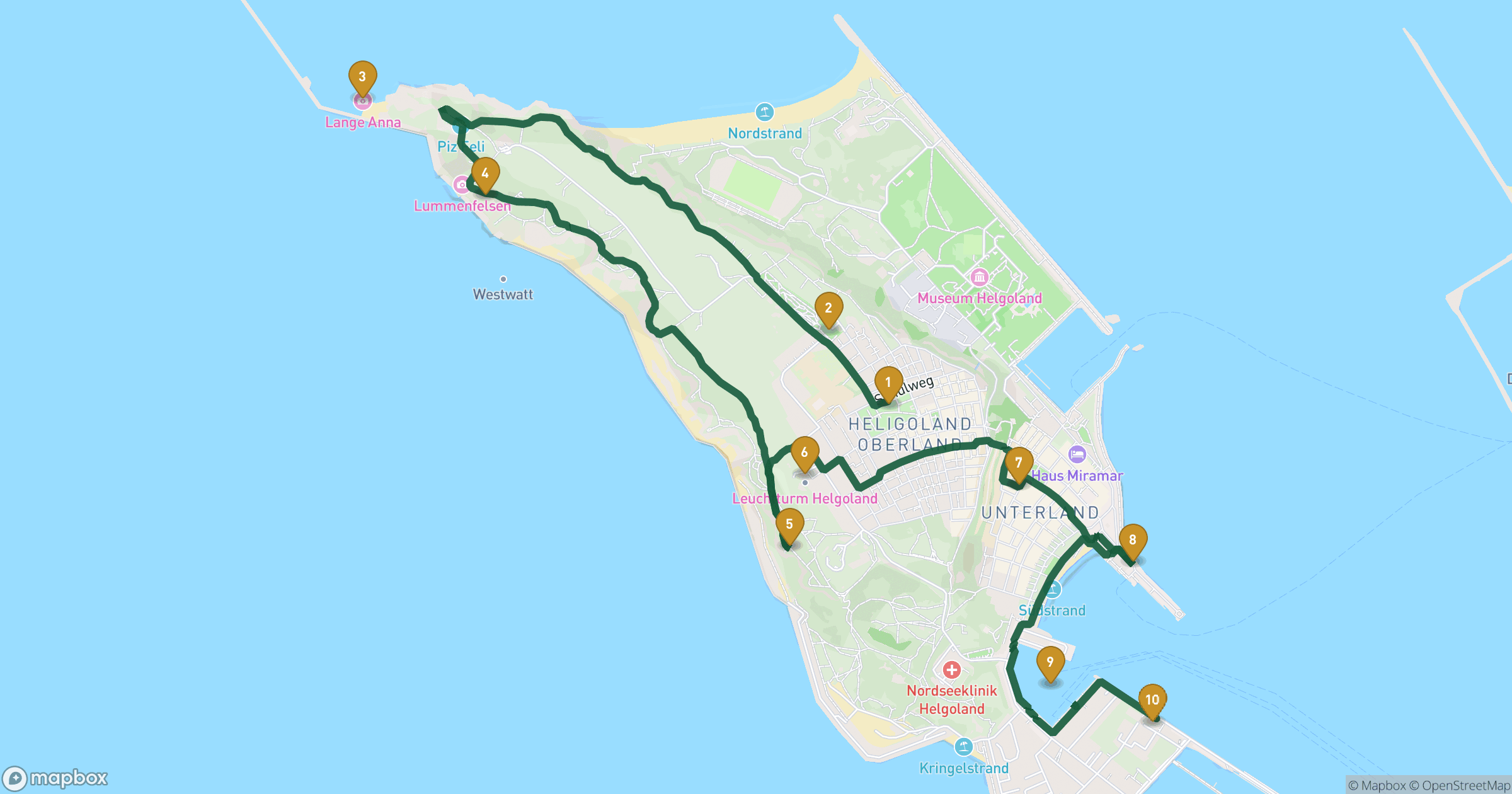
Map for Helgoland walking tour with 10 stops
The static map shows the tour route with St. Nicolai, Heligoland Bird Observatory, Lange Anna, Lummenfelsen der Insel Helgoland, and 6 more stops.

Stops along the route

All stops on this self-guided tour at a glance.

  1. St. Nicolai in Heligoland
    Hajotthu / CC BY-SA 4.0

    1St. NicolaiChurch

    St. Nicolai stands on the Oberland as a modern brick church built after its 17th-century predecessor was almost completely destroyed in April 1945. Its tower bell bears the Halunder inscription "Weer drenn ip Lunn", meaning back home on Helgoland after years of postwar evacuation. Inside, a gilded communion chalice from 1705 survived the bombing alongside captains' votive ships hanging from the ceiling.

    Architect: Rolf Romero · Named after: Saint Nicholas · Wikidata

  2. Heligoland Bird Observatory in Heligoland
    Andreas Lippold / CC BY-SA 4.0

    2Heligoland Bird Observatory

    Helgoland Bird Observatory owes its origins to landscape painter Heinrich Gätke, who arrived in 1837 and stayed sixty years to study bird flocks. In 1910, Hugo Weigold established the official research station and launched scientific bird banding here, marking a song thrush with ring number 1111. Behind the building, giant funnel-shaped Helgoland traps in the catch garden still safely capture migrating birds for study.

    Wikidata

  3. Lange Anna in Heligoland
    Jörg Braukmann / CC BY-SA 4.0

    3Lange AnnaAttraction

    Lange Anna is a 47-meter-tall red sandstone stack known traditionally in Halunder as Nathurn Stak. Legend links its current name to a tall waitress named Anna working in an Oberland café shortly before the First World War. Until a severe storm surge collapsed a natural rock arch on May 16, 1860, this 25,000-ton pillar was physically connected to the main island.

    Wikidata

  4. Lummenfelsen der Insel Helgoland in Heligoland
    Bybbisch94 / CC BY-SA 4.0

    4Lummenfelsen der Insel Helgoland

    The Lummenfelsen reserve spans just 1.1 hectares of red sandstone cliffs famous for Germany's annual guillemot chick leap each June. Three-week-old common murres plunge up to 50 meters into the sea without flying skills, cushioned by V-shaped ribs and internal air sacs before meeting their waiting fathers. Northern gannets have nested here again since 1991, easily spotted by their white plumage and yellowish heads.

    Built: 1964 · Wikidata

  5. Klippenrandweg in Heligoland
    Kai-Uwe Fischer / CC BY-SA 3.0

    5Klippenrandweg

    The Klippenrandweg circuits the Oberland while walking across traces of the largest non-nuclear detonation in world history. On April 18, 1947, the British military detonated nearly 7,000 tons of ammunition in Operation Big Bang to destroy the island's fortifications. Massive blast craters visible along the path created the Mittelland from rubble, which today shelters rare plants.

  6. Leuchtturm Helgoland in Heligoland
    Bärbel Miemietz / CC BY-SA 4.0

    6Leuchtturm Helgoland

    Helgoland Lighthouse was originally constructed in 1941 out of reinforced concrete as an anti-aircraft fire control bunker. Its heavy structure made it the only Oberland building to survive the massive 1947 detonation largely undamaged, leading to its conversion into a lighthouse in 1952. Its xenon beam shines at 35 million candela, while lower levels feature trompe-l'œil windows painted purely for urban aesthetics.

    Built: 1941 · Height: 35 m · Wikidata

  7. 7J.-A.-Siemens-TerrasseSquare

    J.-A.-Siemens-Terrasse offers an elevated viewpoint over the Unterland and the busy harbor below. It honors Jacob Andresen Siemens, a 19th-century hotelier and co-founder of the seaside resort who opened the island's first conversation house in 1826. Today, visitors watch seaside resort vessels anchored in the roadstead while passengers transfer into smaller shuttle craft.

  8. Landungsbrücke in Heligoland
    Michael Brandtner / CC BY 4.0

    8LandungsbrückeSquare

    Landungsbrücke is the island's primary pier, famous for the traditional offloading ritual known as Ausbooten. Because large seaside passenger ships have too deep a draft to dock inside the harbor, passengers disembark into massive oak Börteboote recognized as UNESCO intangible cultural heritage. Skilled boatmen navigate these open wooden craft through choppy surf straight to the quay.

  9. Binnenhafen in Heligoland
    Politikaner | Self-photographed / CC BY-SA 3.0

    9BinnenhafenWater

    The Binnenhafen shelters the island's fishing fleet and colorful oak Börteboote along its quay. Along the harbor street stand the Hummerbuden, bright wooden sheds once used as fishermen's workshops and now housing small shops and galleries. Lobster fishing was once Helgoland's primary source of income, so abundant that locals ate lobster almost daily.

  10. Biologic Institute Helgoland in Heligoland
    Politikaner / CC BY-SA 3.0

    10Biologic Institute Helgoland

    The Biologische Anstalt Helgoland stands as a marine research institute founded in 1892, now part of the Alfred Wegener Institute. In 1835, naturalist Christian Gottfried Ehrenberg proved here that sea sparkle is caused by the single-celled organism Noctiluca scintillans. Johannes Müller initiated local plankton research in 1845, decades before Victor Hensen officially coined the term in 1887.

    Built: 1892 · Wikidata

Download the app

This public page shows a preview. The full route, all content, and navigation are available in CityTour AI.

Cities nearby

Discover self-guided tours in nearby cities.

Frequently asked questions

The key answers before you start.

Is this a self-guided audio tour?

Yes. In the CityTour AI app (iOS and Android), this is a self-guided audio tour for Heligoland — start anytime, at your own pace, with map, stops, and audio narration.

What will you see on this tour?

On this tour you'll see, among others, St. Nicolai, Heligoland Bird Observatory, Lange Anna, Lummenfelsen der Insel Helgoland, Klippenrandweg, Leuchtturm Helgoland and more sights.

Where does the tour start?

The route starts at St. Nicolai and ends at Biologic Institute Helgoland. You can start anytime — the app guides you to the first stop.

How long does the tour take?

About 104 minutes for 10 stops — at your own pace, with breaks whenever you like.

How much does the tour cost?

This tour costs 15 credits. The exact price depends on the pack you buy and your country — roughly $5.

Is it an outdoor tour — are entry tickets included?

Yes, it's an outdoor tour: the sights are viewed from the outside. Entry tickets are not included, and step-free access cannot be guaranteed.

Is the audio guide available in my language?

The tour and audio guide are available in English, Deutsch, Français, Español, Italiano and 9 more languages. You pick your language in the app.

Can I use the tour offline?

Yes. Tours can be used offline.

Can I ask the AI questions along the way?

Yes. At every stop you can ask the AI directly if you want to know more or didn't understand something.