CityTour AI

Kiel self-guided walking tour

Kiel Fjord Magic: Villas, Sea, and History

Experience the best of Kiel on a relaxed stroll along the fjord. From the grand villas of Düsternbrook to the maritime atmosphere of the Kiellinie and the historic Old Town, you'll discover the city like a local. See where history meets a fresh sea breeze and explore hidden green oases.

Audio tourSelf-guidediOS & Android
194minutes
8.5 kmdistance
18stops
Audio guideFormat
Kiel Fjord Magic: Villas, Sea, and History
Hein.Mück / CC BY-SA 3.0

Stops on this route

This tour works well for first-time visitors, weekend trips, and travelers who want to explore Kiel without a fixed tour time.

Route map for Kiel walking tour
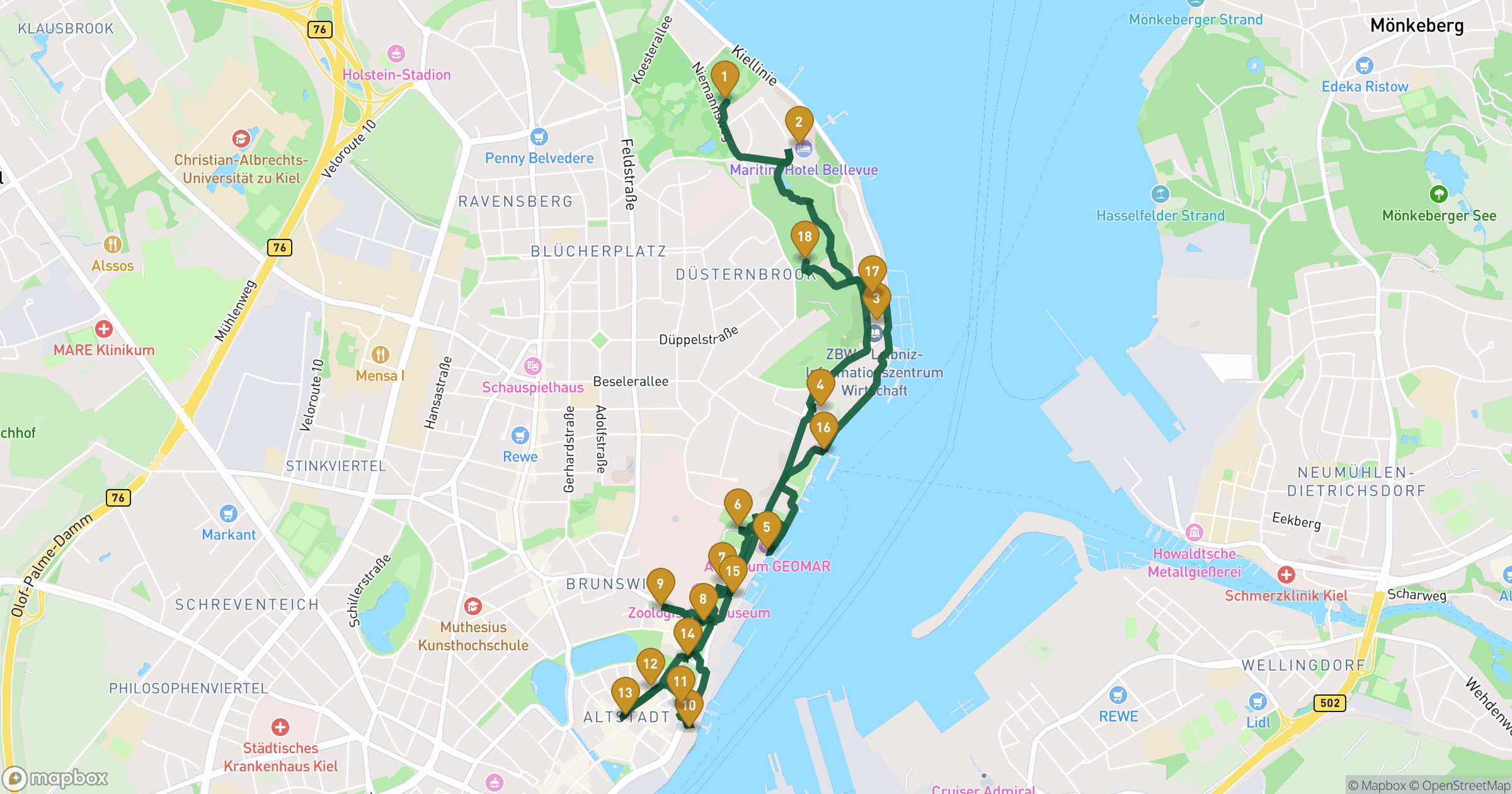
Map for Kiel walking tour with 18 stops
The static map shows the tour route with Diederichsenpark, Maritim Hotel Bellevue (Kiel), Institut für Weltwirtschaft, Landeshaus, and 14 more stops.

Stops along the route

All stops on this self-guided tour at a glance.

  1. Diederichsenpark in Kiel
    DYVER / CC BY-SA 4.0

    1Diederichsenpark

    Diederichsenpark is a terraced garden in Düsternbrook, originally belonging to the private Villa Forsteck of shipowner Heinrich Diederichsen. After the villa's wartime destruction, the site was redesigned in 1957 and opened to the public in 1958. A memorial plaque honors Diederichsen as the savior of the Howaldtswerke shipyard during a severe economic crisis in 1926.

    Named after: Heinrich Diederichsen · Wikidata

  2. Maritim Hotel Bellevue (Kiel) in Kiel
    Magnussen, Friedrich (1914-1987) / CC BY-SA 3.0 de

    2Maritim Hotel Bellevue (Kiel)Building

    Maritim Hotel Bellevue stands on the site of a 19th-century excursion restaurant known for sweeping fjord views. Architect Hans-Konrad Winkler designed the functionalist building, which was finished in time for the 1972 Olympic sailing competitions. Its pier along the Kiellinie serves as a departure point for sailing trips and a prime vantage point during Kieler Woche.

    Wikidata

  3. Institut für Weltwirtschaft in Kiel
    Magnussen, Friedrich (1914-1987) | Kiel municipal archive / CC BY-SA 3.0 de

    3Institut für WeltwirtschaftBuilding

    The Institute for the World Economy was established in 1914 by Bernhard Harms to study global trade networks. Harms started its library with just a few crates of books in a small room, begging worldwide for copies until it became the world's largest economics library. Built on the site of a former seaside bathhouse, it is one of the few institutes with its own boat pier.

    Built: 1914 · Wikidata

  4. Landeshaus in Kiel
    Bjoertvedt / CC BY-SA 3.0

    4LandeshausBuilding

    The Landeshaus serves as the seat of the Schleswig-Holstein state parliament, but it was originally built in 1888 as the Imperial Naval Academy designed by Georg Friedrich Fürst. Kaiser Wilhelm II attended its opening, and in 1918 the building became a key site of the sailors' revolt that toppled the monarchy. In 2003, a transparent glass plenary hall was added to the historic brick structure.

    Wikidata

  5. Sea dog basin Kiel in Kiel
    Magnussen, Friedrich (1914-1987) / CC BY-SA 3.0 de

    5Sea dog basin KielWater

    The seal pool at the Kiellinie belongs to the GEOMAR Helmholtz Centre for Ocean Research and opened in 1972. Harbor seals and grey seals swim in an open-air enclosure that is freely visible to any passerby on the promenade. During daily feeding sessions, keepers conduct medical training that teaches the animals to present their flippers and teeth for examination.

    Wikidata

  6. Alter Botanischer Garten in Kiel
    Hein.Mück / CC BY-SA 3.0

    6Alter Botanischer GartenPark

    The Old Botanical Garden was established in 1884 as Germany's first botanical garden organized according to a hill system. Botanist Adolf Engler personally inspected every single stone for the alpine garden to recreate authentic mountain environments. An ornate cast-iron viewing pavilion crowns its highest point, while the former inspector's house now hosts the Literaturhaus.

    Wikidata

  7. Kunsthalle Kiel in Kiel
    User:Matthias Süßen / CC BY-SA 4.0

    7Kunsthalle KielMuseum

    Kunsthalle Kiel was funded by patron Lotte Hegewisch, who donated the land and a fortune to the university in 1903. Completed in 1909, the shell limestone building features two massive wisent sculptures by August Gaul that survived World War II bombings nearly intact. The museum is currently closed for comprehensive renovation work expected to last until 2028.

    Built: 1909 · Wikidata

  8. Schlossgarten in Kiel
    Siegbert Brey / CC BY-SA 4.0

    8SchlossgartenPark

    The Schlossgarten evolved from a 16th-century Renaissance layout and a French Baroque design into an English-style landscape park. An equestrian statue of Emperor Wilhelm I by sculptor Adolf Brütt was unveiled here in 1896 in the presence of Kaiser Wilhelm II. While pedestal bronzes were melted down during World War II, modern works like Per Kirkeby's brick steles stand on the lawns today.

    Wikidata

  9. Brunswiker Pavillon in Kiel
    Enter / CC BY-SA 4.0

    9Brunswiker PavillonMuseum

    Brunswiker Pavillon is a protected exhibition building constructed around 1960 according to Bauhaus design principles. It serves as the headquarters for the state artists' association, hosting rotating free exhibitions such as the annual showcase for new members. Right before Christmas, its art market sells original works of painting, photography, and sculpture capped at 500 euros.

  10. Kiel Maritime Museum in Kiel
    Holger.Ellgaard / CC BY-SA 3.0

    10Kiel Maritime Museum

    The Schifffahrtsmuseum Fischhalle occupies a 1910 fish auction hall designed by city architect Georg Pauly with a pointed barrel roof. Inside, two eight-meter basins originally kept live fish fresh, but the venue soon proved too small and faced demolition plans in the 1960s. Saved by historic preservation and reopened in 1978, it now docks historic vessels like the 1906 buoy tender Bussard.

    Built: 1978 · Wikidata

  11. Konzerthalle am Kieler Schloss in Kiel
    Siegbert Brey / CC BY-SA 4.0

    11Konzerthalle am Kieler SchlossBuilding

    The Concert Hall at Kiel Castle stands where the Renaissance residence of the Dukes of Holstein-Gottorf was largely destroyed during World War II. Only the historic Rantzau wing survived, leading to the construction of a modern cultural venue during the 1960s. The site was the 1728 birthplace of Duke Karl Peter Ulrich, who briefly ruled as Tsar Peter III before being overthrown by Catherine the Great.

    Built: 1963 · Wikidata

  12. Warleberger Hof in Kiel
    Holger.Ellgaard / CC BY-SA 4.0

    12Warleberger HofMuseum

    Warleberger Hof is Kiel's sole surviving aristocratic town palace, originally built in 1616 by ducal clerk Christoph Martens. Henning Bendix von Rumohr remodeled the facade in 1765, adding a sandstone portal with a golden letter R that locals often mistook for a town hall emblem. In the museum's vaulted cellar, foundation beams have been dated back to 1278, shortly after the city's founding.

    Built: 1616 · Wikidata

  13. Alter Markt in Kiel
    DYVER / CC BY-SA 4.0

    13Alter MarktSquare

    Alter Markt was the heart of Kiel from 1242 until World War II, and was redesigned as a sunken plaza by architect Wilhelm Neveling in 1972. In the 17th century, Duke Friedrich III built the Persian Houses here for a failed silk trade venture, later converting them into councilors' flats. In 1848, the provisional government for Schleswig-Holstein was proclaimed in the Old Town Hall on this square.

    Wikidata

  14. Prinzengarten in Kiel
    Dguendel / CC BY-SA 3.0

    14PrinzengartenMonument

    The Prinzengarten served as a quiet retreat for the ducal family adjoining Kiel Castle. While the main residence was destroyed and rebuilt modern, the grounds retain historical courtly atmosphere beneath mature trees. Nearby stands Ernst Barlach's sculpture Geistkämpfer, an angel with a sword on a wolf-like beast, which citizens hid during Nazi rule after it was deemed degenerate art.

    Named after: Prince Henry of Prussia · Wikidata

  15. Seeburg in Kiel
    Marlo Döhler / CC BY-SA 3.0 de

    15SeeburgBuilding

    The Seeburg was designed by architect Theodor Fischer between 1909 and 1910 as Germany's first student union building. Featuring turrets and red-brick masonry directly on the water, it is one of the few historic waterfront landmarks to survive World War II mostly unscathed. Today, Kiel University uses the space to house institutions such as the Centre for Science Communication.

    Wikidata

  16. Reventloubrücke in Kiel
    Magnussen, Friedrich (1914-1987) | Kiel municipal archive / CC BY-SA 3.0 de

    16Reventloubrücke

    The Reventloubrücke is a bustling passenger boat pier named after Friedrich Graf von Reventlou, a prominent 19th-century Schleswig-Holstein uprising leader. It serves as the docking station for fjord ferries heading across the bay to destinations like Laboe. Directly opposite, the towering cranes of the HDW shipyard illustrate Kiel's ongoing shipbuilding heritage.

    Wikidata

  17. Kieler Yacht Club in Kiel
    Magnussen, Friedrich (1914-1987) | Kiel municipal archive / CC BY-SA 3.0 de

    17Kieler Yacht ClubBuilding

    The Kieler Yacht Club began in 1887 under the name Marine-Regatta-Verein in the Düsternbrook neighborhood. Kaiser Wilhelm II was an avid member who sailed his yacht Meteor here, propelling Kieler Woche into an internationally famous event. The club hosted Olympic sailing competitions in both 1936 and 1972 and continues to moor both classic wooden craft and modern racers.

  18. Düsternbrooker Gehölz in Kiel
    Rüdiger Stehn from Kiel, Deutschland; 03 Dianenspiegel / CC BY-SA 2.0

    18Düsternbrooker Gehölz

    Düsternbrooker Gehölz is an 18th-century municipal woodland park set in Schleswig-Holstein's hilly terminal moraine terrain. Its central meadow, Krusenkoppel, hosts Europe's largest children's cultural event, the Spiellinie, and serves as an open-air concert stage during Kieler Woche. Winding paths weave through mature beech and oak trees, shielded from the bustling Kiellinie promenade.

    Wikidata

Download the app

This public page shows a preview. The full route, all content, and navigation are available in CityTour AI.

Cities nearby

Discover self-guided tours in nearby cities.

Frequently asked questions

The key answers before you start.

Is this a self-guided audio tour?

Yes. In the CityTour AI app (iOS and Android), this is a self-guided audio tour for Kiel — start anytime, at your own pace, with map, stops, and audio narration.

What will you see on this tour?

On this tour you'll see, among others, Diederichsenpark, Maritim Hotel Bellevue (Kiel), Institut für Weltwirtschaft, Landeshaus, Sea dog basin Kiel, Alter Botanischer Garten and more sights.

Where does the tour start?

The route starts at Diederichsenpark and ends at Düsternbrooker Gehölz. You can start anytime — the app guides you to the first stop.

How long does the tour take?

About 194 minutes for 18 stops — at your own pace, with breaks whenever you like.

How much does the tour cost?

This tour costs 30 credits. The exact price depends on the pack you buy and your country — roughly $10.

Is it an outdoor tour — are entry tickets included?

Yes, it's an outdoor tour: the sights are viewed from the outside. Entry tickets are not included, and step-free access cannot be guaranteed.

Is the audio guide available in my language?

The tour and audio guide are available in English, Deutsch, Français, Español, Italiano and 9 more languages. You pick your language in the app.

Can I use the tour offline?

Yes. Tours can be used offline.

Can I ask the AI questions along the way?

Yes. At every stop you can ask the AI directly if you want to know more or didn't understand something.