CityTour AI

Lübeck self-guided walking tour

Queen of the Hanse: A Lübeck Brick Gothic Walk

Step into the medieval 'Queen of the Hanse' on this relaxed walk through Lübeck’s UNESCO-listed Old Town. You’ll explore the city’s iconic red-brick gates, towering Gothic churches, and the historic harbor where 'white gold' once fueled a global trading empire. It’s a journey through centuries of maritime power and literary history, perfect for anyone who loves atmospheric streets and grand architecture.

Audio tourSelf-guidediOS & Android
102minutes
2.5 kmdistance
14stops
Audio guideFormat
Queen of the Hanse: A Lübeck Brick Gothic Walk
W. Bulach / CC BY-SA 4.0

Stops on this route

This tour works well for first-time visitors, weekend trips, and travelers who want to explore Lübeck without a fixed tour time.

Route map for Lübeck walking tour
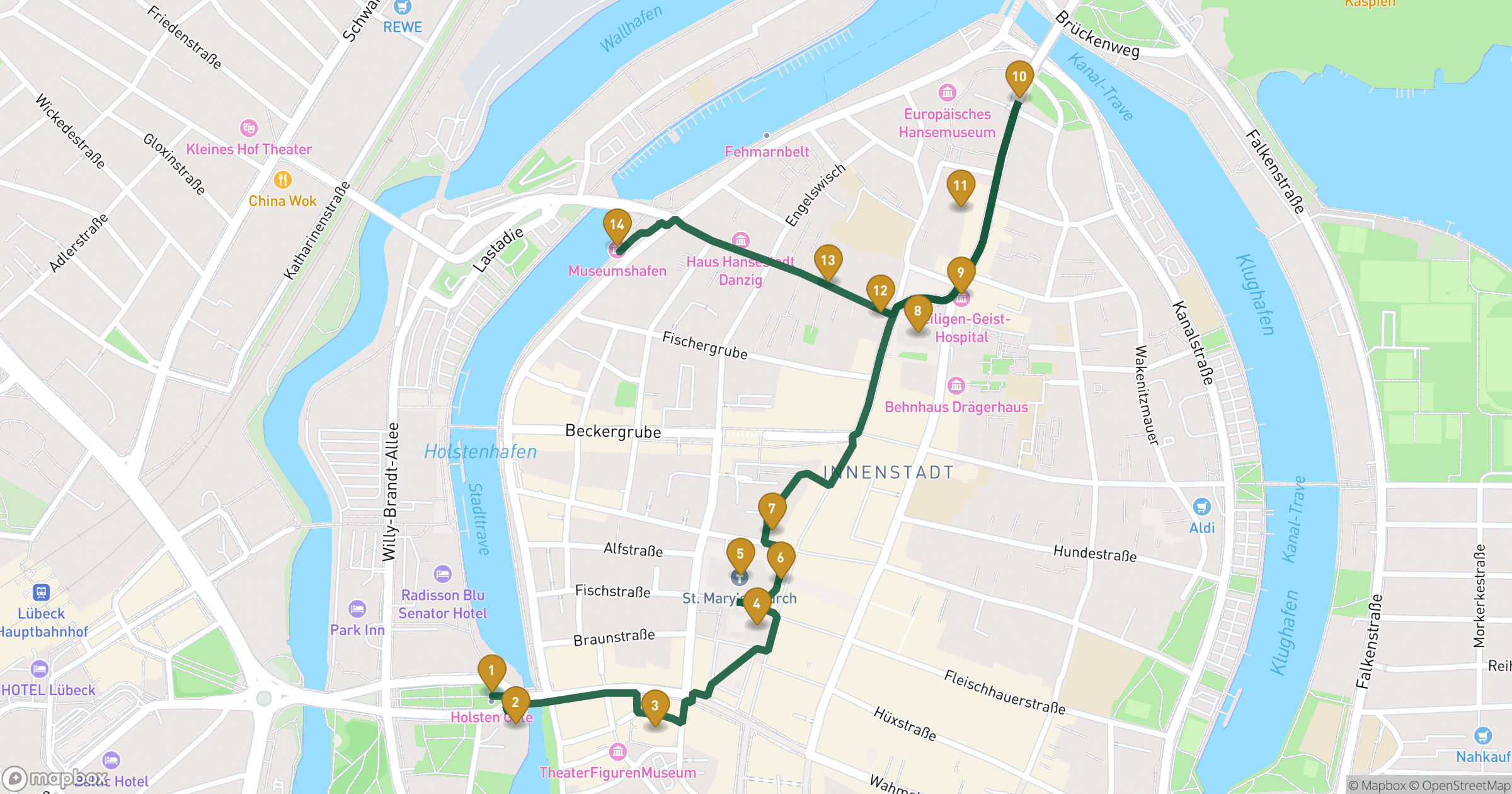
Map for Lübeck walking tour with 14 stops
The static map shows the tour route with Holstentor, Salzspeicher, St. Peter's Church (Lübeck), Lübeck city hall, and 10 more stops.

Stops along the route

All stops on this self-guided tour at a glance.

  1. Holstentor in Lübeck
    W. Bulach / CC BY-SA 4.0

    1HolstentorCastle

    The Holsten Gate stands as the emblem of medieval might, displaying an unmistakable tilt caused by the marshy ground beneath it. Master builder Hinrich Helmstede completed the brick gate in 1478, which citizens later saved from demolition by a single vote in 1863. Walls measuring up to three and a half meters thick preserve the motto 'Concordia domi foris pax' across the front.

    Style: Brick Gothic · Wikidata

  2. Salzspeicher in Lübeck
    Dietmar Rabich / CC BY-SA 4.0

    2SalzspeicherBuilding

    The Salzspeicher line the river Trave as the former storage vaults for salt mined in Lüneburg. Director F.W. Murnau cast these six stepped-gable warehouses as Count Orlok’s lair in the 1922 horror film 'Nosferatu'. The historic buildings once stored grain and cloth, and now house a modern textile store.

    Wikidata

  3. St. Peter's Church (Lübeck) in Lübeck
    Ввласенко / CC BY-SA 3.0

    3St. Peter's Church (Lübeck)

    St. Peter's Church reveals a story of postwar resilience as a five-aisled Gothic hall transformed into a modern cultural hub. Palm Sunday air raids destroyed the original interior and spire in 1942, leading to a long restoration completed in 1987. Striking white walls now frame contemporary pieces like an altar cross by Arnulf Rainer and a glowing neon cross by Hanna Jäger.

    Architect: Gustav Schaumann · Style: Brick Gothic · Height: 108.2 m · Named after: Saint Peter · Wikidata

  4. Lübeck city hall in Lübeck
    W. Bulach / CC BY-SA 4.0

    4Lübeck city hallBuilding

    Lübeck City Hall showcases a continuous architectural evolution that began in 1226 at the center of Hanseatic politics. The massive shield wall features large circular holes engineered to relieve wind pressure during severe storms. Inside the courtroom, defendants once exited through doors of differing heights depending on whether they were acquitted or convicted.

    Style: Brick Gothic · Wikidata

  5. St. Mary's Church Lübeck in Lübeck
    Carsten Steger / CC BY-SA 4.0

    5St. Mary's Church Lübeck

    St. Mary's Church features the world's highest brick vault, built by local merchants to rival French cathedrals and outshine the local bishop. A bronze devil outside recalls the legend of workers tricking Satan into helping construction by promising a wine bar. Inside, two massive bells shattered during the 1942 bombings remain embedded in the floor as a memorial.

    Built: 1300 · Architect: Bruno Fendrich, Gustav Schaumann … · Style: Brick Gothic · Named after: Mary · Wikidata

  6. Kanzleigebäude in Lübeck
    Longbow4u / CC BY-SA 3.0

    6KanzleigebäudeBuilding

    The Kanzleigebäude housed the scribes and notaries who kept the Hanseatic bureaucracy running from 1485 onward. These officials maintained the 'Niederstadtbuch', an extensive record of legal affairs and commerce. The ground-floor arcades later served as police quarters, leading locals to nickname the building the city’s largest vending machine.

    Wikidata

  7. Buddenbrookhaus in Lübeck
    Magnus Manske / CC BY-SA 3.0

    7BuddenbrookhausBuilding

    The Buddenbrookhaus displays an 18th-century Rococo facade closely tied to the literary career of Thomas Mann. Mann spent his childhood in this 1758 residence, setting his debut novel 'Buddenbrooks' here and winning the Nobel Prize in Literature in 1929. The iconic portal and gables were restored after heavy destruction in the 1942 air raids.

    Built: 1758 · Wikidata

  8. St. Jakobi in Lübeck
    Eduard47 / CC BY-SA 4.0

    8St. JakobiChurch

    St. Jakobi stands as the seafarers' church, retaining its medieval interior thanks to having escaped destruction during World War II. It features the historic Stellwagen organ alongside a 112-meter spire that guided navigators for centuries. A chapel shelters a salvaged lifeboat from the Pamir, a four-masted barque that sank during a 1957 hurricane.

    Built: 1227 · Style: Brick Gothic · Height: 112 m · Named after: Saint James the Elder · Wikidata

  9. Heilig-Geist-Hospital Lübeck in Lübeck
    Arnold Paul / CC BY-SA 2.5

    9Heilig-Geist-Hospital LübeckMuseum

    The Heilig-Geist-Hospital opened in 1286 as a merchant-founded sanctuary for the elderly and infirm. Inside the great hall, 19th-century wooden cubicles known as 'Kabäuschen' were constructed to provide residents with individual rooms. These small living compartments remained continuously inhabited until the 1970s below 14th-century biblical frescoes.

    Built: 1286 · Style: Brick Gothic · Wikidata

  10. Burgtor in Lübeck
    Andreas Geick / CC BY 3.0

    10BurgtorCastle

    The Burgtor guarded the narrow northern land entrance to the island city, retaining its original defensive setting from 1444. Red and black glazed bricks were set into the facade to shield the tower against harsh weather. French troops under Napoleon forced their way through this gateway in 1806 following the Battle of Lübeck.

    Built: 1444 · Style: Brick Gothic · Wikidata

  11. Koberg in Lübeck
    Tulipasylvestris / CC BY 4.0

    11KobergBuilding

    Koberg functioned as the city's lively historic fish market on the north side of the Old Town. Between 1889 and 1936, the square bore the name Geibelplatz and displayed a monument to local poet Emanuel Geibel. Restored cobblestones now preserve the setting bounded by St. Jakobi and the Heilig-Geist-Hospital.

    Wikidata

  12. Schiffergesellschaft in Lübeck
    JoachimKohler-HB / CC BY-SA 4.0

    12SchiffergesellschaftMonument

    The Schiffergesellschaft provided a guild headquarters where Hanseatic captains met to arrange trade deals and family insurance. The interior retains historic long oak tables that were once reserved for specific trading routes such as Bergen or Riga. Handcrafted model ships hang suspended from the ceiling as votive gifts offered by captains after treacherous journeys.

    Style: Brick Renaissance Style · Wikidata

  13. Engelsgrube in Lübeck
    Der Bischof mit der E-Gitarre at de.wikipedia / Public domain

    13EngelsgrubeBuilding

    Engelsgrube earned its name from the English merchants who berthed their cargo ships here in the 13th century. When the city elevated the street level by half a meter in 1907, the ground-floor windows of number 30 were left looking sunken. The original medieval ground level remains accessible through the passage of Qualmanns Gang at number 32.

    Wikidata

  14. Museumshafen Lubeck in Lübeck
    Bärwinkel,Klaus / CC BY 3.0

    14Museumshafen Lubeck

    The Museumshafen acts as an active berth for vintage Baltic vessels along the river Trave since 1981. The fleet includes the 'Lisa von Lübeck', a 1990s reconstruction of a 15th-century caravel, and the red lightship 'Fehmarnbelt'. The harbor sits alongside the historic Drehbrücke, a swing bridge built in 1892 that pivots to clear river traffic.

    Wikidata

Download the app

This public page shows a preview. The full route, all content, and navigation are available in CityTour AI.

Cities nearby

Discover self-guided tours in nearby cities.

Frequently asked questions

The key answers before you start.

Is this a self-guided audio tour?

Yes. In the CityTour AI app (iOS and Android), this is a self-guided audio tour for Lübeck — start anytime, at your own pace, with map, stops, and audio narration.

What will you see on this tour?

On this tour you'll see, among others, Holstentor, Salzspeicher, St. Peter's Church (Lübeck), Lübeck city hall, St. Mary's Church Lübeck, Kanzleigebäude and more sights.

Where does the tour start?

The route starts at Holstentor and ends at Museumshafen Lubeck. You can start anytime — the app guides you to the first stop.

How long does the tour take?

About 102 minutes for 14 stops — at your own pace, with breaks whenever you like.

How much does the tour cost?

This tour costs 15 credits. The exact price depends on the pack you buy and your country — roughly $5.

Is it an outdoor tour — are entry tickets included?

Yes, it's an outdoor tour: the sights are viewed from the outside. Entry tickets are not included, and step-free access cannot be guaranteed.

Is the audio guide available in my language?

The tour and audio guide are available in English, Deutsch, Français, Español, Italiano and 9 more languages. You pick your language in the app.

Can I use the tour offline?

Yes. Tours can be used offline.

Can I ask the AI questions along the way?

Yes. At every stop you can ask the AI directly if you want to know more or didn't understand something.