CityTour AI

Tönning self-guided walking tour

Tönning Time Travel: From Fortress Walls to Adventure Harbor

Join us on an exciting discovery tour through the historic port city of Tönning, perfectly tailored for curious families. You will explore hidden fortress moats, marvel at giant warehouses, and find out where a real castle once stood. This cozy walk brings the maritime history and architecture of the Eider city to life with small riddles and anecdotes.

Audio tourSelf-guidediOS & Android
101minutes
3.4 kmdistance
12stops
Audio guideFormat
Tönning Time Travel: From Fortress Walls to Adventure Harbor
Helmlechner / CC0

Stops on this route

This tour works well for first-time visitors, weekend trips, and travelers who want to explore Tönning without a fixed tour time.

Route map for Tönning walking tour
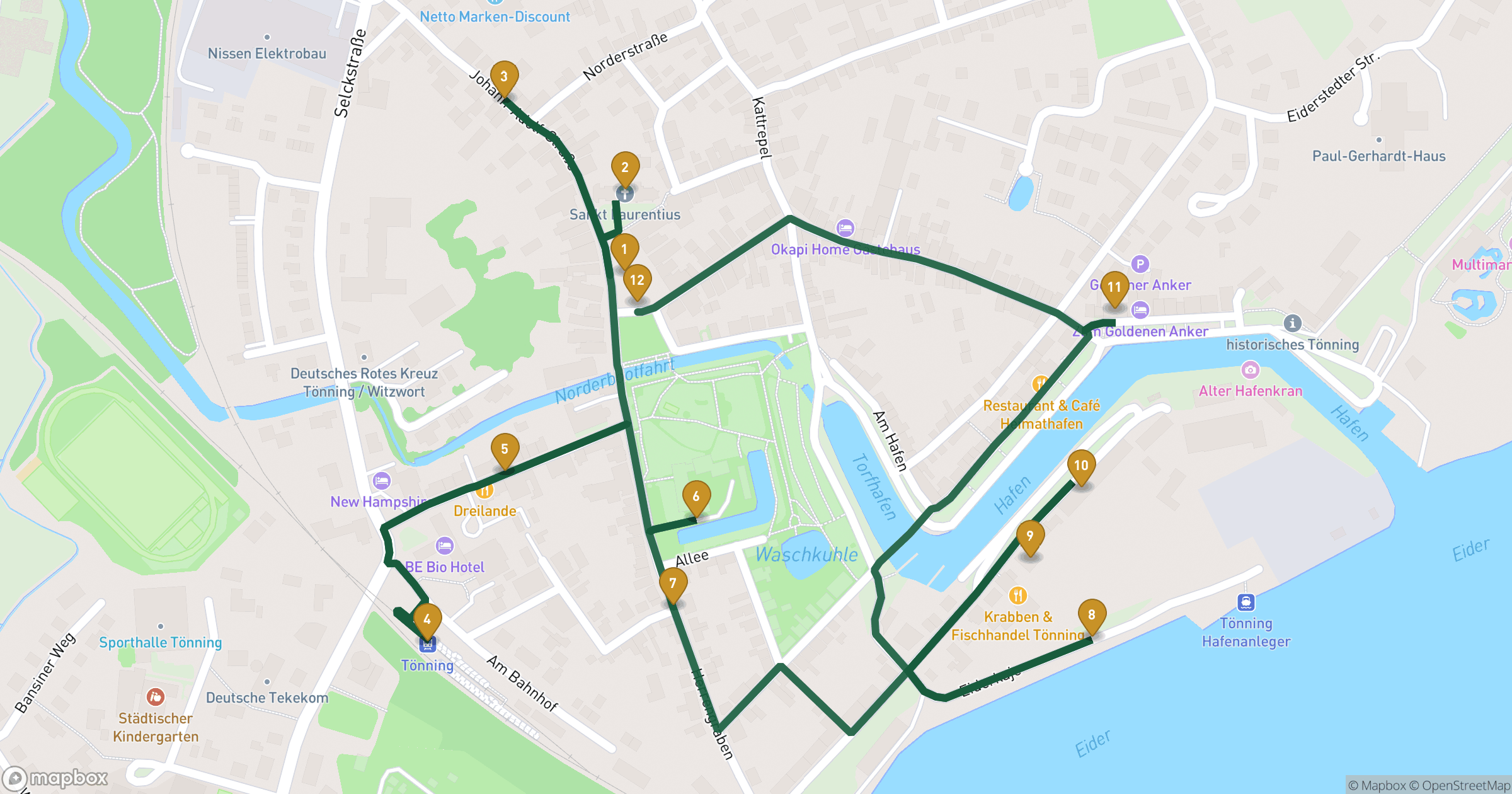
Map for Tönning walking tour with 12 stops
The static map shows the tour route with Marktbrunnen, St. Lawrence church Tönning, Johann-Adolf-Straße, Tönning station, and 8 more stops.

Stops along the route

All stops on this self-guided tour at a glance.

  1. Marktbrunnen in Tönning
    Uwe Barghaan / CC BY 3.0

    1Marktbrunnen

    Tönning's market fountain stands as a renaissance monument and communal gathering place dating back to 1613. Stone masons decorated its columns and basin with ornate details serving as a symbol of mercantile prosperity. To this day, the historic structure is decorated by locals for special celebrations like Christmas.

    Built: 1613 · Wikidata

  2. St. Lawrence church Tönning in Tönning
    Helmlechner / CC0

    2St. Lawrence church Tönning

    St. Laurentius Church is dominated by a 62-meter baroque tower designed by architect Jacob Bläser. Genuine cannonballs remain embedded in the brickwork from bombardment during the Great Northern War in 1700. The interior features an expansive 1704 ceiling painting creating the illusion of an open sky.

    Architect: Jacob Bläser · Style: baroque architecture · Named after: Lawrence of Rome · Wikidata

  3. 3Johann-Adolf-Straße

    Johann-Adolf-Straße reveals how the city grew outward under Duke Johann Adolf of Schleswig-Holstein-Gottorp. Built broad enough for horse-drawn wagons, it linked the central market to the harbor and later the railway station. Today its quiet path highlights the region's brick architecture with assorted decorative facades.

    Wikidata

  4. Tönning station in Tönning
    Juergen Kullmann, Wasserstr. 24, 44379 Dortmund / CC BY-SA 4.0

    4Tönning station

    Tönning railway station opened in 1854 under the Flensburg-Husum-Tönninger Railway Company, sparking an era of industrial trade. Known as a cattle station, it handled thousands of oxen heading for England alongside incoming British coal. The current station features specialized overhead catenary lines where modern battery-powered trains recharge.

    Wikidata

  5. Westerstraße in Tönning
    Bernhard Diener / CC BY-SA 4.0

    5Westerstraße

    Westerstraße showcases the residential heritage of the Eiderstedt peninsula with closely aligned red-brick houses. Stepped gables crown many roofs, which historically signaled the wealth of the homeowners below. Old carved wooden doors along the street still display original coats of arms and inscribed construction dates.

    Wikidata

  6. Schlosspark in Tönning
    Hartmut Schmidt Heidelberg / CC BY-SA 4.0

    6Schlosspark

    The Schlosspark grounds conceal the former site of an expansive renaissance fortress that was fully demolished in 1735. Surviving water moats that wind through the mature trees mark the defensive water borders of the original palace. Buried foundations still rest beneath the open lawns now used by public strollers.

    Wikidata

  7. 7Herrengraben

    The Herrengraben preserves a defensive moat that once shielded Tönning against foreign sieges. The current walking path directly tracks the historic perimeter where sentries once patrolled the fortifications. Quiet residential gardens and house backs now slope down to the water in place of ramparts.

    Wikidata

  8. 8Eiderkaje

    The Eiderkaje waterfront offers clear views of tidal currents shifting along Schleswig-Holstein's longest river. In the distance stands the substantial Eider Bridge, carrying modern automobile and rail transport across the wide waterway. High-water marks fixed along the bank record the peak levels reached during historical storm surges.

  9. Ehemaliges Zollamt in Tönning
    GuruJoe / CC BY-SA 4.0

    9Ehemaliges Zollamt

    The former customs office stands as a solid brick anchor from the bustling era of the Eider Canal. Officials stationed here inspected imported cargoes of wood, fabrics, and spices while assessing duties owed by incoming merchants. Its clean, sturdy lines reflect regional architecture designed to withstand North Sea coastal conditions.

    Wikidata

  10. Am Eiderdeich 18 in Tönning
    Radler59 (talk) / CC BY-SA 4.0

    10Am Eiderdeich 18

    Erected in 1783 along the harbor, the Tönning Packhaus is a 77-meter-long brick storehouse built to hold 15,000 tons of grain. Every December, the baroque commercial structure is transformed into the world's largest Advent calendar using its dozens of facade windows. The cavernous interior now accommodates historical exhibitions about sailing and canal trade.

    Built: 1783 · Wikidata

  11. Am Hafen 30 in Tönning
    Sloddervos / CC BY-SA 4.0

    11Am Hafen 30

    The Schifferhaus dates to 1624 or 1625, originally opening as an inn where sailors lodged after arriving in port. Swedish general Magnus Stenbock used the tavern as his military headquarters during the Great Northern War. On the roof, an old storm bell remains visible that once summoned local men to defend nearby dikes.

    Built: 1625 · Wikidata

  12. Markt in Tönning
    পাপৰি বৰা / CC BY-SA 4.0

    12Markt

    The market square forms an open architectural forum framed by old houses with stepped gables. At its center stands a decorative market fountain gifted to the town by the affluent merchant C.F. Lütcke. The location continues to function as a public venue for open-air markets and seasonal town festivals.

    Wikidata

Download the app

This public page shows a preview. The full route, all content, and navigation are available in CityTour AI.

Cities nearby

Discover self-guided tours in nearby cities.

Frequently asked questions

The key answers before you start.

Is this a self-guided audio tour?

Yes. In the CityTour AI app (iOS and Android), this is a self-guided audio tour for Tönning — start anytime, at your own pace, with map, stops, and audio narration.

What will you see on this tour?

On this tour you'll see, among others, Marktbrunnen, St. Lawrence church Tönning, Johann-Adolf-Straße, Tönning station, Westerstraße, Schlosspark and more sights.

Where does the tour start?

The route starts at Marktbrunnen and ends at Markt. You can start anytime — the app guides you to the first stop.

How long does the tour take?

About 101 minutes for 12 stops — at your own pace, with breaks whenever you like.

How much does the tour cost?

This tour costs 15 credits. The exact price depends on the pack you buy and your country — roughly $5.

Is it an outdoor tour — are entry tickets included?

Yes, it's an outdoor tour: the sights are viewed from the outside. Entry tickets are not included, and step-free access cannot be guaranteed.

Is the audio guide available in my language?

The tour and audio guide are available in English, Deutsch, Français, Español, Italiano and 9 more languages. You pick your language in the app.

Can I use the tour offline?

Yes. Tours can be used offline.

Can I ask the AI questions along the way?

Yes. At every stop you can ask the AI directly if you want to know more or didn't understand something.