CityTour AI

Antigua Guatemala self-guided walking tour

Antigua: Between Baroque Splendor and Volcanic Ash

Discover the magic of Antigua Guatemala on a relaxed walking tour that bridges colonial grandeur and modern city life. Explore impressive Baroque churches, hidden monastery ruins, and vibrant markets while experiencing the fascinating history of Central America's former capital. This walk takes you to the most iconic landmarks and secret corners that define the unique charm of this UNESCO World Heritage site.

Audio tourSelf-guidediOS & Android
195minutes
8.2 kmdistance
19stops
Audio guideFormat
Antigua: Between Baroque Splendor and Volcanic Ash
randreu / CC BY 3.0

Stops on this route

This tour works well for first-time visitors, weekend trips, and travelers who want to explore Antigua Guatemala without a fixed tour time.

Route map for Antigua walking tour
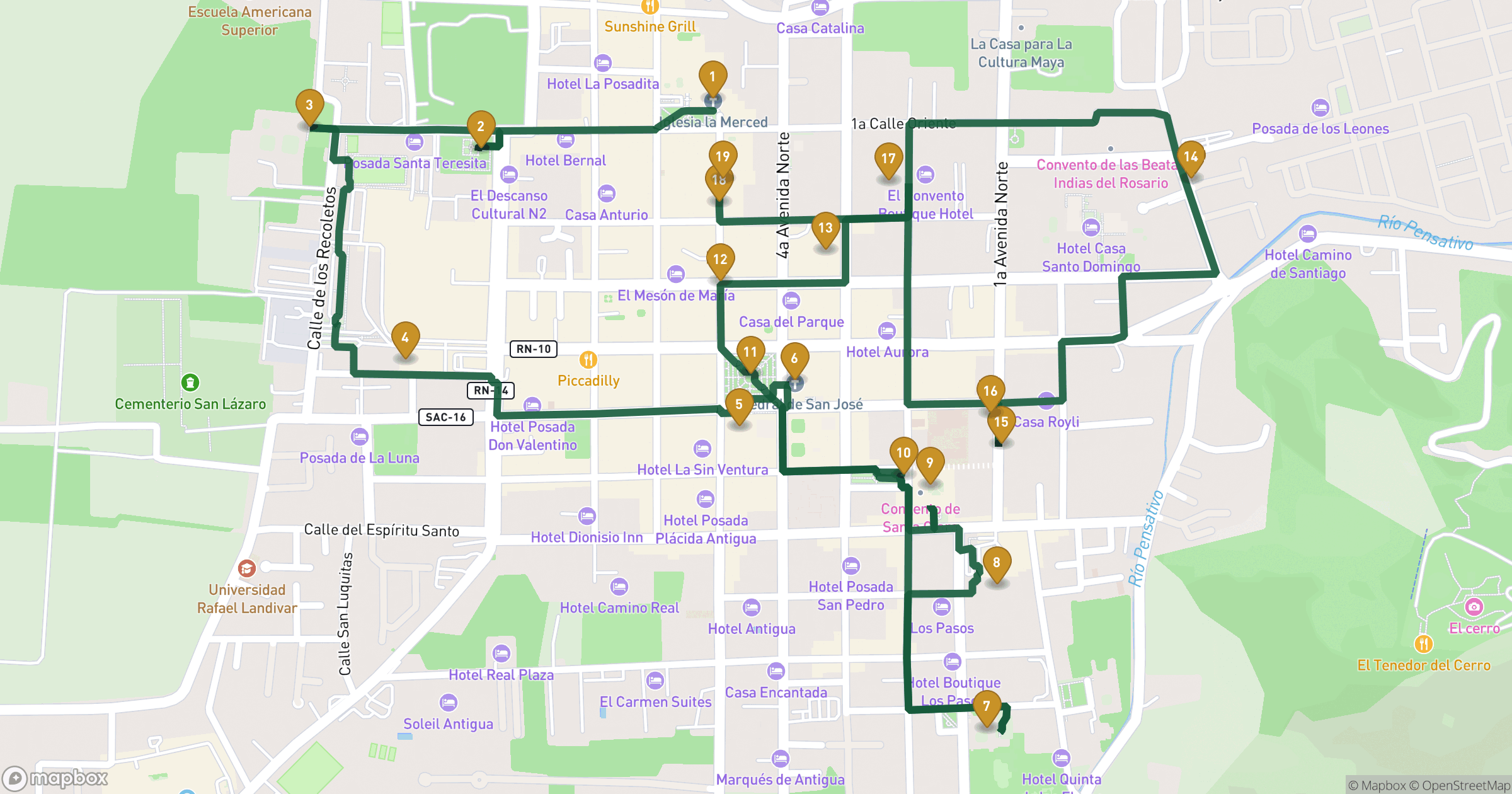
Map for Antigua walking tour with 19 stops
The static map shows the tour route with La Merced Church, Colegio de San Jerónimo o Real Aduana, Ruinas de La Recolección, Mercado de Artesanías, and 15 more stops.

Stops along the route

All stops on this self-guided tour at a glance.

  1. La Merced Church in Antigua Guatemala
    Rambling Traveler derivative work: MrPanyGoff / CC BY-SA 3.0

    1La Merced Church

    La Merced stands out with its bright yellow exterior, preserved almost miraculously through the destructive 1773 earthquake. Its 1767 facade features intricate plant-pattern stucco and a gable niche showing Peter Nolasco, who founded the Mercedarian order back in 1218 to free captives. Inside the cloister rests a 27-meter-wide stone fountain once likely used by monks to raise fish.

    Built: 1767 · Style: baroque architecture · Wikidata

  2. Colegio de San Jerónimo o Real Aduana in Antigua Guatemala
    PPazo1995 / CC BY 4.0

    2Colegio de San Jerónimo o Real AduanaAttraction

    Colegio de San Jerónimo reveals a serene courtyard with a historic dispute behind its walls. Mercedarian friars began constructing it as a school in 1739, but the Spanish Crown seized the unauthorized project and turned it into a royal customs house. Today, maintained gardens and a colonial fountain sit framed by the heavy ruins of its former arcades.

  3. Ruinas de La Recolección in Antigua Guatemala
    Simon Burchell / CC BY-SA 4.0

    3Ruinas de La RecolecciónAttraction

    The ruins of La Recolección showcase the raw destructive force of regional seismic history. Completed in 1717, damaged shortly after, and restored by persistent friars, the complex collapsed permanently in the 1773 earthquake. Visitors now walk among huge, uncleaned blocks of brick and stucco that prompted Spain to abandon the capital entirely.

  4. 4Mercado de Artesanías

    Mercado de Artesanías immerses visitors in the vibrant craft culture of Guatemala. The stalls feature handmade goods ranging from traditional huipil blouses and woven textiles to carved wood and sacred Maya jade. Weavers can frequently be seen working at portable backstrap looms, incorporating regional bird and geometric motifs passed down through generations.

  5. Palace of the Captain Generals in Antigua Guatemala
    BBCLCD / CC BY-SA 4.0

    5Palace of the Captain GeneralsMuseum

    Palacio de los Capitanes Generales was the powerhouse that once administered territory stretching from southern Mexico to Costa Rica. Architect Diego de Porres rebuilt and reinforced the complex after the 1717 disaster, making it remarkably durable for decades. Its massive stone pillars were deemed too heavy to cart off to the new capital in 1773 and remain here today.

    Built: 1755 · Wikidata

  6. Antigua Guatemala Cathedral in Antigua Guatemala
    Rialfver at Dutch Wikipedia / CC BY-SA 3.0

    6Antigua Guatemala CathedralChurch

    Cathedral San José presents a misleading front: its ornate white facade belongs merely to a parish church that occupies a fraction of the original site. Consecrated in 1680, the complete cathedral once held five naves and 18 chapels before collapsing in 1773. Behind the facade, ruined open-air columns stand where conquistador Pedro de Alvarado was reputedly buried.

    Built: 1680 · Style: Mannerist architecture · Named after: Saint James the Elder · Wikidata

  7. Escuela de Cristo in Antigua Guatemala
    Bruno Rijsman; Antigua (Mexico, February 2020) - 70 / CC BY-SA 2.0

    7Escuela de CristoMonument

    Escuela de Cristo distinguishes itself with an austere, unplastered stone exterior designed by Diego de Porres upon its 1730 completion. The institution began in 1664 under Bernardino de Obando y Obregón, an ascetic aiming to reform urban sins through strict spiritual obedience. Located along the Calle de los Pasos, it endured the 1773 tremors largely intact.

    Built: 1720 · Architect: Diego De Porres · Style: baroque architecture · Wikidata

  8. San Francisco Church in Antigua Guatemala
    Hermann Luyken / CC BY-SA 3.0

    8San Francisco ChurchMonument

    San Francisco catches the eye with twisted Solomonic columns and the double-headed Habsburg eagle carved above the portal. The church houses the tomb of Brother Pedro, Central America's first saint, who arrived from Tenerife in the 17th century to tend to the poor and sick. Its evocative ruins served as a backdrop for the 1935 film The New Adventures of Tarzan.

    Built: 1702 · Style: baroque architecture · Named after: Francis of Assisi · Wikidata

  9. Convento de Santa Clara in Antigua Guatemala
    Renato Caniatti at Italian Wikipedia | Self-photographed / CC BY-SA 3.0

    9Convento de Santa ClaraBuilding

    Convento de Santa Clara preserves the serene cloisters designed for the daughters of the Spanish colonial elite in the late 17th century. Repeatedly damaged by earthquakes before falling in 1773, its double arcade remains remarkably intact. In the central garden lies a massive stone fountain that once anchored the nuns' daily water supply.

  10. Tanque La Union in Antigua Guatemala
    Bruno Rijsman | Antigua (Mexico, February 2020) - 122 / CC BY-SA 2.0

    10Tanque La UnionMonument

    Tanque La Unión is a bright yellow, neoclassical civic landmark built with 22 individual washbasins. Inaugurated in 1853 to serve households lacking running water, its name commemorates the aspiration for a Central American union. Local residents still occasionally wash clothing here beneath open arches that overlook a central reflecting basin.

  11. Plaza Mayor in Antigua Guatemala
    Erik Cleves Kristensen | https://www.flickr.com/photos/erikkristensen/51986022850/ / CC BY 2.0

    11Plaza MayorPark

    Plaza Mayor anchors daily social life in the city against a background view of the Agua volcano. Its central feature is the Sirens' Fountain, built in 1738 by Diego de Porres and modeled on Neptune's fountain in Bologna. Local lore claims the Count of La Gomera commissioned it after four sisters refused to nurse their infants, turning them into stone mermaids.

  12. 5a Avenida Norte in Antigua Guatemala
    Pedro Szekely from Los Angeles, USA; Antigua, Guatemala / CC BY 2.0

    125a Avenida Norte

    5th Avenue North offers an authentic stroll along original cobblestones lined with restored colonial architecture. The street provides continuous views toward the famous northern arch framing the Agua volcano in the distance. Tucked behind its plain doorways are lush, concealed courtyard gardens and fountains completely shielded from the street.

  13. Iglesia El Carmen in Antigua Guatemala
    Hans Birger Nilsen | Mercado el Carmen / CC BY-SA 2.0

    13Iglesia El CarmenChurch

    Iglesia El Carmen stands out for its double-tiered arrangement of 24 columns framing an elaborate stucco facade. Dedicated in 1638, the structure lost its main nave during the major earthquakes of 1717 and 1773 while the outer front wall held fast. Textile-like ornamentation typical of the local baroque style still adorns the surviving masonry.

  14. Casa Santo Domingo in Antigua Guatemala
    randreu / CC BY 3.0

    14Casa Santo DomingoMuseum

    Casa Santo Domingo showcases the transformation of a ruined 1773 Dominican monastery into an integrated luxury hotel and open-air museum. The property preserves original crypts, stone foundations, and historical courtyards where macaws perch beside colonial fountains. On-site exhibition spaces display artifacts spanning pre-Columbian ceramics to religious relics.

  15. 15Café No Sé

    Café No Sé is a dimly lit, bohemian dive famed for bringing clandestine mezcal across the border from Mexico. Founded by John Rexer, the venture later gave rise to the internationally recognized brand Ilegal Mezcal. A speakeasy-style room hidden behind a small refrigerator door hosts intimate live folk and blues performances among scribbled walls.

  16. Casa Popenoe in Antigua Guatemala
    Lgalvarado; Self-photographed / CC BY-SA 3.0

    16Casa PopenoeAttraction

    Casa Popenoe provides a window into domestic elite life, built in 1762 by Venancia López over 16th-century ruins. Botanist Wilson Popenoe acquired the derelict property in 1930, named after its imposing cypress, and methodically restored it alongside two successive wives. The residence retains original furnishings and was donated to Universidad Francisco Marroquín in 2007.

    Wikidata

  17. Convento de las Capuchinas in Antigua Guatemala
    miguel lara | https://web.archive.org/web/20161021095315/http://www.panoramio.com/photo/52443985 / CC BY 3.0

    17Convento de las CapuchinasAttraction

    Convento de las Capuchinas was the last convent founded in the city, consecrated in 1736 under architect Diego de Porres. Its centerpiece is the Torre del Retiro, a circular residential tower containing 18 cells each equipped with a private water closet. The central circular courtyard features unique acoustics that supposedly allowed the abbess to hear every nun at once.

  18. Santa Catalina Arch in Antigua Guatemala
    Public domain

    18Santa Catalina ArchMonument

    Santa Catalina Arch was built in the 17th century as a private pedestrian bridge over the street for cloistered nuns. Its elevated covered corridor let residents cross from the convent to their school without breaking their vow of seclusion from the public. The clock tower atop the span was added in the 1890s, and the arch itself is now reinforced with concrete.

    Wikidata

  19. 19Frida's

    Frida's brings a festive burst of Mexican popular culture to the street near the Santa Catalina Arch. Opened in 1995 by Sergio Diaz, known as 'El Che', the restaurant honors artist Frida Kahlo with decor inspired by her Blue House. The colorful interior acts like an informal gallery, filled with portraits of Kahlo and vibrant folk art.

Download the app

This public page shows a preview. The full route, all content, and navigation are available in CityTour AI.

Cities nearby

Discover self-guided tours in nearby cities.

Frequently asked questions

The key answers before you start.

Is this a self-guided audio tour?

Yes. In the CityTour AI app (iOS and Android), this is a self-guided audio tour for Antigua Guatemala — start anytime, at your own pace, with map, stops, and audio narration.

What will you see on this tour?

On this tour you'll see, among others, La Merced Church, Colegio de San Jerónimo o Real Aduana, Ruinas de La Recolección, Mercado de Artesanías, Palace of the Captain Generals, Antigua Guatemala Cathedral and more sights.

Where does the tour start?

The route starts at La Merced Church and ends at Frida's. You can start anytime — the app guides you to the first stop.

How long does the tour take?

About 195 minutes for 19 stops — at your own pace, with breaks whenever you like.

How much does the tour cost?

This tour costs 30 credits. The exact price depends on the pack you buy and your country — roughly $10.

Is it an outdoor tour — are entry tickets included?

Yes, it's an outdoor tour: the sights are viewed from the outside. Entry tickets are not included, and step-free access cannot be guaranteed.

Is the audio guide available in my language?

The tour and audio guide are available in English, Deutsch, Français, Español, Italiano and 9 more languages. You pick your language in the app.

Can I use the tour offline?

Yes. Tours can be used offline.

Can I ask the AI questions along the way?

Yes. At every stop you can ask the AI directly if you want to know more or didn't understand something.