CityTour AI

Reykjavík self-guided walking tour

Basalt, Glass, and the Soul of Reykjavik

Discover the architectural evolution of the world's northernmost capital on this casual stroll from the iconic Hallgrímskirkja down to the historic waterfront. You’ll explore how volcanic landscapes inspired towering cathedrals and jagged theaters while visiting the sites of world-changing summits and the oldest parliament on earth. It’s a perfect blend of local stories, grand design, and the creative spirit that defines Reykjavik today.

Audio tourSelf-guidediOS & Android
102minutes
4.4 kmdistance
10stops
Audio guideFormat
Basalt, Glass, and the Soul of Reykjavik
Laurentgauthier / CC BY-SA 3.0

Stops on this route

This tour works well for first-time visitors, weekend trips, and travelers who want to explore Reykjavík without a fixed tour time.

Route map for Reykjavík walking tour
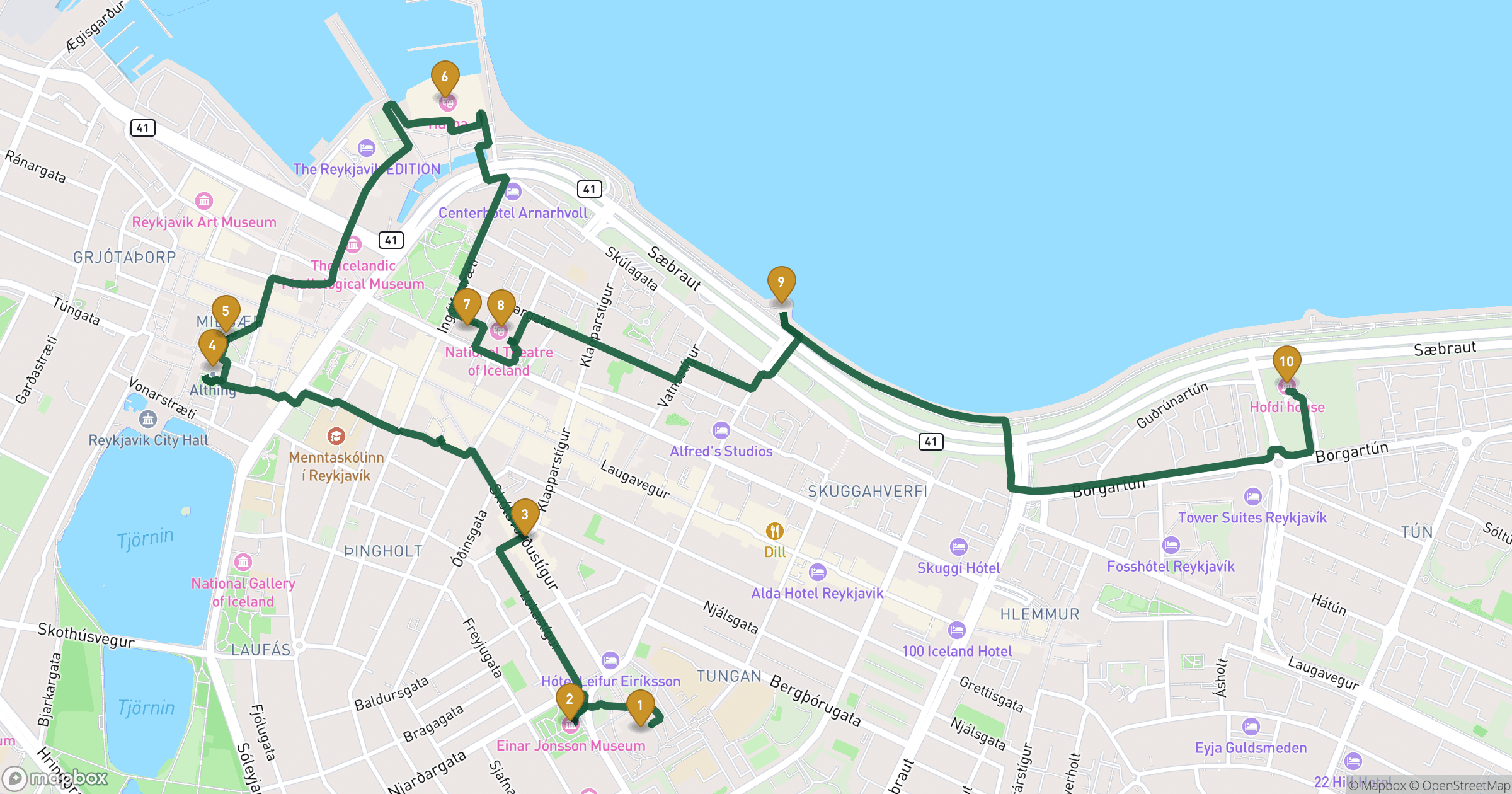
Map for Reykjavík walking tour with 10 stops
The static map shows the tour route with Hallgrímskirkja, Einar Jónsson Museum, Skolavordustigur, Alþingishúsið, and 6 more stops.

Stops along the route

All stops on this self-guided tour at a glance.

  1. Hallgrímskirkja in Reykjavík
    VeraVidiVici / CC BY-SA 4.0

    1HallgrímskirkjaChurch

    Reykjavik's skyline is dominated by Hallgrímskirkja, an expressionist church styled after the natural shapes of Iceland's landscape. Commissioned in 1937, architect Guðjón Samúelsson modeled its soaring wings after hexagonal basalt lava formations like Svartifoss waterfall. Its sanctuary end evokes the shape of a Viking war helmet, and its crypt was consecrated first in 1948.

    Built: 1986 · Architect: Guðjón Samúelsson · Style: expressionist architecture … · Height: 74 m · Wikidata

  2. Einar Jónsson Museum in Reykjavík
    TommyBee / Public domain

    2Einar Jónsson Museum

    The fortress-like Einar Jónsson Museum celebrates Iceland's first true sculptor, who lived and worked in this 1923 structure. Jónsson agreed to return from Denmark on the condition that the government build a home dedicated to his artworks. Behind the studio, a secluded garden displays his mystical bronze casts inspired by Norse mythology and the harsh motif of the outlaw.

    Built: 1923 · Wikidata

  3. Skolavordustigur in Reykjavík
    Villy Fink Isaksen / CC BY-SA 4.0

    3Skolavordustigur

    Descending the hill, Skólavörðustígur takes its name from the historic stone cairn once erected by local students. A rainbow painted on the street points toward the facade of Hallgrímskirkja, passing historic corrugated iron houses and modern boutiques. Along the walk stands Mokkakaffi, which introduced espresso to Reykjavik when it opened its doors to intellectuals in 1958.

    Wikidata

  4. Alþingishúsið in Reykjavík
    APK / CC BY-SA 4.0

    4AlþingishúsiðBuilding

    Alþingishúsið serves as the home of Iceland's parliament, completed in 1881 by Danish architect Ferdinand Meldahl. The exterior walls were built from hewn dolerite, a dark volcanic stone, and feature stone reliefs of Iceland's four guardian spirits on the first-floor windows. Before securing their own campuses, the National Library, National Gallery, and university operated inside.

    Built: 1881 · Architect: Ferdinand Meldahl · Wikidata

  5. Austurvöllur in Reykjavík
    APK / CC BY-SA 4.0

    5AusturvöllurSquare

    Directly facing parliament, the public square of Austurvöllur hosts both sunny leisure and Iceland's most defining political protests. At its heart stands a monument to independence leader Jón Sigurðsson, whose June 17th birthday is celebrated annually as National Day. Here, police first used tear gas during 1949 anti-NATO riots, and crowds banged cookware in the 2008 crisis.

    Wikidata

  6. Harpa in Reykjavík
    Holger Uwe Schmitt / CC BY-SA 4.0

    6HarpaTheatre

    Along the harbor, Harpa is a concert hall defined by an exterior inspired by natural basalt geology. Designed with artist Olafur Eliasson, its honeycomb facade consists of geometric glass panels that shift in color with the coastal light. Halted during the 2008 financial crash, it finally opened in 2011 with conductor Vladimir Ashkenazy leading the Iceland Symphony Orchestra.

    Built: 2011 · Architect: Ólafur Elíasson · Style: high-tech architecture … · Wikidata

  7. Culture House in Reykjavík
    Dougsim / CC BY-SA 3.0

    7Culture HouseMuseum

    Safnahúsið, or the Culture House, is a neoclassical landmark constructed between 1906 and 1908. Architect Johannes Magdahl Nielsen originally planned a dolerite and copper structure, but rising costs forced a shift to concrete and an iron roof. Decorative crests across the exterior honor figures from the sagas, including 13th-century historian Snorri Sturluson.

    Built: 1908 · Wikidata

  8. National Theatre of Iceland in Reykjavík
    MartinPutz / CC BY-SA 3.0

    8National Theatre of Iceland

    The National Theatre of Iceland, or Þjóðleikhúsið, is another volcanic-inspired design by State Architect Guðjón Samúelsson. Conceived in the 1920s, construction halted when British and American troops repurposed the unfinished shell as a military warehouse during World War II. Its exterior features vertical lines imitating basalt columns, finally welcoming audiences on April 20, 1950.

    Built: 1950 · Architect: Guðjón Samúelsson · Wikidata

  9. The Sun Voyager in Reykjavík
    Guilhem Vellut from Annecy, France / CC BY 2.0

    9The Sun VoyagerMonument

    On the waterfront stands the Sun Voyager, a stainless-steel dreamboat conceived by artist Jón Gunnar Árnason. Árnason developed the concept in Finland, envisioning a vessel that followed the sun based on a premonition of an ancient migration from Mongolia. Engineered by Sigurjón Yngvason to resist ocean winds, the nine-meter sculpture rests atop a coastal granite base.

    Built: 1990 · Height: 9 m · Wikidata

  10. Höfði in Reykjavík
    Laurentgauthier / CC BY-SA 3.0

    10HöfðiMuseum

    Höfði is a white timber house shipped from Norway in 1909 as a prefabricated residence for the French consul. It gained worldwide attention in 1986 when Ronald Reagan and Mikhail Gorbachev met within its walls for the Reykjavik Summit. The structure was also believed to be haunted by a spirit called the White Lady, prompting a British ambassador to sell it in 1952.

    Built: 1909 · Style: Jugendstil · Wikidata

Download the app

This public page shows a preview. The full route, all content, and navigation are available in CityTour AI.

Cities nearby

Discover self-guided tours in nearby cities.

Frequently asked questions

The key answers before you start.

Is this a self-guided audio tour?

Yes. In the CityTour AI app (iOS and Android), this is a self-guided audio tour for Reykjavík — start anytime, at your own pace, with map, stops, and audio narration.

What will you see on this tour?

On this tour you'll see, among others, Hallgrímskirkja, Einar Jónsson Museum, Skolavordustigur, Alþingishúsið, Austurvöllur, Harpa and more sights.

Where does the tour start?

The route starts at Hallgrímskirkja and ends at Höfði. You can start anytime — the app guides you to the first stop.

How long does the tour take?

About 102 minutes for 10 stops — at your own pace, with breaks whenever you like.

How much does the tour cost?

This tour costs 15 credits. The exact price depends on the pack you buy and your country — roughly $5.

Is it an outdoor tour — are entry tickets included?

Yes, it's an outdoor tour: the sights are viewed from the outside. Entry tickets are not included, and step-free access cannot be guaranteed.

Is the audio guide available in my language?

The tour and audio guide are available in English, Deutsch, Français, Español, Italiano and 9 more languages. You pick your language in the app.

Can I use the tour offline?

Yes. Tours can be used offline.

Can I ask the AI questions along the way?

Yes. At every stop you can ask the AI directly if you want to know more or didn't understand something.