CityTour AI

Dublin self-guided walking tour

Dublin's Heritage: From Vikings to Rebels

Join us for a relaxed stroll through the heart of Dublin, where we discover magnificent Georgian architecture and hidden medieval alleys. From political power centers to the city's oldest pubs, experience firsthand how Viking heritage and modern lifestyle intertwine. This walk offers the perfect blend of major sights and charming anecdotes known only to locals.

Audio tourSelf-guidediOS & Android
194minutes
8.2 kmdistance
18stops
Audio guideFormat
Dublin's Heritage: From Vikings to Rebels
Megan Tissington / CC BY-SA 4.0

Stops on this route

This tour works well for first-time visitors, weekend trips, and travelers who want to explore Dublin without a fixed tour time.

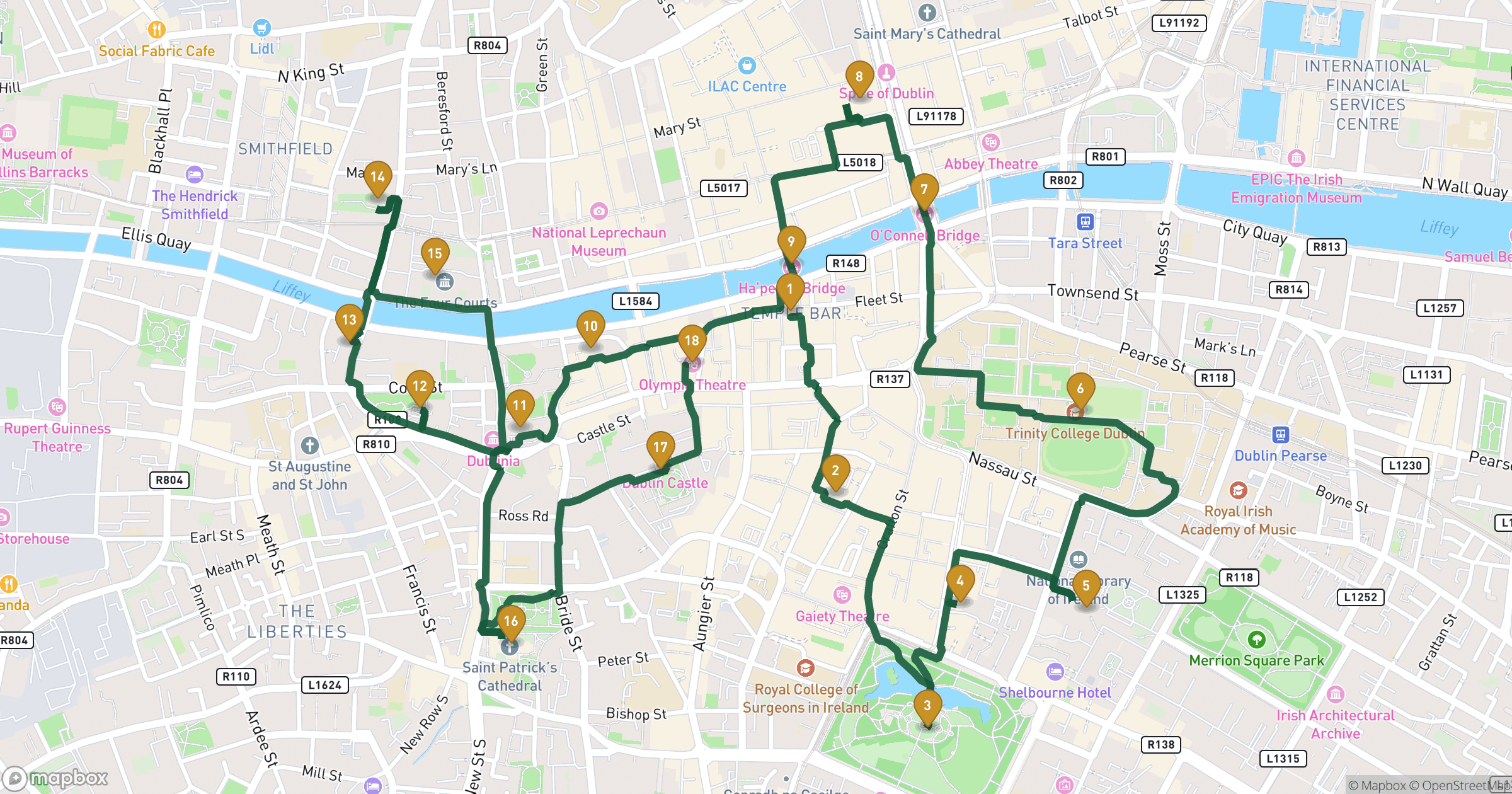
Route map for Dublin walking tour

Map for Dublin walking tour with 18 stops
The static map shows the tour route with Temple Bar Square, Powerscourt Townhouse Centre, Saint Stephen's Green, Mansion House, and 14 more stops.

Stops along the route

All stops on this self-guided tour at a glance.

  1. Temple Bar Square in Dublin
    GilPe / CC BY-SA 4.0

    1Temple Bar Square

    Temple Bar Square preserves Dublin's medieval street layout, originating from the 17th-century estate and gardens of statesman Sir William Temple. In the 1980s, the entire district faced complete demolition to construct a massive central bus station before artists and conservationists intervened. Cobblestoned alleys now host street performers alongside a weekly book market.

    Wikidata

  2. Powerscourt Townhouse Centre in Dublin
    Thoslee / CC BY-SA 4.0

    2Powerscourt Townhouse CentreBuilding

    Powerscourt Townhouse Centre conceals an aristocratic Georgian residence behind a discreet street façade. Commissioned around 1774 by Richard Wingfield, 3rd Viscount Powerscourt, the interior features elaborate plasterwork crafted by architect Robert West. The open courtyard where horse-drawn carriages once arrived operates today as a light-filled atrium filled with boutique cafés.

    Built: 1771 · Wikidata

  3. Saint Stephen's Green in Dublin
    Dronepicr (edited by King of Hearts) Edit corrects CA and sharpens image / CC BY 3.0

    3Saint Stephen's GreenPark

    St. Stephen’s Green traces Dublin's civic evolution from medieval marshland into a Victorian retreat opened to the public in 1880 by Sir Arthur Guinness. During the 1916 Easter Rising, rebels under Michael Mallin and Countess Constance Markiewicz occupied trenches dug across the lawns. Both sides briefly ceased gunfire each day so park keeper James Kearney could feed the pond ducks.

    Wikidata

  4. Mansion House in Dublin
    YvonneM / CC BY-SA 3.0

    4Mansion HouseBuilding

    The Mansion House on Dawson Street has served as the official residence of the Lord Mayor of Dublin since 1715. Merchant Joshua Dawson built the Queen Anne-style home in 1710 on marshland before selling it to the city for 3,500 pounds. In 1821, the adjacent Round Room was erected in just six weeks to host King George IV, later becoming the site of the 1919 independence declaration.

    Built: 1710 · Wikidata

  5. Leinster House in Dublin
    Jean Housen / CC BY-SA 3.0

    5Leinster HouseBuilding

    Leinster House began as an aristocratic statement when the Earl of Kildare commissioned Richard Cassels to build south of the River Liffey in 1745. Irish architect James Hoban studied its Palladian proportions before using them to design the White House in Washington, D.C. Prior to housing the Oireachtas in 1922, the grounds were used by the Royal Dublin Society for horse shows.

    Built: 1748 · Architect: Richard Cassels · Style: Georgian architecture … · Named after: Duke of Leinster · Wikidata

  6. Trinity College Dublin in Dublin
    Imelda Casey / CC BY-SA 4.0

    6Trinity College DublinBuilding

    Trinity College Dublin stands on grounds established in 1592 by Queen Elizabeth I to anchor Protestant education in Ireland. The Long Room of the Old Library extends 65 meters beneath a barrel-vaulted ceiling, sheltering more than 200,000 historic volumes alongside the 9th-century Book of Kells. The central cobblestone courtyards feature a free-standing campanile dating to 1853.

    Built: 1592 · Wikidata

  7. O'Connell Bridge in Dublin
    Thpohl / Public domain

    7O'Connell Bridge

    O’Connell Bridge presents an unusual architectural profile across the River Liffey, measuring 50 meters wide and thus broader than it is long. Built in 1791 by James Gandon as Carlisle Bridge, the structure originally had a steep hump before being widened and flattened in 1879. Reopened in 1882, the three-span granite bridge carries the name of Catholic rights advocate Daniel O’Connell.

    Built: 1791 · Wikidata

  8. General Post Office in Dublin
    Copyright © 2006 Kaihsu Tai / CC BY-SA 3.0

    8General Post OfficeAttraction

    The General Post Office served as rebel headquarters during the 1916 Easter Rising, its stone steps bearing witness to Patrick Pearse's proclamation of the Irish Republic. Architect Francis Johnston designed the Greek Revival landmark in 1814 with massive ionic granite columns. Today, bullet holes remain visible in those pillars, and a statue of mythical warrior Cúchulainn stands inside.

    Built: 1814 · Architect: Francis Johnston · Style: Greek Revival architecture … · Wikidata

  9. Ha'penny Bridge in Dublin
    Public domain

    9Ha'penny Bridge

    Ha'penny Bridge is an 1816 cast-iron footbridge built to replace William Walsh's deteriorating Liffey ferries. Walsh secured the right to extract a half-penny toll, charging the identical price of the former boat passage until the fee was finally abolished in 1919. The white arches were cast in Shropshire before being ferried across the Irish Sea for assembly.

    Built: 1816 · Wikidata

  10. Smock Alley Theatre in Dublin
    N Chadwick / CC BY-SA 2.0

    10Smock Alley Theatre

    Smock Alley Theatre opened in 1662 as the first Theatre Royal beyond London, later sparking riots in 1747 when crowds surged to glimpse actor David Garrick. In the early 19th century, the structure was converted into a Catholic church, adding prominent Gothic windows to the facade. After reopening as a performance venue in 2012, the hall retained its stained glass and church stonework.

    Built: 2012 · Wikidata

  11. Christ Church Cathedral in Dublin
    Donaldytong / CC BY-SA 3.0

    11Christ Church Cathedral

    Christ Church Cathedral traces back to a wooden church founded around 1030 by Viking king Sitric Silkenbeard. Norman invaders later replaced the wood with stone, and their commander Strongbow lies buried inside the nave. The expansive medieval crypt displays a mummified cat and rat recovered from an organ pipe during 19th-century renovations financed by distiller Henry Roe.

    Built: 1031 · Style: Gothic architecture · Named after: Holy Trinity · Wikidata

  12. St Audoen's Church in Dublin
    Megan Tissington / CC BY-SA 4.0

    12St Audoen's Church

    St Audoen’s Church is Dublin's sole surviving medieval parish church, founded in the 12th century by the Normans and dedicated to Saint Ouen of Rouen. A Romanesque portal dating to 1190 leads to grounds bordering the old city wall and St Audoen’s Arch, the last standing town gate. Inside lies the 9th-century Lucky Stone, an ancient carving repeatedly stolen yet mysteriously returned.

    Built: 1190 · Wikidata

  13. The Brazen Head in Dublin
    Coccico2345 / CC BY-SA 3.0

    13The Brazen HeadAttraction

    The Brazen Head originated in 1198 as a coaching inn, making it Dublin's oldest pub site. Rebel leader Robert Emmet used the upstairs rooms as a covert headquarters while planning his early 19th-century uprising against British rule. The interior retains low ceilings, historic photographs, and banknotes from across the globe, earning a mention in James Joyce's Ulysses.

    Built: 1198 · Wikidata

  14. St. Michan's Church in Dublin
    Andreas F. Borchert / CC BY-SA 4.0

    14St. Michan's Church

    St. Michan’s Church conceals burial vaults beneath an exterior rebuilt in 1685 by architect William Robinson. Dry air and limestone keep the interred bodies naturally mummified, including an 800-year-old Crusader whose legs were broken to fit him inside his coffin. Above ground stands a 1724 pipe organ that George Frideric Handel used to rehearse his Messiah prior to its Dublin premiere.

    Architect: William Robinson · Wikidata

  15. Four Courts in Dublin
    XeresNelro / CC BY-SA 4.0

    15Four CourtsBuilding

    The Four Courts is a Neoclassical riverside landmark completed in 1802 under the direction of architect James Gandon. During the 1922 Irish Civil War, anti-Treaty forces held the building until Michael Collins authorized artillery strikes that detonated the Public Record Office. Charred scraps of ancient lineage documents rained over the city before the courts were restored in 1932.

    Built: 1796 · Architect: Thomas Cooley, James Gandon · Style: Neoclassical architecture · Wikidata

  16. Saint Patrick's Cathedral in Dublin
    Diliff / CC BY-SA 3.0

    16Saint Patrick's CathedralChurch

    Saint Patrick's Cathedral stands on the traditional 1191 site where Ireland's patron saint baptized converts. Gulliver's Travels author Jonathan Swift served as dean from 1713 to 1745, and his burial marker rests beside his companion Stella. Visitors also view the Door of Reconciliation, chopped open in 1492 so rival family heads could end their feud with a blind handshake.

    Built: 1191 · Style: Gothic architecture · Height: 43 m · Named after: Saint Patrick · Wikidata

  17. Dublin Castle in Dublin
    Jean Housen / CC BY-SA 3.0

    17Dublin Castle

    Dublin Castle served as the administrative core of British authority for over seven centuries, retaining its original 13th-century Record Tower. On January 16, 1922, the complex was officially transferred to Michael Collins and the provisional government. The grounds border the Dubh Linn Garden, marking the Viking pool that gave Dublin its name, alongside City Hall's domed rotunda.

    Built: 1204 · Wikidata

  18. Olympia Theatre in Dublin
    Gerd Eichmann / CC BY-SA 4.0

    18Olympia Theatre

    The Olympia Theatre opened on Dame Street in 1879 under the name Star of Erin Music Hall, staging comic operas and acrobatics under a cast-iron canopy. A structural disaster struck during a 1974 rehearsal when the proscenium arch collapsed, prompting an extensive community restoration. The stage hosted performers ranging from Charlie Chaplin and Laurel and Hardy to rock act David Bowie.

    Built: 1879 · Wikidata

Download the app

This public page shows a preview. The full route, all content, and navigation are available in CityTour AI.

Cities nearby

Discover self-guided tours in nearby cities.

Frequently asked questions

The key answers before you start.

Is this a self-guided audio tour?

Yes. In the CityTour AI app (iOS and Android), this is a self-guided audio tour for Dublin — start anytime, at your own pace, with map, stops, and audio narration.

What will you see on this tour?

On this tour you'll see, among others, Temple Bar Square, Powerscourt Townhouse Centre, Saint Stephen's Green, Mansion House, Leinster House, Trinity College Dublin and more sights.

Where does the tour start?

The route starts at Temple Bar Square and ends at Olympia Theatre. You can start anytime — the app guides you to the first stop.

How long does the tour take?

About 194 minutes for 18 stops — at your own pace, with breaks whenever you like.

How much does the tour cost?

This tour costs 30 credits. The exact price depends on the pack you buy and your country — roughly $10.

Is it an outdoor tour — are entry tickets included?

Yes, it's an outdoor tour: the sights are viewed from the outside. Entry tickets are not included, and step-free access cannot be guaranteed.

Is the audio guide available in my language?

The tour and audio guide are available in English, Deutsch, Français, Español, Italiano and 9 more languages. You pick your language in the app.

Can I use the tour offline?

Yes. Tours can be used offline.

Can I ask the AI questions along the way?

Yes. At every stop you can ask the AI directly if you want to know more or didn't understand something.