CityTour AI

Bologna self-guided walking tour

Bologna: Between the Medieval Manhattan and the Porticoes

Experience authentic Bologna on a relaxed stroll through its medieval center. From the iconic leaning towers to hidden canals, discover the city's fascinating architecture and intellectual soul. This walk combines famous landmarks with charming hidden gems off the main squares.

Audio tourSelf-guidediOS & Android
101minutes
3.5 kmdistance
11stops
Audio guideFormat
Bologna: Between the Medieval Manhattan and the Porticoes
Liridon / CC BY-SA 4.0

Stops on this route

This tour works well for first-time visitors, weekend trips, and travelers who want to explore Bologna without a fixed tour time.

Route map for Bologna walking tour
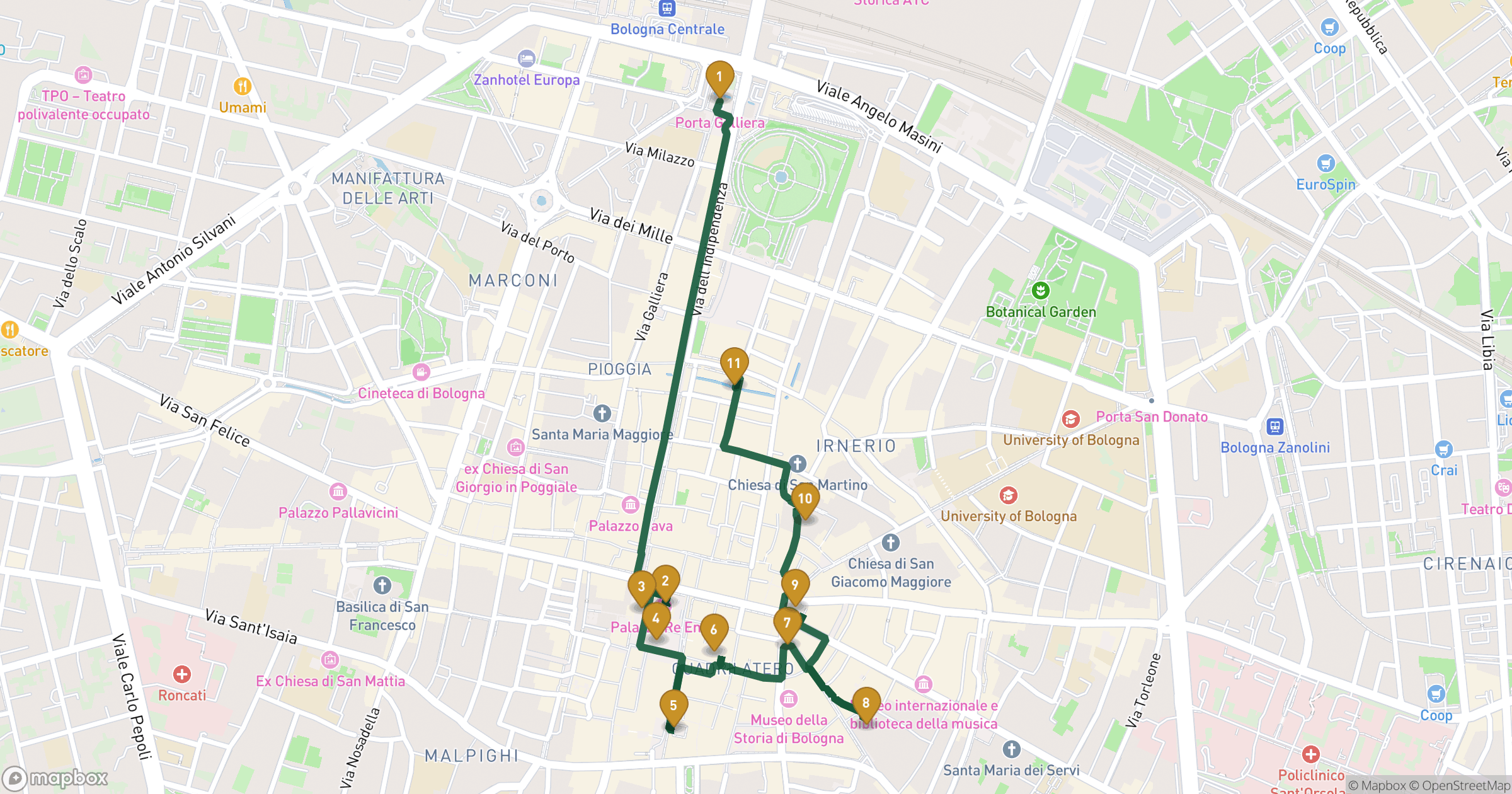
Map for Bologna walking tour with 11 stops
The static map shows the tour route with Porta Galliera, Palazzo Re Enzo, Fountain of Neptune, Bologna, Piazza Maggiore, and 7 more stops.

Stops along the route

All stops on this self-guided tour at a glance.

  1. Porta Galliera in Bologna
    Photograph by Mike Peel (www.mikepeel.net). / CC BY-SA 4.0

    1Porta GallieraCastle

    Porta Galliera reveals the turbulent power struggles between Bologna and papal authority through its contrasting façades. In the fourteenth century, Cardinal Bertrand du Pouget erected a massive fortress here, which rebel residents razed to the ground five separate times. Following the demolition of the medieval city walls in the early twentieth century, the gate stands isolated.

    Built: 1650 · Wikidata

  2. Palazzo Re Enzo in Bologna
    Paul Hermans / CC BY-SA 3.0

    2Palazzo Re EnzoAttraction

    Palazzo Re Enzo introduces medieval political history through the fate of its royal captive. Enzio of Sardinia, son of Emperor Frederick II, was imprisoned here for twenty-three years following the Battle of Fossalta. Under the connecting cross vault with Palazzo del Podestà, an acoustic phenomenon allows people in opposite corners to whisper clearly across the space.

    Built: 1250 · Architect: Alfonso Rubbiani · Style: Gothic architecture · Named after: Enzio of Sardinia · Wikidata

  3. Fountain of Neptune, Bologna in Bologna
    Anneli Salo / CC BY-SA 3.0

    3Fountain of Neptune, BolognaWater

    The Fountain of Neptune presents a masterwork by Flemish sculptor Giambologna, commissioned to symbolize papal control over the world. After church authorities demanded smaller genitals for the sea god, the artist devised an optical trick where Neptune's left thumb appears to protrude from his groin when viewed from a dark stone near the Sala Borsa. Four corner nereids represent the Amazon, Nile, Danube, and Ganges rivers.

    Built: 1550 · Wikidata

  4. Piazza Maggiore in Bologna
    Vanni Lazzari / CC BY-SA 4.0

    4Piazza MaggioreSquare

    Piazza Maggiore has served as the heart of public life and civic authority since the thirteenth century. The Basilica of San Petronio remains unfinished with exposed brick on top because the Pope ordered the Archiginnasio built next door, halting plans to outsize St. Peter's in Rome. On the central raised platform, stone gouges remain from the Allied tanks that rolled in on April 21, 1945.

    Built: 1550 · Wikidata

  5. Palazzo dell’Archiginnasio in Bologna
    Wwikiwalter / CC BY-SA 4.0

    5Palazzo dell’ArchiginnasioAttraction

    Palazzo dell’Archiginnasio was designed by architect Antonio Morandi in 1563 as the first central seat for the Western world's oldest university. Over six thousand student coats of arms decorate the walls, leading upstairs to the all-spruce Anatomical Theater completed in 1637. Two life-sized wooden figures by Ercole Lelli, depicting skinless men with detailed musculature, flank the room around the central dissection table.

    Built: 1550 · Architect: Antonio Morandi · Style: Mannerist architecture · Wikidata

  6. Sanctuary of Santa Maria della Vita in Bologna
    Zairon / CC BY-SA 4.0

    6Sanctuary of Santa Maria della VitaChurch

    Santa Maria della Vita houses a raw expression of grief tracing back to thirteenth-century flagellant traditions. Inside the late-seventeenth-century elliptical interior stands the Lamentation of Christ, a Renaissance terracotta group sculpted by Niccolò dell’Arca. Figures of mourning women rush forward over Christ's body with grief-stricken faces that poet Gabriele D’Annunzio called a cry carved in stone.

    Built: 1687 · Style: baroque architecture · Height: 52 m · Named after: Mary · Wikidata

  7. palazzo della Mercanzia in Bologna
    Armin Kleiner / CC BY-SA 4.0

    7palazzo della MercanziaAttraction

    Palazzo della Mercanzia stands as the Gothic headquarters where the Chamber of Commerce regulated the city's booming textile and silk trade starting in 1382. A delicate marble balcony projecting from the red-brick façade served as the podium where verdicts against dishonest merchants were proclaimed to the public. Inside these walls, officials preserved standard textile measurements to prevent commercial fraud.

    Built: 1350 · Architect: Lorenzo Da Bagnomarino, Antonio di Vincenzo · Style: Gothic architecture · Wikidata

  8. Santo Stefano Church in Bologna
    Vanni Lazzari / CC BY-SA 4.0

    8Santo Stefano Church

    The Basilica of Santo Stefano forms an interconnected labyrinth known as the Seven Churches, designed as a miniature replication of Jerusalem. Saint Petronius launched this initiative in the fifth century, including the octagonal Church of the Holy Sepulchre where his relics rested for centuries. Outside lies the Courtyard of Pilate, centered around a stone basin symbolically tied to Pontius Pilate washing his hands.

    Built: 950 · Style: Early Christian architecture · Named after: Holy Sepulchre · Wikidata

  9. Two Towers in Bologna
    Patrick Clenet / CC BY-SA 3.0

    9Two Towers

    The Two Towers survive from the twelfth century when over one hundred noble towers formed the skyline. Tower degli Asinelli rises over ninety-seven meters beside the steeply leaning Garisenda, built during a fierce contest between their rival namesake families. In the fourteenth century, Duke of Milan Giovanni Visconti connected them with a wooden bridge thirty meters high to survey the market below.

    Wikidata

  10. Ghetto in Bologna
    No machine-readable author provided. Biopresto assumed (based on copyright claims).; No machine-readable source provided. Own work assumed (based on copyright claims). / CC BY-SA 3.0

    10Ghetto

    The Ghetto reflects the isolated life established for the Jewish community in 1556 under a decree by Pope Paul IV. Along Via dell’Inferno and Via de’ Giudei, upper floors connect across alleys via small covered footbridges to maximize indoor living space. The neighborhood became a hub of gem trading, silk commerce, and banking despite the curfew gates locking residents in at night.

    Wikidata

  11. Finestrella di Via Piella in Bologna
    Bristin / CC BY-SA 3.0

    11Finestrella di Via PiellaAttraction

    Finestrella di Via Piella looks out onto the hidden waters of the Canale delle Moline through a modest opening in a residential wall. These medieval canals once drove grain mills and supported a silk manufacturing hub that made the city a European powerhouse. Most of this aquatic network was paved over or filled in during the twentieth century for modern street traffic and sanitation.

    Wikidata

Download the app

This public page shows a preview. The full route, all content, and navigation are available in CityTour AI.

Cities nearby

Discover self-guided tours in nearby cities.

Frequently asked questions

The key answers before you start.

Is this a self-guided audio tour?

Yes. In the CityTour AI app (iOS and Android), this is a self-guided audio tour for Bologna — start anytime, at your own pace, with map, stops, and audio narration.

What will you see on this tour?

On this tour you'll see, among others, Porta Galliera, Palazzo Re Enzo, Fountain of Neptune, Bologna, Piazza Maggiore, Palazzo dell’Archiginnasio, Sanctuary of Santa Maria della Vita and more sights.

Where does the tour start?

The route starts at Porta Galliera and ends at Finestrella di Via Piella. You can start anytime — the app guides you to the first stop.

How long does the tour take?

About 101 minutes for 11 stops — at your own pace, with breaks whenever you like.

How much does the tour cost?

This tour costs 15 credits. The exact price depends on the pack you buy and your country — roughly $5.

Is it an outdoor tour — are entry tickets included?

Yes, it's an outdoor tour: the sights are viewed from the outside. Entry tickets are not included, and step-free access cannot be guaranteed.

Is the audio guide available in my language?

The tour and audio guide are available in English, Deutsch, Français, Español, Italiano and 9 more languages. You pick your language in the app.

Can I use the tour offline?

Yes. Tours can be used offline.

Can I ask the AI questions along the way?

Yes. At every stop you can ask the AI directly if you want to know more or didn't understand something.