CityTour AI

Milan self-guided walking tour

Milan: Spires, Silk, and Spinning Bulls

Discover the elegant contradictions of Italy’s fashion capital on a walk that balances grand Gothic ambition with hidden Renaissance gems. You will spin for luck in a 19th-century glass palace, explore a fortress where Leonardo da Vinci once worked, and end with the city’s best street food. This tour captures the wit and history of Milan, from its towering iron spires to its secret frescoed chapels.

Audio tourSelf-guidediOS & Android
104minutes
5.0 kmdistance
8stops
Audio guideFormat
Milan: Spires, Silk, and Spinning Bulls
Jakub Hałun / CC BY-SA 4.0

Stops on this route

This tour works well for first-time visitors, weekend trips, and travelers who want to explore Milan without a fixed tour time.

Route map for Milan walking tour
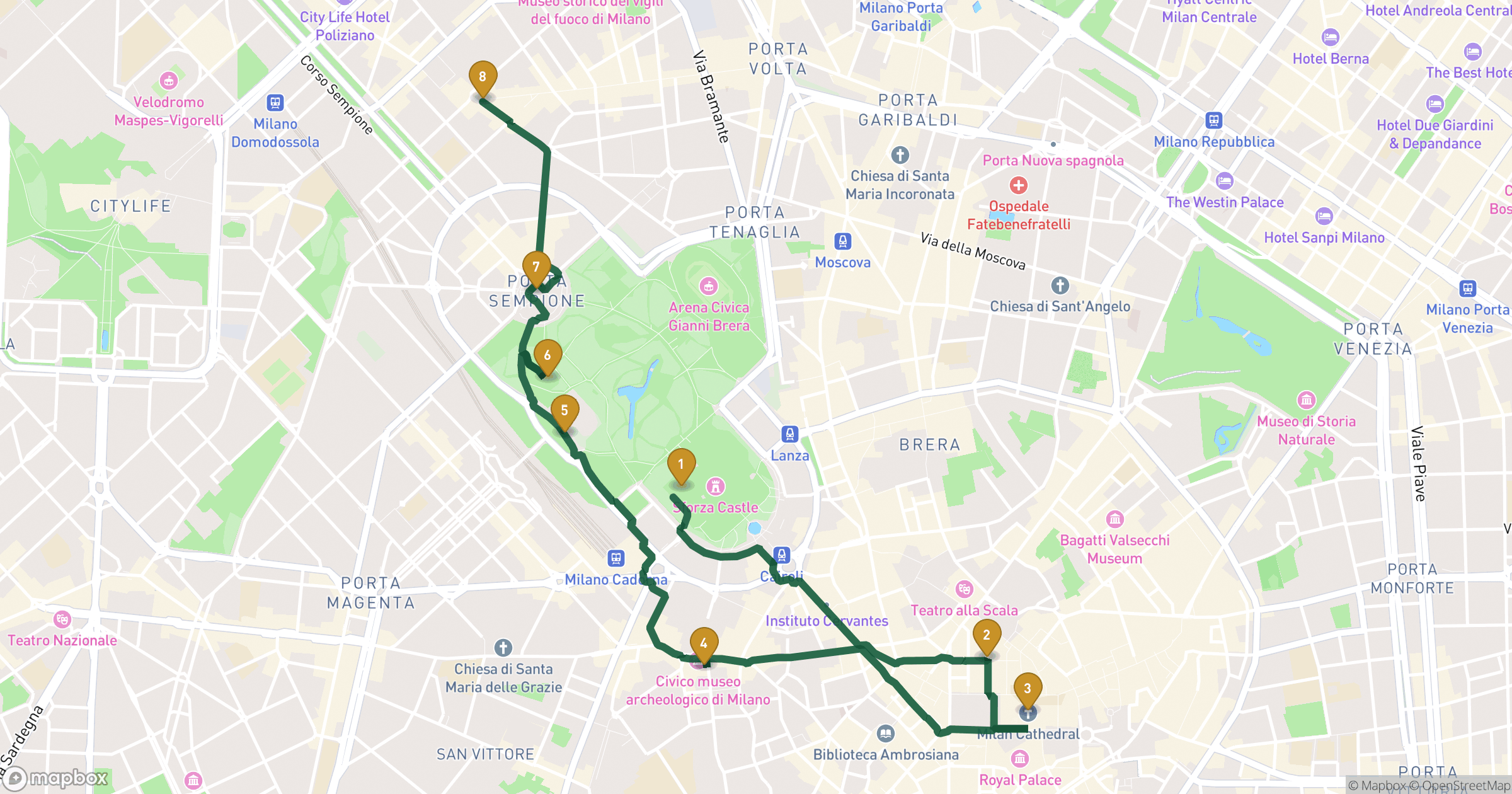
Map for Milan walking tour with 8 stops
The static map shows the tour route with Castello Sforzesco, Galleria Vittorio Emanuele Secondo, Duomo di Milano, San Maurizio al Monastero Maggiore, and 4 more stops.

Stops along the route

All stops on this self-guided tour at a glance.

  1. Castello Sforzesco in Milan
    Jakub Hałun / CC BY-SA 4.0

    1Castello SforzescoCastle

    Sforza Castle reveals its complex identity as both a defensive fortress and a lavish Renaissance court. Francesco Sforza hired Leonardo da Vinci, who decorated the ceiling of the Sala delle Asse with interwoven mulberry trees referencing Ludovico 'Il Moro'. The central Torre del Filarete is a 20th-century reconstruction after the original collapsed centuries earlier.

    Built: 1360 · Architect: Filarete · Style: Renaissance architecture · Wikidata

  2. Galleria Vittorio Emanuele Secondo in Milan
    Antonina Dattola / CC BY-SA 4.0

    2Galleria Vittorio Emanuele SecondoAttraction

    Galleria Vittorio Emanuele II highlights an architectural tragedy alongside a peculiar local tradition. Architect Giuseppe Mengoni fell to his death from the scaffolding in 1877, just one day before the official inauguration. On the floor of the central octagon, visitors have worn a polished hole into the mosaic bull by spinning on its groin three times for good luck.

    Built: 1867 · Architect: Giuseppe Mengoni · Style: Renaissance Revival architecture · Height: 29.2 m · Wikidata

  3. Duomo di Milano in Milan
    Nelson Pérez | https://web.archive.org/web/20161102033721/http://www.panoramio.com/photo/119487054 / CC BY-SA 3.0

    3Duomo di MilanoChurch

    Milan Cathedral traces its nearly six-century construction and the surprising figures carved into its exterior. The facade features a statue of Napoleon Bonaparte as well as 'The New Law' from 1810, which closely resembles the Statue of Liberty. Tax-free marble blocks marked 'AUF' for cathedral work originated the local expression 'a ufo,' meaning getting something for free.

    Built: 1386 · Architect: Simone da Orsenigo · Style: Italian Gothic architecture … · Height: 108.5 m · Wikidata

  4. San Maurizio al Monastero Maggiore in Milan
    MarkusMark / CC BY-SA 3.0

    4San Maurizio al Monastero MaggioreChurch

    San Maurizio al Monastero Maggiore exposes a strict spatial divide built for a powerful Benedictine convent. A partition wall separates the public front from the Hall of the Nuns, keeping cloistered sisters completely hidden from churchgoers. Inside, vibrant 16th-century frescoes include Aurelio Luini's painting of Noah's Ark, which features a pair of confused unicorns.

    Built: 1503 · Architect: Giovanni Antonio Amadeo, Gian Giacomo Dolcebuono · Style: Renaissance architecture · Named after: Saint Maurice · Wikidata

  5. Triennale di Milano in Milan
    Photograph by Mike Peel (www.mikepeel.net). / CC BY-SA 4.0

    5Triennale di MilanoBuilding

    Triennale di Milano in the Palazzo dell'Arte showcases Italian Rationalism and the evolution of decorative arts. Designed by Giovanni Muzio and constructed between 1931 and 1933, the project was funded by textile magnates the Bernocchi brothers. The exterior is faced with reddish clinker brick, framed at the entrance by three deep arches that blend classicism with clean modern lines.

    Built: 1923 · Architect: Giovanni Muzio, Gualtiero Galmanini · Named after: Milan Triennial · Wikidata

  6. Torre Branca in Milan
    Ludvig14 / CC BY-SA 4.0

    6Torre BrancaTower

    Branca Tower in Parco Sempione illustrates an ambitious feat of 1930s engineering shaped by local height restrictions. Gio Ponti designed the 108.6-meter steel structure for the 1933 Triennial, assembling it in just 68 days. To respect a decree that no building exceed the Duomo's golden Madonnina statue, the tower was built just centimeters shorter than the cathedral's peak.

    Built: 1933 · Architect: Cesare Chiodi, Gio Ponti · Wikidata

  7. Arco della Pace in Milan
    Filip Maljković from Pancevo, Serbia / CC BY-SA 2.0

    7Arco della PaceMonument

    Arco della Pace stands as a monument reshaped by shifting geopolitical rulers. Napoleon commissioned the arch in 1806, but following his defeat at Waterloo, the Austrians finished it and dedicated it to European peace. In a deliberate political snub, the Austrians rotated the six bronze chariot horses 180 degrees so their backsides face directly toward France.

    Architect: Luigi Cagnola · Style: Italian Neoclassical architecture · Wikidata

  8. Via Paolo Sarpi in Milan
    LucaChp / CC BY-SA 3.0

    8Via Paolo SarpiSquare

    Via Paolo Sarpi anchors Milan's Chinatown, established in the 1920s by silk workers from Zhejiang province. The street was transformed into a fully pedestrianized district in 2011, deliberately avoiding traditional tourist tropes like red lanterns. At Ravioleria Sarpi, hand-folded Chinese dumplings are stuffed with meats sourced from the historic Italian butcher shop next door.

    Named after: Paolo Sarpi · Wikidata

Download the app

This public page shows a preview. The full route, all content, and navigation are available in CityTour AI.

Cities nearby

Discover self-guided tours in nearby cities.

Frequently asked questions

The key answers before you start.

Is this a self-guided audio tour?

Yes. In the CityTour AI app (iOS and Android), this is a self-guided audio tour for Milan — start anytime, at your own pace, with map, stops, and audio narration.

What will you see on this tour?

On this tour you'll see, among others, Castello Sforzesco, Galleria Vittorio Emanuele Secondo, Duomo di Milano, San Maurizio al Monastero Maggiore, Triennale di Milano, Torre Branca and more sights.

Where does the tour start?

The route starts at Castello Sforzesco and ends at Via Paolo Sarpi. You can start anytime — the app guides you to the first stop.

How long does the tour take?

About 104 minutes for 8 stops — at your own pace, with breaks whenever you like.

How much does the tour cost?

This tour costs 15 credits. The exact price depends on the pack you buy and your country — roughly $5.

Is it an outdoor tour — are entry tickets included?

Yes, it's an outdoor tour: the sights are viewed from the outside. Entry tickets are not included, and step-free access cannot be guaranteed.

Is the audio guide available in my language?

The tour and audio guide are available in English, Deutsch, Français, Español, Italiano and 9 more languages. You pick your language in the app.

Can I use the tour offline?

Yes. Tours can be used offline.

Can I ask the AI questions along the way?

Yes. At every stop you can ask the AI directly if you want to know more or didn't understand something.