CityTour AI

Catania self-guided walking tour

Catania: The Soul of Lava and Baroque

Discover the soul of Catania on a walk through Roman ruins, monumental squares, and sumptuous lava stone Baroque. Admire the city's symbols, hear folk legends, and see how Mount Etna's power shaped every palace and church. A relaxed journey through the beating heart of Sicily where ancient history meets modern vibrancy.

Audio tourSelf-guidediOS & Android
60minutes
1.7 kmdistance
7stops
Audio guideFormat
Catania: The Soul of Lava and Baroque
Berthold Werner / CC BY-SA 3.0

Stops on this route

This tour works well for first-time visitors, weekend trips, and travelers who want to explore Catania without a fixed tour time.

Route map for Catania walking tour
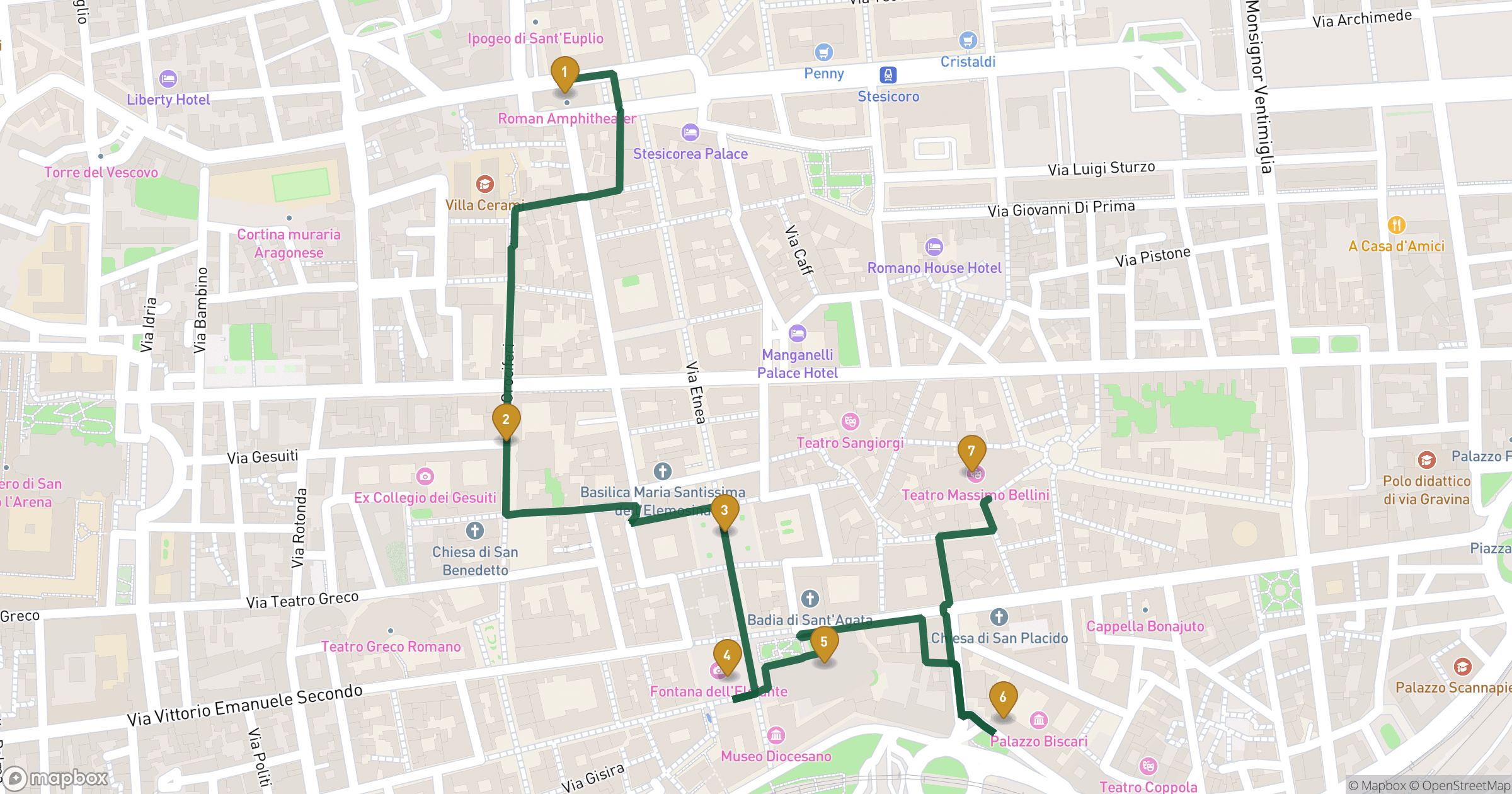
Map for Catania walking tour with 7 stops
The static map shows the tour route with Roman amphitheatre of Catania, Via dei Crociferi, Piazza dell'Università (Catania), Piazza del Duomo, and 3 more stops.

Stops along the route

All stops on this self-guided tour at a glance.

  1. Roman amphitheatre of Catania in Catania
    Berthold Werner / CC BY-SA 4.0

    1Roman amphitheatre of CataniaAttraction

    This Roman amphitheatre on Piazza Stesicoro seated roughly 15,000 spectators and showcases dark lava stone paired with red brick. Local legend holds that Saint Agatha's veil halted the 252 eruption of Mount Etna right before its arches. After being buried by the 1693 earthquake, the structure was partially uncovered by excavations at the start of the twentieth century.

    Wikidata

  2. Via dei Crociferi in Catania
    Antony-22 / CC BY-SA 4.0

    2Via dei CrociferiSquare

    Via dei Crociferi is a preserved eighteenth-century street featuring four monumental churches along a stretch of just 410 metres. The Arch of San Benedetto was erected in a single night in 1704 to bypass a building ban and shield cloistered nuns. This architectural setting also served as the filming location for Franco Zeffirelli's movie 'Storia di una capinera'.

    Wikidata

  3. Piazza dell'Università (Catania) in Catania
    Peppe64 / CC BY-SA 3.0

    3Piazza dell'Università (Catania)Square

    Piazza dell'Università hosts Sicily's oldest university from 1434 alongside four distinctive bronze candelabra installed in 1957. Sculptors Mimì Maria Lazzaro and Domenico Tudisco cast these streetlamps to depict four traditional local legends. Their reliefs tell the stories of Gammazita, the Pious Brothers, the Paladin Uzeda, and Colapesce holding up the island from the seabed.

    Named after: University of Catania · Wikidata

  4. Piazza del Duomo in Catania
    Dariolp83 / CC BY-SA 4.0

    4Piazza del DuomoSquare

    Piazza del Duomo showcases a striking urban layout shaped by black lava stone and bright white limestone. At its centre stands the Roman lava elephant known as u Liotru, crowned with an Egyptian obelisk by architect Vaccarini in 1736. Beneath the paving flows the Amenano River, which once fed the fourth-century Roman Achillian Baths still accessible below ground.

    Named after: Catania Cathedral · Wikidata

  5. Catania Cathedral in Catania
    Berthold Werner / CC BY-SA 4.0

    5Catania CathedralChurch

    Catania Cathedral originated as a fortified church founded by Count Roger between 1086 and 1094. Inside lie the relics of Saint Agatha, recovered from Constantinople in 1126 by two soldiers named Gilberto and Goselino. The building also holds the tomb of composer Vincenzo Bellini, inscribed with the opening line of the aria 'Ah! non credea mirarti'.

    Architect: Giovanni Battista Vaccarini · Style: baroque architecture … · Wikidata

  6. Palazzo Biscari in Catania
    DMarx22 / CC BY-SA 4.0

    6Palazzo BiscariMuseum

    Palazzo Biscari is an aristocratic residence built by the Paternò Castello family directly atop the sixteenth-century walls of Charles V. Its seaward facade features seven large windows decorated with allegorical figures by Messinese sculptor Antonino Amato. During his Italian journey in 1787, Johann Wolfgang Goethe visited to view the prince's archaeological collections.

    Built: 1758 · Architect: Alonzo di Benedetto · Style: Sicilian Baroque · Wikidata

  7. Teatro Massimo Bellini in Catania
    Berthold Werner / CC BY-SA 3.0

    7Teatro Massimo BelliniTheatre

    Teatro Massimo Vincenzo Bellini opened in 1890 with a staging of 'Norma', the celebrated opera by the Catania-born composer. Designed by Andrea Scala and Carlo Sada, the auditorium features four tiers of boxes and a ceiling painted by Ernesto Bellandi. Its historic curtain, created by Giuseppe Sciuti, depicts the legendary victory of Catania's citizens over the Libyans.

    Architect: Carlo Sada, Andrea Scala · Style: Art Nouveau architecture · Named after: Vincenzo Bellini · Wikidata

Download the app

This public page shows a preview. The full route, all content, and navigation are available in CityTour AI.

Cities nearby

Discover self-guided tours in nearby cities.

Frequently asked questions

The key answers before you start.

Is this a self-guided audio tour?

Yes. In the CityTour AI app (iOS and Android), this is a self-guided audio tour for Catania — start anytime, at your own pace, with map, stops, and audio narration.

What will you see on this tour?

On this tour you'll see, among others, Roman amphitheatre of Catania, Via dei Crociferi, Piazza dell'Università (Catania), Piazza del Duomo, Catania Cathedral, Palazzo Biscari and more sights.

Where does the tour start?

The route starts at Roman amphitheatre of Catania and ends at Teatro Massimo Bellini. You can start anytime — the app guides you to the first stop.

How long does the tour take?

About 60 minutes for 7 stops — at your own pace, with breaks whenever you like.

How much does the tour cost?

This tour costs 8 credits. The exact price depends on the pack you buy and your country — roughly $3.

Is it an outdoor tour — are entry tickets included?

Yes, it's an outdoor tour: the sights are viewed from the outside. Entry tickets are not included, and step-free access cannot be guaranteed.

Is the audio guide available in my language?

The tour and audio guide are available in English, Deutsch, Français, Español, Italiano and 9 more languages. You pick your language in the app.

Can I use the tour offline?

Yes. Tours can be used offline.

Can I ask the AI questions along the way?

Yes. At every stop you can ask the AI directly if you want to know more or didn't understand something.