CityTour AI

Bolzano self-guided walking tour

Bolzano Contrasts: Between Trading City and Spa District

Join me for a relaxed stroll through the heart of Bolzano, where medieval trade routes meet Mediterranean spa flair. We will explore the magnificent old town, look back at 20th-century history, and leave the hustle and bustle behind in the green district of Gries. Experience the perfect blend of South Tyrolean tradition and Italian lifestyle on this diverse discovery tour.

Audio tourSelf-guidediOS & Android
102minutes
3.8 kmdistance
10stops
Audio guideFormat
Bolzano Contrasts: Between Trading City and Spa District
Vollmond11 / CC BY-SA 3.0

Stops on this route

This tour works well for first-time visitors, weekend trips, and travelers who want to explore Bolzano without a fixed tour time.
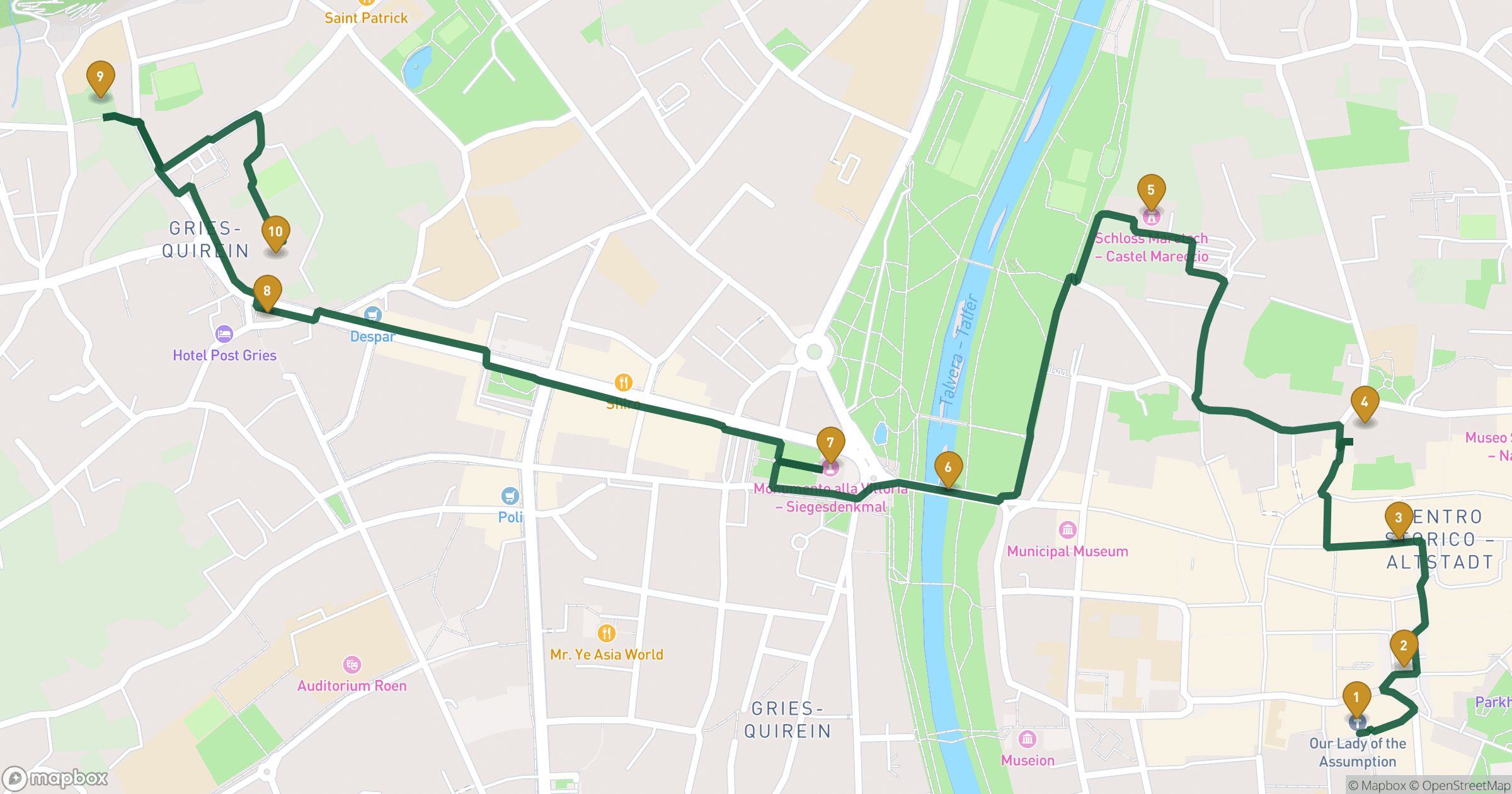
Route map for Bolzano walking tour

Map for Bolzano walking tour with 10 stops
The static map shows the tour route with Bolzano Cathedral, Waltherplatz, Lauben, Franciscan Friary, and 6 more stops.

Stops along the route

All stops on this self-guided tour at a glance.

  1. Bolzano Cathedral in Bolzano
    sailko / CC BY-SA 3.0

    1Bolzano CathedralChurch

    Bozen Cathedral is recognized by its mosaic-like roof and filigree Gothic sandstone tower, yet its history reaches much further back into antiquity. Archaeologists discovered remains of a 5th-century basilica and a 4th-century votive stone dedicated by Secundus Regontius and his son Severinus. In the baroque chapel behind the high altar, visitors can view a 12th-century statue of Our Lady of the Moss, linked to a legend of a cart driver who found it in a marsh.

    Style: Gothic architecture · Named after: Mary · Wikidata

  2. Waltherplatz in Bolzano
    User:Mattes / Public domain

    2WaltherplatzSquare

    Waltherplatz serves as the city's lively central square, dominated by an 1889 statue of minnesinger Walther von der Vogelweide carved from white Laas marble by Heinrich Natter. Originally a medieval vineyard at the city's edge, King Maximilian of Bavaria sold the property to the city in 1808 to serve as a drill ground. Under fascist rule, the monument was exiled to a remote park while the square was renamed Piazza Vittorio Emanuele.

    Named after: Walther von der Vogelweide · Wikidata

  3. Lauben in Bolzano
    Hubert Berberich (HubiB) / CC BY 2.5

    3LaubenSquare

    Laubengasse formed the commercial core of the old town starting in the 12th century under Emperor Barbarossa, characterized by parcels only six meters wide yet up to twenty meters deep. Traders were taxed on their street frontage, prompting this narrow layout, and merchants divided into northern Italian and southern German arcades. A devastating fire in 1224 claimed 150 lives, leading to the construction of the stone vaults seen today.

    Wikidata

  4. Franciscan Friary in Bolzano
    I, Sailko; sailko / CC BY-SA 3.0

    4Franciscan Friary

    The Franciscan Monastery of Bozen was founded in 1221, shortly after the first followers of Francis of Assisi crossed the Brenner Pass. Local legend recalls young Francis himself visiting on business with his cloth-merchant father, serving Mass in the chapel and ringing the bells. Its 14th-century Gothic cloister contains well-preserved frescoes, surviving both a destructive 1291 blaze and an allied bomb hit in 1944.

    Built: 1221 · Wikidata

  5. Maretsch Castle in Bolzano
    Frans-Banja Mulder / CC BY 3.0

    5Maretsch Castle

    Surrounded by Lagrein vineyards, Maretsch Castle features four prominent round towers added during its 16th-century conversion into a Renaissance residence by Teutonic Order knight Lukas Römer. Built originally in the 13th century by Heinrich von Maretsch, Römer adorned the interior with frescoes of biblical and mythological scenes to display his humanist culture. A curious, enigmatic Sator square remains preserved on one of the castle walls.

    Built: 1275 · Wikidata

  6. Talferbrücke in Bolzano
    Thomas Ledl / CC BY 4.0

    6TalferbrückeBridge

    The Talfer Bridge is a steel truss structure erected around 1900 under Mayor Julius Perathoner to unite the historic centre with the Gries district. Opening with celebrations on November 5, 1900, it replaced a fragile wooden crossing frequently threatened by river floods. Although the fascist regime drafted plans in the 1930s to replace it with a monumental Ponte Claudio, local citizens campaigned successfully in the 1970s to restore the bridge.

    Wikidata

  7. Bolzano Victory Monument in Bolzano
    Sailko / CC BY 3.0

    7Bolzano Victory Monument

    The Victory Monument is a 1928 rationalist triumphal arch designed by Marcello Piacentini to celebrate Italy's fascist claim over South Tyrol. Its fourteen columns are shaped as giant fasces, topped with a relief of the goddess of victory by Arturo Dazzi shooting an arrow northward. The eastern Latin inscription facing the old town controversially substituted the word ceteros for barbaros, and in 2014 a documentation centre opened below the arch.

    Built: 1928 · Architect: Marcello Piacentini · Style: rationalism · Wikidata

  8. Grieser Platz in Bolzano
    Berger / Public domain

    8Grieser PlatzPark

    Grieser Platz reveals the village atmosphere of Gries, which developed into an international spa town before being incorporated into Bozen in 1925. Once named in honour of Emperor Franz Joseph I, the square features the former Gries town hall designed by Sebastian Altmann. Nearby stands the old Goldenes Kreuz inn, where an electric tram once delivered arriving spa guests directly from the railway station.

    Wikidata

  9. Old Parish Church of Gries in Bolzano
    Vollmond11 / CC BY-SA 3.0

    9Old Parish Church of Gries

    The Old Gries Parish Church stands beside a historic cemetery at the foot of Guntschnaberg, having first been documented as ecclesia de Celle in 1165. Its interior houses a celebrated late-Gothic winged altarpiece by Michael Pacher depicting the Coronation of the Virgin. Regular earth burials ceased in the surrounding graveyard in 1922, preserving a quiet ensemble of old gravestones and wrought-iron crosses around the 1414 polygonal choir.

    Style: Gothic architecture · Named after: Mary · Wikidata

  10. Muri-Gries Abbey in Bolzano
    Berger / Public domain

    10Muri-Gries Abbey

    Muri-Gries Monastery originated as a 13th-century fortress erected by Meinhard II of Tyrol before the Habsburgs donated it to Augustinian canons in the 15th century. Its baroque church of St. Augustine was built between 1768 and 1770 by Antonio Giuseppe Sartori and decorated with frescoes by painter Martin Knoller. Swiss Benedictines took over the site in 1845, continuing a winemaking heritage that produces dark, full-bodied Lagrein wines.

    Wikidata

Download the app

This public page shows a preview. The full route, all content, and navigation are available in CityTour AI.

Cities nearby

Discover self-guided tours in nearby cities.

Frequently asked questions

The key answers before you start.

Is this a self-guided audio tour?

Yes. In the CityTour AI app (iOS and Android), this is a self-guided audio tour for Bolzano — start anytime, at your own pace, with map, stops, and audio narration.

What will you see on this tour?

On this tour you'll see, among others, Bolzano Cathedral, Waltherplatz, Lauben, Franciscan Friary, Maretsch Castle, Talferbrücke and more sights.

Where does the tour start?

The route starts at Bolzano Cathedral and ends at Muri-Gries Abbey. You can start anytime — the app guides you to the first stop.

How long does the tour take?

About 102 minutes for 10 stops — at your own pace, with breaks whenever you like.

How much does the tour cost?

This tour costs 15 credits. The exact price depends on the pack you buy and your country — roughly $5.

Is it an outdoor tour — are entry tickets included?

Yes, it's an outdoor tour: the sights are viewed from the outside. Entry tickets are not included, and step-free access cannot be guaranteed.

Is the audio guide available in my language?

The tour and audio guide are available in English, Deutsch, Français, Español, Italiano and 9 more languages. You pick your language in the app.

Can I use the tour offline?

Yes. Tours can be used offline.

Can I ask the AI questions along the way?

Yes. At every stop you can ask the AI directly if you want to know more or didn't understand something.