CityTour AI

Merano self-guided walking tour

Merano Time Travel: From Medieval Gates to Imperial Splendor

Discover the heart of Merano on a family-friendly tour that bridges the Middle Ages and the Imperial era. Explore fortified towers, stroll under magnificent Art Nouveau arcades, and uncover the secrets of Tyrol's longest arcade street. This varied experience brings history to life through exciting details and legends for all ages.

Audio tourSelf-guidediOS & Android
104minutes
3.3 kmdistance
13stops
Audio guideFormat
Merano Time Travel: From Medieval Gates to Imperial Splendor
Ymblanter / CC BY-SA 4.0

Stops on this route

This tour works well for first-time visitors, weekend trips, and travelers who want to explore Merano without a fixed tour time.

Route map for Merano walking tour
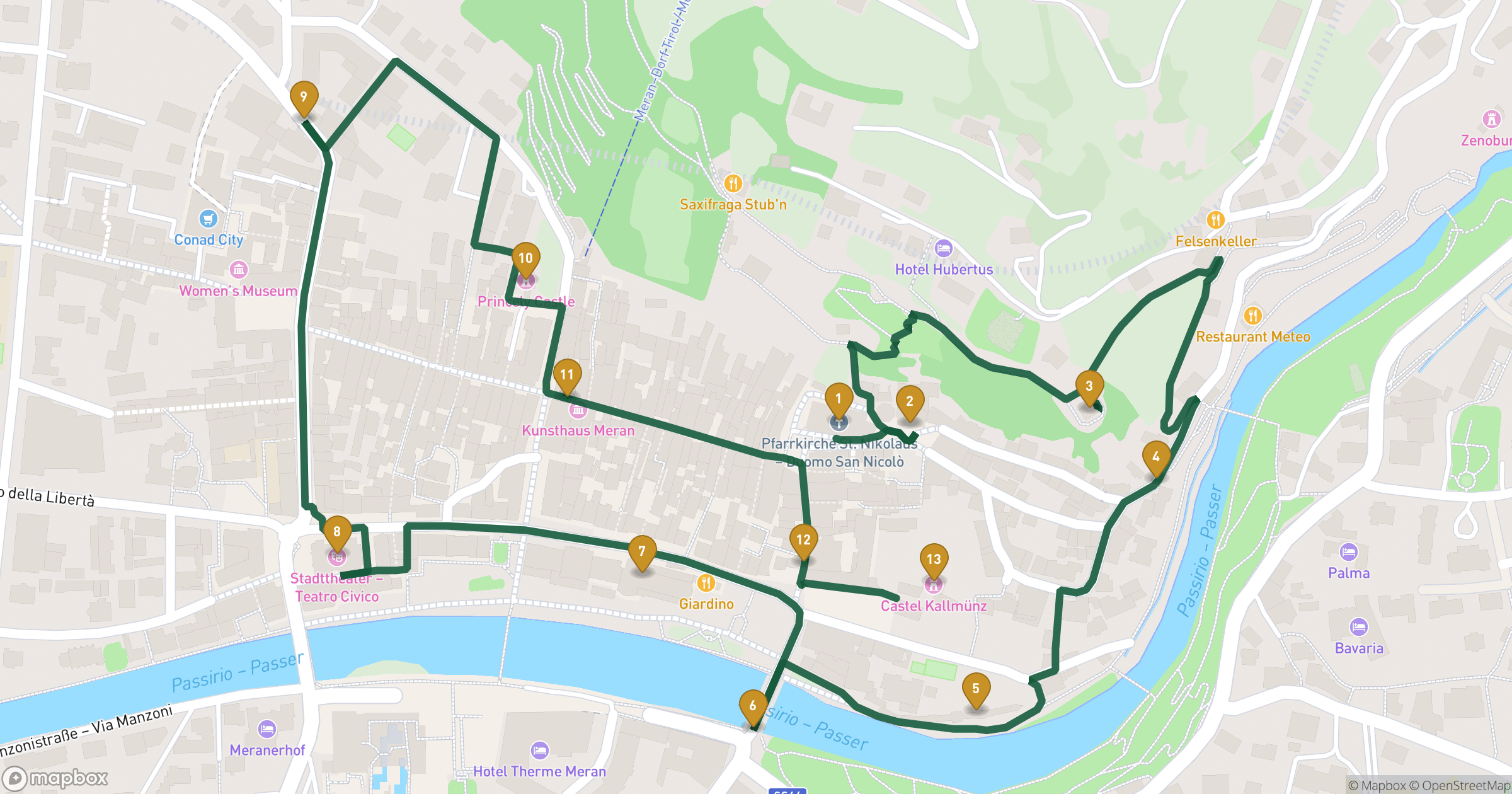
Map for Merano walking tour with 13 stops
The static map shows the tour route with Pfarrkirche St. Nikolaus - Duomo San Nicolò, Palais Mamming Museum, Pulverturm - Torre delle Polveri, Passeirer Tor, and 9 more stops.

Stops along the route

All stops on this self-guided tour at a glance.

  1. Pfarrkirche St. Nikolaus - Duomo San Nicolò in Merano
    User:Franco Visintainer / CC BY-SA 3.0

    1Pfarrkirche St. Nikolaus - Duomo San NicolòChurch

    St. Nicholas' Parish Church features an 83-meter tower and an exterior painted to protect travelers heading into the mountains. A giant fresco of Saint Christopher watches over passersby from the outer wall, once believed to ward off sudden death. Draconic stone gargoyles jut from the roof, alongside a southern cycle of Passion frescoes designed as a bible for the illiterate.

    Built: 1401 · Style: Gothic architecture · Named after: Saint Nicholas · Wikidata

  2. Palais Mamming Museum in Merano
    Ymblanter / CC BY-SA 4.0

    2Palais Mamming Museum

    Palais Mamming is a late-17th-century baroque residence built for local barons, now housing the municipal museum. Behind its stuccoed rooms lies an eclectic civic collection featuring an authentic Egyptian mummy and Napoleon Bonaparte's death mask. Curved window frames and pale facades reflect the aristocratic lifestyle of Merano as it began its transformation into a spa town.

    Wikidata

  3. Pulverturm - Torre delle Polveri in Merano
    Thesurvived99 / CC BY-SA 3.0

    3Pulverturm - Torre delle PolveriTower

    The Pulverturm sits high above the old town, preserving the 13th-century keep of former Ortenstein Castle. In the 17th century, the town stored gunpowder inside its 12-meter-tall walls, keeping the explosive material safely isolated from residential houses. Today, modern steel stairs lead up to a viewing platform overlooking the Adige Valley at the start of the Tappeiner Promenade.

    Wikidata

  4. Passeirer Tor in Merano
    ManfredK / CC BY-SA 3.0

    4Passeirer TorMonument

    The 14th-century Passeirer Tor guarded the northern entrance to Merano against traffic arriving from the Passeier Valley. Its narrow arch was built to allow only one wagon through at a time, forcing inbound merchants to halt and pay customs duties. Visible on the exterior wall are the Austrian shield and the coat of arms of Tyrol, marking historical territorial rule.

    Wikidata

  5. Wandelhalle in Merano
    Thomas Hummel / CC BY-SA 4.0

    5WandelhalleMonument

    The late-19th-century Wandelhalle offered promenade shelter along the Passer river so spa visitors could stroll in any weather. Covered walls display large open-air landscape paintings by local artists like Franz Lenhart, designed to inspire day trips across South Tyrol. Portrait busts of notable personalities and open colonnades preserve the leisurely atmosphere of the Belle Époque.

    Wikidata

  6. Ponte della Posta - Postbrücke in Merano
    ManfredK / CC BY-SA 3.0

    6Ponte della Posta - PostbrückeBridge

    The 1909 Postbrücke spans the Passer river, adorned with the gilded metalwork and ornate lanterns of the Art Nouveau movement. Named after the nearby former main post office, the crossing connected the medieval center with the villa district of Obermais. Its railings frame classic views of the Kurhaus set against the surrounding mountain ridges.

    Built: 1909 · Architect: Theodor Fischer · Wikidata

  7. Kurhaus in Merano
    böhringer friedrich / CC BY-SA 2.5

    7KurhausMonument

    The Kurhaus reflects Merano's golden spa era through a dual structure uniting an 1874 wing with a grand domed pavilion. The older section initially relied on 102 gas lamps before receiving electric lighting in 1897, while Friedrich Ohmann designed the newer Art Nouveau interior. Stone dancing maidens crown the roof, complemented inside by ceiling paintings celebrating the sun.

    Architect: Friedrich Ohmann · Style: Art Nouveau architecture · Wikidata

  8. Stadttheater Meran in Merano
    ManfredK / CC BY-SA 4.0

    8Stadttheater MeranTheatre

    The Stadttheater opened in 1900 with Goethe's Faust, presenting a showcase of Art Nouveau design by Munich architect Martin Dülfer. Late-night attendees once caught dedicated theater trams waiting outside to carry audience members as far as neighboring Lana. Named Teatro Puccini in the 1930s after the visiting composer, its auditorium gleams in red, gold, and salmon velvet.

    Architect: Martin Dülfer · Style: Art Nouveau architecture · Wikidata

  9. Vinschgauer Tor - Porta Venosta in Merano
    Gryffindor / CC BY-SA 3.0

    9Vinschgauer Tor - Porta VenostaMonument

    The Vinschgauer Tor is the oldest surviving town gate, first recorded in 1290 at the western edge of the historic quarter. During the 18th century, the structure served as a municipal debtors' prison under its pointed shingled roof. Twin portals separate pedestrian and vehicle traffic beneath a faded fresco displaying the arms of Austria and Tyrol.

    Wikidata

  10. Landesfürstliche Burg - Castello Principesco in Merano
    ManfredK / CC BY-SA 3.0

    10Landesfürstliche Burg - Castello PrincipescoCastle

    The Landesfürstliche Burg served as an urban residence built around 1470 by Duke Sigismund, known as the Wealthy. Interior wall paintings depict curiosities like bird-trapping wooden pliers, reflecting the duke's passion for hunting and courtly pleasures. The main entrance features a tiny manhole door that forced entrants through one by one under the watch of castle guards.

    Style: International Gothic · Wikidata

  11. Laubengasse in Merano
    Zairon / CC BY-SA 4.0

    11LaubengasseMonument

    The 400-meter Laubengasse forms the longest arcade street in Tyrol, commissioned by Count Meinhard II in the 13th century. Split between the mountain-facing northern arcades and the river-facing water arcades, the lane ran entirely without cross streets until 1913. Narrow passageways between varied archways lead into hidden courtyards filled with wooden balconies.

    Wikidata

  12. Bozner Tor in Merano
    Tilman2007 / CC BY-SA 4.0

    12Bozner TorCastle

    The 14th-century Bozner Tor stands three stories high with a steep saddle roof that once housed the town gatekeepers. Its stone facade displays the Habsburg double eagle alongside the chain of the Order of the Golden Fleece and the Merano city arms. Locals long called it the butchers' gate because municipal meat stalls operated directly outside its portal.

    Wikidata

  13. Castel Kallmünz in Merano
    Tilman2007 / CC BY-SA 4.0

    13Castel KallmünzCastle

    Schloss Kallmünz is a battlemented manor named after 15th-century mayor Andrä Kalmüntzer, an immigrant from the Upper Palatinate. In 1516, Emperor Maximilian I confirmed the family nobility and granted them a coat of arms depicting a sparrowhawk's talon. The residence assumed its present aristocratic appearance with an enclosed courtyard around 1631.

    Wikidata

Download the app

This public page shows a preview. The full route, all content, and navigation are available in CityTour AI.

Cities nearby

Discover self-guided tours in nearby cities.

Frequently asked questions

The key answers before you start.

Is this a self-guided audio tour?

Yes. In the CityTour AI app (iOS and Android), this is a self-guided audio tour for Merano — start anytime, at your own pace, with map, stops, and audio narration.

What will you see on this tour?

On this tour you'll see, among others, Pfarrkirche St. Nikolaus - Duomo San Nicolò, Palais Mamming Museum, Pulverturm - Torre delle Polveri, Passeirer Tor, Wandelhalle, Ponte della Posta - Postbrücke and more sights.

Where does the tour start?

The route starts at Pfarrkirche St. Nikolaus - Duomo San Nicolò and ends at Castel Kallmünz. You can start anytime — the app guides you to the first stop.

How long does the tour take?

About 104 minutes for 13 stops — at your own pace, with breaks whenever you like.

How much does the tour cost?

This tour costs 15 credits. The exact price depends on the pack you buy and your country — roughly $5.

Is it an outdoor tour — are entry tickets included?

Yes, it's an outdoor tour: the sights are viewed from the outside. Entry tickets are not included, and step-free access cannot be guaranteed.

Is the audio guide available in my language?

The tour and audio guide are available in English, Deutsch, Français, Español, Italiano and 9 more languages. You pick your language in the app.

Can I use the tour offline?

Yes. Tours can be used offline.

Can I ask the AI questions along the way?

Yes. At every stop you can ask the AI directly if you want to know more or didn't understand something.