CityTour AI

Florence self-guided walking tour

Florence on Foot: Power, Marble, and Masterpieces

Experience the heart of Tuscany on a relaxed walking tour from the magnificent Santa Maria Novella to the monumental Medici tombs. You will discover world-famous landmarks like the Duomo and Ponte Vecchio while learning about the curious stories and rivalries behind the grand facades. An authentic insight into the art, power, and daily life of the Renaissance metropolis.

Audio tourSelf-guidediOS & Android
103minutes
3.1 kmdistance
12stops
Audio guideFormat
Florence on Foot: Power, Marble, and Masterpieces
C1815 / CC0

Stops on this route

This tour works well for first-time visitors, weekend trips, and travelers who want to explore Florence without a fixed tour time.

Route map for Florence walking tour
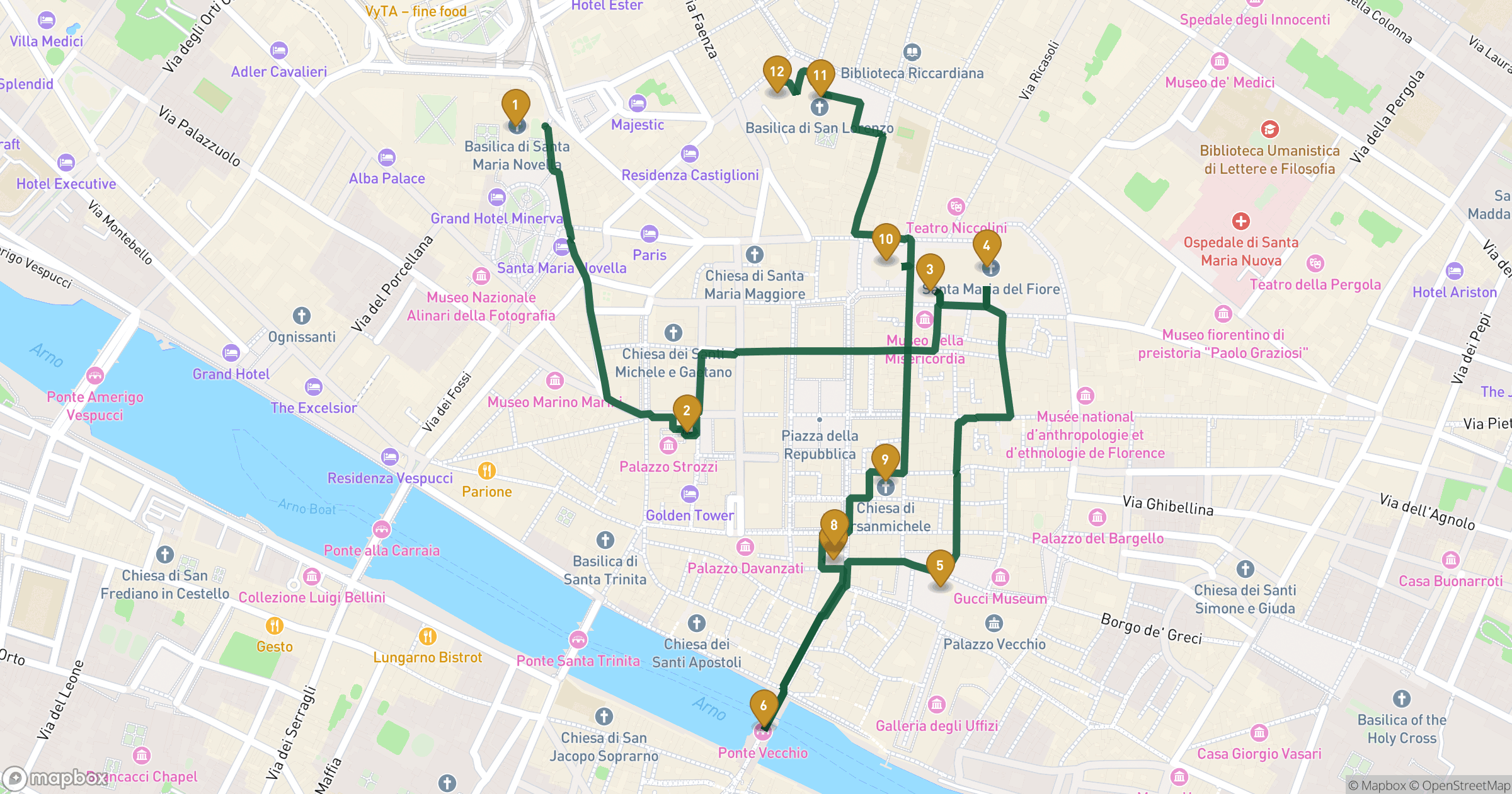
Map for Florence walking tour with 12 stops
The static map shows the tour route with Basilica di Santa Maria Novella, Palazzo Strozzi, Campanile di Giotto, Cattedrale di Santa Maria del Fiore, and 8 more stops.

Stops along the route

All stops on this self-guided tour at a glance.

  1. Basilica di Santa Maria Novella in Florence
    Commonists / CC BY-SA 4.0

    1Basilica di Santa Maria NovellaChurch

    Santa Maria Novella illustrates the shift from Gothic to Renaissance style through Leon Battista Alberti's geometric facade. Alberti solved the puzzle of unifying the older lower section by adding S-shaped volutes to conceal the aisle roofs. Inside, Masaccio's fresco of the Holy Trinity stunned contemporaries with its groundbreaking central perspective.

    Built: 1278 · Architect: Fra' Ristoro da Campi, Jacopo Passavanti … · Style: Renaissance architecture … · Named after: Mary · Wikidata

  2. Palazzo Strozzi in Florence
    Chabe01 / CC BY-SA 4.0

    2Palazzo Strozzi

    Palazzo Strozzi stands as a fortress of rivalry against the Medici family. Filippo Strozzi the Elder commissioned it in 1489, demolishing multiple buildings and consulting astrologers to find the ideal moment to lay the cornerstone. The rugged stone exterior contrasts sharply with an interior courtyard lined with delicate Corinthian columns.

    Architect: Benedetto da Maiano · Style: Renaissance architecture · Wikidata

  3. Campanile di Giotto in Florence
    Diego Delso / CC BY-SA 4.0

    3Campanile di GiottoTower

    Giotto's Campanile rises 84.7 meters above Florence as a celebration of human ingenuity. Begun by Giotto di Bondone in 1334, its exterior is clad in white Carrara, green Prato, and red Maremma marble. Lower reliefs sculpted by Andrea Pisano trace human trades and sciences, while Francesco Talenti finished the top with large windows in 1359.

    Built: 1298 · Architect: Arnolfo di Cambio, Giotto · Style: Gothic architecture · Height: 84.7 m · Wikidata

  4. Cattedrale di Santa Maria del Fiore in Florence
    Petar Milošević / CC BY-SA 4.0

    4Cattedrale di Santa Maria del FioreChurch

    Santa Maria del Fiore tells the story of Brunelleschi's audacious solution to crown the cathedral. Filippo Brunelleschi erected the colossal dome without timber scaffolding by employing a self-supporting herringbone brick pattern. Atop the lantern sits a gilded copper sphere designed by Verrocchio, whose installation captivated the young Leonardo da Vinci.

    Built: 1296 · Architect: Francesco Talenti, Arnolfo di Cambio … · Style: Italian Gothic architecture … · Height: 114.5 m · Wikidata

  5. Piazza della Signoria in Florence
    Samuli Lintula / CC BY 2.5

    5Piazza della SignoriaSquare

    Piazza della Signoria has served as the political heartbeat of Florence since the 14th century. Inside the Loggia dei Lanzi, Benvenuto Cellini melted down over 200 tin plates from his own dinner table to save his bronze cast of Perseus. Nearby stands Bartolomeo Ammannati's Neptune Fountain, originally mocked by locals under the nickname Il Biancone.

    Named after: Signoria of Florence · Wikidata

  6. Ponte Vecchio in Florence
    Commonists / CC BY-SA 4.0

    6Ponte VecchioBridge

    Ponte Vecchio survived the destructions of World War II and carries the secret corridor of the ruling dynasty. Grand Duke Ferdinand I banished butchers and tanners in 1593 to spare the Medici family the stench during their walks above the shops. Giorgio Vasari was forced to route his corridor around the Torre dei Mannelli after the owners refused demolition.

    Built: 1335 · Architect: Neri di Fioravante · Heritage status: World Heritage Site · Wikidata

  7. Fontana del Porcellino in Florence
    Sailko / CC BY 3.0

    7Fontana del PorcellinoMonument

    Fontana del Porcellino features a bronze wild boar linked to a famed local superstition. Pietro Tacca cast the piece in 1633 based on an ancient marble work, intending it for the Boboli Gardens before it was installed here to provide water for market merchants. Tacca decorated the bronze base with detailed natural elements, including small frogs and turtles.

    Built: 1633 · Wikidata

  8. Loggia del Mercato Nuovo in Florence
    Gunnar Klack / CC BY-SA 4.0

    8Loggia del Mercato NuovoMarket

    The Loggia del Mercato Nuovo reveals the harsh realities of Renaissance trade beneath its airy arches. Built in the mid-16th century by Giovanni Battista del Tasso, the open hall originally hosted silk merchants before becoming a straw hat market. In the center lies the Pietra dello Scandalo, a marble disc where bankrupt merchants were forced to sit exposed.

    Built: 1551 · Architect: Giovanni Battista del Tasso · Style: Renaissance architecture · Wikidata

  9. Chiesa di Orsanmichele in Florence
    Guido Castelli66 / CC BY-SA 4.0

    9Chiesa di OrsanmicheleChurch

    Orsanmichele embodies an unusual transformation from a municipal granary into a guild church. Built in 1337 with open ground-floor trading arcades, its exterior arches were later walled up to house 14 niches funded by rival trade guilds. Inside rests Andrea Orcagna's ornate 1359 tabernacle, crafted from marble and colored glass to shelter a miraculous image of Mary.

    Built: 1337 · Architect: http://www.wikidata.org/.well-known/genid/b83ea8b09c6877e73760258b7883a569, http://www.wikidata.org/.well-known/genid/8797c0a8c11b42f2c867073dc17f1704 … · Style: Gothic architecture · Named after: Michael · Wikidata

  10. Battistero di San Giovanni in Florence
    Zairon / CC BY 4.0

    10Battistero di San GiovanniChurch

    The Baptistery of San Giovanni stands on Roman foundations as a central site of Florentine civic life. Lorenzo Ghiberti spent 27 years crafting the ten gilded panels of the east doors, earning praise from Michelangelo as the Gates of Paradise. Among the sculpted border figures framing these biblical scenes, Ghiberti included a bald self-portrait.

    Built: 1059 · Style: Romanesque architecture · Named after: John the Baptist · Wikidata

  11. Basilica di San Lorenzo in Florence
    Nelson Pérez / CC BY-SA 3.0

    11Basilica di San LorenzoChurch

    The Basilica of San Lorenzo served as the private parish church of the Medici family. Its rough brick facade remains unfinished because Pope Leo X halted Michelangelo's marble facade project in 1520 following years of stone selection in Carrara. Inside Brunelleschi's harmonious nave, Donatello's two final bronze pulpits flank the path toward Cosimo de' Medici's tomb.

    Built: 1421 · Architect: Filippo Brunelleschi · Style: Renaissance architecture · Named after: Lawrence of Rome · Wikidata

  12. Cappelle Medicee in Florence
    No machine-readable author provided. Richardfabi~commonswiki assumed (based on copyright claims). / Public domain

    12Cappelle MediceeMuseum

    The Medici Chapels form a dynastic mausoleum showcasing supreme artistic mastery. The lavish Prince's Chapel features walls coated in semi-precious stone inlays produced by the specially founded Opificio delle Pietre Dure. In the New Sacristy, Michelangelo carved tombs for Lorenzo and Giuliano de' Medici, framed by allegorical figures of Day, Night, Dawn, and Dusk.

    Built: 1869 · Architect: Michelangelo · Named after: House of Medici · Wikidata

Download the app

This public page shows a preview. The full route, all content, and navigation are available in CityTour AI.

Cities nearby

Discover self-guided tours in nearby cities.

Frequently asked questions

The key answers before you start.

Is this a self-guided audio tour?

Yes. In the CityTour AI app (iOS and Android), this is a self-guided audio tour for Florence — start anytime, at your own pace, with map, stops, and audio narration.

What will you see on this tour?

On this tour you'll see, among others, Basilica di Santa Maria Novella, Palazzo Strozzi, Campanile di Giotto, Cattedrale di Santa Maria del Fiore, Piazza della Signoria, Ponte Vecchio and more sights.

Where does the tour start?

The route starts at Basilica di Santa Maria Novella and ends at Cappelle Medicee. You can start anytime — the app guides you to the first stop.

How long does the tour take?

About 103 minutes for 12 stops — at your own pace, with breaks whenever you like.

How much does the tour cost?

This tour costs 15 credits. The exact price depends on the pack you buy and your country — roughly $5.

Is it an outdoor tour — are entry tickets included?

Yes, it's an outdoor tour: the sights are viewed from the outside. Entry tickets are not included, and step-free access cannot be guaranteed.

Is the audio guide available in my language?

The tour and audio guide are available in English, Deutsch, Français, Español, Italiano and 9 more languages. You pick your language in the app.

Can I use the tour offline?

Yes. Tours can be used offline.

Can I ask the AI questions along the way?

Yes. At every stop you can ask the AI directly if you want to know more or didn't understand something.