CityTour AI

San Gimignano self-guided walking tour

Towers, Turmoil, and Tuscan Wine

Step into the 'Manhattan of the Middle Ages' on a walk that balances breathtaking architecture with the gritty reality of medieval life. You will navigate the narrow alleys where powerful families waged vertical warfare, discover the secrets of the city’s ancient water systems, and learn why the local wine was worth writing poetry about. It is a journey through a skyline built on ego, saffron, and a surprising amount of neighborly spite.

Audio tourSelf-guidediOS & Android
105minutes
2.0 kmdistance
15stops
Audio guideFormat
Towers, Turmoil, and Tuscan Wine
gaspa; Flickr / CC BY-SA 2.0

Stops on this route

This tour works well for first-time visitors, weekend trips, and travelers who want to explore San Gimignano without a fixed tour time.

Route map for San Gimignano walking tour
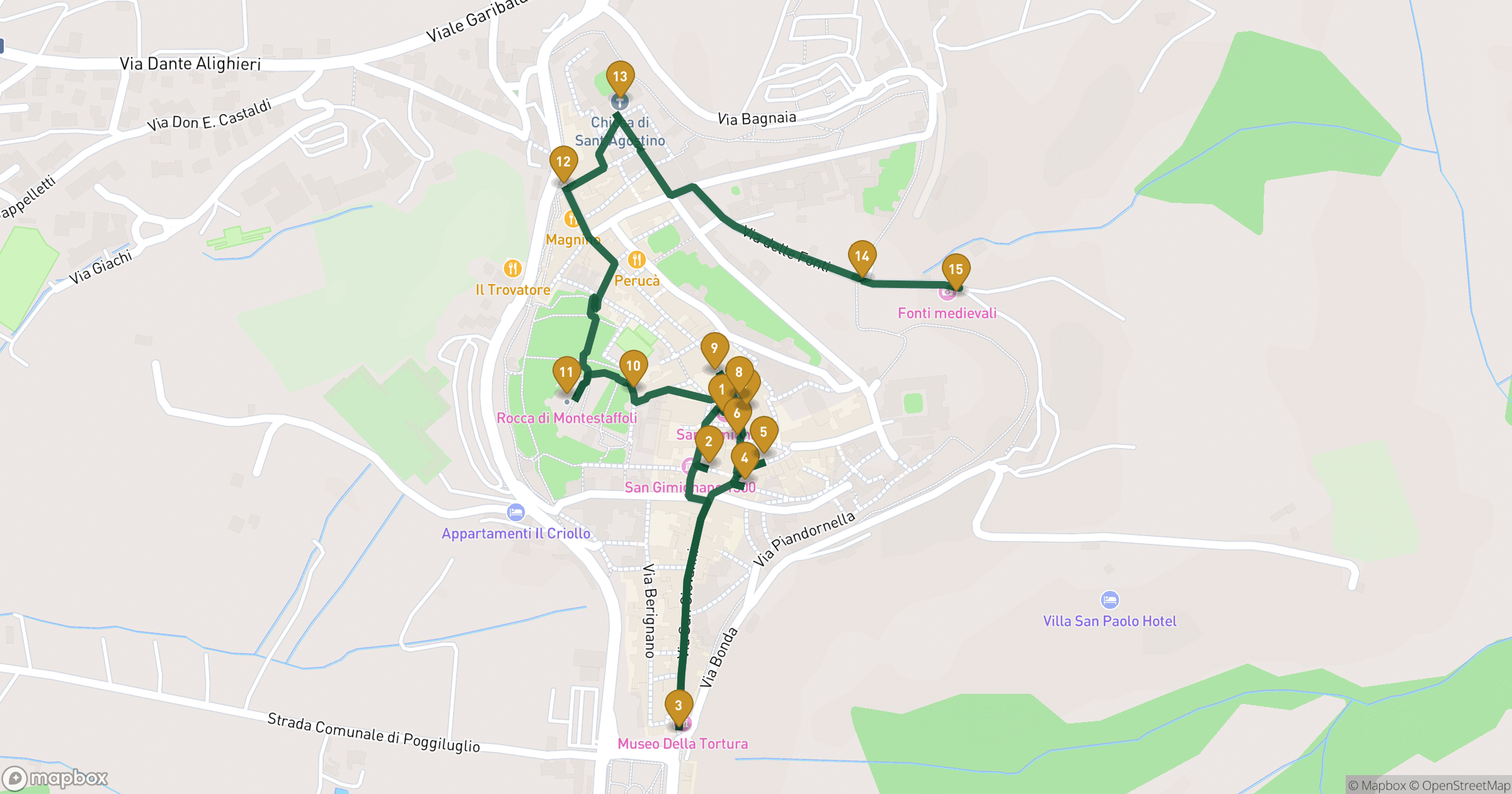
Map for San Gimignano walking tour with 15 stops
The static map shows the tour route with piazza del Duomo, Palazzo Comunale, Pinacoteca, Torre Grossa, Porta San Giovanni, Torre dei Becci, and 11 more stops.

Stops along the route

All stops on this self-guided tour at a glance.

  1. piazza del Duomo in San Gimignano
    Holger Uwe Schmitt / CC BY-SA 4.0

    1piazza del DuomoSquare

    Piazza del Duomo stands as the civic and religious center of San Gimignano, framed by rivalries and grand architecture. In May 1300, Dante Alighieri stood before these buildings to deliver an ignored diplomatic speech for the Guelph league. Adjacent lies the Piazza delle Erbe, flanked by the twin Salvucci towers erected in deliberate defiance of local building codes.

    Named after: Collegiate Church of San Gimignano · Wikidata

  2. Palazzo Comunale, Pinacoteca, Torre Grossa in San Gimignano
    Jordiferrer / CC BY-SA 4.0

    2Palazzo Comunale, Pinacoteca, Torre GrossaMuseum

    The Palazzo Comunale and Torre Grossa embody municipal authority, housing the Podestà from 1288 onward. Completed in 1311, the 54-meter tower was legally designated as the tallest structure in the city, barring any private citizen from exceeding its height. Inside the complex, visitors find the Sala di Dante alongside works by Lippo Memmi and Benozzo Gozzoli.

    Wikidata

  3. Porta San Giovanni in San Gimignano
    MarkusMark / Public domain

    3Porta San GiovanniCastle

    Porta San Giovanni was built in 1262 as the grand southern entrance along the crucial Via Francigena pilgrimage route. The gateway displays a slightly pointed Sienese arch topped by a small guardroom where sentries monitored all incoming travelers. Pointing south toward rival Siena, it served as the frontline defense against military assaults from Volterra.

    Wikidata

  4. Torre dei Becci in San Gimignano
    gaspa; Flickr / CC BY 2.0

    4Torre dei BecciTower

    Torre dei Becci exemplifies a fortified 13th-century merchant residence designed to withstand intense urban violence. To minimize fire danger and isolate unwanted intruders, the kitchen was situated at the very top, while external ladders could be withdrawn entirely. The tower sits directly beside the ancient Arco dei Becci, allowing the family to watch traffic entering the central squares.

    Wikidata

  5. Piazza della Cisterna in San Gimignano
    Fiat 500e / CC BY 4.0

    5Piazza della CisternaSquare

    Piazza della Cisterna served as both an essential municipal hub and the bustling center of local medieval trade. In 1287, the travertine well at its center was completed under Podestà Guccio dei Malavolti, whose ladder coat of arms remains carved into the stone. The triangular space features a distinctive herringbone brick pavement surrounded by noble palaces and towers.

    Wikidata

  6. Torri degli Ardinghelli in San Gimignano
    Ingo Mehling / CC BY-SA 4.0

    6Torri degli ArdinghelliTower

    The Torri degli Ardinghelli served as the fortified base of the city's leading Guelph family during their feud with the Ghibelline Salvucci. After being built higher than the municipal Torre Rognosa in violation of local law, the twin towers were forcibly cut down to their present height. This relentless factional fighting contributed directly to the city surrendering to Florence after the 1348 plague.

    Wikidata

  7. Torre Rognosa in San Gimignano
    Luca Aless / CC BY-SA 4.0

    7Torre RognosaMonument

    Rising 51 meters above the Palazzo del Podestà, Torre Rognosa long served as the absolute legal height ceiling for private towers. Constructed in the 13th century for the Gregori family and later transferred to the Oti, the tower eventually functioned as the municipal prison. Its stern stone facade features narrow openings, remaining well-preserved beneath the neighboring Torre Grossa.

    Wikidata

  8. Torre Chigi in San Gimignano
    I, Sailko; sailko; Self-photographed / CC BY 2.5

    8Torre ChigiTower

    Built in 1280 for the Useppi family, Torre Chigi is an elegant fortress tower designed with heightened defenses. The original builders included no ground-floor door, relying instead on a first-floor portal reached only by a retractable wooden ladder. Rows of stone putlog holes, originally made for scaffolding, were cleverly reused to anchor external timber balconies above the street.

    Wikidata

  9. Torri dei Salvucci in San Gimignano
    Luca Aless / CC BY-SA 4.0

    9Torri dei SalvucciTower

    The Torri dei Salvucci were erected by the city’s leading Ghibelline clan as an overt visual challenge to their Guelph rivals, the Ardinghelli. To bypass height caps on single residences, the family constructed two adjacent towers that would easily exceed the limit if stacked together. City authorities eventually compelled them to behead the towers, though both still overlook Piazza delle Erbe.

    Wikidata

  10. Museo del Vino Vernaccia di San Gimignano in San Gimignano
    Jordiferrer / CC BY-SA 4.0

    10Museo del Vino Vernaccia di San GimignanoMuseum

    The Museo della Vernaccia inside Villa della Rocca honors Italy's first DOC-designated wine, awarded in 1966. Mentioned by Dante in the Divine Comedy regarding Pope Martin IV, the white wine thrives on the area's distinct sandstone soils. Opened in 2003, the museum details seven centuries of local viticulture and the unique geology shaping this savory vintage.

    Wikidata

  11. Rocca di Montestaffoli in San Gimignano
    sailko / CC BY 2.5

    11Rocca di MontestaffoliAttraction

    Rocca di Montestaffoli was constructed by Florence in 1353 to control the town following its voluntary surrender. Built on the hill's summit after the Black Death and clan wars crippled the city, the pentagonal fortress was largely dismantled in the 1500s by Cosimo I de' Medici. Today, visitors can walk the remaining perimeter walls and single tower for panoramic views of the stone skyline.

    Built: 1353 · Wikidata

  12. Porta San Matteo in San Gimignano
    MarkusMark / Public domain

    12Porta San MatteoCastle

    Porta San Matteo was completed in the 13th century as the northern checkpoint of the secondary defensive wall. Designed to monitor traffic along the Via Francigena, it features a double arch and battlements built to stop armies marching from Pisa and Lucca. The city generated substantial revenues at this threshold by taxing shipments of locally produced saffron and textiles.

  13. Chiesa di Sant'Agostino in San Gimignano
    René Hourdry / CC BY-SA 4.0

    13Chiesa di Sant'AgostinoChurch

    The Chiesa di Sant'Agostino houses celebrated 15th-century religious art within a cavernous 1298 brick sanctuary. Between 1464 and 1465, Florence plague refugee Benozzo Gozzoli painted a seventeen-panel fresco cycle depicting the life of Saint Augustine across the choir. The interior also features the Cappella di San Bartolo, where a marble altar honors a local priest who tended to lepers.

    Built: 1280 · Style: Romanesque architecture · Named after: Augustine of Hippo · Wikidata

  14. Porta delle Fonti in San Gimignano
    gaspa; Flickr / CC BY 2.0

    14Porta delle FontiCastle

    Porta delle Fonti connected the elevated city to the public water basins situated at the base of the hill. In 1930, workers demolished a 1501 chapel from the inner gate wall, detaching a fresco by the circle of Lippo Memmi to display in the civic museum. The structure retains its signature Sienese arch alongside an upper row of stone brackets built to support defenses.

    Wikidata

  15. Fonti medievali in San Gimignano
    gaspa; Flickr / CC BY-SA 2.0

    15Fonti medievaliAttraction

    Fonti medievali is a public spring water complex recessed into a steep limestone slope outside the city walls. The structure features ten stone spans, combining six 12th-century Romanesque arches with four larger 14th-century Gothic arches. Municipal statutes strictly partitioned the flow: the clean initial basin for drinking, the spillover for pack animals, and the lowest basins for leather tanning.

Download the app

This public page shows a preview. The full route, all content, and navigation are available in CityTour AI.

Cities nearby

Discover self-guided tours in nearby cities.

Frequently asked questions

The key answers before you start.

Is this a self-guided audio tour?

Yes. In the CityTour AI app (iOS and Android), this is a self-guided audio tour for San Gimignano — start anytime, at your own pace, with map, stops, and audio narration.

What will you see on this tour?

On this tour you'll see, among others, piazza del Duomo, Palazzo Comunale, Pinacoteca, Torre Grossa, Porta San Giovanni, Torre dei Becci, Piazza della Cisterna, Torri degli Ardinghelli and more sights.

Where does the tour start?

The route starts at piazza del Duomo and ends at Fonti medievali. You can start anytime — the app guides you to the first stop.

How long does the tour take?

About 105 minutes for 15 stops — at your own pace, with breaks whenever you like.

How much does the tour cost?

This tour costs 15 credits. The exact price depends on the pack you buy and your country — roughly $5.

Is it an outdoor tour — are entry tickets included?

Yes, it's an outdoor tour: the sights are viewed from the outside. Entry tickets are not included, and step-free access cannot be guaranteed.

Is the audio guide available in my language?

The tour and audio guide are available in English, Deutsch, Français, Español, Italiano and 9 more languages. You pick your language in the app.

Can I use the tour offline?

Yes. Tours can be used offline.

Can I ask the AI questions along the way?

Yes. At every stop you can ask the AI directly if you want to know more or didn't understand something.