CityTour AI

Venice self-guided walking tour

Venice's Splendor and Hidden Paths

Join us for an atmospheric stroll through the heart of the Serenissima, from the bustling Rialto Bridge to the quiet art treasures of the Frari Church. We explore symbols of Venetian power and merchant wealth while discovering hidden architectural gems in the winding alleys. This tour combines iconic postcard views with fascinating stories hidden behind grand facades and in secret courtyards.

Audio tourSelf-guidediOS & Android
103minutes
4.0 kmdistance
10stops
Audio guideFormat
Venice's Splendor and Hidden Paths
Didier Descouens / CC BY-SA 4.0

Stops on this route

This tour works well for first-time visitors, weekend trips, and travelers who want to explore Venice without a fixed tour time.

Route map for Venice walking tour
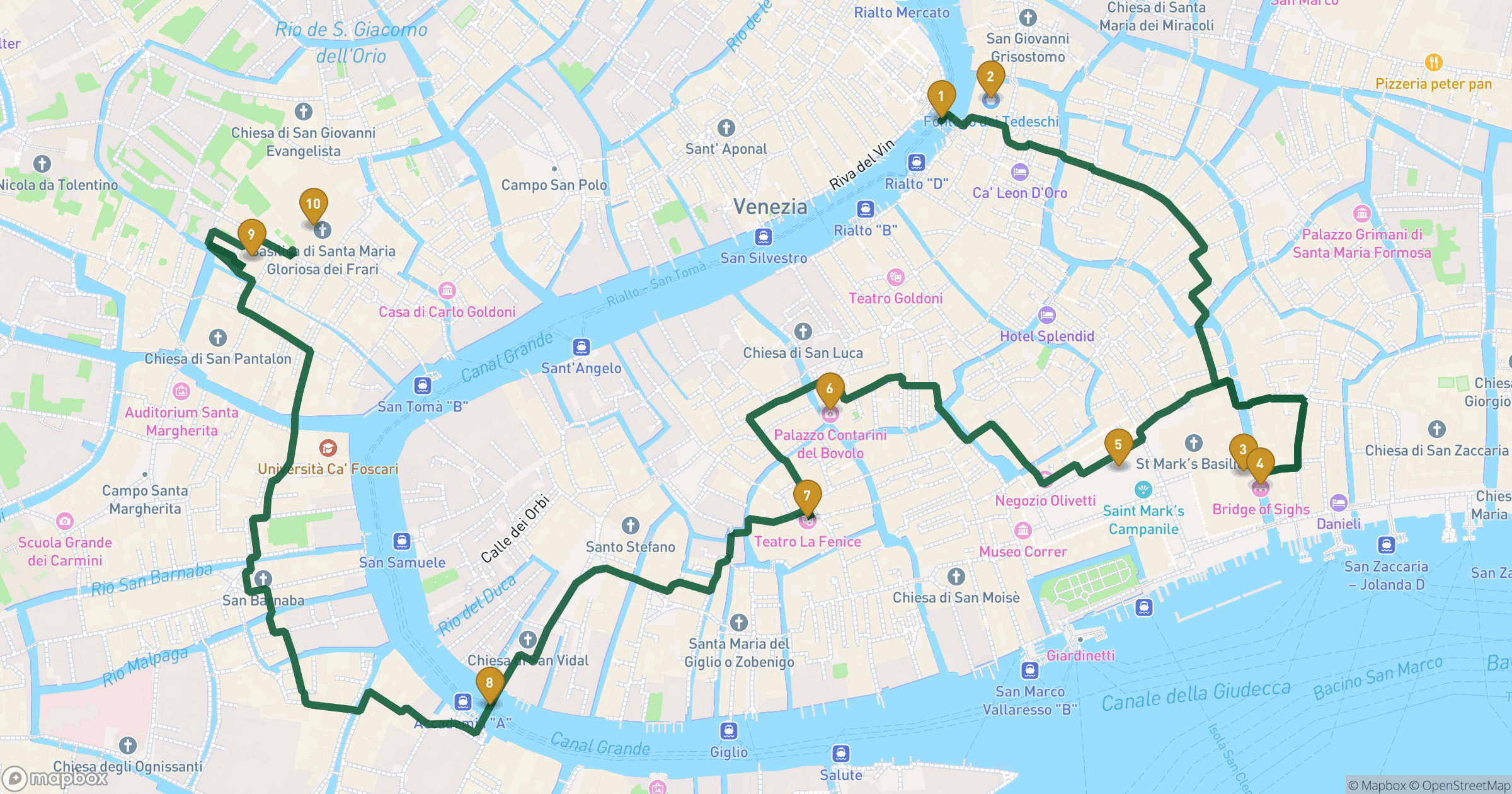
Map for Venice walking tour with 10 stops
The static map shows the tour route with Rialto Bridge, Fondaco dei Tedeschi, Doge's Palace, Bridge of Sighs, and 6 more stops.

Stops along the route

All stops on this self-guided tour at a glance.

  1. Rialto Bridge in Venice
    kallerna / CC BY-SA 4.0

    1Rialto Bridge

    The Rialto Bridge represents a bold engineering gamble that defied the era's leading architects. In 1551, the city bypassed Michelangelo and Palladio to award the stone bridge project to the 75-year-old Antonio da Ponte. Over 12,000 oak piles hold up the single 28-meter arch of Istrian stone, which has stood firm since 1591.

    Built: 1588 · Architect: Antonio da Ponte · Height: 6.7 m · Named after: Rialto · Wikidata

  2. Fondaco dei Tedeschi in Venice
    Freddo213 / CC BY-SA 4.0

    2Fondaco dei TedeschiBuilding

    The Fontego dei Tedeschi functioned as the strictly controlled headquarters of German merchants in Venice from 1228 onward. Venetian authorities forced the traders to spend their nights locked inside and conduct all deals under local supervision. Rebuilt after a fire in 1505, the building originally featured canal-facing frescoes by Giorgione and a young Titian.

    Built: 1228 · Style: Renaissance architecture · Wikidata

  3. Doge's Palace in Venice
    Didier Descouens / CC BY-SA 4.0

    3Doge's PalaceCastle

    The Doge's Palace served as the formidable center of Venetian justice, governance, and residence from around 1340. In 1755, Giacomo Casanova was imprisoned under the roof in the sweltering lead chambers for magic and free-thinking before executing a daring rooftop escape. In the first-floor loggia, two reddish columns recall the traditional spot where death sentences were read.

    Built: 1340 · Architect: Nicolò Barattieri, Antonio Rizzo · Style: Gothic architecture · Named after: Doge of Venice · Wikidata

  4. Bridge of Sighs in Venice
    Didier Descouens / CC BY-SA 4.0

    4Bridge of Sighs

    The Bridge of Sighs was designed by Antonio Contin in 1614 to connect interrogation rooms directly to the New Prison. Built from white Istrian stone, it features an enclosed double passage engineered so arriving and departing prisoners could never cross paths. Its evocative name owes its fame to nineteenth-century poet Lord Byron rather than the era of the Doges.

    Built: 1614 · Architect: Antonio Contin · Named after: sigh · Wikidata

  5. Piazza San Marco in Venice
    Matthias Süßen / CC BY-SA 4.0

    5Piazza San MarcoSquare

    St. Mark's Square preserves tales of pious theft and architectural disaster at the political heart of Venice. The basilica was raised to house the relics of Saint Mark, smuggled from Alexandria in 828 under pork to elude Muslim guards. Facing the portals stands the nearly 99-meter bell tower, an exact replica built after the original collapsed unexpectedly in 1902.

    Built: 900 · Style: Venetian Renaissance architecture … · Named after: St Mark's Basilica · Wikidata

  6. Palazzo Contarini del Bovolo in Venice
    Didier Descouens / CC BY-SA 4.0

    6Palazzo Contarini del BovoloAttraction

    Palazzo Contarini del Bovolo hides an extraordinary spiral staircase commissioned at the end of the fifteenth century. Architect Giovanni Candi joined this striking blend of Gothic and Renaissance styles to the palace, which features more than 80 steps ascending through open arcades. Pietro Contarini reputedly commissioned it to flaunt the prominence of his ducal dynasty.

    Style: Gothic art · Wikidata

  7. Teatro La Fenice in Venice
    Didier Descouens / CC BY-SA 4.0

    7Teatro La FeniceTheatre

    Teatro La Fenice rose from the ashes of theatrical rivalry following a 1774 fire and bitter legal dispute with the patrician Venier family. Designed by Gian Antonio Selva, the neoclassical opera house opened in 1792 with a name intentionally evoking Masonic rebirth. Giuseppe Verdi suffered a legendary flop here in 1853, when the audience mocked the premiere of La traviata.

    Built: 1792 · Architect: Tommaso Meduna, Giovanni Battista Meduna … · Style: Italian theater · Named after: phoenix · Wikidata

  8. Ponte dell'Accademia in Venice
    kallerna / CC BY-SA 4.0

    8Ponte dell'AccademiaBridge

    Ponte dell’Accademia is the only wooden crossing over the Grand Canal, renowned for framing views of Santa Maria della Salute. Engineer Eugenio Miozzi designed the timber structure in 1933, completing it in a record 37 days as an emergency replacement for an unpopular Austrian iron bridge. Although planned as a stopgap, the design remained until being entirely rebuilt in the 1980s.

    Named after: Gallerie dell'Accademia · Wikidata

  9. Scuola Grande di San Rocco in Venice
    Didier Descouens / CC BY-SA 4.0

    9Scuola Grande di San RoccoMuseum

    The Scuola Grande di San Rocco displays an immense decorative program secured through brazen artistic cunning. During a 1564 ceiling competition, Tintoretto bypassed the requirement for mere sketches by secretly mounting a finished painting overnight. Because brotherhood rules forbade rejecting gifts, he won the commission and spent the next 24 years painting over 50 canvases.

    Built: 1517 · Architect: Pietro Bon · Style: Renaissance architecture · Wikidata

  10. Santa Maria Gloriosa dei Frari in Venice
    Didier Descouens / CC BY-SA 4.0

    10Santa Maria Gloriosa dei FrariChurch

    The Basilica of Santa Maria Gloriosa dei Frari reveals how humble Franciscan brickwork conceals staggering artistic milestones. Titian’s revolutionary 1518 Altarpiece shocked friars with its bright dynamic color, and the master was later buried here as the sole plague victim granted city interment in 1576. Nearby, a white marble pyramid holds only the heart of sculptor Antonio Canova.

    Built: 1250 · Style: Gothic architecture · Named after: Assumption of Mary · Wikidata

Download the app

This public page shows a preview. The full route, all content, and navigation are available in CityTour AI.

Cities nearby

Discover self-guided tours in nearby cities.

Frequently asked questions

The key answers before you start.

Is this a self-guided audio tour?

Yes. In the CityTour AI app (iOS and Android), this is a self-guided audio tour for Venice — start anytime, at your own pace, with map, stops, and audio narration.

What will you see on this tour?

On this tour you'll see, among others, Rialto Bridge, Fondaco dei Tedeschi, Doge's Palace, Bridge of Sighs, Piazza San Marco, Palazzo Contarini del Bovolo and more sights.

Where does the tour start?

The route starts at Rialto Bridge and ends at Santa Maria Gloriosa dei Frari. You can start anytime — the app guides you to the first stop.

How long does the tour take?

About 103 minutes for 10 stops — at your own pace, with breaks whenever you like.

How much does the tour cost?

This tour costs 15 credits. The exact price depends on the pack you buy and your country — roughly $5.

Is it an outdoor tour — are entry tickets included?

Yes, it's an outdoor tour: the sights are viewed from the outside. Entry tickets are not included, and step-free access cannot be guaranteed.

Is the audio guide available in my language?

The tour and audio guide are available in English, Deutsch, Français, Español, Italiano and 9 more languages. You pick your language in the app.

Can I use the tour offline?

Yes. Tours can be used offline.

Can I ask the AI questions along the way?

Yes. At every stop you can ask the AI directly if you want to know more or didn't understand something.