CityTour AI

Rotterdam self-guided walking tour

Rotterdam's Boldness: From Ruins to Architectural Icons

Experience the architectural reinvention of a city that bravely embraced modernity after the destruction of WWII. On this walk, discover the contrast between the historic Witte Huis and futuristic icons like the Markthal or the mirrored Depot. Immerse yourself in the maritime heart and the irrepressible spirit of innovation in 'Manhattan on the Maas'.

Audio tourSelf-guidediOS & Android
193minutes
7.9 kmdistance
19stops
Audio guideFormat
Rotterdam's Boldness: From Ruins to Architectural Icons
Art Anderson / CC BY-SA 3.0

Stops on this route

This tour works well for first-time visitors, weekend trips, and travelers who want to explore Rotterdam without a fixed tour time.

Route map for Rotterdam walking tour
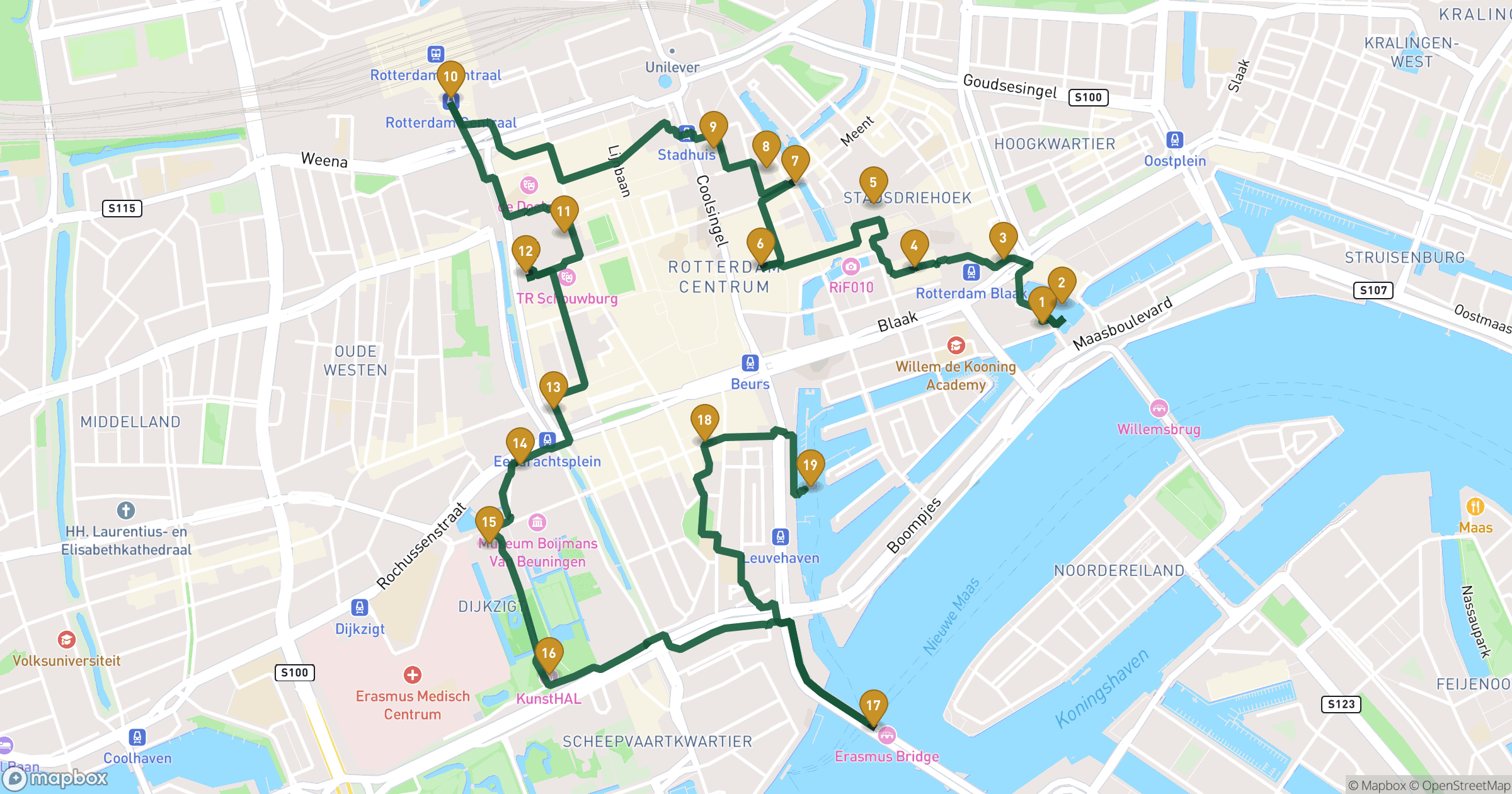
Map for Rotterdam walking tour with 19 stops
The static map shows the tour route with Witte Huis, Oude Haven, Blaakse Bos, Markthal Rotterdam, and 15 more stops.

Stops along the route

All stops on this self-guided tour at a glance.

  1. Witte Huis in Rotterdam
    F.Eveleens / CC BY 3.0

    1Witte Huis

    Europe’s first high-rise, the Witte Huis, survived the devastating bombing of May 1940 against all odds. Architect Willem Molenbroek had more than 1,000 piles driven into Rotterdam's soft marshy ground to support the 43-meter, eleven-story structure completed in 1898. Scars from shell impacts remain deliberately preserved as a memorial on its white glazed-brick facade.

    Built: 1897 · Architect: Willem Molenbroek · Style: eclectic architecture … · Wikidata

  2. Oude Haven in Rotterdam
    GraphyArchy / CC BY-SA 4.0

    2Oude HavenWater

    The Oude Haven is the city's oldest harbor basin, dating back to the 14th century. Historic sailing ships and old barges rock gently in the water, with many maintained by enthusiasts for the nearby Maritime Museum. Terraces line the quay right beside wooden hulls and old masts, set directly against the futuristic skyline.

    Wikidata

  3. Blaakse Bos in Rotterdam
    Jan Geerling / CC BY-SA 4.0

    3Blaakse Bos

    Piet Blom designed the Blaakse Bos in the 1970s as a village of trees where private life takes place high up in tilted cubes. Thirty-eight yellow residential cubes stand on concrete pillars and are rotated by 45 degrees, forcing occupants to order custom-made furniture for the sloping walls. Right next to them rises the pointed Blaaktoren tower, nicknamed the Pencil.

    Built: 1978 · Architect: Piet Blom · Wikidata

  4. Markthal Rotterdam in Rotterdam
    Exmpletree / CC BY-SA 3.0

    4Markthal Rotterdam

    Designed by MVRDV like a giant silver horseshoe magnet, the Markthal encloses a bustling public food hall beneath 228 residential apartments. The interior arch features the 11,000-square-meter artwork 'Horn of Plenty' by Arno Coenen and Iris Roskam, created using Pixar animation software. Medieval artifacts from 10th-century Rotta are displayed in the underground garage.

    Built: 2004 · Architect: Winy Maas, MVRDV … · Wikidata

  5. Grote of Sint-Laurenskerk in Rotterdam
    F.Eveleens / CC BY 3.0

    5Grote of Sint-LaurenskerkChurch

    The Grote of Sint-Laurenskerk is Rotterdam's sole surviving medieval building, constructed in Brabant Gothic style between 1449 and 1525. Left as a burnt-out ruin in 1940, it was painstakingly rebuilt in a project that concluded in 1968. Heavy bronze entrance doors designed by Italian artist Giacomo Manzù depict war and peace, fronted by a statue of Erasmus of Rotterdam.

    Built: 1412 · Architect: Hendrick de Keyser · Style: Late Gothic · Height: 65 m · Wikidata

  6. Beurstraverse in Rotterdam
    G.Lanting / CC BY-SA 4.0

    6Beurstraverse

    The Beurstraverse, popularly known as the Koopgoot or shopping gutter, is a sunken retail passage conceived by architect Pi de Bruijn in the mid-1990s. The pedestrian zone was lowered an entire level so shoppers could bypass the heavy traffic of Coolsingel without waiting at red lights. Built with curved stone forms like a dry riverbed, it connects directly to Beurs metro station.

    Built: 1992 · Architect: Cie Architects, Pi de Bruijn · Wikidata

  7. Dudok in Rotterdam
    erwinboogert / CC BY-SA 3.0

    7DudokCafé

    Architect Willem Marinus Dudok designed this functionalist post-war landmark in 1952 for an insurance company called De Nederlanden van 1845. Expansive glass fronts and bright, straight lines were meant to signal complete corporate transparency toward a modern future. Formerly packed with rows of office desks, the interior now serves as a lively café and meeting spot.

  8. Timmerhuis in Rotterdam
    Sandra Fauconnier / CC BY 4.0

    8Timmerhuis

    Rem Koolhaas and his firm OMA transformed the 1953 Stadstimmerhuis, the municipal administrative core of post-war rebuilding, by encasing it in a modular cloud of glass pixels. Staggered glass cubes float above the original brick foundation to allow flexible structural expansion or subtraction. Today the complex combines offices and apartments behind its steel frame.

    Built: 1947 · Architect: J.R.A. Koops · Wikidata

  9. Rotterdam City Hall in Rotterdam
    Johan Bakker / CC BY-SA 4.0

    9Rotterdam City Hall

    Completed in 1920 by architect Henri Evers, Rotterdam's Neo-Renaissance Stadhuis emerged almost undamaged from the May 1940 bombings. Its historicist facade features numerous stone sculptures representing commerce, crowned by a 71-meter clock tower holding a 63-bell carillon. The monument stands out as a rare link to the city's pre-war grandeur along Coolsingel.

    Built: 1910 · Architect: Henri Evers · Style: Renaissance Revival architecture · Wikidata

  10. Rotterdam Centraal railway station in Rotterdam
    Jan Oosterhuis; Spoorjan / CC BY-SA 3.0

    10Rotterdam Centraal railway station

    Rotterdam Centraal serves as the city's gateway, crowned by an angular stainless-steel roof pointing like a giant arrow toward the city center. Designed by Benthem Crouwel, Meyer en Van Schooten, and West 8, the 2014 building carries over the clock and lettering from Sybold van Ravesteyn's 1957 station. Locals nickname it Station Kapsalon after a local fast-food dish.

    Built: 2003 · Architect: Benthem Crouwel Architects, West 8 … · Named after: Rotterdam · Wikidata

  11. Schouwburgplein in Rotterdam
    Ralf Roletschek / CC BY 3.0

    11SchouwburgpleinSquare

    Landscape architect Adriaan Geuze and West 8 built Schouwburgplein in the mid-1990s as an elevated civic stage made of metal panels, wood, and epoxy resin. Four enormous red light fixtures mirror the silhouette of Rotterdam's harbor cranes. Pedestrians can interactively alter the positions of these mechanical lights directly on the square.

    Built: 1957 · Wikidata

  12. Pauluskerk in Rotterdam
    Ben Bender / CC BY-SA 3.0

    12PauluskerkChurch

    British architect Will Alsop designed the futuristic Pauluskerk with an angular, copper-toned metal facade resembling a cut gemstone. Opened in 2013, the institution carries on a decades-long social mission established by pastors Hans Visser and Dick Couvée. Inside, alongside the worship space, the building houses medical care facilities for homeless people, refugees, and addicts.

    Architect: Will Alsop · Wikidata

  13. Eendrachtsplein in Rotterdam
    Wikifrits / Public domain

    13EendrachtspleinSquare

    Eendrachtsplein originated in the 19th century as part of architect Willem Nicolaas Rose's water project to protect the city from flooding. The square became the permanent home in 2008 for Paul McCarthy’s bronze sculpture Santa Claus, which locals promptly dubbed Kabouter Buttplug. A nearby statue honors poet and singer J.H. Speenhoff, famous for biting songs about ordinary folk.

    Built: 1961 · Wikidata

  14. Huis Sonneveld in Rotterdam
    Wikifrits / Public domain

    14Huis Sonneveld

    Huis Sonneveld is an icon of Nieuwe Zakelijkheid designed in the early 1930s by Brinkman and Van der Vlugt for Van Nelle factory director Albertus Sonneveld. The preserved interior features tubular steel furniture from Gispen set against vibrant walls of yellow, blue, and red rather than sterile white. Sonneveld even had the kitchen cabinets arranged according to ergonomic principles.

    Built: 1929 · Architect: Brinkman & Van der Vlugt, Leendert van der Vlugt … · Style: functionalism · Wikidata

  15. Depot Boijmans Van Beuningen in Rotterdam
    Vysotsky / CC BY-SA 4.0

    15Depot Boijmans Van Beuningen

    MVRDV architect Winy Maas designed Depot Boijmans Van Beuningen as a reflective bowl covered in 1,664 glass panels, mirroring the skyline above the park. It is the world's first fully public art depot, housing 151,000 works that visitors can view alongside working conservators. The 39.5-meter-high roof garden features 75 birch trees bred specifically for high altitudes.

    Built: 2013 · Architect: John Körmeling, Winy Maas … · Height: 39.5 m · Wikidata

  16. Kunsthal in Rotterdam
    Jeffrey Beall / CC BY-SA 3.0

    16KunsthalMuseum

    Completed in 1992 by Rem Koolhaas and OMA, the Kunsthal has no permanent collection and instead hosts about 25 temporary exhibitions annually. Ramps replace traditional floors, leading visitors through raw concrete, corrugated metal, and industrial glass set directly into a dike. In October 2012, thieves stole seven paintings here, including works by Picasso, Monet, and Gauguin.

    Built: 1987 · Architect: Office for Metropolitan Architecture, Rem Koolhaas · Wikidata

  17. Erasmusbrug in Rotterdam
    F.Eveleens / CC BY 3.0

    17ErasmusbrugBridge

    Ben van Berkel’s 1996 Erasmus Bridge is nicknamed De Zwaan for the 139-meter bent white pylon supporting its 802-meter span. Its 89-meter bascule section is the largest and heaviest of its kind in Western Europe. Shortly after opening, strong wind and rain caused the stay cables to sway dangerously, forcing the emergency installation of specialized vibration dampers.

    Built: 1989 · Architect: Ben van Berkel · Height: 139 m · Named after: Erasmus · Wikidata

  18. Witte de Withstraat in Rotterdam
    Sonse / CC BY 2.0

    18Witte de Withstraat

    Witte de Withstraat takes its name from Admiral Witte Corneliszoon de With, a hot-tempered 17th-century naval officer famed for quarreling with his own superiors. Once notorious, the corridor transformed during the 1990s into a vibrant arts thoroughfare of galleries, boutiques, and bars. Murals by local and international artists cover brick street corners throughout the block.

    Built: 1871 · Named after: Witte Corneliszoon de With · Wikidata

  19. Leuvehaven in Rotterdam
    W. Bulach / CC BY-SA 4.0

    19LeuvehavenWater

    Dredging began at Leuvehaven in 1598, transforming a shallow estuary into a deep basin that welcomed massive Dutch East India Company ships from 1609 onward. Johannes van Nelle founded his tea, coffee, and tobacco trading firm right on these quays in the late 18th century. Construction of a new bridge in 1849 blocked tall sailing vessels, turning the water over to tugboats.

    Wikidata

Download the app

This public page shows a preview. The full route, all content, and navigation are available in CityTour AI.

Cities nearby

Discover self-guided tours in nearby cities.

Frequently asked questions

The key answers before you start.

Is this a self-guided audio tour?

Yes. In the CityTour AI app (iOS and Android), this is a self-guided audio tour for Rotterdam — start anytime, at your own pace, with map, stops, and audio narration.

What will you see on this tour?

On this tour you'll see, among others, Witte Huis, Oude Haven, Blaakse Bos, Markthal Rotterdam, Grote of Sint-Laurenskerk, Beurstraverse and more sights.

Where does the tour start?

The route starts at Witte Huis and ends at Leuvehaven. You can start anytime — the app guides you to the first stop.

How long does the tour take?

About 193 minutes for 19 stops — at your own pace, with breaks whenever you like.

How much does the tour cost?

This tour costs 30 credits. The exact price depends on the pack you buy and your country — roughly $10.

Is it an outdoor tour — are entry tickets included?

Yes, it's an outdoor tour: the sights are viewed from the outside. Entry tickets are not included, and step-free access cannot be guaranteed.

Is the audio guide available in my language?

The tour and audio guide are available in English, Deutsch, Français, Español, Italiano and 9 more languages. You pick your language in the app.

Can I use the tour offline?

Yes. Tours can be used offline.

Can I ask the AI questions along the way?

Yes. At every stop you can ask the AI directly if you want to know more or didn't understand something.