CityTour AI

Trondheim self-guided walking tour

Trondheim's Treasures: From Cathedrals to Colorful Wooden Houses

Experience a unique blend of royal splendor and Scandinavian coziness on this relaxed walking tour of Trondheim. We stroll from the imposing Nidaros Cathedral through the colorful alleys of Bakklandet up to the historic Kristiansten Fortress. Along the way, you'll discover hidden gems of wooden architecture and learn why a simple bridge here is considered a portal to happiness.

Audio tourSelf-guidediOS & Android
105minutes
4.2 kmdistance
11stops
Audio guideFormat
Trondheim's Treasures: From Cathedrals to Colorful Wooden Houses
User:Arj / CC BY-SA 3.0

Stops on this route

This tour works well for first-time visitors, weekend trips, and travelers who want to explore Trondheim without a fixed tour time.

Route map for Trondheim walking tour
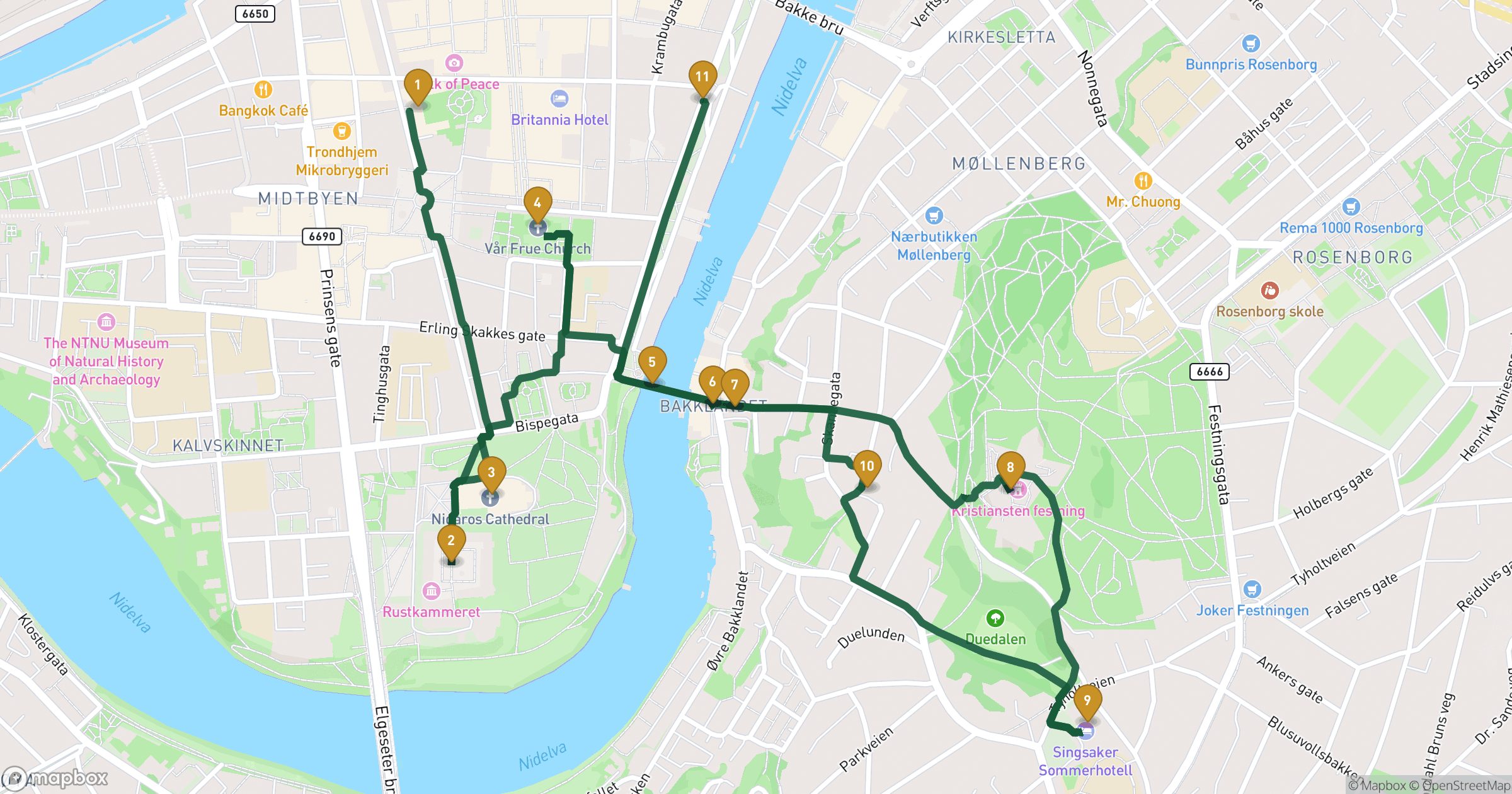
Map for Trondheim walking tour with 11 stops
The static map shows the tour route with Stiftsgården, Erkebispegårdens kapell, Nidaros Cathedral, Vår Frue Church, and 7 more stops.

Stops along the route

All stops on this self-guided tour at a glance.

  1. Stiftsgården in Trondheim
    Diego Delso / CC BY-SA 4.0

    1StiftsgårdenMuseum

    Stiftsgården stands out as Scandinavia's largest wooden palace, built between 1774 and 1778 for the wealthy Danish widow Cecilie Christine von Schøller. Although she spent about 7,400 riksdaler on the massive yellow log residence, she relocated permanently to Copenhagen only five years after its completion. Today, the building serves as the official royal residence when Norway's monarch visits Trondheim.

    Built: 1778 · Architect: Christian Lerche · Style: baroque architecture · Wikidata

  2. Erkebispegårdens kapell in Trondheim
    DXR / CC BY-SA 4.0

    2Erkebispegårdens kapellCastle

    Tucked in the shadow of the cathedral, the Archbishop's Palace Chapel represents a modern sacred space inserted directly into medieval masonry. Consecrated in 1997 through the vision of Bishop Finn Wagle and antiquarian Øivind Lunde, it occupies the vaulted medieval Vesthuset, which historically served as living quarters rather than a church. Architect Arne Gunnarsjaa designed the quiet interior to let the ancient stone walls narrate their own past.

    Wikidata

  3. Nidaros Cathedral in Trondheim
    Holger Uwe Schmitt / CC BY-SA 4.0

    3Nidaros CathedralChurch

    Nidaros Cathedral marks Norway's national sanctuary, built with carved soapstone directly over the burial site of King Olav Haraldsson after his fall in the 1030 Battle of Stiklestad. Archbishop Øystein Erlendsson later introduced English architectural trends to construct the prominent eastern octagon starting in 1185. The site served as the coronation venue for seven monarchs, while its last Catholic archbishop fled into exile during the 1537 Reformation.

    Built: 1201 · Architect: Heinrich Ernst Schirmer · Style: Gothic architecture … · Wikidata

  4. Vår Frue Church in Trondheim
    Jensens / Public domain

    4Vår Frue Church

    The medieval stone Church of Our Lady, founded in the late twelfth century by Bjørn Sigvardsson, survived devastating fires that repeatedly ravaged the city. In 1814, the building played a pivotal national role as an election church during the process of drafting the Norwegian constitution. Late nineteenth-century purist architect Christian Christie stripped away its later Baroque and Rococo embellishments to restore its sparse medieval appearance.

    Built: 1207 · Style: Romanesque architecture · Named after: Mary · Wikidata

  5. Old Town Bridge in Trondheim
    giggel / CC BY 3.0

    5Old Town Bridge

    The Old Town Bridge, affectionately called the Gate of Happiness by locals, features vibrant red portals designed in wood by Carl Adolf Dahl in 1861. It was here in 1940 that musician Oscar Hoddø penned the beloved ballad 'Nidelven stille og vakker du er' to successfully win back a lost love before he joined the resistance. At the western bridgehead, an eighteenth-century customs house still stands, now repurposed as a children's daycare.

    Wikidata

  6. Bakklandet in Trondheim
    HuBar / CC BY-SA 2.5

    6Bakklandet

    Bakklandet preserves an idyllic quarter of historic wooden houses that narrowly escaped demolition in 1965 when city planners intended to replace it with a four-lane highway. Fierce resident protests persisted for years until authorities completely abandoned the highway project in the early 1980s. Dating mostly from the eighteenth and nineteenth centuries, these former homes of working-class artisans now shelter bustling cafés and hidden riverside courtyards.

    Wikidata

  7. Trampe bicycle lift in Trondheim
    Bic / CC BY-SA 3.0

    7Trampe bicycle liftAttraction

    The Brubakken bicycle lift, introduced in 1993, operates as the world's first urban bike tow on an 18-percent gradient hill. Cyclists place their right foot onto a small metal plate rising from a track in the ground to get pushed along the 130-meter track at 7.4 kilometers per hour. Upgraded in 2013 to meet modern safety requirements, the mechanical device effortlessly shuttles commuters from low-lying Bakklandet to the hilltop fort.

    Built: 1993 · Wikidata

  8. Kristiansten Fortress in Trondheim
    User:Arj / CC BY-SA 3.0

    8Kristiansten FortressCastle

    Kristiansten Fortress was built in 1682 under the direction of General Johan Caspar von Cicignon to secure the city's vulnerable eastern flank. Its central white donjon helped defenders under Vincens Budde successfully withstand a siege by Swedish General Armfeldt during the Great Northern War in 1718. The site also holds grim modern memory: 23 resistance fighters and later the collaborator Henry Rinnan were executed here in the 1940s.

    Built: 1681 · Wikidata

  9. Singsaker Studenterhjem in Trondheim
    Chiene at English Wikipedia / CC BY-SA 3.0

    9Singsaker Studenterhjem

    Singsaker Studenterhjem ranks among Scandinavia's largest inhabited wooden residences, carrying an unusual origin born of the Second World War. German occupying forces seized the student plot in 1940 to erect a lavish officers' mess, which the student foundation acquired in 1945 for just 87,000 kroner. Since 1946, the self-governing resident engineers and architects maintain unique customs like the lighthearted order known as Den Loslitte Tøffel.

    Built: 2006 · Wikidata

  10. Pappenheim in Trondheim
    Rüdiger Stehn from Kiel, Deutschland; Norwegen 1998 (450) Trondheim / CC BY-SA 2.0

    10Pappenheim

    Pappenheim is a quiet enclave of humble wooden homes constructed between 1916 and 1920 as emergency municipal housing for workers. The community's informal name began as a mocking reference to poor construction or the cardboard tar materials used for roofing and insulation. Despite its origins as a temporary measure on the plain below the fortress, the settlement has transformed into a well-preserved residential area with tidy private gardens.

    Wikidata

  11. Kjøpmannsgata in Trondheim
    Trondheim Havn from Trondheim, Norway | Kjøpmannsgata og Bakklandet Uploaded by beagle84 / CC BY-SA 2.0

    11Kjøpmannsgata

    Kjøpmannsgata stretches parallel to the river Nidelva, dominated by historic wooden warehouses known as Bryggen that rest directly on tall pilings over the water. The avenue was laid out exceptionally broad following the catastrophic 1681 fire to serve as a vital firebreak between the riverfront and downtown. High on the gables, vintage cargo cranes still remain visible where dockworkers hoisted fish, timber, and grain directly from docked boats.

Download the app

This public page shows a preview. The full route, all content, and navigation are available in CityTour AI.

Cities nearby

Discover self-guided tours in nearby cities.

Frequently asked questions

The key answers before you start.

Is this a self-guided audio tour?

Yes. In the CityTour AI app (iOS and Android), this is a self-guided audio tour for Trondheim — start anytime, at your own pace, with map, stops, and audio narration.

What will you see on this tour?

On this tour you'll see, among others, Stiftsgården, Erkebispegårdens kapell, Nidaros Cathedral, Vår Frue Church, Old Town Bridge, Bakklandet and more sights.

Where does the tour start?

The route starts at Stiftsgården and ends at Kjøpmannsgata. You can start anytime — the app guides you to the first stop.

How long does the tour take?

About 105 minutes for 11 stops — at your own pace, with breaks whenever you like.

How much does the tour cost?

This tour costs 15 credits. The exact price depends on the pack you buy and your country — roughly $5.

Is it an outdoor tour — are entry tickets included?

Yes, it's an outdoor tour: the sights are viewed from the outside. Entry tickets are not included, and step-free access cannot be guaranteed.

Is the audio guide available in my language?

The tour and audio guide are available in English, Deutsch, Français, Español, Italiano and 9 more languages. You pick your language in the app.

Can I use the tour offline?

Yes. Tours can be used offline.

Can I ask the AI questions along the way?

Yes. At every stop you can ask the AI directly if you want to know more or didn't understand something.