CityTour AI

Wrocław self-guided walking tour

Wrocław Bridges and Baroque Charm

Discover the heart of Wrocław on a relaxed stroll from the magnificent Baroque University to the mystical Cathedral Island. This route connects architectural masterpieces like the Market Hall with hidden, romantic courtyards and the city's oldest iron bridges. Experience the unique atmosphere of a city that reinvented itself from the ruins of the past.

Audio tourSelf-guidediOS & Android
57minutes
1.9 kmdistance
7stops
Audio guideFormat
Wrocław Bridges and Baroque Charm
Barbara Maliszewska / CC BY-SA 3.0 pl

Stops on this route

This tour works well for first-time visitors, weekend trips, and travelers who want to explore Wrocław without a fixed tour time.

Route map for Wrocław walking tour
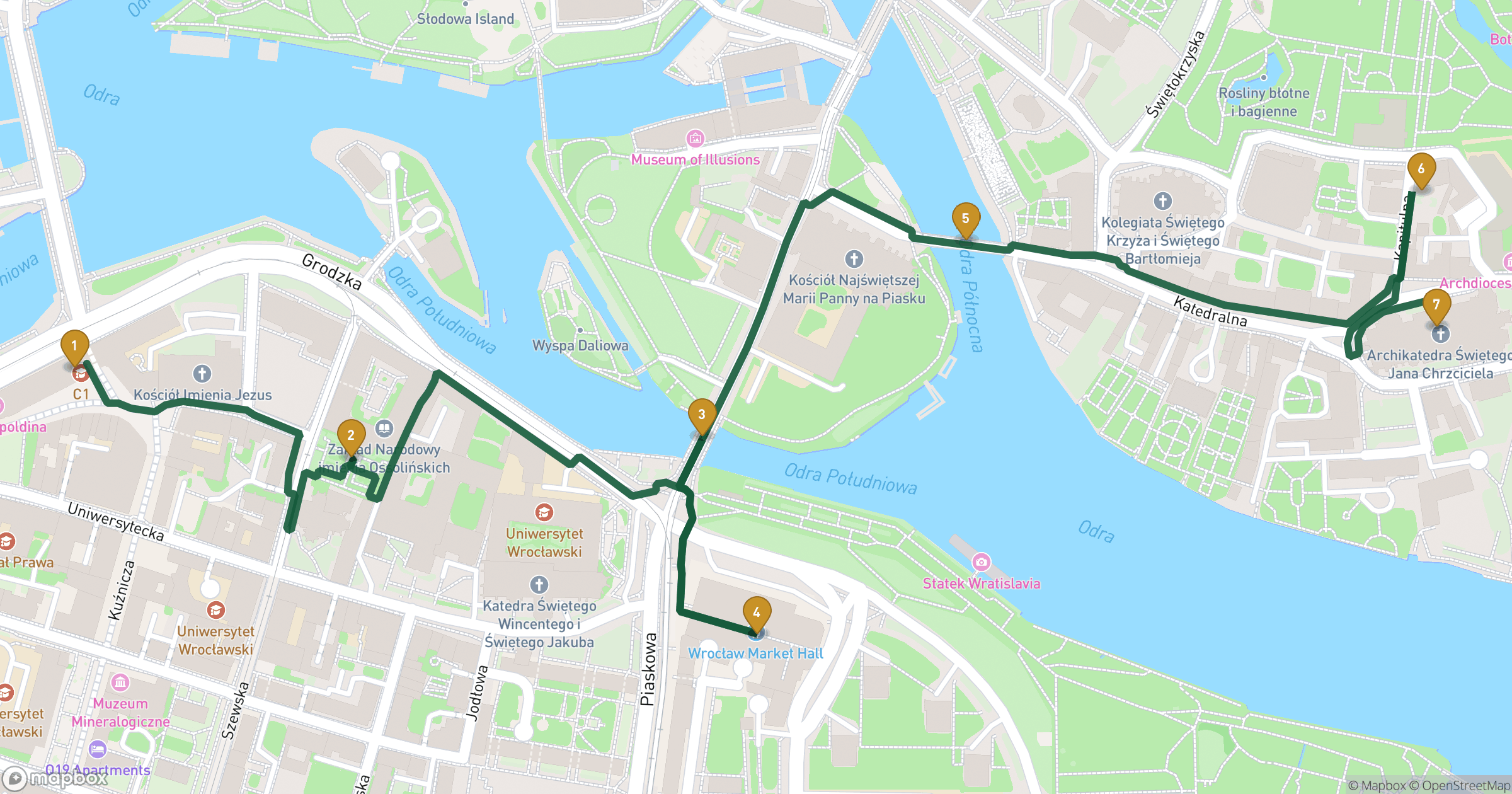
Map for Wrocław walking tour with 7 stops
The static map shows the tour route with Collegium Maximum, Ossoliński National Institute, Piaskowy Bridge in Wrocław, Wrocław Market Hall, and 3 more stops.

Stops along the route

All stops on this self-guided tour at a glance.

  1. Collegium Maximum in Wrocław
    Jar.ciurus / CC BY-SA 3.0 pl

    1Collegium MaximumBuilding

    Wrocław University’s Collegium Maximum stretches along the Oder, revealing imperial ambitions curtailed by conflict. Emperor Leopold I laid the foundation stone for the Jesuit academy in 1728, but the Seven Years' War halted work, leaving only the Mathematical Tower built. Inside the complex, an original monastery pharmacy preserves its baroque ceiling frescoes and plasterwork.

    Built: 1739 · Style: baroque architecture · Wikidata

  2. Ossoliński National Institute in Wrocław
    Diego Delso / CC BY-SA 4.0

    2Ossoliński National InstituteBuilding

    The Ossolineum occupies the former St. Matthias Gymnasium as a repository of displaced Polish heritage. Count Józef Maksymilian Ossoliński founded the institute in Lviv in 1817, before the collection was relocated here in 1947 after post-war border shifts. Behind the arcaded courtyard, its archives safeguard Adam Mickiewicz manuscripts and a fifteenth-century Zabłocki Bible.

    Built: 1817 · Named after: House of Ossoliński · Wikidata

  3. Piaskowy Bridge in Wrocław in Wrocław
    Michał460 / Public domain

    3Piaskowy Bridge in Wrocław

    Most Piaskowy connects the mainland to Sand Island as the city's oldest surviving iron crossing. Master mason Ernst Uber designed the riveted red structure in 1861, replacing wooden spans dating back to 1149, one of which collapsed under a procession in 1423. The roadway cobbles overhead date to 1893, installed when the city's first electric tram began rumbling across the river.

    Built: 1861 · Named after: Sand Island · Wikidata

  4. Wrocław Market Hall in Wrocław
    Андрэй Дзмітрыеў (http://fgb.by/viewtopic.php?p=60515#60515) / CC BY-SA 3.0

    4Wrocław Market Hall

    The Market Hall pairs a neo-Gothic brick facade and twin clock towers with early twentieth-century engineering. Architect Richard Plüddemann and engineer Heinrich Küster erected the hall between 1906 and 1908 using pioneering parabolic reinforced concrete arches. Built to replace open-air trading on Nowy Targ, the soaring hall still functions today with bustling food and flower stalls.

    Built: 1908 · Architect: Richard Plüddemann · Style: Art Nouveau architecture · Wikidata

  5. Most Tumski in Wrocław
    Daviidos / CC BY-SA 4.0

    5Most TumskiBridge

    Most Tumski serves as the historic portal connecting Sand Island to the cathedral precinct. Erected in 1889, this green steel bridge recently had thousands of love padlocks cleared away to protect its structural integrity. At dusk, one of Europe’s last manual lamplighters still makes his rounds here to light the gas streetlamps leading toward the twin cathedral spires.

    Built: 1889 · Wikidata

  6. Cathedral Island in Wrocław
    Barbara Maliszewska / CC BY-SA 3.0 pl

    6Cathedral IslandMonument

    Ostrów Tumski preserves the cloistered atmosphere of Wrocław's original seat of religious authority. A Slavic stronghold stood here in the tenth century, followed by the establishment of the bishopric in the year 1000. Cobblestone lanes wind past the Archbishop’s Palace and brick gothic churches like Holy Cross and St. Martin's without intrusion from modern glass storefronts.

    Wikidata

  7. Wrocław Cathedral in Wrocław
    Daniel.zolopa / CC BY 4.0

    7Wrocław CathedralChurch

    The Cathedral of St. John the Baptist dominates the skyline with twin towers reaching nearly ninety-eight metres high. Beneath the nave of the 1244–1341 gothic building, archaeologists in the 1990s uncovered foundations of a tenth-century Bohemian church. Behind the high altar sits the Lady Chapel, featuring architectural work by baroque master Johann Bernhard Fischer von Erlach.

    Built: 1244 · Architect: Johann Bernhard Fischer von Erlach · Style: Gothic architecture · Height: 98 m · Wikidata

Download the app

This public page shows a preview. The full route, all content, and navigation are available in CityTour AI.

Cities nearby

Discover self-guided tours in nearby cities.

Frequently asked questions

The key answers before you start.

Is this a self-guided audio tour?

Yes. In the CityTour AI app (iOS and Android), this is a self-guided audio tour for Wrocław — start anytime, at your own pace, with map, stops, and audio narration.

What will you see on this tour?

On this tour you'll see, among others, Collegium Maximum, Ossoliński National Institute, Piaskowy Bridge in Wrocław, Wrocław Market Hall, Most Tumski, Cathedral Island and more sights.

Where does the tour start?

The route starts at Collegium Maximum and ends at Wrocław Cathedral. You can start anytime — the app guides you to the first stop.

How long does the tour take?

About 57 minutes for 7 stops — at your own pace, with breaks whenever you like.

How much does the tour cost?

This tour costs 8 credits. The exact price depends on the pack you buy and your country — roughly $3.

Is it an outdoor tour — are entry tickets included?

Yes, it's an outdoor tour: the sights are viewed from the outside. Entry tickets are not included, and step-free access cannot be guaranteed.

Is the audio guide available in my language?

The tour and audio guide are available in English, Deutsch, Français, Español, Italiano and 9 more languages. You pick your language in the app.

Can I use the tour offline?

Yes. Tours can be used offline.

Can I ask the AI questions along the way?

Yes. At every stop you can ask the AI directly if you want to know more or didn't understand something.