CityTour AI

Warsaw self-guided walking tour

Warsaw: From Socialist Realism to Royal Splendor

Discover the fascinating contrasts of Warsaw on a walk that blends monumental socialist realism with the meticulously rebuilt Old Town. Witness how the city rose from the ashes of war, uncover the secrets of royal residences, and feel the unique energy of a metropolis that constantly reinvents itself. This is a story of resilience written in architecture, from the hidden traces of history at Grzybowski Square to the prestigious glow of Krakowskie Przedmieście.

Audio tourSelf-guidediOS & Android
100minutes
3.6 kmdistance
9stops
Audio guideFormat
Warsaw: From Socialist Realism to Royal Splendor
Kapitel / CC BY-SA 4.0

Stops on this route

This tour works well for first-time visitors, weekend trips, and travelers who want to explore Warsaw without a fixed tour time.

Route map for Warsaw walking tour
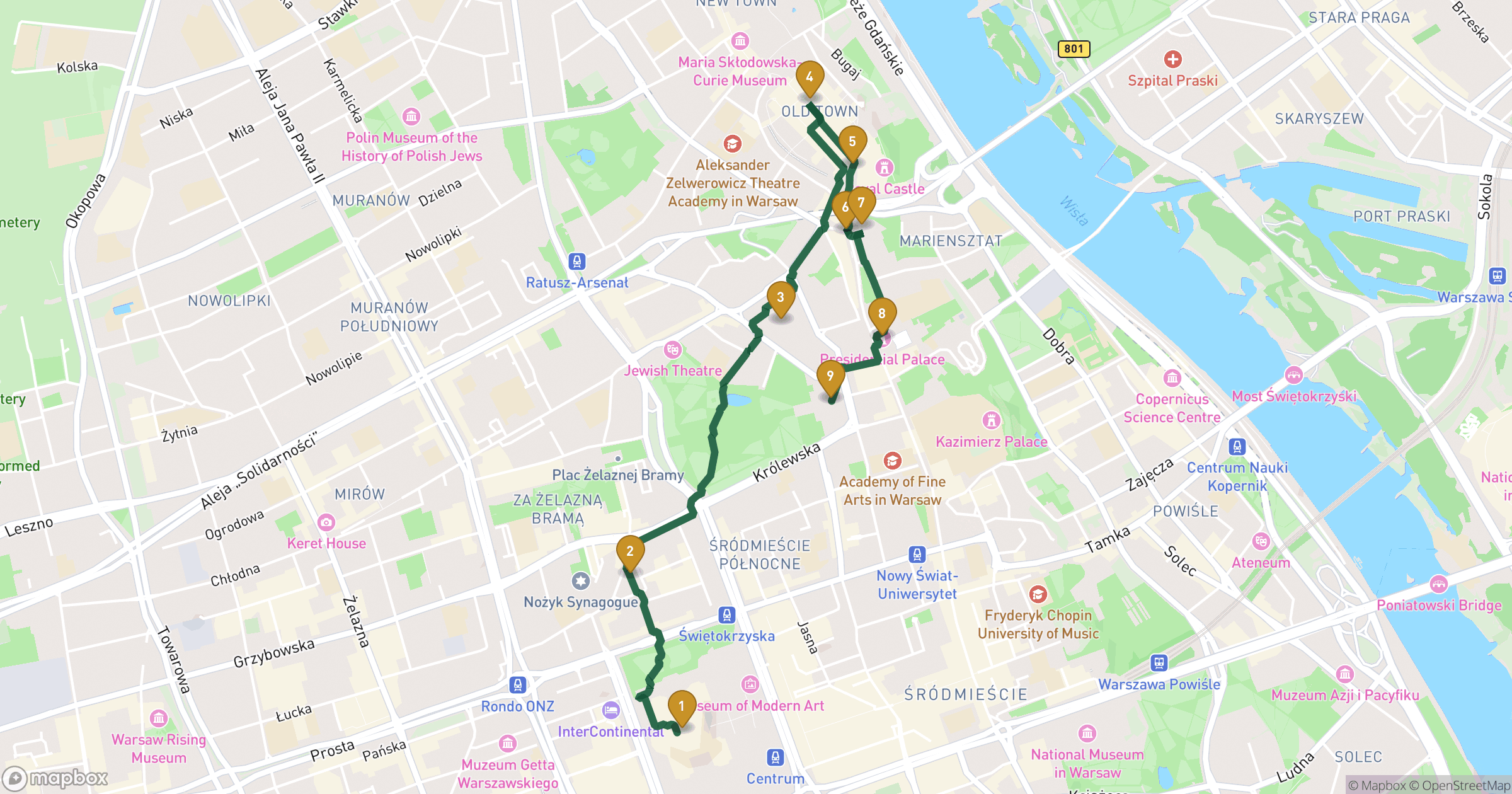
Map for Warsaw walking tour with 9 stops
The static map shows the tour route with Pałac Kultury i Nauki, Plac Grzybowski, Teatr Wielki, Rynek Starego Miasta, and 5 more stops.

Stops along the route

All stops on this self-guided tour at a glance.

  1. Pałac Kultury i Nauki in Warsaw
    Adrian Grycuk / CC BY-SA 3.0 pl

    1Pałac Kultury i NaukiAttraction

    The Palace of Culture and Science defines the skyline as a monumental blend of socialist realism and Polish renaissance motifs. Soviet architect Lev Rudnev toured Poland from Kraków to Zamość to incorporate regional details like historical attic parapets. Over 3,500 Soviet workers built the complex, which later hosted a 1967 concert by The Rolling Stones.

    Built: 1955 · Architect: Lev Rudnev · Style: socialist realism · Height: 230 m · Wikidata

  2. Plac Grzybowski in Warsaw
    Kapitel / CC BY-SA 4.0

    2Plac GrzybowskiSquare

    Grzybowski Square reveals layers of urban history as the historic core of the Grzybów jurydyka and former Jewish quarter. Bordering the square, Próżna Street remains the only road in the former Warsaw Ghetto with prewar tenements preserved on both sides. All Saints Church pastor Marceli Godlewski overcame radical prewar antisemitism to hide Jewish residents and issue false baptism certificates.

    Wikidata

  3. Teatr Wielki in Warsaw
    Toniklemm / CC BY-SA 4.0

    3Teatr Wielki

    The Grand Theatre showcases an imposing neoclassical design created by Italian architect Antonio Corazzi. His planned Apollo Quadriga sculpture remained missing for nearly 170 years after the tsar rejected it, finally being installed in 2002. Behind the preserved colonnaded facade lies one of the world's largest opera stages, home to Stanisław Moniuszko's premiere of Halka.

    Built: 1833 · Wikidata

  4. Rynek Starego Miasta in Warsaw
    Adrian Grycuk / CC BY-SA 3.0 pl

    4Rynek Starego MiastaSquare

    The Old Town Market Square stands as a meticulous post-1944 reconstruction guided by 18th-century paintings by Bernardo Bellotto, known as Canaletto. At its heart rises the monument of the Warsaw Mermaid, crafted by sculptor Konstanty Hegel. House number 36, named 'Pod Murzynkiem', features a carved African head on its facade that marked a 17th-century owner's maritime trade.

    Wikidata

  5. Plac Zamkowy in Warsaw
    Rhododendrites / CC BY-SA 4.0

    5Plac ZamkowySquare

    Castle Square welcomes arrivals with the 1644 Sigismund's Column, the city's oldest secular monument honoring King Sigismund III Vasa. Dark stone segments of the column, toppled during the Warsaw Uprising, are still preserved beside the castle walls. The reconstructed Royal Castle hosted the adoption of the May 3rd Constitution in 1791.

    Wikidata

  6. Krakowskie Przedmieście in Warsaw
    Maksym Kozlenko / CC BY-SA 4.0

    6Krakowskie Przedmieście

    Krakowskie Przedmieście forms an aristocratic section of the Royal Route where grand palaces now host universities and public institutions. The 1955 Warsaw Pact was signed inside the Presidential Palace, fronted by an equestrian statue of Prince Józef Poniatowski. Further along, the Church of the Holy Cross holds the heart of Frédéric Chopin sealed within one of its pillars.

    Wikidata

  7. St. Anne's Church in Warsaw
    Adrian Grycuk / CC BY-SA 3.0 pl

    7St. Anne's Church

    St. Anne's Church presents a neoclassical facade by Piotr Aigner that conceals 15th-century foundations laid for the Bernardine order. Inside, illusionistic ceiling frescoes and baroque paintings expand the church above the relics of patron Blessed Władysław of Gielniów. The building narrowly avoided collapse in 1949 when the hillside cracked during construction of the W-Z Route tunnel.

    Built: 1454 · Architect: Tylman van Gameren, Giovanni Battista Gisleni … · Style: baroque architecture … · Named after: Saint Anne · Wikidata

  8. Pałac Prezydencki in Warsaw
    Rhododendrites / CC BY-SA 4.0

    8Pałac PrezydenckiCastle

    The Presidential Palace displays a storied past as Warsaw's largest palace, originally begun in 1643 by Hetman Stanisław Koniecpolski. An eight-year-old Frédéric Chopin gave his first public concert in its halls in February 1818 before the local nobility. Its courtyard features Bertel Thorvaldsen's equestrian statue of Józef Poniatowski, a postwar replacement gifted by Denmark.

    Built: 1643 · Architect: Constantino Tencalla · Style: Neoclassical architecture · Wikidata

  9. Piłsudski Square in Warsaw
    Kapitel / CC BY-SA 4.0

    9Piłsudski Square

    Marshal Józef Piłsudski Square centers on a surviving fragment of the Saxon Palace colonnade housing the Tomb of the Unknown Soldier. Pope John Paul II delivered his pivotal 1979 sermon here, an event now commemorated by a large memorial cross. Directly behind the eternal flame lies the Saxon Garden, opened to the public by King Augustus II the Strong in 1727.

    Named after: Józef Piłsudski · Wikidata

Download the app

This public page shows a preview. The full route, all content, and navigation are available in CityTour AI.

Cities nearby

Discover self-guided tours in nearby cities.

Frequently asked questions

The key answers before you start.

Is this a self-guided audio tour?

Yes. In the CityTour AI app (iOS and Android), this is a self-guided audio tour for Warsaw — start anytime, at your own pace, with map, stops, and audio narration.

What will you see on this tour?

On this tour you'll see, among others, Pałac Kultury i Nauki, Plac Grzybowski, Teatr Wielki, Rynek Starego Miasta, Plac Zamkowy, Krakowskie Przedmieście and more sights.

Where does the tour start?

The route starts at Pałac Kultury i Nauki and ends at Piłsudski Square. You can start anytime — the app guides you to the first stop.

How long does the tour take?

About 100 minutes for 9 stops — at your own pace, with breaks whenever you like.

How much does the tour cost?

This tour costs 15 credits. The exact price depends on the pack you buy and your country — roughly $5.

Is it an outdoor tour — are entry tickets included?

Yes, it's an outdoor tour: the sights are viewed from the outside. Entry tickets are not included, and step-free access cannot be guaranteed.

Is the audio guide available in my language?

The tour and audio guide are available in English, Deutsch, Français, Español, Italiano and 9 more languages. You pick your language in the app.

Can I use the tour offline?

Yes. Tours can be used offline.

Can I ask the AI questions along the way?

Yes. At every stop you can ask the AI directly if you want to know more or didn't understand something.