CityTour AI

Gyeongju self-guided walking tour

Gyeongju: The Golden Kingdom Walk

Discover the 'Golden Kingdom' of Silla on a walk that blends ancient royal mysteries with Gyeongju's vibrant modern culture. You will explore massive burial mounds, the oldest observatory in Asia, and a reconstructed bridge that glows over the river. This route offers a perfect mix of UNESCO-listed history and the city's trendiest hidden spots.

Audio tourSelf-guidediOS & Android
105minutes
5.4 kmdistance
8stops
Audio guideFormat
Gyeongju: The Golden Kingdom Walk
Christophe95 / CC BY-SA 4.0

Stops on this route

This tour works well for first-time visitors, weekend trips, and travelers who want to explore Gyeongju without a fixed tour time.

Route map for Gyeongju walking tour
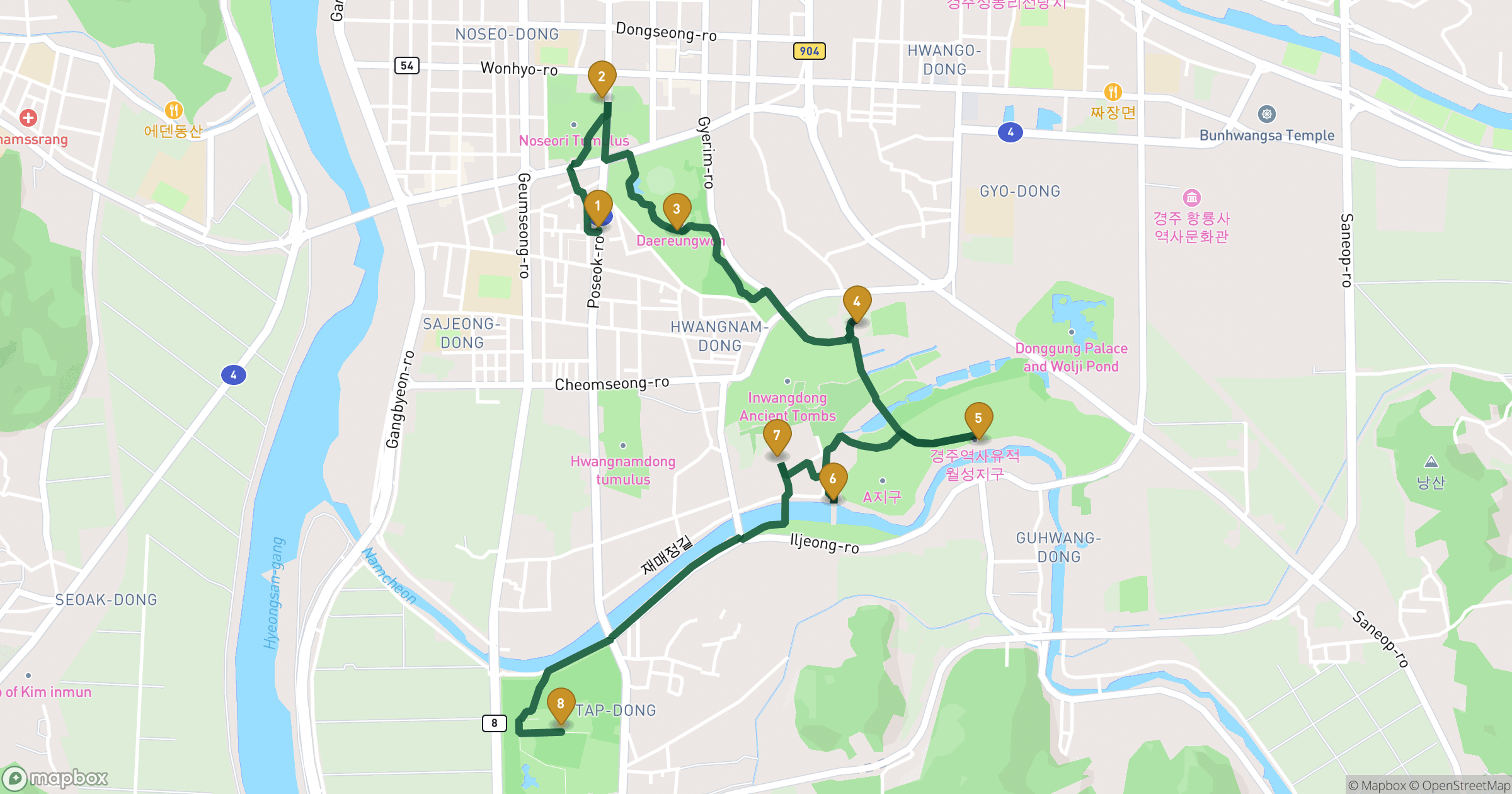
Map for Gyeongju walking tour with 8 stops
The static map shows the tour route with Hwangnidan-gil, Gold Crown Tomb, Daereungwon, Cheomseongdae, and 4 more stops.

Stops along the route

All stops on this self-guided tour at a glance.

  1. Hwangnidan-gil in Gyeongju
    Seefooddiet / CC BY-SA 4.0

    1Hwangnidan-gil

    Hwangnidan-gil began its transformation around 2015 when young entrepreneurs turned aging hanok homes into roughly 400 modern cafes and galleries. The street sparked a national snack craze in late 2019 with its cheese-filled 10-won bread, shaped after a 1960s coin. Overhead power lines were relocated underground to protect the views across traditional tiled roofs.

    Wikidata

  2. Gold Crown Tomb in Gyeongju
    Abasaa / Public domain

    2Gold Crown TombMonument

    Geumgwanchong yielded Silla's first discovered gold crown in 1921 when backyard construction accidentally struck the ancient burial mound. The site contained more than 40,000 artifacts, including 20,000 blue Indo-Pacific beads, silver belt ornaments, and a bronze tripod pouring vessel from China. Lacking a separate entrance, the stone-and-earth mound protected these treasures for over 1,500 years.

    Wikidata

  3. Daereungwon in Gyeongju
    riNux from Taipei, Taiwan / CC BY-SA 2.0

    3DaereungwonPark

    Daereungwon preserves 23 grass-covered tumuli constructed between the 4th and 6th centuries for Silla's monarchs and aristocracy. Archaeologists excavating Cheonmachong in 1973 unearthed a painting of a heavenly horse on a birch-bark saddle flap. As recently as 2020, researchers discovered late 5th-century ceremonial gilt-bronze shoes buried deep beneath the river stones.

    Wikidata

  4. Cheomseongdae in Gyeongju
    by Junho Jung at Flickr from South Korea / CC BY-SA 3.0

    4Cheomseongdae

    Cheomseongdae was erected during the 7th-century reign of Queen Seondeok as a dedicated scientific instrument for reading celestial movements. The tower uses 365 cut granite stones to reflect the solar year, split evenly by a central window into 12 stone tiers above and 12 below. Even though the structure tilts slightly northeast, automated sensors installed in 2007 monitor its stability hourly.

    Built: 700 · Wikidata

  5. Wolseong in Gyeongju
    Christophe95 / CC BY-SA 4.0

    5WolseongMonument

    Wolseong served as Silla's primary royal palace for nearly a millennium, defended by earthwork walls shaped like a crescent moon. Excavations in 2021 revealed the 4th-century sacrificial burial of a woman wearing a bracelet and necklace at the main entrance. The grounds still feature the Seokbinggo icehouse, equipped with an arched roof, three vents, and a sloped floor for runoff.

    Wikidata

  6. Gyeongju Chunyang Bridge and Woljeong Bridge in Gyeongju
    bryan... / CC BY-SA 2.0

    6Gyeongju Chunyang Bridge and Woljeong Bridge

    Woljeonggyo is a covered wooden bridge originally built in 760 AD to link Wolseong palace with the city's southern reaches. Reconstructed and reopened in 2018, the 66-meter bridge features two-story gatehouses displaying original riverbed foundation stones used to calculate its scale. At night, extensive illumination reflects directly off the surface of the Namcheon stream.

    Wikidata

  7. Gyochon Village in Gyeongju
    Christophe95 / CC BY-SA 4.0

    7Gyochon Village

    Gyochon Village grew around Silla's ancient academy before becoming the home of the Choi family for twelve generations. The family practiced strict benevolence, distributing wealth during famines so that no one starved within a 25-kilometer radius. Centered around the historic Choe Jun House, the village continues the brewing of Gyeongju Gyo-dong beopju rice wine.

    Wikidata

  8. Oreung in Gyeongju
    Korea Heritage Service / CC BY-SA 4.0

    8OreungPark

    Oreung preserves five unexcavated royal mounds dating from the 1st century BC and AD, attributed to Silla founder Park Hyeokgeose and early rulers. The Samguk sagi terms the complex Sareung, or Snake Tomb, recalling a legend that a giant snake drove the founder's fallen remains into five separate burials. The forested mounds vary in scale, ranging from under two meters to roughly ten meters high.

    Wikidata

Download the app

This public page shows a preview. The full route, all content, and navigation are available in CityTour AI.

Cities nearby

Discover self-guided tours in nearby cities.

Frequently asked questions

The key answers before you start.

Is this a self-guided audio tour?

Yes. In the CityTour AI app (iOS and Android), this is a self-guided audio tour for Gyeongju — start anytime, at your own pace, with map, stops, and audio narration.

What will you see on this tour?

On this tour you'll see, among others, Hwangnidan-gil, Gold Crown Tomb, Daereungwon, Cheomseongdae, Wolseong, Gyeongju Chunyang Bridge and Woljeong Bridge and more sights.

Where does the tour start?

The route starts at Hwangnidan-gil and ends at Oreung. You can start anytime — the app guides you to the first stop.

How long does the tour take?

About 105 minutes for 8 stops — at your own pace, with breaks whenever you like.

How much does the tour cost?

This tour costs 15 credits. The exact price depends on the pack you buy and your country — roughly $5.

Is it an outdoor tour — are entry tickets included?

Yes, it's an outdoor tour: the sights are viewed from the outside. Entry tickets are not included, and step-free access cannot be guaranteed.

Is the audio guide available in my language?

The tour and audio guide are available in English, Deutsch, Français, Español, Italiano and 9 more languages. You pick your language in the app.

Can I use the tour offline?

Yes. Tours can be used offline.

Can I ask the AI questions along the way?

Yes. At every stop you can ask the AI directly if you want to know more or didn't understand something.