CityTour AI

Granada self-guided walking tour

Granada: Where Two Worlds Meet

Step into a city where Islamic artistry and Renaissance ambition are woven into every street corner. This casual walk takes you from the towering red walls of the Alhambra through the winding, jasmine-scented alleys of the Albaicín, revealing how Granada transformed from a Moorish capital into a Spanish icon. You will experience the layers of history firsthand, ending with a sunset view that has captivated travelers for centuries.

Audio tourSelf-guidediOS & Android
102minutes
3.4 kmdistance
12stops
Audio guideFormat
Granada: Where Two Worlds Meet
justinknabb / CC BY-SA 2.0

Stops on this route

This tour works well for first-time visitors, weekend trips, and travelers who want to explore Granada without a fixed tour time.

Route map for Granada walking tour
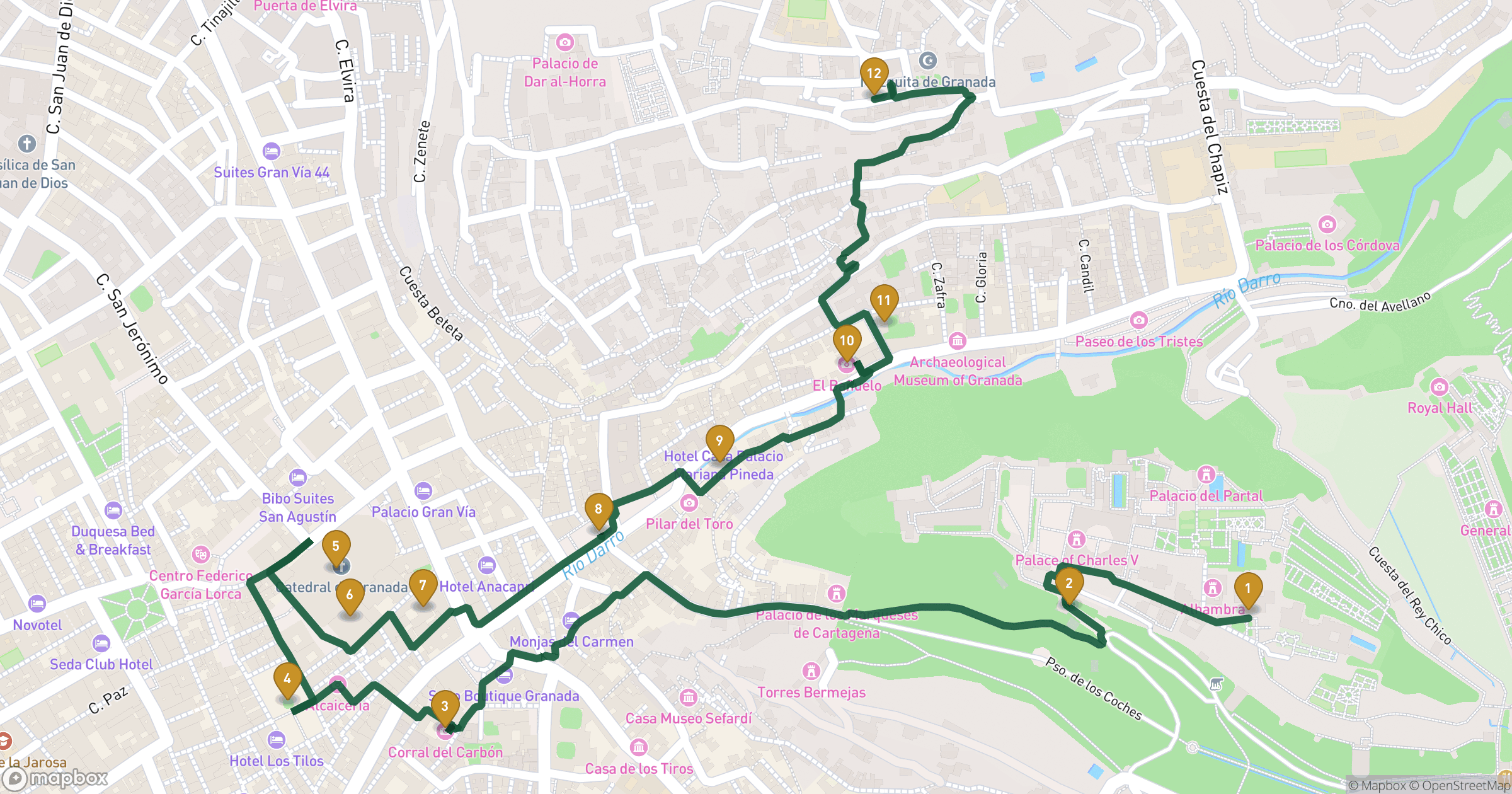
Map for Granada walking tour with 12 stops
The static map shows the tour route with Alhambra, Puerta de la Justicia, Corral del Carbón, Plaza de Bib-Rambla, and 8 more stops.

Stops along the route

All stops on this self-guided tour at a glance.

  1. Alhambra in Granada
    Jebulon / CC0

    1AlhambraCastle

    The Alhambra began in 1238 on the Sabika hill as the Nasrid dynasty's fortified palatine city under Muhammad I Ibn al-Ahmar. In 1492, Christopher Columbus stood before Queen Isabella and King Ferdinand here to secure royal endorsement for his voyage. American author Washington Irving later lived in its abandoned palace rooms in 1829, penning 'Tales of the Alhambra.'

    Built: 1239 · Style: Art of Al-Andalus · Wikidata

  2. Puerta de la Justicia in Granada
    Superchilum / CC BY-SA 3.0

    2Puerta de la JusticiaBuilding

    The Justice Gate was erected in 1348 under Yusuf I as the Alhambra's grandest entrance tower. Local legend claimed the fortress would only fall if the hand carved on the outer arch reached down to grasp the key on the inner arch. Inside, an L-shaped bend slowed horse-mounted attackers, while a 1492 image of the Virgin and Child marks the transition to Christian rule.

    Wikidata

  3. Corral del Carbón in Granada
    Paul Hermans / CC BY-SA 3.0

    3Corral del CarbónAttraction

    Corral del Carbón is the only surviving Nasrid-era merchant inn, or funduq, on the Iberian Peninsula. Historical records link its early 14th-century origins to the wives of Nasrid sultans who owned the bustling commercial hub. In later centuries it served as a courtyard theater for plays and a 17th-century tenement where coal was weighed and stored.

    Style: Nasrid architecture · Wikidata

  4. Plaza de Bib-Rambla in Granada
    Nacho Corral Crespo / CC BY-SA 4.0

    4Plaza de Bib-RamblaSquare

    Bib-Rambla Square originated in the Nasrid period beside the Darro River and the Alcaicería silk bazaar as a major commercial space. Remodeled after the Christian conquest, it long hosted jousting tournaments, bullfights, and Inquisition trials. The plaza now features traditional flower stalls and the 17th-century Fountain of the Giants decorated with bucolic motifs.

    Wikidata

  5. S.A.I. Catedral Metropolitana de la Encarnación in Granada
    Berthold Werner / CC BY-SA 3.0

    5S.A.I. Catedral Metropolitana de la EncarnaciónChurch

    Granada Cathedral began construction in 1518 over the former Great Mosque, taking 181 years to complete. Diego de Siloé took over in 1529, pairing a Gothic floor plan with an Italian-inspired circular main chapel and Renaissance dome. Only one of its two planned 81-meter towers was ever built, left permanently at half-height due to financial and structural issues.

    Built: 1600 · Architect: Alonso Cano · Style: Renaissance architecture · Wikidata

  6. Royal Chapel of Granada in Granada
    Heparina1985 / CC BY-SA 4.0

    6Royal Chapel of GranadaBuilding

    The Royal Chapel was commissioned in 1504 by Queen Isabella I and King Ferdinand II as their personal burial site. Built by Enrique Egas in the Isabelline Gothic style, it houses their marble tombs alongside those of Joanna the Mad and Philip the Handsome. Visitors can observe a monumental wrought-iron grille alongside Isabella's personal crown, scepter, and Flemish paintings.

    Built: 1506 · Architect: Enrique Egas · Style: Renaissance architecture … · Wikidata

  7. Madrasah of Granada in Granada
    Berthold Werner / CC BY-SA 3.0

    7Madrasah of GranadaBuilding

    The Madrasah of Granada was founded in 1349 by Sultan Yusuf I as the city's first university and al-Andalus's only major madrasa. Famed polymath Ibn al-Khatib studied here under the poet Ibn al-Jayyab before becoming a vizier. Behind an 18th-century Baroque facade remains the original prayer oratory, adorned with intricate stucco work, colorful tiles, and Christian coats of arms.

    Built: 1349 · Style: Nasrid architecture · Wikidata

  8. Plaza Nueva in Granada
    Superchilum / CC BY-SA 3.0

    8Plaza NuevaSquare

    Plaza Nueva was constructed in the 16th century as Granada's oldest square atop a massive stone vault over the Darro River. Philip II oversaw the completion of its Mannerist Royal Chancery, the first purpose-built court of justice in Spain. The space once staged bullfights and public executions right where water continues to rush directly below the stone pavement.

    Wikidata

  9. church of Saint Anne in Granada
    justinknabb / CC BY-SA 2.0

    9church of Saint Anne

    The Church of Saint Anne was constructed in 1537 by Diego de Siloé atop the former Almanzora mosque. Juan Castellar modeled its bell tower directly on Nasrid minarets, using traditional proportions and decorative brickwork. The interior houses José de Mora’s 1671 'Dolorosa' sculpture, created in weeks of isolation to render an intense expression of grief.

    Style: Mudéjar architecture · Named after: Saint Giles, Saint Anne · Wikidata

  10. Baños árabes del Bañuelo in Granada
    R Prazeres / CC BY-SA 4.0

    10Baños árabes del BañueloAttraction

    The Bañuelo preserves Zirid-dynasty Arab baths dating to the 11th or 12th century with star-shaped roof vents that managed steam and light. The structure survived because a private residence was built over it after 1492, repurposing the chambers into a public laundry. Architect Leopoldo Torres Balbás cleared the debris in the early 20th century, revealing recycled Roman capitals.

    Style: Art of Al-Andalus · Wikidata

  11. Casa de Zafra, Granada in Granada
    Junta Granada Informa from Granada, España / CC BY-SA 2.0

    11Casa de Zafra, GranadaAttraction

    Casa de Zafra is a 14th-century Nasrid house built around a courtyard pool in the Albaicín. Catholic Monarchs Ferdinand and Isabella gifted the residence to their secretary, Hernando de Zafra, after he negotiated Granada’s peaceful surrender with King Boabdil. Its quiet rooms retain original wall paintings and plasterwork preserved for more than six centuries.

    Wikidata

  12. Mirador de San Nicolas, Granada in Granada
    Harvey Barrison from Massapequa, NY, USA / CC BY-SA 2.0

    12Mirador de San Nicolas, GranadaViewpoint

    The San Nicolás Viewpoint overlooks the Alhambra and Sierra Nevada mountains from a square fronting a 1525 church built on a former mosque. The site gained modern fame in 1997 when U.S. President Bill Clinton praised the vista as the most beautiful sunset in the world. Street flamenco guitarists and local craftspeople gather daily where Christian and Moorish history align.

    Wikidata

Download the app

This public page shows a preview. The full route, all content, and navigation are available in CityTour AI.

Cities nearby

Discover self-guided tours in nearby cities.

Frequently asked questions

The key answers before you start.

Is this a self-guided audio tour?

Yes. In the CityTour AI app (iOS and Android), this is a self-guided audio tour for Granada — start anytime, at your own pace, with map, stops, and audio narration.

What will you see on this tour?

On this tour you'll see, among others, Alhambra, Puerta de la Justicia, Corral del Carbón, Plaza de Bib-Rambla, S.A.I. Catedral Metropolitana de la Encarnación, Royal Chapel of Granada and more sights.

Where does the tour start?

The route starts at Alhambra and ends at Mirador de San Nicolas, Granada. You can start anytime — the app guides you to the first stop.

How long does the tour take?

About 102 minutes for 12 stops — at your own pace, with breaks whenever you like.

How much does the tour cost?

This tour costs 15 credits. The exact price depends on the pack you buy and your country — roughly $5.

Is it an outdoor tour — are entry tickets included?

Yes, it's an outdoor tour: the sights are viewed from the outside. Entry tickets are not included, and step-free access cannot be guaranteed.

Is the audio guide available in my language?

The tour and audio guide are available in English, Deutsch, Français, Español, Italiano and 9 more languages. You pick your language in the app.

Can I use the tour offline?

Yes. Tours can be used offline.

Can I ask the AI questions along the way?

Yes. At every stop you can ask the AI directly if you want to know more or didn't understand something.