CityTour AI

Málaga self-guided walking tour

Malaga: From Moorish Stronghold to Modern Port

Experience the layered history of Malaga on a stroll that bridges ancient fortresses and modern waterfronts. You’ll wander through bustling markets, grand Renaissance squares, and lush botanical gardens while uncovering the city's Phoenician, Moorish, and industrial past. It’s a relaxed journey through the heart of the Costa del Sol’s cultural capital.

Audio tourSelf-guidediOS & Android
104minutes
3.3 kmdistance
11stops
Audio guideFormat
Malaga: From Moorish Stronghold to Modern Port
Frog17 / CC BY-SA 4.0

Stops on this route

This tour works well for first-time visitors, weekend trips, and travelers who want to explore Málaga without a fixed tour time.

Route map for Malaga walking tour
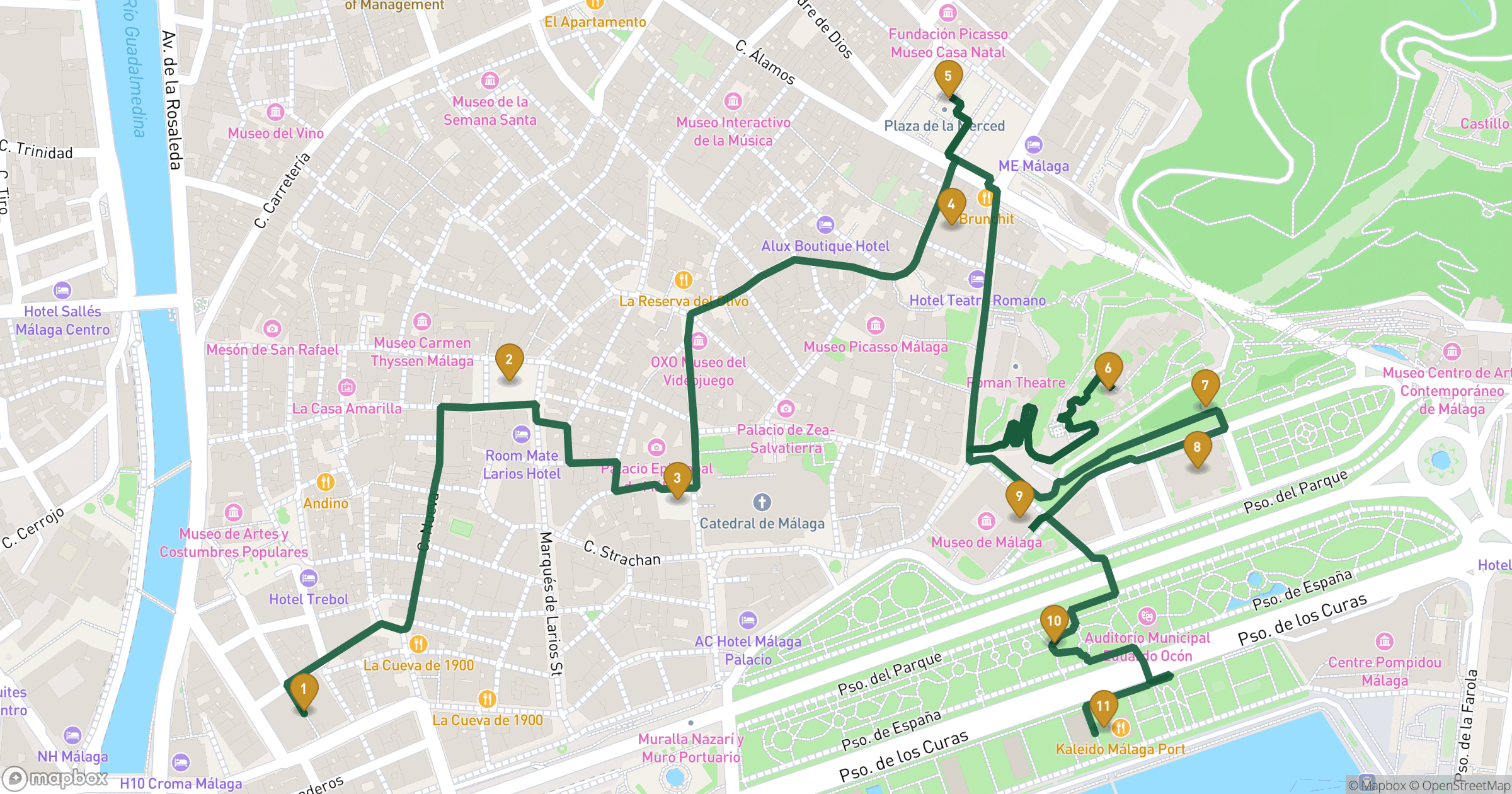
Map for Malaga walking tour with 11 stops
The static map shows the tour route with Mercado de Atarazanas, Plaza de la Constitución (Málaga), Plaza del Obispo, Málaga, Iglesia de Santiago, and 7 more stops.

Stops along the route

All stops on this self-guided tour at a glance.

  1. Mercado de Atarazanas in Málaga
    Lupulo2010 / Public domain

    1Mercado de AtarazanasMarket

    Mercado de Atarazanas stands where Moorish shipyards once met the sea, later repurposed as barracks and a military hospital. Architect Joaquín Rucoba salvaged the site's 14th-century Nasrid marble gate in the 1870s, relocating it 25 meters to serve as the market entrance. The iron skeleton was cast at Seville's San Antonio Foundry and features molded details like fish and cornucopias.

    Built: 1879 · Architect: Joaquín Rucoba · Wikidata

  2. Plaza de la Constitución (Málaga) in Málaga
    Américo Toledano / CC BY-SA 4.0

    2Plaza de la Constitución (Málaga)Square

    Plaza de la Constitución has functioned as Malaga's central public stage since the Christian Reconquista in 1487, when it was known as the Plaza de las Cuatro Calles. City Hall, the mayor's residence, and the local jail stood on this square until 1869. The 16th-century Renaissance marble Fuente de Génova was returned to the marble-paved pedestrian square in 2003.

    Wikidata

  3. Plaza del Obispo, Málaga in Málaga
    Gert Mewes from Erlensee, Deutschland / CC BY-SA 2.0

    3Plaza del Obispo, MálagaSquare

    Plaza del Obispo sits before the Cathedral facade and Episcopal Palace on ground that hides late-Roman and Byzantine defensive walls. The square's 1785 central fountain shares the palace entrance's grey marble and was fed by the historic San Telmo Aqueduct. In 2004, the deep red and yellow Baroque palace served as a film set depicting 18th-century colonial Peru.

    Wikidata

  4. Iglesia de Santiago in Málaga
    Tajchman / CC BY-SA 3.0 es

    4Iglesia de SantiagoChurch

    Iglesia de Santiago was founded in 1487 over a former mosque, making it the first parish created after the Catholic Monarchs entered through Calle Granada. The brick tower displays original Gothic-Mudéjar work by local craftsmen, and the interior retains the font where Pablo Picasso was baptized on November 10, 1881. Baroque sculptor Fernando Ortiz is buried here.

    Style: Gothic architecture · Named after: St. James the Elder · Wikidata

  5. Plaza de la Merced in Málaga
    Tyk / CC BY-SA 3.0

    5Plaza de la MercedSquare

    Plaza de la Merced was a Roman gathering place and a 15th-century market named after the Mercedarian friars who established a church here in 1507. A central obelisk by Rafael Mitjana holds a crypt with the remains of General José María Torrijos and his 48 companions, executed on the beach in 1831. Outside building number 15, a bronze statue portrays Pablo Picasso sitting on a marble bench.

    Wikidata

  6. Alcazaba of Málaga in Málaga
    Fernando / CC BY-SA 4.0

    6Alcazaba of MálagaCastle

    The Alcazaba is an 11th-century Hammudid palatial fortress expanded in the 1300s by the Nasrids with fortified gates and sharp L-shaped turns to thwart battering rams. Moorish builders took Roman stone columns and capitals from the 1st-century theatre at the base of the hill to assemble the fortress arches. A walled corridor known as the Coracha connects the compound to Gibralfaro Castle above.

    Built: 1057 · Style: Moorish architecture · Wikidata

  7. Jardines de Puerta Oscura in Málaga
    Tyk / CC BY-SA 3.0

    7Jardines de Puerta OscuraPark

    Jardines de Puerta Oscura were created in 1937 on the slope of Mount Gibralfaro to frame the stone ramparts of the Alcazaba. Architect Fernando Guerrero-Strachan Rosado chose a Neo-Islamic style, incorporating water features, Canary Island palms, and Aleppo pines. The terraces take their name from the Puerta Oscura, a former gate that once stood on this hillside.

    Wikidata

  8. town hall of Málaga in Málaga
    Jeff Hitchcock from Seattle, WA, USA / CC BY 2.0

    8town hall of MálagaBuilding

    The Málaga City Hall, dubbed La Casona del Parque, was designed in a Neo-Baroque style with Modernist details by Manuel Rivera Vera and Fernando Guerrero Strachan. Mayor Ricardo Albert laid the first stone on the final day of 1911, leading to its official inauguration on April 11, 1919. Built for 1.5 million pesetas, it initially was intended to house provincial and investigative courts.

    Built: 1911 · Architect: Manuel Rivera Vera, Fernando Guerrero Strachan · Wikidata

  9. Palacio de la Aduana in Málaga
    Zarateman / CC0

    9Palacio de la AduanaBuilding

    Palacio de la Aduana was designed by Manuel Martín Rodríguez in 1787 in the style of an Italian Renaissance palace with a central courtyard and Roman busts along the top gallery balustrade. Construction paused in 1810 when occupying French forces sacked the unfinished site during the Peninsular War, delaying completion until 1829. A devastating fire in April 1922 destroyed city archives and claimed 28 lives.

    Architect: Manuel Martín Rodríguez · Style: Neoclassical architecture · Wikidata

  10. Málaga Park in Málaga
    Frog17 / CC BY-SA 4.0

    10Málaga Park

    Parque de la Alameda occupies 150 meters of land reclaimed from the Mediterranean Sea through a project initiated in 1897 under politician Antonio Cánovas del Castillo. Engineer Rafael Yagüe finalized the layout of this grand promenade, which brings together subtropical flora from five continents. Among its unusual botanical specimens is the bottle-shaped, thorn-covered palo borracho tree.

    Built: 1897 · Wikidata

  11. Palmeral de las Sorpresas in Málaga
    The Crazy Tourist (thecrazytourist.com) / CC BY-SA 4.0

    11Palmeral de las SorpresasPark

    Palmeral de las Sorpresas opened in 2011 to transform a previously closed-off industrial port area into a public seaside promenade. An undulating white pergola runs along the waterfront, engineered to mimic sea waves while letting Mediterranean breezes through. The walkway is planted with hundreds of palm trees and provides direct views of docking cruise ships.

    Built: 2011 · Wikidata

Download the app

This public page shows a preview. The full route, all content, and navigation are available in CityTour AI.

Cities nearby

Discover self-guided tours in nearby cities.

Frequently asked questions

The key answers before you start.

Is this a self-guided audio tour?

Yes. In the CityTour AI app (iOS and Android), this is a self-guided audio tour for Málaga — start anytime, at your own pace, with map, stops, and audio narration.

What will you see on this tour?

On this tour you'll see, among others, Mercado de Atarazanas, Plaza de la Constitución (Málaga), Plaza del Obispo, Málaga, Iglesia de Santiago, Plaza de la Merced, Alcazaba of Málaga and more sights.

Where does the tour start?

The route starts at Mercado de Atarazanas and ends at Palmeral de las Sorpresas. You can start anytime — the app guides you to the first stop.

How long does the tour take?

About 104 minutes for 11 stops — at your own pace, with breaks whenever you like.

How much does the tour cost?

This tour costs 15 credits. The exact price depends on the pack you buy and your country — roughly $5.

Is it an outdoor tour — are entry tickets included?

Yes, it's an outdoor tour: the sights are viewed from the outside. Entry tickets are not included, and step-free access cannot be guaranteed.

Is the audio guide available in my language?

The tour and audio guide are available in English, Deutsch, Français, Español, Italiano and 9 more languages. You pick your language in the app.

Can I use the tour offline?

Yes. Tours can be used offline.

Can I ask the AI questions along the way?

Yes. At every stop you can ask the AI directly if you want to know more or didn't understand something.