CityTour AI

Seville self-guided walking tour

Seville: From Imperial Grandeur to Triana’s Soul

Experience the monumental heart of Seville on a relaxed stroll that bridges the gap between royal history and local life. You’ll explore the city’s most iconic landmarks, from the towering Gothic cathedral to the vibrant riverside, while uncovering the stories of the explorers and architects who shaped its skyline. It’s a perfect introduction to the city’s unique blend of Moorish elegance and Spanish Baroque flair.

Audio tourSelf-guidediOS & Android
105minutes
4.2 kmdistance
10stops
Audio guideFormat
Seville: From Imperial Grandeur to Triana’s Soul
Anual / CC BY 3.0

Stops on this route

This tour works well for first-time visitors, weekend trips, and travelers who want to explore Seville without a fixed tour time.

Route map for Seville walking tour
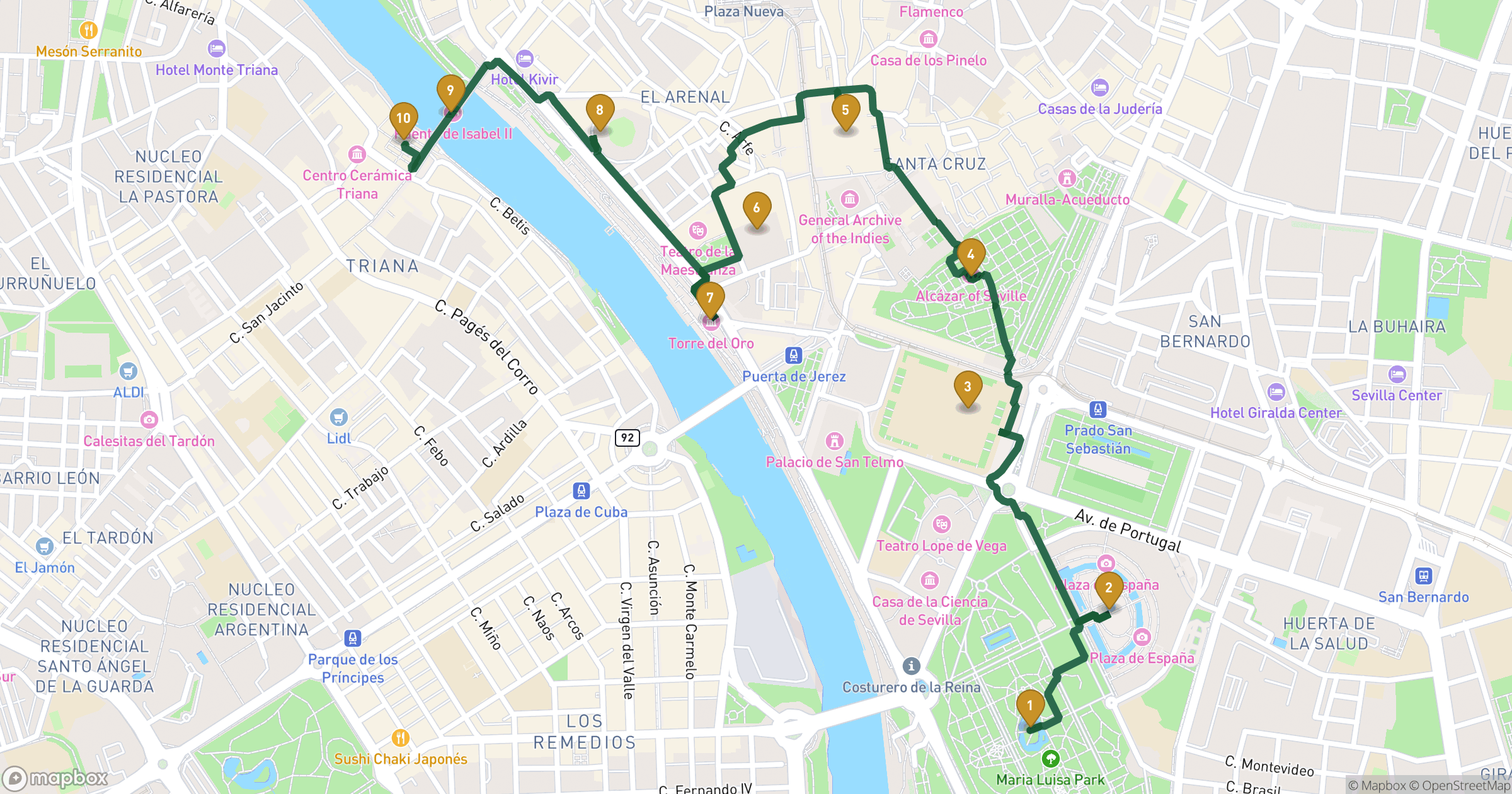
Map for Seville walking tour with 10 stops
The static map shows the tour route with Parque de María Luisa, Plaza de España, Royal Tobacco Factory of Seville, Reales Alcázares, and 6 more stops.

Stops along the route

All stops on this self-guided tour at a glance.

  1. Parque de María Luisa in Seville
    Roberta Morea from Madrid / CC BY-SA 2.0

    1Parque de María LuisaPark

    Maria Luisa Park was transformed from the private gardens of the Palace of San Telmo into a Moorish-style public paradise for the 1929 Ibero-American Exposition. French landscape architect Jean-Claude Nicolas Forestier shaped its lush layout, replacing rigid forms with tiled fountains and orange trees. Among its pathways stands Lorenzo Coullaut-Valera’s 1911 monument to poet Gustavo Adolfo Bécquer, depicting Cupid alongside three allegorical women.

    Built: 1914 · Style: Romanticism · Wikidata

  2. Plaza de España in Seville
    Carlos Delgado / CC BY-SA 4.0

    2Plaza de EspañaSquare

    Plaza de España showcases Seville’s grand architectural ambitions through a semi-circular blend of 1920s Art Deco, Renaissance, and Mudéjar styles. Designed by Aníbal González as the centerpiece of the 1929 Expo, it features 48 tiled alcoves representing the Spanish provinces. Four bridges named after the ancient kingdoms of Castile, Aragon, León, and Navarre cross the moat beneath its facade.

    Built: 1928 · Architect: Aníbal González · Style: regionalist architecture in Spain · Named after: Spain · Wikidata

  3. Royal Tobacco Factory of Seville in Seville
    Anual / CC BY-SA 4.0

    3Royal Tobacco Factory of SevilleBuilding

    The Royal Tobacco Factory reveals an 18th-century industrial powerhouse disguised as an imposing Baroque fortress. Built on a former Roman cemetery known as the 'land of the skulls', engineer Ignacio Sala had to redirect the Tagarete stream to secure its foundations. Surrounded by a moat to deter smuggling, it famously employed female cigar rollers before becoming the University of Seville.

    Built: 1728 · Style: baroque architecture · Wikidata

  4. Reales Alcázares in Seville
    Cat from Sevilla, Spain / CC BY 2.0

    4Reales AlcázaresCastle

    The Alcázar of Seville highlights centuries of royal power layered over a 10th-century citadel initiated by Abd al-Rahman III. King Pedro I commissioned Moorish artisans from Granada and Toledo during the 1360s to craft the Mudéjar interiors seen throughout the palace. Today, the complex still serves as an official residence for the Spanish royal family during their visits to the city.

    Built: 1364 · Style: Art of Al-Andalus · Wikidata

  5. Seville Cathedral in Seville
    Weldon Kennedy from London, UK / CC BY 2.0

    5Seville CathedralChurch

    The Cathedral of Seville stands over the footprint of a 12th-century Almohad mosque, built to prove the audacious ambition of 15th-century church leaders. The original minaret survives as the Giralda bell tower, alongside the Orange Tree Courtyard once used for ritual ablutions. Inside, Christopher Columbus lies in an elevated monument supported by four sculpted figures representing Spain's historic kingdoms.

    Built: 1402 · Style: Gothic architecture · Height: 105 m · Wikidata

  6. Hospital de la Santa Caridad in Seville
    Holger Uwe Schmitt / CC BY-SA 4.0

    6Hospital de la Santa CaridadMuseum

    Hospital de la Santa Caridad embodies the dramatic personal redemption of Miguel de Mañara, a 17th-century nobleman rumored to have inspired Don Juan. Following a chilling vision of his own funeral, he turned the building into a refuge for the poor and dying. Four of Murillo’s original eight charity canvases still hang in Saint George's church, while the rest were looted during Napoleonic rule.

    Built: 1682 · Style: Baroque · Wikidata

  7. Torre del Oro in Seville
    kallerna / CC BY-SA 4.0

    7Torre del OroTower

    The Torre del Oro guarded medieval river traffic along the Guadalquivir from the moment Almohad governor Abu l-Ulà built it in 1221. Its famous golden shimmer did not come from American treasure, but from an ordinary blend of mortar, lime, and pressed hay reflected on the water. In 1248, Castilian commander Ramón de Bonifaz breached the defensive iron chain once attached to this twelve-sided base.

    Built: 1221 · Style: Art of Al-Andalus … · Height: 36.8 m · Wikidata

  8. Plaza de toros de la Maestranza in Seville
    Vincenzo venditti / CC BY-SA 3.0 es

    8Plaza de toros de la MaestranzaBuilding

    Plaza de Toros de la Real Maestranza captures the Baroque elegance of Seville's bullfighting tradition, rising upon Baratillo Hill from 1749 onward. Work stalled repeatedly, most notably in 1786 when King Carlos III completely banned the spectacle, dragging construction out over 130 years. Overhead, the Prince's Box displays a half-orange vault faced in blue and white tiles by sculptor Cayetano de Acosta.

    Built: 1881 · Style: baroque architecture · Wikidata

  9. Isabel II Bridge in Seville
    Anual / CC BY 3.0

    9Isabel II Bridge

    Isabel II Bridge connects central Seville to Triana, marking the city's leap into industrial-age engineering upon its 1852 completion. It replaced a precarious floating pontoon crossing of chained boats that had served the river crossing since the Moors introduced it in the 12th century. The iron span stretches across the Canal de Alfonso XIII, affording wide vistas toward the Cathedral and Torre del Oro.

    Built: 1852 · Named after: Isabella II of Spain · Wikidata

  10. Mercado de Triana in Seville
    Chabe01 / CC BY-SA 4.0

    10Mercado de TrianaMarket

    Mercado de Triana is a bustling neighborhood food market built directly above the subterranean remnants of the Castle of San Jorge. The fortress once served as the fearsome headquarters of the Spanish Inquisition before the city approved a market design by Tomás de Escacena y Anaya in 1823. A 1983 renovation uncovered the forgotten medieval fortress walls, which remain preserved under the current 2001 facility.

    Wikidata

Download the app

This public page shows a preview. The full route, all content, and navigation are available in CityTour AI.

Cities nearby

Discover self-guided tours in nearby cities.

Frequently asked questions

The key answers before you start.

Is this a self-guided audio tour?

Yes. In the CityTour AI app (iOS and Android), this is a self-guided audio tour for Seville — start anytime, at your own pace, with map, stops, and audio narration.

What will you see on this tour?

On this tour you'll see, among others, Parque de María Luisa, Plaza de España, Royal Tobacco Factory of Seville, Reales Alcázares, Seville Cathedral, Hospital de la Santa Caridad and more sights.

Where does the tour start?

The route starts at Parque de María Luisa and ends at Mercado de Triana. You can start anytime — the app guides you to the first stop.

How long does the tour take?

About 105 minutes for 10 stops — at your own pace, with breaks whenever you like.

How much does the tour cost?

This tour costs 15 credits. The exact price depends on the pack you buy and your country — roughly $5.

Is it an outdoor tour — are entry tickets included?

Yes, it's an outdoor tour: the sights are viewed from the outside. Entry tickets are not included, and step-free access cannot be guaranteed.

Is the audio guide available in my language?

The tour and audio guide are available in English, Deutsch, Français, Español, Italiano and 9 more languages. You pick your language in the app.

Can I use the tour offline?

Yes. Tours can be used offline.

Can I ask the AI questions along the way?

Yes. At every stop you can ask the AI directly if you want to know more or didn't understand something.