CityTour AI

Palma self-guided walking tour

Palma's Stone Treasures: Of Kings and Tiles

Discover Palma beyond the postcard views on a witty stroll through the centuries. From the massive cathedral walls to the curious curves of Mallorcan Modernisme, experience the architectural diversity of this Mediterranean gem. This walk blends historical landmarks with hidden courtyards, telling the story of a city that constantly reinvents itself.

Audio tourSelf-guidediOS & Android
104minutes
3.1 kmdistance
13stops
Audio guideFormat
Palma's Stone Treasures: Of Kings and Tiles
Foto Fitti / CC BY-SA 3.0

Stops on this route

This tour works well for first-time visitors, weekend trips, and travelers who want to explore Palma without a fixed tour time.

Route map for Palma walking tour
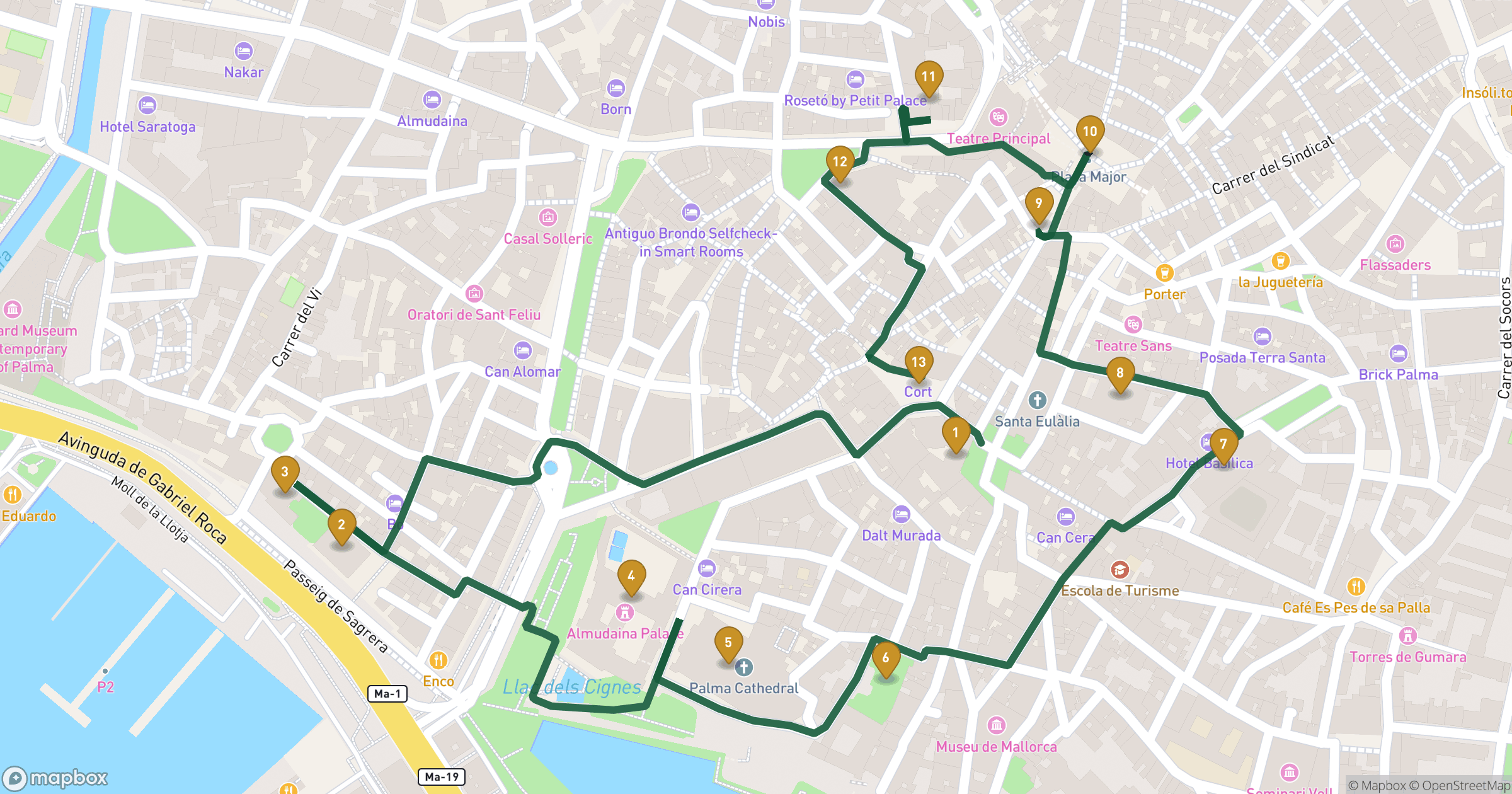
Map for Palma walking tour with 13 stops
The static map shows the tour route with Palma City Council, Llotja de Palma, Consolat de Mar de Palma, Royal Palace of La Almudaina, and 9 more stops.

Stops along the route

All stops on this self-guided tour at a glance.

  1. Palma City Council in Palma
    Foto Fitti / CC BY-SA 3.0

    1Palma City Council

    Palma City Council stands out with a striking facade completed by 1680 beneath an oversized wooden roof known as Ses Paparres. Carved caryatids and grotesque figures peer down from the eaves as if awaiting civic scandals. Outside sits the Banc de si no fos, legendary gathering spot for idle locals claiming they would work if not for some excuse.

    Built: 1718 · Wikidata

  2. Llotja de Palma in Palma
    Enric / CC BY-SA 4.0

    2Llotja de PalmaAttraction

    Llotja de Palma is the 15th-century maritime trade exchange whose architect, Guillem Sagrera, took from 1426 until 1447 instead of the contracted twelve years to finish it. Six slender, spiral columns rise directly into ribbed vaulting without capitals, creating the look of a petrified palm grove. Over the main portal, the Ángel de la Mercadería clutches a carved scroll.

    Style: Catalan Gothic … · Wikidata

  3. Consolat de Mar de Palma in Palma
    Enric / CC BY-SA 4.0

    3Consolat de Mar de Palma

    Consolat de Mar reveals how 17th-century merchants built a seaside Renaissance palace for discreet meetings after finding the Llotja too drafty. Under the Crown of Aragon, it operated as a maritime court settling bitter disputes over piracy and bad rum. Its prominent seafront loggia remains a key feature as the building now hosts the Balearic regional government.

    Style: Renaissance architecture · Wikidata

  4. Royal Palace of La Almudaina in Palma
    Antoni I. Alomar Canyelles / CC BY-SA 3.0

    4Royal Palace of La AlmudainaCastle

    The Almudaina Palace showcases royal architectural recycling, built over a Moorish fortress named Zuda by order of King James II between 1309 and 1314. High atop the tallest tower, a statue of the Archangel Gabriel doubles as a wind-swept weather vane. Inside, the Romanesque portal of St. Anne's Chapel contrasts with the surrounding Gothic and Moorish defenses.

    Named after: Almudaina · Wikidata

  5. Palma Cathedral in Palma
    Sergiy Galyonkin from Raleigh, USA | Cathederal de Mallorca / CC BY-SA 2.0

    5Palma CathedralChurch

    Palma Cathedral, known locally as La Seu, was founded in 1229 after James I vowed during a storm at sea to build a church if he survived. Its 12-meter-wide Gothic Eye rose window projects an illuminated figure eight on opposite walls twice a year, on February 2 and November 11. Antoni Gaudí later reshaped the choir and added a hanging canopy resembling a crown of thorns.

    Built: 1228 · Style: Gothic architecture · Named after: virgin birth of Jesus · Wikidata

  6. Jardí del Bisbe in Palma
    © Ralf Roletschek - Fahrradtechnik und Fotografie / FAL

    6Jardí del BisbePark

    Jardí del Bisbe offers a serene retreat arranged in the traditional layout of a Majorcan manor, featuring fruit trees, vegetables, and ornamentals. Restored and opened to the public in 2000, it previously served as the bishop's private sanctuary overlooking water lilies. Traditional irrigation systems recall the island's Arab past, with views of the cathedral behind.

    Wikidata

  7. Basilica of St. Francis in Palma
    A.Savin / FAL

    7Basilica of St. FrancisChurch

    The Basilica of Sant Francesc dates back to 1281 under King Jaume II, though its ornate portal by Francisco de Herrera reflects 17th-century Baroque grandeur. Behind the altar rests Ramon Llull, the 13th-century philosopher whose tomb was crafted by Francesc Sagrera. Outside the church stands a monument to Junípero Serra before his 18th-century journey to California.

    Style: baroque architecture … · Named after: Francis of Assisi · Wikidata

  8. Can Vivot in Palma
    Enric / CC BY-SA 4.0

    8Can VivotBuilding

    Can Vivot conceals behind heavy wooden gates one of Palma's grandest courtyards, remodeled by Joan Sureda i Villalonga after surviving a death sentence in Barcelona. Following his return in 1714 as Marquis of Vivot, he added round red marble columns with Corinthian capitals and an imperial staircase. The mansion incorporates an Islamic cellar below street level.

    Wikidata

  9. Can Forteza Rey in Palma
    MiguelAlanCS / CC BY-SA 4.0

    9Can Forteza ReyBuilding

    Can Forteza Rey brings vibrant Modernisme to Palma through the vision of jeweller Lluís Forteza-Rey, who completed the residence in 1908. Using the colourful trencadís broken-tile technique, the facade swirls with floral motifs and animal designs. Between second-floor windows, a grotesque carved face glares out flanked by a pair of winged dragons.

    Built: 1908 · Style: Art Nouveau architecture · Wikidata

  10. Plaça Major in Palma
    Enric / CC BY-SA 4.0

    10Plaça MajorSquare

    Plaça Major marks the former site of the Inquisition's headquarters, which stood here until its demolition in 1823. Yellow facades, green shutters, and symmetrical arcades finally enclosed the rectangular plaza well into the 20th century. Modern life was added below ground during the 1960s with an underground shopping center and parking garage.

    Wikidata

  11. Gran Hotel in Palma
    Pérez / CC BY-SA 4.0

    11Gran HotelMuseum

    The Gran Hotel introduced modern luxury tourism to Majorca when it opened in 1903 as the island's first hotel with electricity and telephones. Designed by Lluís Domènech i Montaner with ceramic tiles and floral sculptures, it was later closed in 1941 to house a social security office. A 1990s restoration reopened its walled-up arcades, turning it into a cultural center.

    Built: 1903 · Architect: Lluís Domènech i Montaner · Style: Art Nouveau architecture · Wikidata

  12. Can Casasayas in Palma
    Enric / CC BY-SA 4.0

    12Can CasasayasBuilding

    Can Casasayas consists of two undulating 1908–1911 twin buildings commissioned by Josep Casasayas Casajuana, owner of the Frasquet pastry shop. Architects Francesc Roca Simó and Guillem Reynés Font drew inspiration from Gaudí's Casa Batlló with wave-like sandstone walls. City council rejected plans for an upper-floor bridge across Carrer de Santacília in 1909.

    Architect: Francisco Roca Simó · Wikidata

  13. Plaça de Cort in Palma
    Foto Fitti / CC BY-SA 3.0

    13Plaça de CortSquare

    Plaça de Cort marks Majorca's geographic Kilometer Zero, named after the courts and curias that convened here since the 13th century. On the town hall facade, stonemasons carved a tiny snail and lizard, supposedly mocking the slow-paying city fathers. In the center stands the Olivera de Cort, an ancient four-ton olive tree transplanted from Pollença in 1989.

    Wikidata

Download the app

This public page shows a preview. The full route, all content, and navigation are available in CityTour AI.

Cities nearby

Discover self-guided tours in nearby cities.

Frequently asked questions

The key answers before you start.

Is this a self-guided audio tour?

Yes. In the CityTour AI app (iOS and Android), this is a self-guided audio tour for Palma — start anytime, at your own pace, with map, stops, and audio narration.

What will you see on this tour?

On this tour you'll see, among others, Palma City Council, Llotja de Palma, Consolat de Mar de Palma, Royal Palace of La Almudaina, Palma Cathedral, Jardí del Bisbe and more sights.

Where does the tour start?

The route starts at Palma City Council and ends at Plaça de Cort. You can start anytime — the app guides you to the first stop.

How long does the tour take?

About 104 minutes for 13 stops — at your own pace, with breaks whenever you like.

How much does the tour cost?

This tour costs 15 credits. The exact price depends on the pack you buy and your country — roughly $5.

Is it an outdoor tour — are entry tickets included?

Yes, it's an outdoor tour: the sights are viewed from the outside. Entry tickets are not included, and step-free access cannot be guaranteed.

Is the audio guide available in my language?

The tour and audio guide are available in English, Deutsch, Français, Español, Italiano and 9 more languages. You pick your language in the app.

Can I use the tour offline?

Yes. Tours can be used offline.

Can I ask the AI questions along the way?

Yes. At every stop you can ask the AI directly if you want to know more or didn't understand something.