CityTour AI

Barcelona self-guided walking tour

Barcelona Unveiled: From Modernisme to Roman Roots

Trace the evolution of Barcelona from its flamboyant 19th-century expansion to its ancient Roman foundations. You will wander past the wavy stone facades of Gaudí’s masterpieces, navigate the bustling stalls of a world-famous market, and lose yourself in the atmospheric shadows of the Gothic Quarter. This casual stroll captures the city’s unique blend of avant-garde creativity and two thousand years of layered history.

Audio tourSelf-guidediOS & Android
104minutes
3.4 kmdistance
12stops
Audio guideFormat
Barcelona Unveiled: From Modernisme to Roman Roots
Thomas Ledl / CC BY-SA 4.0

Stops on this route

This tour works well for first-time visitors, weekend trips, and travelers who want to explore Barcelona without a fixed tour time.

Route map for Barcelona walking tour
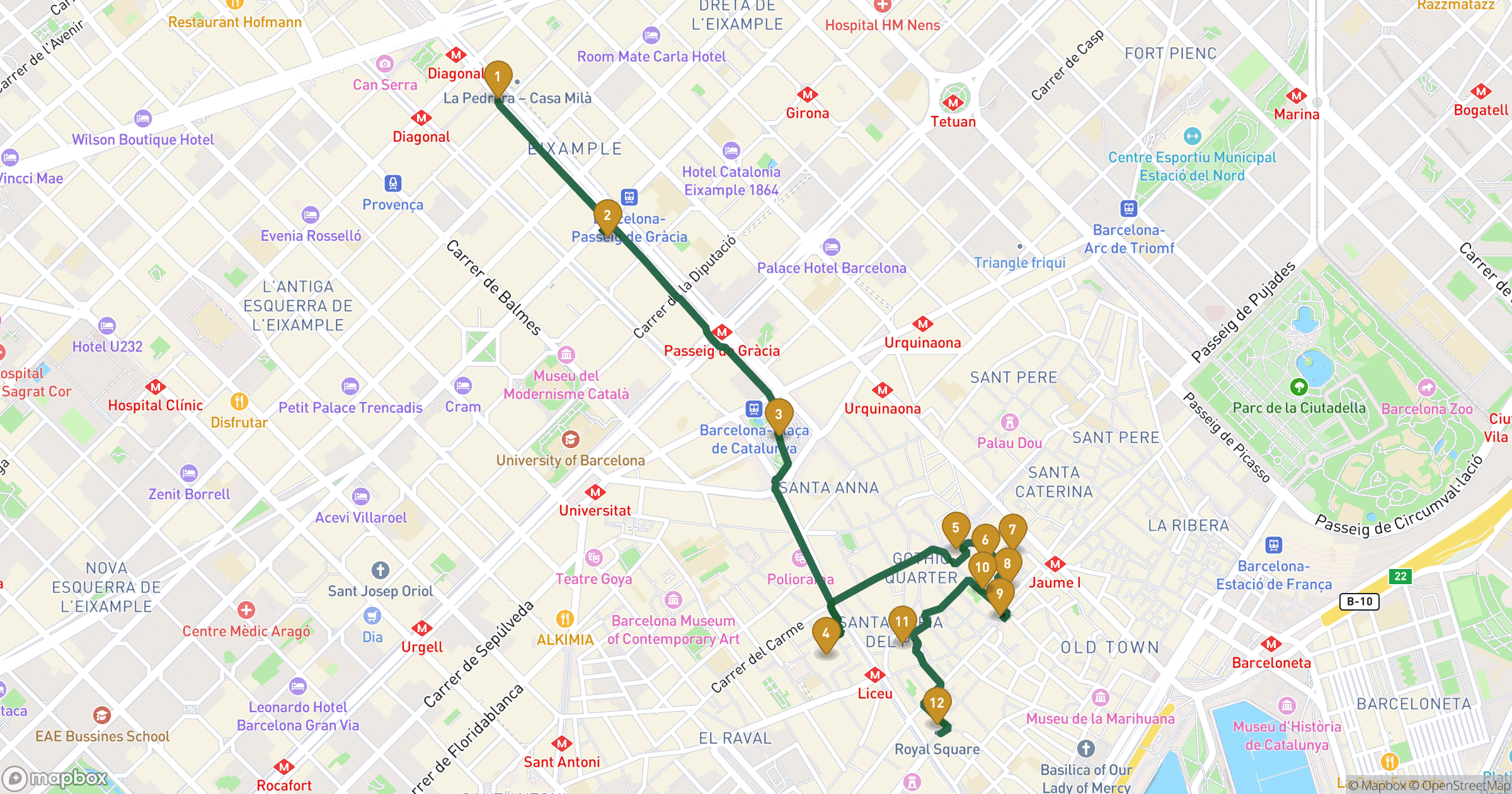
Map for Barcelona walking tour with 12 stops
The static map shows the tour route with Casa Milà, Casa Batlló, Plaça de Catalunya, La Boqueria, and 8 more stops.

Stops along the route

All stops on this self-guided tour at a glance.

  1. Casa Milà in Barcelona
    Thomas Ledl / CC BY-SA 4.0

    1Casa MilàBuilding

    Casa Milà, known to locals as La Pedrera, was designed by Antoni Gaudí with an undulating stone facade devoid of straight lines. When Roser Segimon complained about placing her piano along curved walls, Gaudí suggested she play the violin instead. On the roof, chimneys resembling warrior sentinels stand clad in broken ceramic and glass.

    Built: 1906 · Architect: Antoni Gaudí · Style: Catalan modernism · Named after: Pere Milà i Camps · Wikidata

  2. Casa Batlló in Barcelona
    Mike McBey / CC BY 2.0

    2Casa BatllóMonument

    Casa Batlló presents Antoni Gaudí's fantastical reimagining of an 1877 apartment block on the Block of Discord. Balconies shaped like skulls and columns mimicking femurs earned the structure its nickname as the House of Bones. High above the mosaic facade, the scaly roofline and four-armed cross evoke the dragon slain by Catalonia's patron, Saint George.

    Built: 1877 · Architect: Antoni Gaudí · Style: Catalan modernism · Named after: Josep Batlló i Casanovas · Wikidata

  3. Plaça de Catalunya in Barcelona
    Sergi Larripa (User:SergiL) / CC BY-SA 3.0

    3Plaça de CatalunyaSquare

    Plaça de Catalunya stands at the junction between the Old City and the grid of the Eixample. Urbanized in 1902, the square features Josep Clarà's serene sculpture Deessa alongside a monument honoring former Catalan president Francesc Macià. In May 1937, during the Spanish Civil War, rival factions fought here over the corner telephone exchange building.

    Named after: Catalonia · Wikidata

  4. La Boqueria in Barcelona
    Thingstodoinbarcelona / CC BY-SA 4.0

    4La BoqueriaMarket

    La Boqueria market began in 1217 as an outdoor collection of meat stalls near the old city gate. The site likely took its name from the Catalan word boc, referencing the goat meat sold here centuries ago. Architect Mas Vilá designed the market hall that opened in 1853, topped later in 1914 by its cast-iron Modernista roof.

    Built: 1914 · Style: Catalan modernism … · Wikidata

  5. Roman walls of Barcelona in Barcelona
    Enric / CC BY-SA 4.0

    5Roman walls of BarcelonaMonument

    The Roman Wall reveals the ancient defensive circuit of Barcino, founded by Emperor Augustus on Mount Tàber. While initial fortifications date to the 1st century BC, most visible sections stem from a 4th-century AD upgrade featuring walls four meters thick and 74 towers. Roman builders constructed the masonry partly out of recycled stones taken from older monuments and cemeteries.

    Built: 300 · Style: ancient Roman architecture · Wikidata

  6. Cathedral of the Holy Cross and Saint Eulalia in Barcelona
    Fernando / CC BY-SA 4.0

    6Cathedral of the Holy Cross and Saint EulaliaChurch

    The Cathedral of Santa Eulalia serves as the seat of Barcelona's archbishop, constructed primarily between 1298 and the mid-15th century. Saint Eulalia suffered 13 Roman tortures for her faith, including being rolled down a street inside a knife-filled barrel. The cloister today houses 13 white geese matching her age, while the choir stalls preserve coats of arms from a 1519 Habsburg assembly.

    Built: 1298 · Architect: Jaume Solà, Bertran Riquer … · Style: historicist architecture … · Height: 80 m · Wikidata

  7. plaça del Rei in Barcelona
    C messier / CC BY-SA 4.0

    7plaça del ReiSquare

    Plaça del Rei formed the center of royal authority for the Counts of Barcelona and Kings of Aragon. Here, King Ferdinand and Queen Isabella reportedly received Christopher Columbus on the steps in 1493 following his return from the Americas. To clear space for Via Laietana in the 1930s, the 15th-century Casa Padellàs was moved stone by stone to this Gothic square.

    Style: Gothic architecture · Named after: Palau Reial Major · Wikidata

  8. Temple of Augustus in Barcelona in Barcelona
    Enfo / CC BY-SA 3.0

    8Temple of Augustus in BarcelonaMuseum

    The Temple of Augustus survives in a hidden courtyard on Carrer del Paradís atop the modest rise of Mont Tàber. Four 1,900-year-old Corinthian sandstone columns reach nearly nine meters high, once embedded within surrounding medieval houses. Architect Josep Puig i Cadafalch studied the site and retrieved the fourth column from Plaça del Rei to reunite the set.

    Wikidata

  9. Plaça Sant Jaume in Barcelona
    Axelv / CC BY-SA 3.0

    9Plaça Sant JaumeSquare

    Plaça de Sant Jaume preserves its role as the administrative hub where the Roman Cardo and Decumanus once intersected. The square took form in 1823 after the demolition of an older church whose porch had served as the council meeting place. Across the open space, the Catalan government seat displays a Renaissance facade with Saint George slaying the dragon.

    Wikidata

  10. Bishops Bridge in Barcelona
    Llull / CC BY-SA 2.0

    10Bishops BridgeBuilding

    The Pont del Bisbe connects buildings in the Gothic Quarter despite having been erected recently in 1928 by Joan Rubió i Bellver. Disgruntled by the rejection of his wider urban plans, the architect carved a marble skull pierced by a bronze dagger beneath the arch. Superstition holds that Barcelona will fall if the dagger is ever removed.

  11. Basilica of Our Lady of the Pine Tree in Barcelona
    Adam Jones from Kelowna, BC, Canada / CC BY-SA 2.0

    11Basilica of Our Lady of the Pine TreeChurch

    Santa Maria del Pi stands out for the Catalan Gothic design of its single broad nave, named after an image of Mary discovered in a pine. Its original 14th-century rose window was destroyed when anarchists burned the building in 1936, prompting a faithful ten-meter reconstruction in the 1940s. Master builder Bartomeu Mas oversaw work on the 54-meter octagonal bell tower from 1460 until 1497.

    Built: 1320 · Style: Gothic architecture · Height: 54 m · Named after: Mary, Pinus · Wikidata

  12. Royal Square in Barcelona
    Paux127 / CC BY-SA 4.0

    12Royal Square

    Plaça Reial is a neoclassical plaza laid out by Francesc Daniel Molina i Casamajó after the demolition of a Capuchin convent in 1835. The two central lampposts were Antoni Gaudí's first professional commission, completed in 1878 following his graduation. Gaudí topped these fixtures with winged helmets and the caduceus of Mercury to evoke the city's maritime trade.

    Built: 1850 · Architect: Francesc Daniel Molina i Casamajó · Style: Neoclassical architecture · Named after: monarchy · Wikidata

Download the app

This public page shows a preview. The full route, all content, and navigation are available in CityTour AI.

Cities nearby

Discover self-guided tours in nearby cities.

Frequently asked questions

The key answers before you start.

Is this a self-guided audio tour?

Yes. In the CityTour AI app (iOS and Android), this is a self-guided audio tour for Barcelona — start anytime, at your own pace, with map, stops, and audio narration.

What will you see on this tour?

On this tour you'll see, among others, Casa Milà, Casa Batlló, Plaça de Catalunya, La Boqueria, Roman walls of Barcelona, Cathedral of the Holy Cross and Saint Eulalia and more sights.

Where does the tour start?

The route starts at Casa Milà and ends at Royal Square. You can start anytime — the app guides you to the first stop.

How long does the tour take?

About 104 minutes for 12 stops — at your own pace, with breaks whenever you like.

How much does the tour cost?

This tour costs 15 credits. The exact price depends on the pack you buy and your country — roughly $5.

Is it an outdoor tour — are entry tickets included?

Yes, it's an outdoor tour: the sights are viewed from the outside. Entry tickets are not included, and step-free access cannot be guaranteed.

Is the audio guide available in my language?

The tour and audio guide are available in English, Deutsch, Français, Español, Italiano and 9 more languages. You pick your language in the app.

Can I use the tour offline?

Yes. Tours can be used offline.

Can I ask the AI questions along the way?

Yes. At every stop you can ask the AI directly if you want to know more or didn't understand something.