CityTour AI

Valencia self-guided walking tour

Gothic Grandeur and Art Nouveau: Valencia’s Architectural Soul

Step into the heart of Valencia on a journey that spans from its medieval 'Golden Age' to the vibrant heights of Valencian Art Nouveau. You’ll explore iconic Gothic landmarks, hidden circular plazas, and opulent palaces while soaking in the casual, sun-drenched atmosphere of the Old Town. This walk captures the city’s transition from a silk-trading powerhouse to a modern Mediterranean gem.

Audio tourSelf-guidediOS & Android
104minutes
3.5 kmdistance
12stops
Audio guideFormat
Gothic Grandeur and Art Nouveau: Valencia’s Architectural Soul
Diego Delso / CC BY-SA 3.0

Stops on this route

This tour works well for first-time visitors, weekend trips, and travelers who want to explore Valencia without a fixed tour time.

Route map for Valencia walking tour
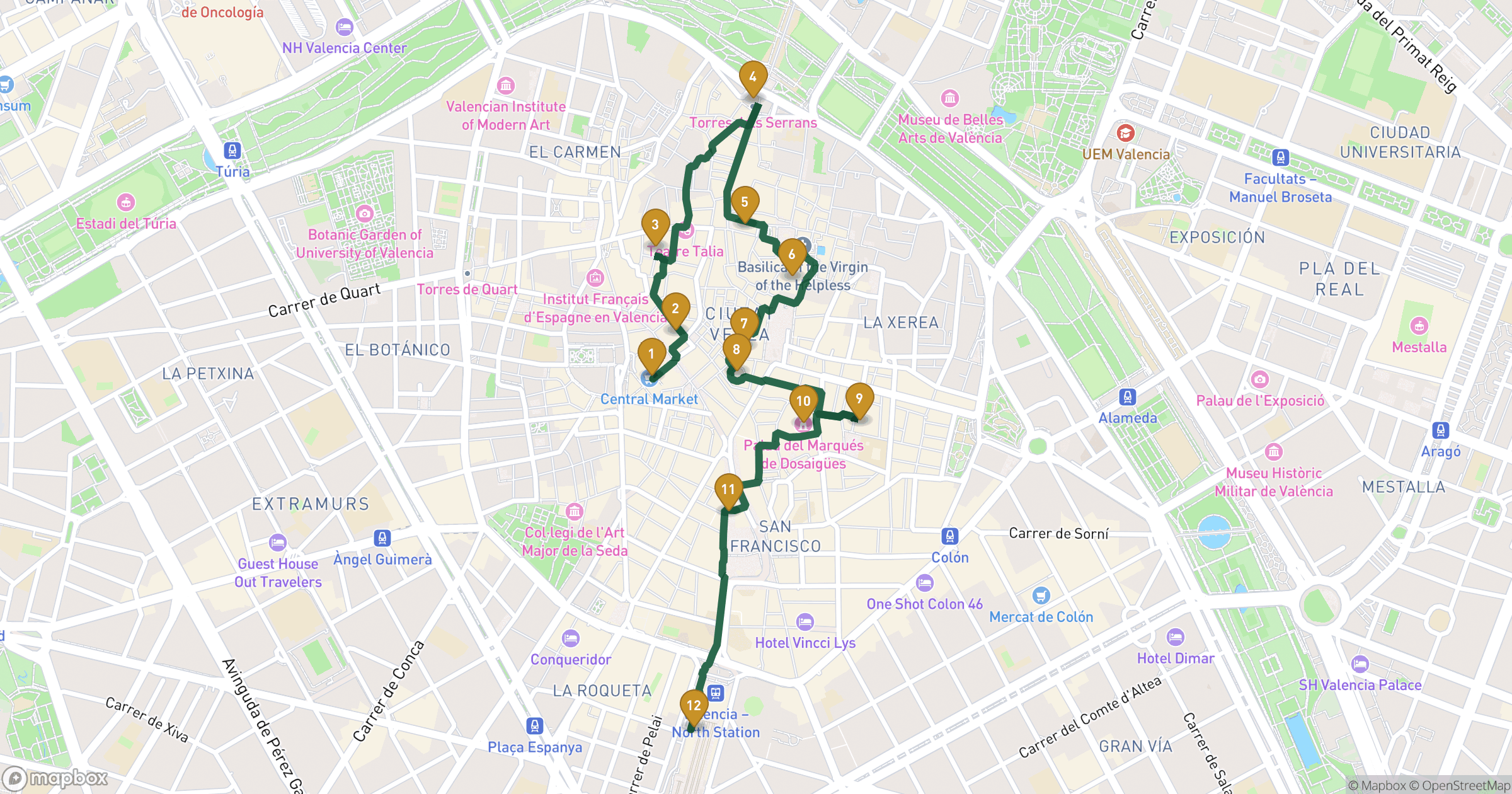
Map for Valencia walking tour with 12 stops
The static map shows the tour route with Mercat Central, Llotja de la Seda, Church of San Nicolás, Torres dels Serrans, and 8 more stops.

Stops along the route

All stops on this self-guided tour at a glance.

  1. Mercat Central in Valencia
    Sjaak Kempe from Groningen, The Netherlands / CC BY 2.0

    1Mercat CentralMarket

    Mercat Central presents a grand cathedral-like temple of food built in the Valencian Art Nouveau style. Alexandre Soler March and Francesc Guàrdia Vidal won the 1910 design contest, bringing ideas from Barcelona that Enric Viedma Vidal eventually completed in 1928. The sprawling roof covers over 8,000 square meters with varied domes, polychrome tiles, and stained glass.

    Built: 1914 · Architect: Ángel Romaní Verdeguer, Francesc Guàrdia i Vial … · Style: Valencian Art Nouveau … · Wikidata

  2. Llotja de la Seda in Valencia
    Juan Mayordomo / CC BY-SA 4.0

    2Llotja de la SedaAttraction

    The Silk Exchange showcases the zenith of Valencia's 15th-century golden age of civic Gothic architecture. Master builder Pere Compte completed the Trading Hall in just fifteen years, filling it with twisted columns soaring over 17 meters into vaulted ceilings. A grim central tower also served as a prison for merchants unable to pay their debts.

    Architect: Pere Compte · Style: Valencian Gothic · Height: 17.4 m · Heritage status: World Heritage Site · Wikidata

  3. Church of San Nicolás in Valencia
    Joanbanjo / CC BY-SA 3.0

    3Church of San Nicolás

    The Church of Sant Nicolau de Bari and Sant Pere Màrtir hides an extraordinary Baroque transformation beneath a modest Gothic exterior. Designed by Antonio Palomino, the frescoes covering the vault were executed by his disciple Dionís Vidal to depict the titular saints. A ceramic plaque outside recalls Saint Vincent Ferrer's fulfilled prophecy that rector Alfonso de Borgia would become Pope.

    Style: Valencian Gothic · Named after: Saint Peter · Wikidata

  4. Torres dels Serrans in Valencia
    Felivet / Public domain

    4Torres dels SerransCastle

    Torres dels Serrans guarded medieval Valencia as a premier ceremonial gate in the 14th-century Christian Wall. Architect Pere Balaguer examined famous fortifications like Morella's Porta de Sant Miquel before erecting these limestone-clad polygonal towers between 1392 and 1398. After a 1586 fire, the gate served as a noble prison for three centuries, which spared it from demolition in 1865.

    Built: 1400 · Architect: Pedro Balaguer · Style: Valencian Gothic · Wikidata

  5. Palau de la Generalitat Valenciana in Valencia
    Anual / CC BY 3.0

    5Palau de la Generalitat Valenciana

    The Palau de la Generalitat stands as an exceptional medieval survivor, remaining the seat of the institution that commissioned it in 1421. Local stone from Godella and Rocafort forms its halls alongside decorative ceramics from Manises and Paterna. The New Room features a carved wooden ceiling and royal portraits, while the tower was finished in the mid-20th century to match 15th-century plans.

    Built: 1500 · Style: Valencian Gothic · Wikidata

  6. Valencia Cathedral in Valencia
    Diego Delso / CC BY-SA 3.0

    6Valencia CathedralChurch

    Valencia Cathedral chronicles centuries of transformation, consecrated in 1238 over a former mosque that had supplanted a Visigothic predecessor. Its dedicated chapel houses the Holy Chalice, a purple agate cup widely associated with the Last Supper. Every Thursday at noon at the Apostles' Gate, eight black-robed farmers convene for the ancient Tribunal de las Aguas.

    Built: 1262 · Architect: Francesc Baldomar, Andreu Julià · Style: Valencian Gothic … · Height: 55 m · Wikidata

  7. Church of Santa Catalina, Valencia in Valencia
    Diego Delso / CC BY-SA 3.0

    7Church of Santa Catalina, Valencia

    The Church of Santa Catalina reflects a layered history built over an old mosque site right after the Reconquista. Juan Bautista Viñes designed its soaring five-level hexagonal bell tower between 1688 and 1705 over the exact footprint of the ancient minaret. A 2012 restoration removed a modern clock mechanism from the facade to reinstall the original bell silent since 1902.

    Built: 1201 · Named after: Catherine of Alexandria · Wikidata

  8. Plaça Redona in Valencia
    Joanbanjo / Public domain

    8Plaça RedonaSquare

    Plaça Redona is an unusual urban hideaway built around 1900 inside the dense street grid of the old town. Reached only through four narrow alleys, it forms a perfect cylinder bordered by a continuous, four-story yellow facade. In the center, a tall fountain illuminated by a single lamp stands encircled by wooden market stalls selling lace and embroidery.

    Built: 1900 · Wikidata

  9. Reial Col·legi Seminari de Corpus Christi in Valencia
    Felivet / Public domain

    9Reial Col·legi Seminari de Corpus ChristiBuilding

    El Patriarca embodies the Italian Renaissance's influence on Spanish architecture under the vision of Archbishop Juan de Ribera. Ribera was so drawn to the mystical trances of Franciscan nun Margarita Agullona that he housed her here for 25 years and placed an eternal lamp at her tomb. The complex also holds the world's only surviving copy of Petrus Plancius's 1592 world map.

    Built: 1586 · Architect: Guillem del Rey · Style: Renaissance architecture · Wikidata

  10. Palau del Marqués de Dos Aigües in Valencia
    Francesco Bini / CC BY-SA 4.0

    10Palau del Marqués de Dos AigüesCastle

    The Palau del Marqués de Dos Aigües displays the heights of Valencian Rococo opulence created for the Rabassa de Perellós family. Sculptors Hipólito Rovira and Ignacio Vergara fashioned the alabaster entrance into figures representing the Turia and Júcar rivers. Beneath the palace, 1743 renovations unearthed evidence of a 1st-century Roman necropolis.

    Built: 1500 · Architect: Hipólito Rovira, Ignacio Vergara · Style: Rococo · Wikidata

  11. Plaça de l'Ajuntament in Valencia
    Demiannnn / CC BY-SA 2.5

    11Plaça de l'AjuntamentSquare

    Plaça de l'Ajuntament embodies the rapid 20th-century civic reinventions of a space once known as the Bajada de San Francisco. Architect Javier Goerlich Lleó reshaped the plaza in 1931 with an elevated platform nicknamed the cake, along with an underground flower market despised by florists. The cake platform was later demolished under the post-war regime to accommodate military parades.

    Wikidata

  12. Estació del Nord in Valencia
    Public domain

    12Estació del NordBuilding

    Estació del Nord is a 1917 Art Nouveau railway terminus that celebrates regional agriculture. Architect Demetrio Ribes adorned the exterior with bright ceramic oranges, blossoms, and green leaves honoring surrounding orchards. The lobby features intricate wood carvings and mosaics welcoming passengers in dozens of languages.

    Built: 1917 · Architect: Demetrio Ribes · Style: Valencian Art Nouveau · Named after: Compañía de los Caminos de Hierro del Norte de España · Wikidata

Download the app

This public page shows a preview. The full route, all content, and navigation are available in CityTour AI.

Cities nearby

Discover self-guided tours in nearby cities.

Frequently asked questions

The key answers before you start.

Is this a self-guided audio tour?

Yes. In the CityTour AI app (iOS and Android), this is a self-guided audio tour for Valencia — start anytime, at your own pace, with map, stops, and audio narration.

What will you see on this tour?

On this tour you'll see, among others, Mercat Central, Llotja de la Seda, Church of San Nicolás, Torres dels Serrans, Palau de la Generalitat Valenciana, Valencia Cathedral and more sights.

Where does the tour start?

The route starts at Mercat Central and ends at Estació del Nord. You can start anytime — the app guides you to the first stop.

How long does the tour take?

About 104 minutes for 12 stops — at your own pace, with breaks whenever you like.

How much does the tour cost?

This tour costs 15 credits. The exact price depends on the pack you buy and your country — roughly $5.

Is it an outdoor tour — are entry tickets included?

Yes, it's an outdoor tour: the sights are viewed from the outside. Entry tickets are not included, and step-free access cannot be guaranteed.

Is the audio guide available in my language?

The tour and audio guide are available in English, Deutsch, Français, Español, Italiano and 9 more languages. You pick your language in the app.

Can I use the tour offline?

Yes. Tours can be used offline.

Can I ask the AI questions along the way?

Yes. At every stop you can ask the AI directly if you want to know more or didn't understand something.