CityTour AI

Basel self-guided walking tour

Basel: Medieval Gates and Modern Masterpieces

Explore the winding streets of Switzerland's cultural capital on a walk that bridges the gap between medieval fortifications and whimsical modern art. You'll discover the stories behind the city's iconic red sandstone landmarks, hidden Gothic fountains, and the bustling squares where local life has thrived for centuries. It’s a relaxed journey through Basel’s unique blend of Rhine-side charm and intellectual history.

Audio tourSelf-guidediOS & Android
103minutes
3.2 kmdistance
13stops
Audio guideFormat
Basel: Medieval Gates and Modern Masterpieces
Basler24 / CC BY-SA 3.0

Stops on this route

This tour works well for first-time visitors, weekend trips, and travelers who want to explore Basel without a fixed tour time.

Route map for Basel walking tour
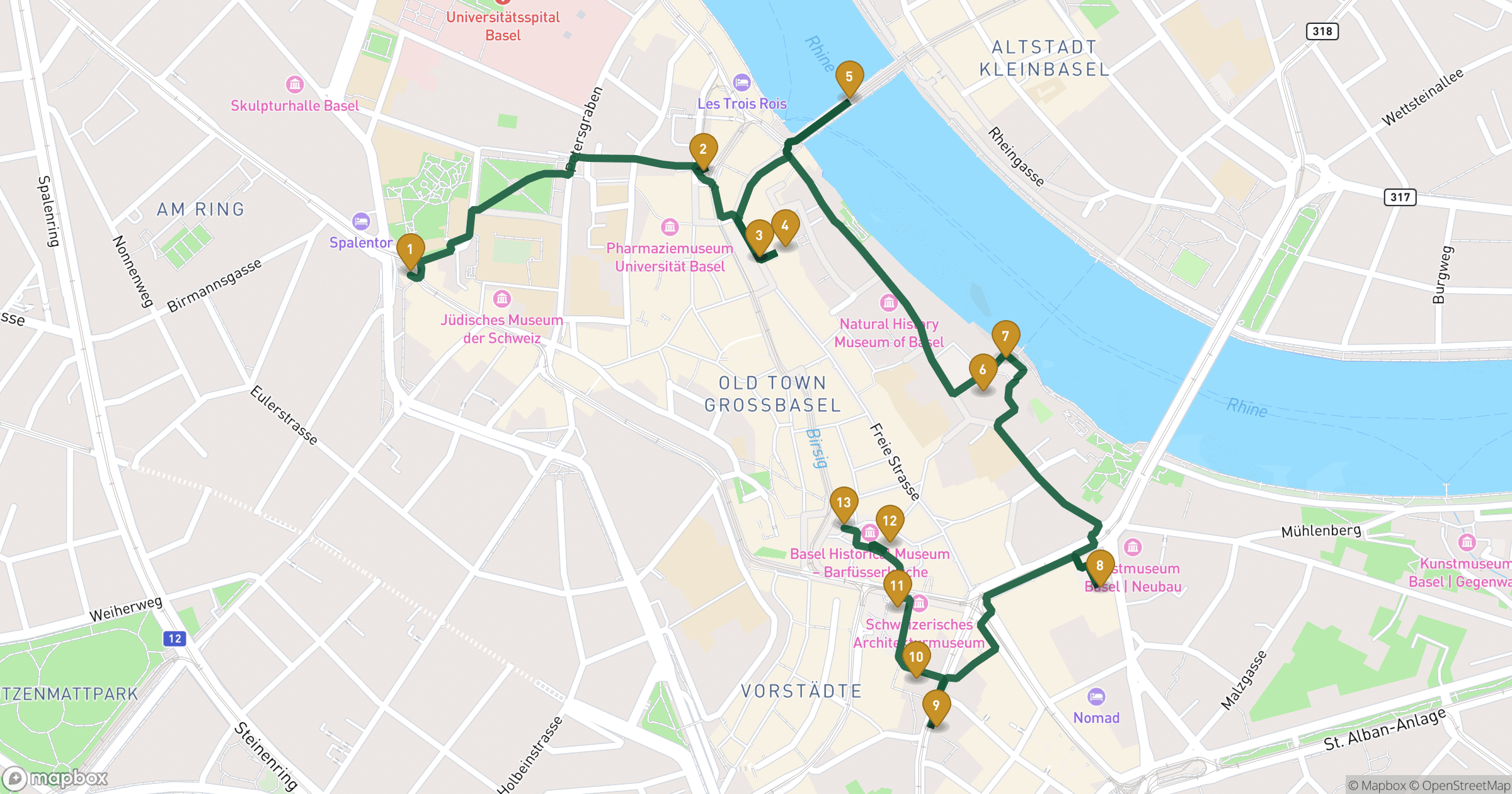
Map for Basel walking tour with 13 stops
The static map shows the tour route with Gate of Spalen, Fischmarktbrunnen, Marktplatz, Basel Town Hall, and 9 more stops.

Stops along the route

All stops on this self-guided tour at a glance.

  1. Gate of Spalen in Basel
    Zairon / CC BY-SA 4.0

    1Gate of SpalenCastle

    Spalentor showcases medieval defense strategies born out of disaster. Built around 1370 after the devastating 1356 earthquake leveled Basel, this square main tower is adorned with 15th-century statues of a Madonna and two prophets. Grooves for lowering the heavy iron portcullis remain visible, marking one of only three gates spared when the city walls were torn down.

    Wikidata

  2. Fischmarktbrunnen in Basel
    Niederkasseler / CC BY-SA 3.0

    2FischmarktbrunnenMonument

    The Fischmarktbrunnen stands at the historic center of local commerce on the Fischmarkt. Carved in the 1390s, the original fountain was moved to the Basel Historical Museum to protect its detailed carvings of the Virgin Mary, Saint Peter, and Saint John the Evangelist. In the past, fishmongers stored their daily catch from the Rhine alive inside the water basin until sold.

    Wikidata

  3. Marktplatz in Basel
    Niederkasseler / CC BY-SA 3.0

    3Marktplatz

    Marktplatz acts as the primary trading hub and civic gathering ground of Basel. Lined by traditional guild houses alongside modern commercial structures, it highlights the city's shift into a pharmaceutical and chemical powerhouse. Most days of the week, the square still functions as an open-air market for flowers and regional produce right outside the seat of government.

    Wikidata

  4. Basel Town Hall in Basel
    Wladyslaw Sojka / CC BY-SA 3.0

    4Basel Town HallBuilding

    The Rathaus serves as Basel's political center, wrapped in red sandstone and Renaissance murals. Constructed between 1504 and 1514 to celebrate Basel joining the Swiss Confederation, the inner courtyard displays civic frescoes originally designed by Hans Holbein the Younger. A late 16th-century statue portrays Roman general Lucius Munatius Plancus, who founded Augusta Raurica.

    Style: Gothic architecture · Wikidata

  5. Mittlere Brücke in Basel
    Ermell / CC BY-SA 4.0

    5Mittlere BrückeBridge

    Mittlere Brücke highlights the economic boom sparked by a crucial Rhine crossing. Opened around 1225 by Bishop Heinrich von Thun, it stood as the sole bridge between Lake Constance and the North Sea for centuries, collecting tolls from trade merchants. The mid-bridge chapel, Käppelijoch, was once used for medieval capital punishment by throwing bound convicts into the river.

    Wikidata

  6. Basel Minster in Basel
    Karlheinz Klingbeil from Germany / CC BY 4.0

    6Basel MinsterChurch

    Basel Münster sits above the river Rhine, blending Romanesque foundations with Gothic architecture. After the 1356 earthquake toppled the choir, rebuilding produced towering spires, including Saint George's tower featuring a 14th-century dragon-slaying relief. Humanist scholar Erasmus of Rotterdam was buried here in 1536, and his red marble epitaph is preserved inside.

    Built: 1091 · Style: Gothic architecture · Height: 67.3 m · Wikidata

  7. Pfalz in Basel
    Michael Kramer / CC BY-SA 3.0

    7PfalzSquare

    Pfalz provides a panoramic terrace overlooking the Rhine from the site of the former bishop's residence. The overlook takes its name from the Latin word palatium and looks across the river toward Kleinbasel. Down below, swimmers carrying colorful, fish-shaped waterproof bags called Wickelfisch drift down the river alongside views stretching to the Black Forest and Vosges.

    Wikidata

  8. Kunstmuseum Basel in Basel
    User:Mattes / CC BY 2.0 de

    8Kunstmuseum Basel

    Kunstmuseum Basel hosts the world's oldest municipal art collection open to the public. Its foundations were laid in 1661 when Basel purchased the Amerbach Cabinet, securing a vast cache of works by Hans Holbein. In 1967, after local citizens voted in a referendum to purchase two loaned paintings, Pablo Picasso personally gifted four additional artworks to the city's youth.

    Built: 1661 · Architect: Rudolf Christ, Paul Bonatz · Wikidata

  9. Haus zum Kirschgarten in Basel
    Basler24 / CC BY-SA 3.0

    9Haus zum KirschgartenMuseum

    Haus zum Kirschgarten presents an opulent Neoclassical urban palace built between 1775 and 1780. Commissioned by 25-year-old silk ribbon manufacturer Johann Rudolf Burckhardt, the house featured an enclosed carriage entrance so visitors could arrive without stepping onto the street. Now part of the historical museum, it preserves original stuccoes, antique clocks, and porcelain.

    Wikidata

  10. Elisabethenkirche in Basel
    Norbert Aepli, Switzerland (User:Noebu) / CC BY 2.5

    10ElisabethenkircheChurch

    Elisabethenkirche stands as Switzerland's preeminent Neo-Gothic church despite dating only to the mid-19th century. Funded by wealthy philanthropist Christoph Merian and his wife Margaretha Burckhardt-Merian, the building houses both benefactors in its crypt. Outside its towering 72-meter spire, it operates today as an open church hosting cultural events, concerts, and a café.

    Style: Gothic Revival · Named after: Elizabeth · Wikidata

  11. Carnival Fountain in Basel
    Rokus Cornelis / CC BY 3.0

    11Carnival FountainBuilding

    Tinguely Fountain brings kinetic art and movement to the site of the city's demolished old theater. Created by Jean Tinguely in 1977, ten mechanical scrap-metal figures driven by low-voltage motors spray water in continuous motions. The moving water-spewing parts were deliberately modeled to mirror the gestures of stage actors, dancers, and the satirical spirit of Basel Carnival.

    Named after: Jean Tinguely, Carnival of Basel · Wikidata

  12. Barfüsserkirche in Basel
    Tilman2007 / CC BY-SA 4.0

    12BarfüsserkircheChurch

    Barfüsserkirche was constructed by 13th-century Franciscan monks who earned their name from vows of poverty and barefoot living. Following the 1529 Reformation, the Gothic sanctuary was converted into a salt warehouse, which slowly deteriorated the stone masonry. Today it houses the Basel Historical Museum, bearing a visibly off-center front window from 1890s remodeling work.

    Style: Gothic architecture · Wikidata

  13. Barfüsserplatz in Basel
    Roehrensee / CC BY-SA 3.0

    13BarfüsserplatzSquare

    Barfüsserplatz operates as a bustling intersection where eight tram routes cross over a concealed riverbed. Founded by Franciscans in 1256, it later served as an open marketplace locally dubbed Säublatz because livestock like pigs were traded here. The Birsig river was completely vaulted over beneath the square in 1529 to open up usable ground for urban development.

    Wikidata

Download the app

This public page shows a preview. The full route, all content, and navigation are available in CityTour AI.

Cities nearby

Discover self-guided tours in nearby cities.

Frequently asked questions

The key answers before you start.

Is this a self-guided audio tour?

Yes. In the CityTour AI app (iOS and Android), this is a self-guided audio tour for Basel — start anytime, at your own pace, with map, stops, and audio narration.

What will you see on this tour?

On this tour you'll see, among others, Gate of Spalen, Fischmarktbrunnen, Marktplatz, Basel Town Hall, Mittlere Brücke, Basel Minster and more sights.

Where does the tour start?

The route starts at Gate of Spalen and ends at Barfüsserplatz. You can start anytime — the app guides you to the first stop.

How long does the tour take?

About 103 minutes for 13 stops — at your own pace, with breaks whenever you like.

How much does the tour cost?

This tour costs 15 credits. The exact price depends on the pack you buy and your country — roughly $5.

Is it an outdoor tour — are entry tickets included?

Yes, it's an outdoor tour: the sights are viewed from the outside. Entry tickets are not included, and step-free access cannot be guaranteed.

Is the audio guide available in my language?

The tour and audio guide are available in English, Deutsch, Français, Español, Italiano and 9 more languages. You pick your language in the app.

Can I use the tour offline?

Yes. Tours can be used offline.

Can I ask the AI questions along the way?

Yes. At every stop you can ask the AI directly if you want to know more or didn't understand something.