CityTour AI

Lucerne self-guided walking tour

Bridges, Walls, and Guilds: The Heart of Lucerne

Experience the timeless charm of Lucerne on a walk that bridges the gap between medieval fortifications and vibrant city life. You’ll explore world-famous wooden bridges, ornate guild houses, and the massive stone walls that have protected this lakeside gem for centuries. It’s a relaxed journey through the history, art, and engineering that define the heart of Switzerland.

Audio tourSelf-guidediOS & Android
103minutes
3.2 kmdistance
12stops
Audio guideFormat
Bridges, Walls, and Guilds: The Heart of Lucerne
Friedhelm Dröge / CC BY-SA 3.0

Stops on this route

This tour works well for first-time visitors, weekend trips, and travelers who want to explore Lucerne without a fixed tour time.

Route map for Lucerne walking tour
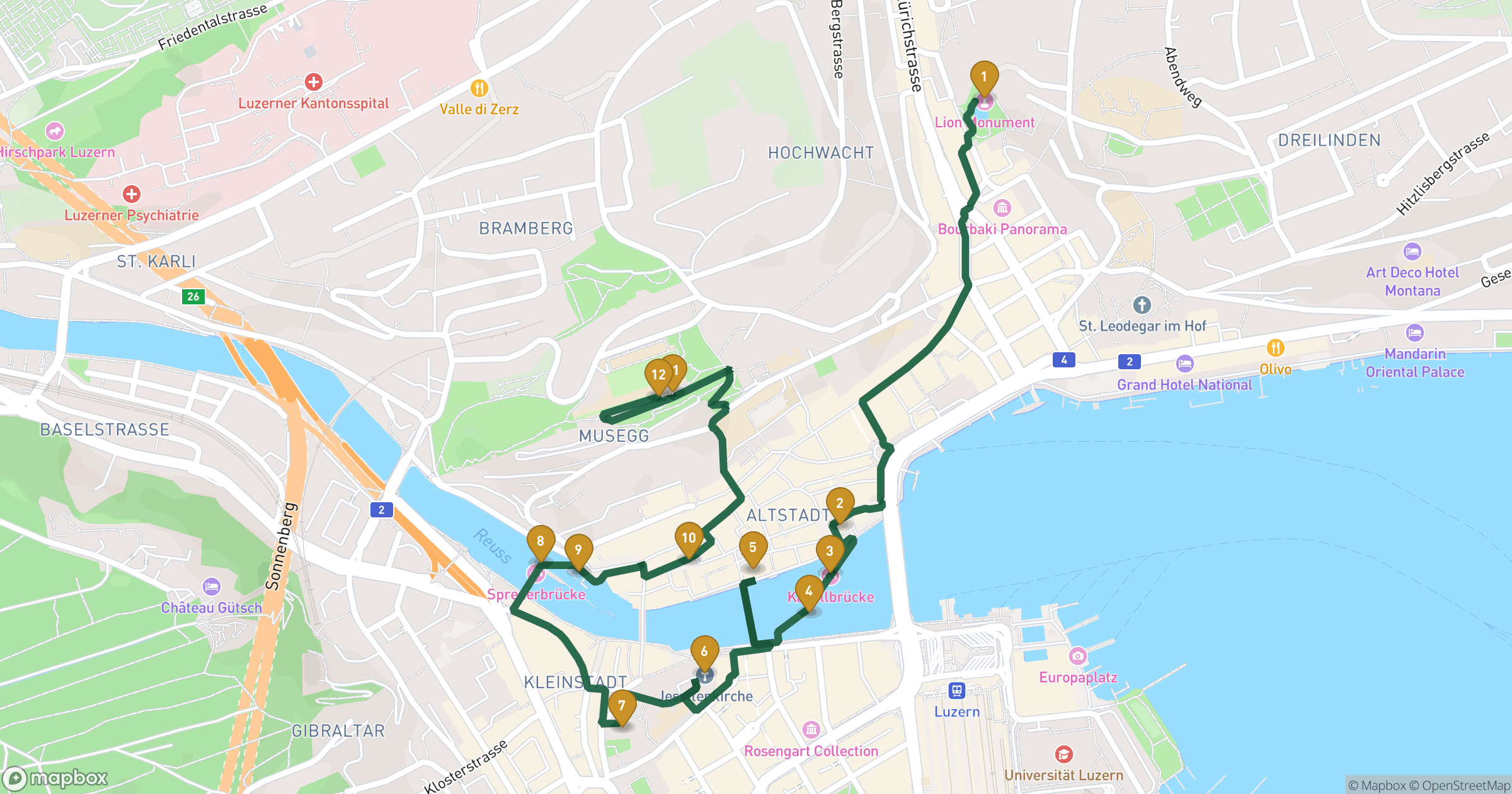
Map for Lucerne walking tour with 12 stops
The static map shows the tour route with Lion Monument, Chapel St. Peter, Chapel Bridge, Wasserturm, and 8 more stops.

Stops along the route

All stops on this self-guided tour at a glance.

  1. Lion Monument in Lucerne
    Lukas Ahorn / Bertel Thorvaldsen / CC BY-SA 3.0

    1Lion Monument

    Carved into a sandstone cliff, the Lion Monument honors the Swiss Guards killed during the 1792 storming of the Tuileries Palace. Major Karl Josef von Bachmann commanded the guards and refused to remove his red uniform even when facing the guillotine. Designed by Bertel Thorvaldsen and chiseled by Lukas Ahorn, the ten-meter relief depicts a dying lion shielding the Bourbon fleur-de-lis.

    Built: 1821 · Wikidata

  2. Chapel St. Peter in Lucerne
    WES1947 / CC BY-SA 3.0

    2Chapel St. PeterChurch

    Chapel St. Peter stands as the oldest church within the original city boundaries, with written roots reaching back to 1178. Bishop Eberhard II of Waldburg traveled from Constance in 1259 to reconsecrate the sanctuary following extensive alterations. In the mid-1700s, builders replaced the Gothic pointed windows with rectangular openings and added an interior stucco barrel vault.

    Built: 1178 · Wikidata

  3. Chapel Bridge in Lucerne
    Lothar Weber / CC BY-SA 4.0

    3Chapel Bridge

    Spanning the Reuss since around 1365, the Chapel Bridge was built as a covered timber truss to guard against waterborne assaults from the lake. In the 17th century, Hans Heinrich Wägmann painted triangular ceiling panels portraying local patrons Leodegar and Maurice. A devastating fire in August 1993 scorched two-thirds of the structure, leaving visible charred panels inside today.

    Wikidata

  4. Wasserturm in Lucerne
    Slav Yakounin / CC BY-SA 4.0

    4WasserturmTower

    The octagonal Wasserturm served not for storing water, but as a fortified lookout, treasury, dungeon, and torture chamber dating to 1262. Its lower level was an enclosed pit accessed solely through a hole in the ceiling above. Since 1892, an active colony of Alpine swifts has nested around the roof, monitored by the local ornithological society.

    Wikidata

  5. Town Hall in Lucerne
    Hansueli Krapf  This file was uploaded with Commonist. / CC BY-SA 3.0

    5Town HallAttraction

    Lucerne Town Hall showcases how architect Anton Isenmann merged Italian Renaissance arcades with a traditional Bernese hipped roof between 1602 and 1606. Isenmann presided over the inaugural council gathering in the completed building on June 24, 1606. The ground floor, originally an active grain market called the Kornschütte, now operates as a public gallery space.

    Built: 1606 · Architect: Anton Isenmann · Wikidata

  6. Jesuit Church, Lucerne in Lucerne
    Ank Kumar / CC BY-SA 4.0

    6Jesuit Church, Lucerne

    The Jesuit Church marks the Counter-Reformation as the first large Baroque church erected north of the Swiss Alps. Construction began in 1667 backed by mayor Ludwig Pfyffer, who spent personal wealth to house the order in the adjacent Ritter Palace. The high altar took until four years after the 1677 consecration to finish, while the onion-domed towers were added later.

    Built: 1667 · Style: baroque architecture · Named after: Francis Xavier · Wikidata

  7. Franciscan Church in Lucerne
    Friedhelm Dröge / CC BY-SA 3.0

    7Franciscan Church

    The Franciscan Church preserves Gothic simplicity on ground acquired in the 13th century by noblewoman Gepa von Wolhusen. High on the nave walls, painted frescoes recreate original battle flags captured during medieval conflicts like the Battle of Sempach. A 1701 powder explosion at the Musegg wall shattered several church windows without ruining the 16th-century net-ribbed vaulting.

    Style: Gothic architecture · Wikidata

  8. Spreuer Bridge in Lucerne
    Wolf-Dieter / CC BY 2.5

    8Spreuer Bridge

    The Spreuer Bridge was rebuilt after a 1566 flood and permitted locals to discard chaff directly into the downstream current. Across the ceiling rafters, Kaspar Meglinger oversaw the painting of 45 Danse Macabre panels between 1616 and 1637. Donor coats of arms and explanatory verses border each panel, portraying skeletons claiming emperors, popes, peasants, and children alike.

    Wikidata

  9. Mühlenplatz power plant in Lucerne
    Paebi / CC BY-SA 4.0

    9Mühlenplatz power plantMonument

    Mühlenplatz harnessed river currents for mills documented as early as 1178, later evolving into a hub for Jonval turbines. In 1926, the plant incorporated a generator from Brown, Boveri & Cie to electrify urban needs, including the tram network. Although a replacement plant moved underground in the late 1990s, an original 1920s turbine wheel and control panel remain on display.

    Wikidata

  10. Weinmarkt in Lucerne
    Andrew Bossi / CC BY-SA 2.5

    10WeinmarktSquare

    The Weinmarkt stands framed by historic guildhalls adorned with traditional Lüftlmalerei mural facades. It was on this square in 1332 that local citizens swore their alliance with the Forest Cantons of Uri, Schwyz, and Unterwalden. At its center stands a limestone replica of the elaborate Gothic fountain sculpted in 1481 by Konrad Lux.

    Wikidata

  11. Zytturm in Lucerne
    JoachimKohler-HB / CC BY-SA 4.0

    11ZytturmTower

    The 31-meter Zeitturm on the Musegg wall exercises a legal privilege granting its clock the right to strike one minute ahead of all others in town. Master watchmaker Jörg Spöring collected and restored its internal exhibit of historic wrought-iron mechanisms, some dating back to 1526. Open to visitors since 1951, the tower carries an oversized dial meant to be read by distant fishermen.

    Wikidata

  12. Museggmauer in Lucerne
    W. Bulach / CC BY-SA 4.0

    12MuseggmauerBuilding

    The Museggmauer preserved its northern medieval ramparts after Lucerne tore down its southern fortifications between 1833 and 1856. Work began around 1370 with the Luegisland tower, belying local lore that attributed the wall to the 1386 Battle of Sempach. Nine towers survive along the stone ridge, including the Schirmerturm gate and the Wachtturm once used for gunpowder storage.

    Wikidata

Download the app

This public page shows a preview. The full route, all content, and navigation are available in CityTour AI.

Cities nearby

Discover self-guided tours in nearby cities.

Frequently asked questions

The key answers before you start.

Is this a self-guided audio tour?

Yes. In the CityTour AI app (iOS and Android), this is a self-guided audio tour for Lucerne — start anytime, at your own pace, with map, stops, and audio narration.

What will you see on this tour?

On this tour you'll see, among others, Lion Monument, Chapel St. Peter, Chapel Bridge, Wasserturm, Town Hall, Jesuit Church, Lucerne and more sights.

Where does the tour start?

The route starts at Lion Monument and ends at Museggmauer. You can start anytime — the app guides you to the first stop.

How long does the tour take?

About 103 minutes for 12 stops — at your own pace, with breaks whenever you like.

How much does the tour cost?

This tour costs 15 credits. The exact price depends on the pack you buy and your country — roughly $5.

Is it an outdoor tour — are entry tickets included?

Yes, it's an outdoor tour: the sights are viewed from the outside. Entry tickets are not included, and step-free access cannot be guaranteed.

Is the audio guide available in my language?

The tour and audio guide are available in English, Deutsch, Français, Español, Italiano and 9 more languages. You pick your language in the app.

Can I use the tour offline?

Yes. Tours can be used offline.

Can I ask the AI questions along the way?

Yes. At every stop you can ask the AI directly if you want to know more or didn't understand something.