CityTour AI

Lausanne self-guided walking tour

Lausanne: Hills, History, and Hidden Valleys

Experience the dramatic verticality of Lausanne on this casual walking tour through its most iconic neighborhoods. We’ll climb from the trendy, transformed industrial valley of Le Flon up to the medieval heart of the Cité, uncovering hidden bridges and ancient towers along the way. It’s a journey through centuries of Swiss history, offering breathtaking Alpine views and a deep dive into the city’s unique architectural character.

Audio tourSelf-guidediOS & Android
104minutes
3.6 kmdistance
11stops
Audio guideFormat
Lausanne: Hills, History, and Hidden Valleys
Gzzz / CC BY-SA 4.0

Stops on this route

This tour works well for first-time visitors, weekend trips, and travelers who want to explore Lausanne without a fixed tour time.

Route map for Lausanne walking tour
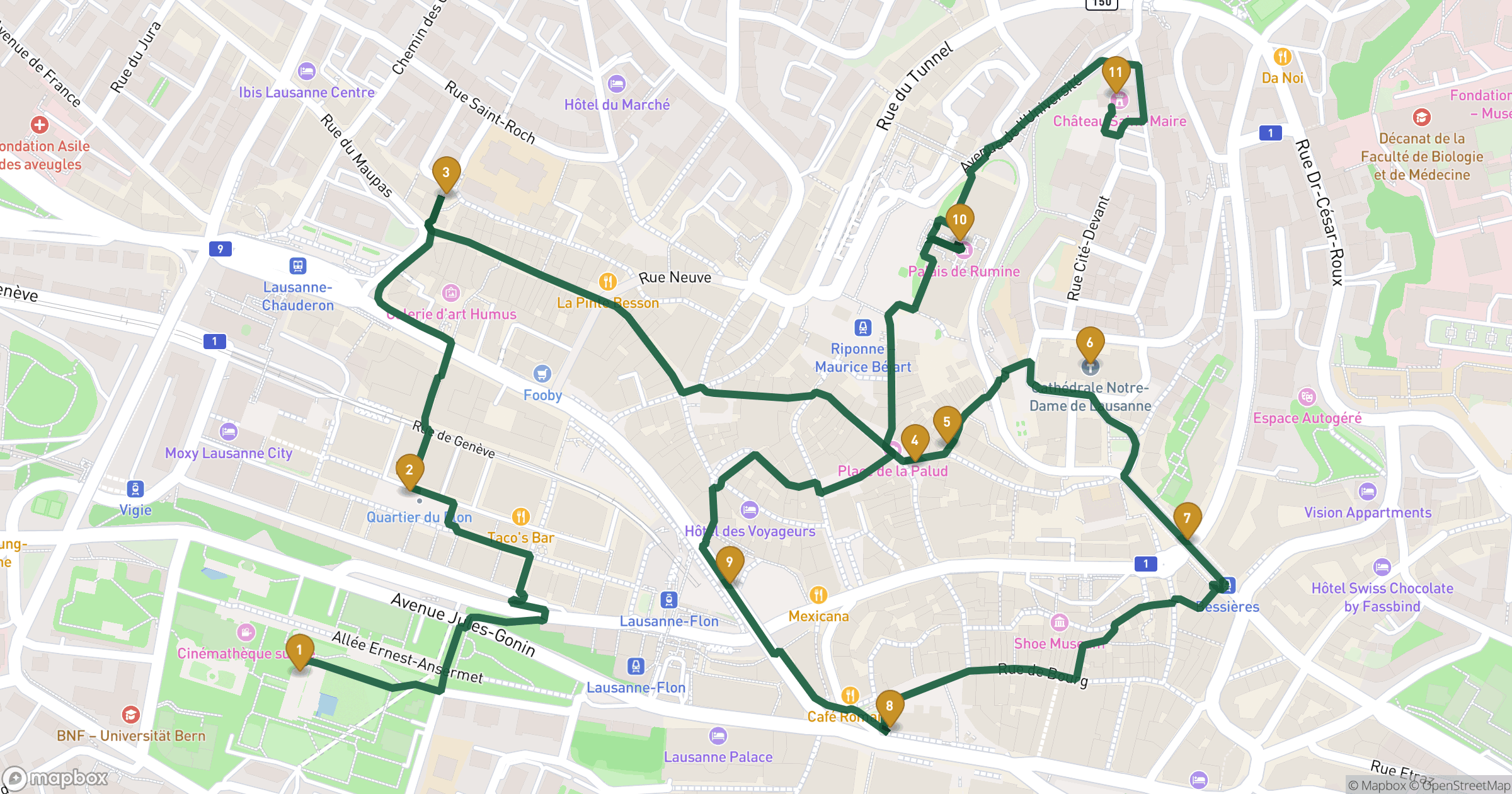
Map for Lausanne walking tour with 11 stops
The static map shows the tour route with Montbenon, Le Flon, Ale Tower, Fountain with Statue of Justice, and 7 more stops.

Stops along the route

All stops on this self-guided tour at a glance.

  1. Montbenon in Lausanne
    Fabiuccio / Public domain

    1MontbenonPark

    The Esplanade de Montbenon offers sweeping vistas of Lake Geneva and the French Alps alongside buildings shaped by cinema and international diplomacy. Between 1915 and 1922, the 1908 Belle Époque Casino served as headquarters for the International Olympic Committee under founder Pierre de Coubertin. Next door stands the Palais de Justice, built in the 1880s for the Federal Supreme Court.

    Wikidata

  2. Le Flon in Lausanne
    Quartier du Flon / CC BY-SA 4.0

    2Le FlonBuilding

    Le Flon showcases an industrial valley that transformed into a modern dining and shopping quarter. In the 1870s, excavated soil from railway tunnel construction was dumped here, completely burying the leather tanneries and the foul-smelling river. A revival sparked in the 1980s and 90s by the MAD nightclub preserved the warehouse layout while the Flon river still runs below through an underground pipe.

    Wikidata

  3. Ale Tower in Lausanne
    Ninetta / Public domain

    3Ale Tower

    The Ale Tower survives as the final significant relic of Lausanne's medieval defensive walls. Built in 1340 to protect the Ale district outside the Saint-Laurent gate, this cylindrical stone tower rises 21 meters high and spans eight meters across. After the city council voted to demolish it in 1890, widespread public outcry saved the structure, leading to its declaration as a historical monument in 1900.

    Wikidata

  4. Fountain with Statue of Justice in Lausanne
    michel simeonidis / Public domain

    4Fountain with Statue of JusticeMonument

    The Fountain of Justice centers on an allegorical Renaissance statue sculpted between 1584 and 1585 by Laurent and Jacques Perroud. At the feet of the blindfolded figure, four small effigies depicting the Pope, the Emperor, the Grand Turk, and a magistrate bow in submission to the law. Following multiple thefts of the sword between 2009 and 2017, the city installed GPS tracking chips into the weapon and scales.

    Built: 1726 · Wikidata

  5. Escaliers du Marché et de la Cathédrale in Lausanne
    Gzzz / CC BY-SA 4.0

    5Escaliers du Marché et de la CathédraleBuilding

    The Escaliers du Marché form a covered wooden staircase connecting the market square below with the cathedral hill above. Dating to between 1717 and 1719, the current structure features 177 steps bordered by narrow medieval houses. After the construction of Rue Pierre-Viret severed the continuous flight of stairs in 1911, a pedestrian tunnel was finally opened underneath in 1975 to restore the path.

    Wikidata

  6. Lausanne Cathedral in Lausanne
    Guilhem Vellut from Annecy, France / CC BY 2.0

    6Lausanne CathedralChurch

    Lausanne Cathedral stands atop the hill as a massive Gothic structure consecrated in 1275 in the presence of Pope Gregory X and King Rudolph I. The south transept preserves a 13th-century rose window designed by Villard de Honnecourt with much of its original glass intact. A night watchman has called out the hours across the city from the bell tower every night between 10:00 PM and 2:00 AM since 1405.

    Built: 1170 · Architect: Jean Cotereel · Style: Gothic architecture · Height: 79.6 m · Wikidata

  7. Bessières bridge in Lausanne
    Grez / CC BY-SA 3.0

    7Bessières bridge

    The Bessières bridge spans the deep valley between the Cité and Bourg hills, built from steel under the direction of architect Eugène Jost in 1910. A gift of 500,000 Swiss francs from banker Charles Bessières, supplemented by 50,000 francs from his brother Victor, funded the construction. Rather than Jost's proposed neo-medieval turrets, 11-meter-high obelisks were chosen, while the m2 metro runs below.

    Built: 1910 · Architect: Eugène Jost · Height: 23 m · Wikidata

  8. Saint-François in Lausanne
    Gzzz / CC BY-SA 4.0

    8Saint-FrançoisSquare

    Place Saint-François transformed from a 13th-century Franciscan retreat into the central transit hub and banking heart of the city. After the Bernese arrived during the Reformation, the medieval church was repurposed as a foundry and later operated as a printing shop run by Jean and François Le Preux. The 19th-century post office replaced the old convent buildings right across from bank headquarters.

    Wikidata

  9. Grand Pont in Lausanne
    Grez / CC BY-SA 3.0

    9Grand PontBridge

    The Grand Pont connects the city center's hills across the former valley of the Flon river. Cantonal engineer Adrien Pichard completed the bridge in 1844 with two tiers of arches reaching a total height of 25 meters. Between 1874 and 1876, soil from railway construction was dumped into the ravine, burying the lower stone arches and reducing the visible structure to 13 meters.

    Built: 1844 · Height: 13 m · Wikidata

  10. Palais de Rumine in Lausanne
    Michel Krafft / CC BY-SA 4.0

    10Palais de RumineMuseum

    The Palais de Rumine reflects Florentine Renaissance styling funded by a bequest of 1.5 million Swiss francs left by Gabriel de Rumine. On July 24, 1923, international delegates signed the Treaty of Lausanne within these walls, setting the borders of the modern Republic of Turkey. Originally built to house the university and its library, the structure now contains five separate museums.

    Architect: Gaspard André · Named after: Gabriel de Rumine · Wikidata

  11. Château Saint-Maire in Lausanne
    Gzzz / CC BY-SA 4.0

    11Château Saint-MaireCastle

    Château Saint-Maire has served as the regional seat of government atop the Cité hill since its construction began in 1397. When the Bernese army seized Lausanne in 1536, the last ruling bishop, Sébastien of Montfalcon, fled the fortress through a secret stairwell. Originally topped with Italian Ghibelline battlements, the open gaps were later filled in and roofed over to protect the walls from Swiss rain.

    Built: 1397 · Named after: Marius Aventicensis · Wikidata

Download the app

This public page shows a preview. The full route, all content, and navigation are available in CityTour AI.

Cities nearby

Discover self-guided tours in nearby cities.

Frequently asked questions

The key answers before you start.

Is this a self-guided audio tour?

Yes. In the CityTour AI app (iOS and Android), this is a self-guided audio tour for Lausanne — start anytime, at your own pace, with map, stops, and audio narration.

What will you see on this tour?

On this tour you'll see, among others, Montbenon, Le Flon, Ale Tower, Fountain with Statue of Justice, Escaliers du Marché et de la Cathédrale, Lausanne Cathedral and more sights.

Where does the tour start?

The route starts at Montbenon and ends at Château Saint-Maire. You can start anytime — the app guides you to the first stop.

How long does the tour take?

About 104 minutes for 11 stops — at your own pace, with breaks whenever you like.

How much does the tour cost?

This tour costs 15 credits. The exact price depends on the pack you buy and your country — roughly $5.

Is it an outdoor tour — are entry tickets included?

Yes, it's an outdoor tour: the sights are viewed from the outside. Entry tickets are not included, and step-free access cannot be guaranteed.

Is the audio guide available in my language?

The tour and audio guide are available in English, Deutsch, Français, Español, Italiano and 9 more languages. You pick your language in the app.

Can I use the tour offline?

Yes. Tours can be used offline.

Can I ask the AI questions along the way?

Yes. At every stop you can ask the AI directly if you want to know more or didn't understand something.