CityTour AI

Brighton self-guided walking tour

Brighton: From Medieval Lanes to Regency Grandeur

Trace the architectural and social evolution of Brighton from its origins as the medieval fishing village of Brighthelmstone to its peak as a flamboyant Regency resort. This fact-rich walking tour explores the labyrinthine 16th-century Lanes, the Indo-Saracenic grandeur of the Royal Pavilion, and the historic Victorian arches along the beachfront. You will discover the city's engineering marvels, its dark history of Victorian crime, and the vibrant street art that defines its modern bohemian character.

Audio tourSelf-guidediOS & Android
103minutes
3.8 kmdistance
11stops
Audio guideFormat
Brighton: From Medieval Lanes to Regency Grandeur
Frank Jepsen / CC BY 2.0

Stops on this route

This tour works well for first-time visitors, weekend trips, and travelers who want to explore Brighton without a fixed tour time.

Route map for Brighton walking tour
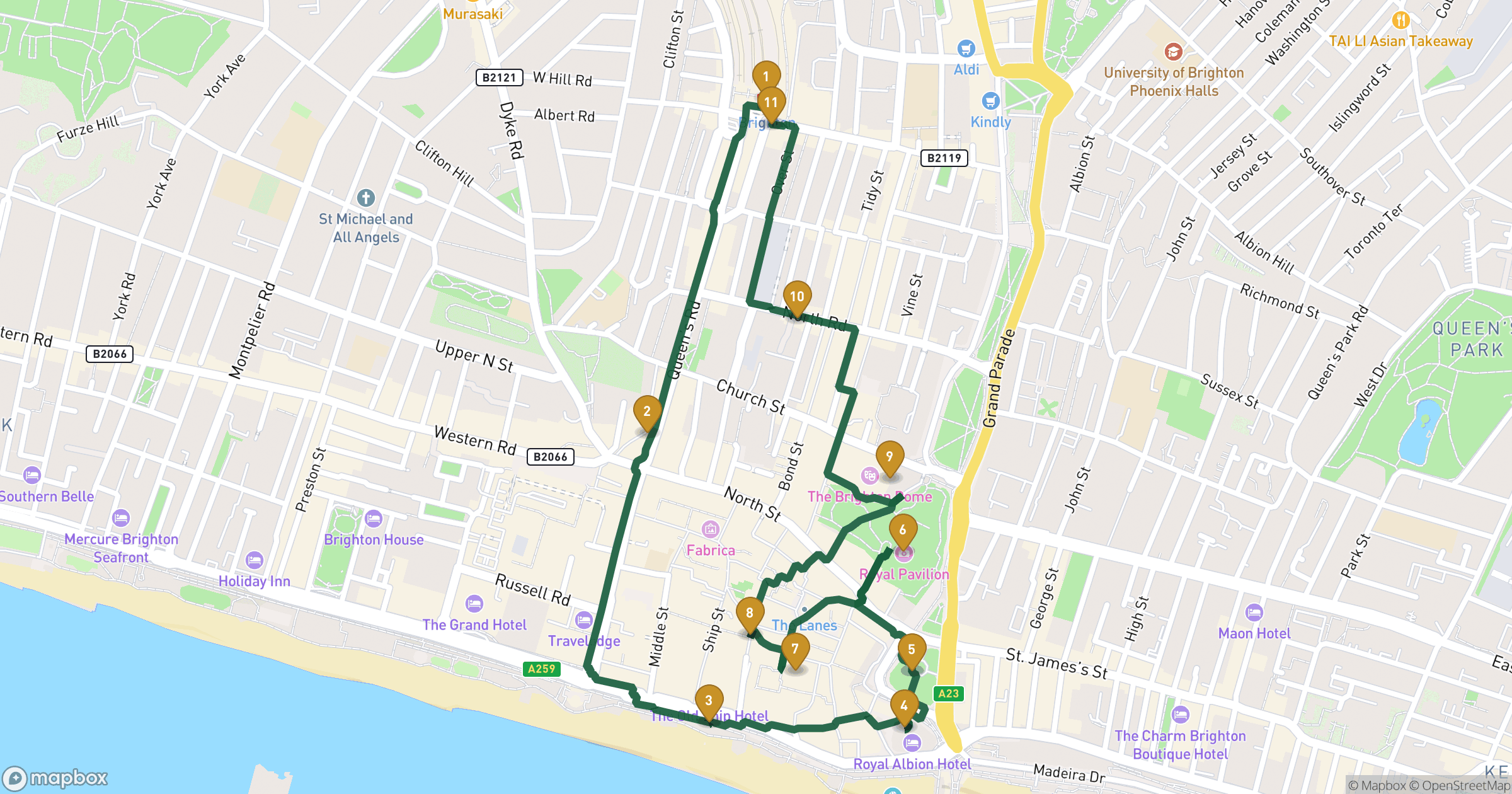
Map for Brighton walking tour with 11 stops
The static map shows the tour route with Brighton railway station, The Quadrant Public House, Brighton Fishing Museum, The Lanes, and 7 more stops.

Stops along the route

All stops on this self-guided tour at a glance.

  1. Brighton railway station in Brighton
    kallerna / CC BY-SA 4.0

    1Brighton railway stationBuilding

    Brighton railway station serves as the gateway to the city and the site of an infamous twentieth-century mystery. On June 17, 1934, porter William Joseph Vinnicombe discovered a woman's dismembered torso inside an abandoned plywood trunk in the cloakroom. Overhead spans F.D. Banister's 1880s curved iron and glass roof, engineered specifically to endure coastal winds.

    Named after: Brighton · Wikidata

  2. The Quadrant Public House in Brighton
    User:Hassocks5489 / CC0

    2The Quadrant Public HouseBuilding

    The Quadrant Public House commands a sharp street corner while showcasing traditional Sussex craftsmanship. Built around 1864, its curving exterior features locally sourced knapped flint made from split stones. An upper-floor balcony overlooks the intersection near the 1888 Jubilee Clock Tower, while modern street art frequently covers parts of the facade.

    Wikidata

  3. Brighton Fishing Museum in Brighton
    Brighton Fishing Museum by Colin Smith; Colin Smith; Geograph Britain and Ireland / CC BY-SA 2.0

    3Brighton Fishing Museum

    Brighton Fishing Museum occupies seafront arches where fishermen originally stored gear, charting the town's life before tourism took hold. The centerpiece is a 27-foot clinker-built Sussex Beach Punt made to launch straight from steep shingle shores. The exhibits also feature Captain Fred Collins, famous for running shilling-a-head sea excursions on the Skylark.

    Built: 1992 · Wikidata

  4. The Lanes in Brighton
    Frank Jepsen / CC BY 2.0

    4The LanesBuilding

    The Lanes encompass Brighton's sixteenth-century street plan, defined by narrow passageways known as twittens that offered shelter from fierce marine winds. This dense quarter inspired the turf-war territory of razor gangs and teenage mobster Pinkie Brown in Graham Greene's 1938 novel Brighton Rock. One passage marks the site of Flemish brewer Deryk Carver's brewery.

    Wikidata

  5. Old Steine Gardens in Brighton
    Hassocks5489 / CC0

    5Old Steine GardensPark

    Old Steine Gardens occupies land where early fishermen once dried their nets before it became an enclosed Georgian resort promenade. The southern section holds the 32-foot Victoria Fountain, cast at the local Eagle Foundry in 1846 with a basin resting on three dolphins. Near the center stands a statue honoring surgeon and three-time mayor Sir John Cordy Burrows.

    Built: 1846 · Wikidata

  6. Royal Pavilion in Brighton
    Qmin / CC BY-SA 3.0

    6Royal PavilionAttraction

    The Royal Pavilion presents an extravagant Indo-Saracenic royal getaway shaped between 1815 and 1823 by architect John Nash. King George IV frequently brought guests to admire the kitchen's steam heating and its four cast-iron columns shaped like palm trees. Between 1914 and 1916, this royal palace served as a military hospital for wounded Indian Army soldiers.

    Built: 1787 · Architect: John Nash · Style: Indo-Saracenic architecture · Wikidata

  7. Brighton Town Hall in Brighton
    The Voice of Hassocks / Public domain

    7Brighton Town HallBuilding

    Brighton Town Hall showcases classical Greek Revival civic architecture that witnessed an unprecedented Victorian police tragedy. In 1844, Chief Constable Henry Solomon was fatally struck over the head with an iron poker in his office by carpet thief John Lawrence. Built between 1830 and 1832, the building still retains original holding cells beneath the main council chamber.

    Wikidata

  8. Black Lion Lane in Brighton
    Black Lion Street, Brighton by pam fray; pam fray; Geograph Britain and Ireland / CC BY-SA 2.0

    8Black Lion LaneMonument

    Black Lion Lane is an evocative narrow alley revealing the sixteenth-century footprint and clandestine underbelly of old Brighthelmstone. It honors Flemish brewer Deryk Carver, who was arrested here for holding secret Protestant prayer meetings before being burned at the stake in 1555. During the eighteenth century, smugglers moved brandy through connected cellars below.

  9. Brighton Museum & Art Gallery in Brighton
    The Voice of Hassocks / Public domain

    9Brighton Museum & Art Gallery

    Brighton Museum & Art Gallery occupies former royal property that once housed stables built in 1831 for William IV and Queen Adelaide. The town acquired the grounds in 1850 for £53,000 after Queen Victoria left the bustling coastal resort. Next door, an underground tunnel connected George IV's private quarters directly to the royal stables and riding house.

    Built: 1805 · Architect: John Nash · Wikidata

  10. North Laine in Brighton
    Hassocks5489 at en.wikipedia / Public domain

    10North LaineMonument

    North Laine is an eclectic quarter following the boundaries of ancient Sussex farming strips known as hides and furlongs. In the 1970s, planning officer Ken Fines prevented the demolition of its historic worker terraces for a proposed flyover and car park. The once squalid area formerly known as Pimlico now houses over four hundred independent shops and cafes.

    Wikidata

  11. The Prince Albert Public House in Brighton
    Acd1066 / CC BY-SA 4.0

    11The Prince Albert Public HouseBuilding

    The Prince Albert Public House is a Victorian music venue that became a central canvas for modern street art. Its exterior wall gained worldwide notoriety in 2004 when Banksy painted the stenciled piece Kissing Policemen, which was later auctioned off in Miami. Today, street artist REQ's Icons mural displays over fifty life-sized portraits of deceased music legends.

    Wikidata

Download the app

This public page shows a preview. The full route, all content, and navigation are available in CityTour AI.

Cities nearby

Discover self-guided tours in nearby cities.

Frequently asked questions

The key answers before you start.

Is this a self-guided audio tour?

Yes. In the CityTour AI app (iOS and Android), this is a self-guided audio tour for Brighton — start anytime, at your own pace, with map, stops, and audio narration.

What will you see on this tour?

On this tour you'll see, among others, Brighton railway station, The Quadrant Public House, Brighton Fishing Museum, The Lanes, Old Steine Gardens, Royal Pavilion and more sights.

Where does the tour start?

The route starts at Brighton railway station and ends at The Prince Albert Public House. You can start anytime — the app guides you to the first stop.

How long does the tour take?

About 103 minutes for 11 stops — at your own pace, with breaks whenever you like.

How much does the tour cost?

This tour costs 15 credits. The exact price depends on the pack you buy and your country — roughly $5.

Is it an outdoor tour — are entry tickets included?

Yes, it's an outdoor tour: the sights are viewed from the outside. Entry tickets are not included, and step-free access cannot be guaranteed.

Is the audio guide available in my language?

The tour and audio guide are available in English, Deutsch, Français, Español, Italiano and 9 more languages. You pick your language in the app.

Can I use the tour offline?

Yes. Tours can be used offline.

Can I ask the AI questions along the way?

Yes. At every stop you can ask the AI directly if you want to know more or didn't understand something.