CityTour AI

York self-guided walking tour

York: A Journey Through Time in the Eternal City of the North

Join us for a relaxed stroll through the historic heart of York, where Roman ruins meet medieval timber-framed houses. Experience the city from a local perspective and discover world-famous highlights like The Shambles and the majestic Minster. This tour blends the great eras of English history with charming anecdotes and architectural treasures.

Audio tourSelf-guidediOS & Android
100minutes
2.9 kmdistance
13stops
Audio guideFormat
York: A Journey Through Time in the Eternal City of the North
Kaly99 / CC BY-SA 3.0

Stops on this route

This tour works well for first-time visitors, weekend trips, and travelers who want to explore York without a fixed tour time.

Route map for York walking tour
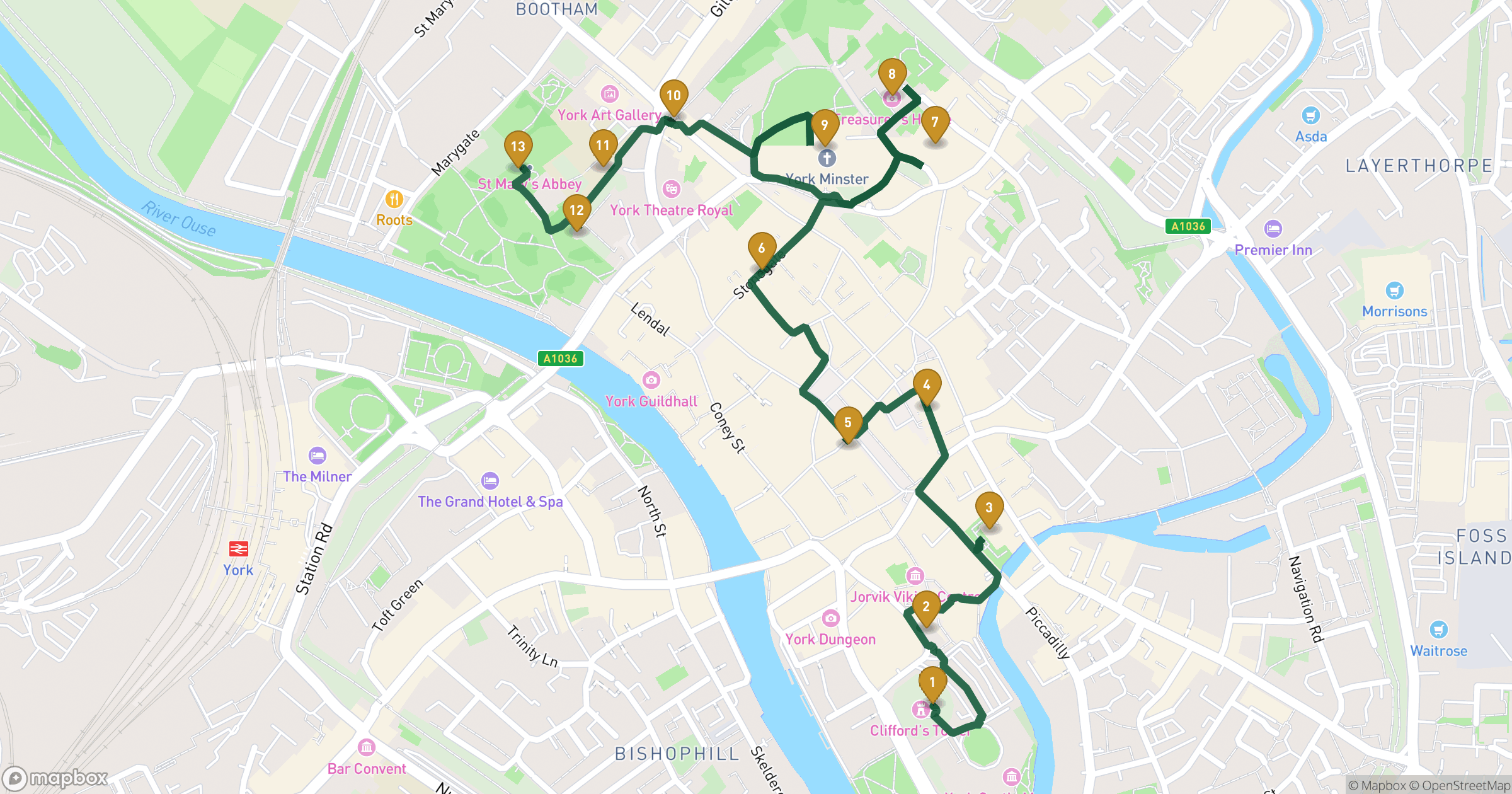
Map for York walking tour with 13 stops
The static map shows the tour route with Clifford's Tower, Fairfax House, Merchant Adventurers' Hall, The Shambles, and 9 more stops.

Stops along the route

All stops on this self-guided tour at a glance.

  1. Clifford's Tower in York
    bryan... / CC BY-SA 2.0

    1Clifford's Tower

    Clifford’s Tower crowns a steep earthen motte as the main surviving remnant of York Castle, remembered for a dark moment in Norman history. In 1190, the city's Jewish community sought refuge here from a mob and chose mass suicide before the wooden predecessor burned. The present stone keep, built around 1245 under Henry III, features a rare four-leaf clover shape.

    Built: 1245 · Wikidata

  2. Fairfax House in York
    Malcolmxl5 / CC BY-SA 4.0

    2Fairfax House

    Fairfax House represents 18th-century domestic elegance, renovated starting in 1759 as a winter home for Viscount Fairfax and his daughter. Architect John Carr remodeled the interior, commissioning intricate plaster ceilings by Giuseppe Cortese and James Henderson. Saved from decay after housing a cinema until 1970, it now displays Noel Terry's collection of Georgian furniture.

    Wikidata

  3. Merchant Adventurers' Hall in York
    Kaly99 / CC BY-SA 3.0

    3Merchant Adventurers' Hall

    Merchant Adventurers' Hall showcases medieval carpentry, built from 1357 onward by a fraternity that became a cloth merchants' guild. The roof of the timber-framed Great Hall rests on massive posts assembled entirely with wooden pegs, free of metal nails. Below in the undercroft, a hospital for the city's poor was established in 1371 beside an adjoining chapel.

    Wikidata

  4. The Shambles in York
    FrDr / CC BY-SA 4.0

    4The ShamblesSquare

    The Shambles preserves a tight row of medieval timber-framed buildings that once centered on the butcher trade. Overhanging upper floors kept direct sunlight off the open meat displays, which still numbered 31 shops in 1885. Street channels formerly flushed away butchery waste and blood during rainstorms, while old meat hooks remain visible on surviving window frames.

    Wikidata

  5. York city walls in York
    User:Hassocks5489 / CC0

    5York city walls

    York city walls form England's longest medieval circuit, tracing Roman fortifications that began in 71 AD with Eboracum. The ten-sided Multangular Tower survives from around 310 AD as the best-preserved Roman structure in the city. The medieval stonework, measuring four meters high and two wide, later withstood parliamentary troops during the 1644 siege of York.

    Wikidata

  6. Stonegate in York
    Doug Olson / CC BY-SA 3.0

    6StonegateSquare

    Stonegate follows the line of the Roman Via Praetoria, taking a name first documented in 1119 for its paved surface. Over centuries it turned into a center for printers and glass sellers, and conspirator Guy Fawkes was born in a house here in 1570. Ornate overhead trade emblems line the street, including a red devil figure once used by local printer apprentices.

    Wikidata

  7. St Williams College in York
    Kaly99 / CC BY-SA 3.0

    7St Williams CollegeAttraction

    St William's College provided lodgings for 23 chantry priests serving York Minster, founded in 1460 by Archbishop George Neville. Its facade combines a light limestone ground floor with dark overhanging oak framing around a central courtyard. The building served as a residence and shop space before architect Temple Moore carried out a major restoration in the 20th century.

    Wikidata

  8. Treasurer's House, York in York
    Tilman2007 / CC BY-SA 4.0

    8Treasurer's House, YorkAttraction

    Treasurer's House belonged to the treasurers of York Minster from 1091 until the Reformation abolished the post in 1547. Rebuilt with a symmetrical front in the early 17th century, Sir George Young hosted King James I here in 1617. Eccentric industrialist Frank Green restored the house with Temple Moore and donated it to the National Trust in 1930 with its full contents.

    Wikidata

  9. York Minster in York
    MatzeTrier / CC BY-SA 3.0

    9York MinsterChurch

    York Minster represents English Gothic architecture on a massive scale, officially completed in 1472 after 250 years of work. It stands over the headquarters of Roman Eboracum, where Anglo-Saxon King Edwin of Northumbria was baptized in a wooden church in 627. The northern transept holds the Five Sisters grisaille windows, while the Great East Window matches a tennis court in size.

    Built: 1220 · Style: English Gothic architecture · Named after: Saint Peter · Wikidata

  10. Bootham Bar Hotel in York
    Malcolmxl5 / CC BY-SA 4.0

    10Bootham Bar HotelCastle

    Bootham Bar marks the Roman fortress gateway Porta Principalis Dextra and commanded the main route north toward Scotland. During the Middle Ages, authorities displayed the severed heads of executed traitors from the gatehouse to deter travelers. The masonry features surviving Roman foundation stones alongside later rebuilds and retains an original wooden portcullis.

    Wikidata

  11. King's Manor in York
    Malcolmxl5 / CC BY-SA 4.0

    11King's Manor

    King's Manor evolved from an abbot's residence into the headquarters of Henry VIII's Council of the North after 1539. King James I stayed here in April 1603 while traveling to claim the English crown, prompting hurried restocking of the cellar. Thomas Wentworth expanded the complex between 1628 and 1631, adding the stone portals and coats of arms seen in the courtyard.

    Wikidata

  12. Multangular Tower And Wall Attached To South East in York
    Nessy-Pic / CC BY-SA 3.0

    12Multangular Tower And Wall Attached To South East

    The Multangular Tower formed the western corner bastion of the Roman fortress Eboracum, facing toward the River Ouse. Its lower eight meters consist of finely dressed Roman masonry dating to the late 3rd or early 4th century. A 13th-century medieval addition crowns the top, adding larger stones and arrow slits to the original ten-sided structure.

    Wikidata

  13. St Mary's Abbey, York in York
    Kaly99 / CC BY-SA 3.0

    13St Mary's Abbey, York

    St Mary's Abbey survives as ruined Gothic arches from a Benedictine foundation co-founded in 1088 by King William II. An internal revolt over monastery discipline erupted in 1132, leading reformist monks to leave and establish Fountains Abbey. The present ruins reflect a reconstruction between 1271 and 1294, deliberately misaligned from true east due to riverbank constraints.

    Built: 1088 · Wikidata

Download the app

This public page shows a preview. The full route, all content, and navigation are available in CityTour AI.

Cities nearby

Discover self-guided tours in nearby cities.

Frequently asked questions

The key answers before you start.

Is this a self-guided audio tour?

Yes. In the CityTour AI app (iOS and Android), this is a self-guided audio tour for York — start anytime, at your own pace, with map, stops, and audio narration.

What will you see on this tour?

On this tour you'll see, among others, Clifford's Tower, Fairfax House, Merchant Adventurers' Hall, The Shambles, York city walls, Stonegate and more sights.

Where does the tour start?

The route starts at Clifford's Tower and ends at St Mary's Abbey, York. You can start anytime — the app guides you to the first stop.

How long does the tour take?

About 100 minutes for 13 stops — at your own pace, with breaks whenever you like.

How much does the tour cost?

This tour costs 15 credits. The exact price depends on the pack you buy and your country — roughly $5.

Is it an outdoor tour — are entry tickets included?

Yes, it's an outdoor tour: the sights are viewed from the outside. Entry tickets are not included, and step-free access cannot be guaranteed.

Is the audio guide available in my language?

The tour and audio guide are available in English, Deutsch, Français, Español, Italiano and 9 more languages. You pick your language in the app.

Can I use the tour offline?

Yes. Tours can be used offline.

Can I ask the AI questions along the way?

Yes. At every stop you can ask the AI directly if you want to know more or didn't understand something.