CityTour AI

Edinburgh self-guided walking tour

Edinburgh’s Old Town Echoes and Royal Vistas

Experience the moody romance and dramatic history of Scotland's capital on this comprehensive walk through the heart of the Old Town. You’ll wander through hidden 17th-century courtyards, stand in the shadow of the world’s most iconic writer’s monument, and climb toward the fortress that defines the skyline. It’s a journey through centuries of royal drama and literary legend, perfect for those who want to feel the pulse of the city locals call Auld Reekie.

Audio tourSelf-guidediOS & Android
189minutes
7.1 kmdistance
20stops
Audio guideFormat
Edinburgh’s Old Town Echoes and Royal Vistas
Stephencdickson / CC BY-SA 4.0

Stops on this route

This tour works well for first-time visitors, weekend trips, and travelers who want to explore Edinburgh without a fixed tour time.

Route map for Edinburgh walking tour
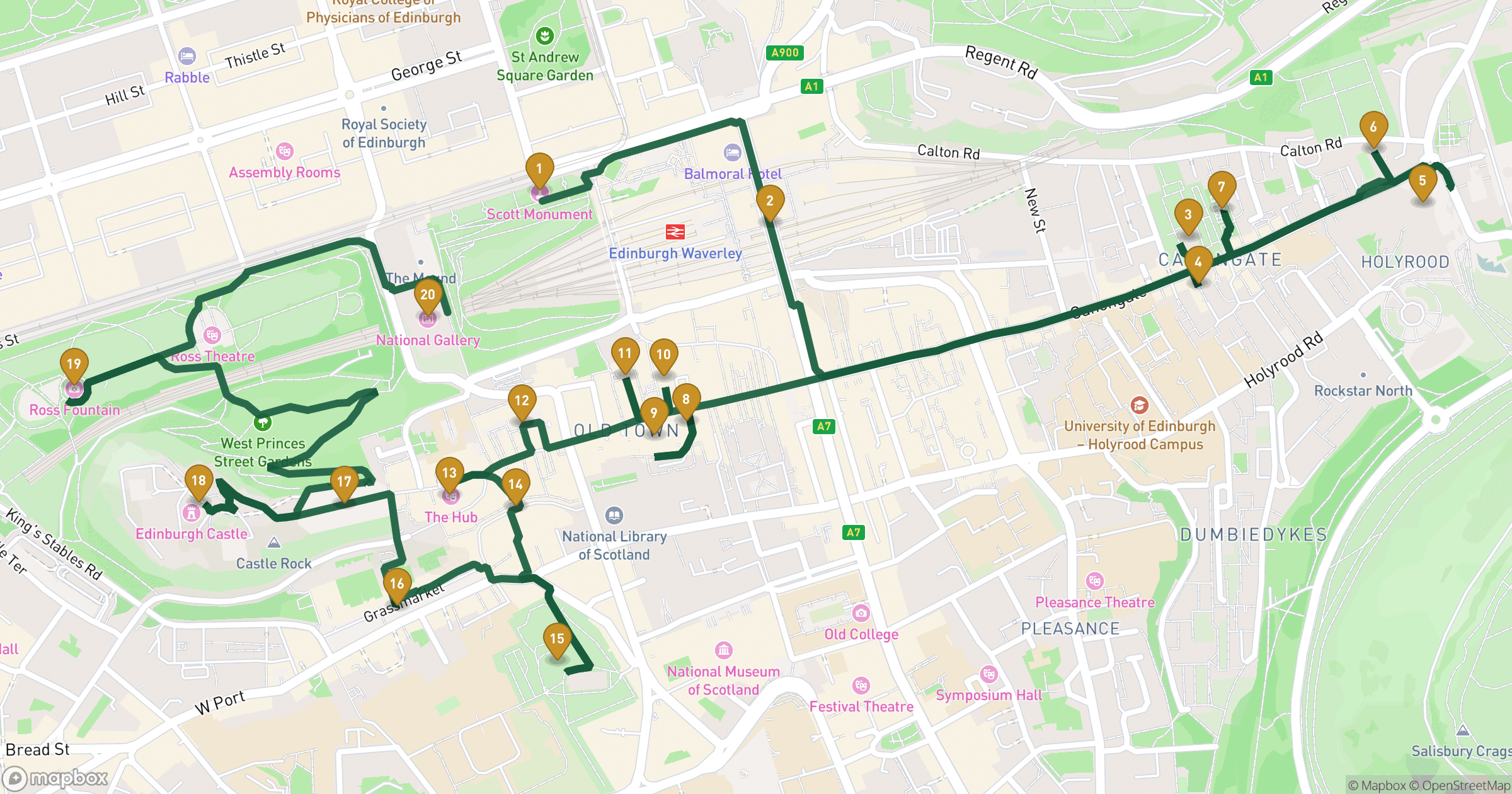
Map for Edinburgh walking tour with 20 stops
The static map shows the tour route with Scott Monument, North Bridge, Kirk of the Canongate, Bakehouse Close, and 16 more stops.

Stops along the route

All stops on this self-guided tour at a glance.

  1. Scott Monument in Edinburgh
    No machine-readable author provided. Schatir assumed (based on copyright claims). / Public domain

    1Scott Monument

    The Scott Monument pays Victorian homage to Sir Walter Scott, focusing on the heavy human cost behind carving its soot-stained Binny sandstone. Twenty-three stonemasons died of lung disease from breathing fine dust in closed sheds before the finial went up in 1844. A white marble statue of Scott seated with his dog Maida rests at the base of this 200-foot spire.

    Built: 1840 · Wikidata

  2. North Bridge in Edinburgh
    Benson85 at English Wikipedia / CC BY-SA 3.0

    2North Bridge

    North Bridge spans the gap between the medieval Old Town and the Georgian New Town, telling a story of fatal engineering miscalculations. In 1769, before its completion, part of architect William Mylne's bridge collapsed on loose slope earth, killing five people. From this vantage point above Waverley Station, views stretch across to the Balmoral Hotel clock tower and Salisbury Crags.

    Built: 1763 · Wikidata

  3. Kirk of the Canongate in Edinburgh
    瑞丽江的河水 / CC BY-SA 4.0

    3Kirk of the CanongateChurch

    Kirk of the Canongate reveals an unexpected royal dispute when King James VII evicted local worshippers from Holyrood Abbey to take it for himself. Financed by a bequest from merchant Thomas Moodie, the replacement church was completed in 1691. A stag's head with a cross between its antlers tops the roof, while economist Adam Smith rests in the peaceful churchyard.

    Wikidata

  4. Bakehouse Close in Edinburgh
    Kim Traynor / CC BY-SA 3.0

    4Bakehouse Close

    Bakehouse Close offers a rare preserved slice of 18th-century tenement life, renowned for doubling as Jamie Fraser’s print shop in Outlander. At the lane's end stands Acheson House, built in 1633 with its original family crest and date carved above the entrance. Careful 20th-century restoration preserved its authentic layout of stone buildings leaning over a secluded path.

    Wikidata

  5. Scottish Parliament Building in Edinburgh
    瑞丽江的河水 / CC BY-SA 4.0

    5Scottish Parliament Building

    The Scottish Parliament Building presents a bold postmodern design envisioned by Spanish architect Enric Miralles to grow directly from the Scottish landscape. The troubled project was heavily delayed, drastically over budget, and prompted an inquiry by Lord Fraser of Carmyllie. MSP office windows feature unique built-in think pods, while the debating chamber holds a stone lintel from 1707.

    Architect: RMJM, Benedetta Tagliabue … · Style: postmodern architecture · Wikidata

  6. White Horse Close in Edinburgh
    Discott / CC BY-SA 4.0

    6White Horse Close

    White Horse Close looks like a 17th-century coaching inn, though it is largely a romanticized 1930s restoration complete with a likely retrofitted 1632 date. In 1639, an angry mob trapped Covenanter leaders here, with only the Earl of Montrose managing to slip through. Montrose was later paraded past this exact entrance on his way to his execution for treason.

    Wikidata

  7. Dunbar’s Close Garden in Edinburgh
    Sir Gawain / CC BY-SA 3.0

    7Dunbar’s Close GardenPark

    Dunbar’s Close Garden reconstructs a quiet 17th-century knot garden inspired by botanist Patrick Geddes's philosophy of providing pockets of nature for city dwellers. Landscape architect Seamus Filor revived the forgotten site in the 1970s for the Mushroom Trust, laying out eight distinct rooms bordered by neat box hedging. Right next door stands Panmure House, home of Adam Smith.

    Wikidata

  8. Mercat Cross in Edinburgh
    User:Kim Traynor / CC BY-SA 3.0

    8Mercat CrossMonument

    The Mercat Cross marks the traditional heart of city life, having witnessed proclamations, public celebrations, and civic punishments. Demolished in 1756 as an obstruction to traffic, the original pillar was carted off to Drum House before Sir Walter Scott helped spur its revival. Rebuilt in 1885 with funding from William Gladstone, the current octagonal base features carved royal arms.

    Wikidata

  9. St Giles' Cathedral in Edinburgh
    Allie_Caulfield / CC BY 2.0

    9St Giles' CathedralChurch

    St Giles' Cathedral highlights the spiritual turbulence of Scotland, anchored by John Knox, who became its fiery minister in 1559. In the late 19th century, William Chambers led a sweeping restoration aimed at creating a Westminster Abbey for Scotland. Designed by Robert Lorimer and completed in 1911, the Thistle Chapel features intricate wood carvings of bagpipe-playing angels.

    Built: 1400 · Style: Gothic architecture · Named after: Saint Giles · Wikidata

  10. Edinburgh City Chambers in Edinburgh
    Ronnie Leask; Geograph project / CC BY-SA 2.0

    10Edinburgh City Chambers

    Edinburgh City Chambers was constructed in 1753 as the Royal Exchange, yet wealthy merchants disliked meeting indoors and stubbornly stayed outside at the Mercat Cross. A colossal bronze statue of Alexander Taming Bucephalus stands in the central quadrangle, cast over fifty years after its 1832 model. Below the courtyard lie lost medieval streets that were walled off and buried.

    Built: 1753 · Wikidata

  11. Advocates Close in Edinburgh
    Ken Eckert / CC BY-SA 4.0

    11Advocates Close

    Advocate’s Close is a steep 15th-century alley named after Lord Advocate Sir James Stewart, who once lived at its foot. The opening of the close frames a picturesque vista of the Scott Monument, an accidental view created when decaying western tenements were demolished in the 1920s. City architect Ebenezer James MacRae embedded saved 16th-century doorways into the walls as unusable architectural puzzles.

    Wikidata

  12. Lady Stair's Close in Edinburgh
    Stefan Schäfer, Lich / CC BY-SA 3.0

    12Lady Stair's Close

    Lady Stair's Close centers on Lady Stair’s House, built in 1622 and later acquired in 1719 by Elizabeth Dundas, the Dowager Countess of Stair. The building houses the Writers' Museum, honoring Robert Burns, Sir Walter Scott, and Robert Louis Stevenson. Flagstones across Makars' Court are inscribed with quotes from Scottish writers, just steps from where Burns lodged in 1786.

    Wikidata

  13. The Hub in Edinburgh
    Enchufla Con Clave / CC BY-SA 4.0

    13The HubTheatre

    The Hub is crowned by central Edinburgh's highest spire, constructed between 1842 and 1845 to house the General Assembly of the Church of Scotland. Architect James Gillespie Graham collaborated on the Gothic Revival design with Augustus Pugin, who shaped its intricate exterior stonework. A young Queen Victoria laid the building's foundation stone during her first visit to Edinburgh in 1842.

    Built: 1842 · Style: Gothic Revival · Wikidata

  14. Victoria Street in Edinburgh
    Daniel Kraft / CC BY-SA 3.0

    14Victoria StreetSquare

    Victoria Street showcases an innovative split-level roadway built between 1829 and 1834 to replace the Old Town's awkward, steep alleys. Above the lower cobblestones and bright storefronts, the raised stone walkway of Victoria Terrace runs along the building facades. This curving double-decker layout inspired numerous storytellers, most famously serving as a muse for Diagon Alley.

    Named after: Victoria · Wikidata

  15. Greyfriars Kirkyard in Edinburgh
    Kim Traynor / CC BY-SA 3.0

    15Greyfriars Kirkyard

    Greyfriars Kirkyard pairs the tale of Greyfriars Bobby with dark religious history, marked by the 1638 signing of the National Covenant. In 1679, twelve hundred captured Covenanters were held in brutal conditions inside the yard's gated prison following the Battle of Bothwell Bridge. In the 1840s, photography pioneers David Octavius Hill and Robert Adamson used these tombstone backdrops for early portraits.

    Wikidata

  16. Grassmarket in Edinburgh
    Kim Traynor / CC BY-SA 3.0

    16GrassmarketSquare

    The Grassmarket sits below Castle Rock, functioning as Edinburgh's primary livestock market after first being documented in 1363 as Newbygging. For more than a century, crowds gathered in the square to watch public executions, a legacy echoed in local pub names today. In 1828, the infamous killers Burke and Hare murdered victims in neighboring Tanners Close to sell bodies to medical schools.

    Wikidata

  17. Edinburgh Castle Esplanade in Edinburgh
    Gareth Davies / CC BY-SA 4.0

    17Edinburgh Castle EsplanadeSquare

    The Esplanade serves as a military parade ground perched on the ridge of an extinct volcano, created in 1753 for castle garrison drills. Every August, temporary grandstands are erected here to host the pipes, drums, and displays of the Royal Edinburgh Military Tattoo. Memorials lining the open ground commemorate Scottish regiments and soldiers who fought across the globe.

    Built: 1753 · Wikidata

  18. Edinburgh Castle in Edinburgh
    Stephencdickson / CC BY-SA 4.0

    18Edinburgh Castle

    Edinburgh Castle is the nation's heavily fortified core, claiming the title of Great Britain's most besieged stronghold across twenty-six recorded sieges. Built in the early 12th century by King David I, tiny St Margaret’s Chapel remains the oldest surviving building in the city. The Royal Palace displays the Honours of Scotland, rediscovered inside a locked chest in 1818 by Sir Walter Scott.

    Built: 1200 · Wikidata

  19. Ross Fountain in Edinburgh
    Discott / CC BY-SA 4.0

    19Ross FountainAttraction

    Ross Fountain displays intricate French ironwork fabricated at Antoine Durenne's foundry in Sommevoire and showcased at London's 1862 Great Exhibition. Gunmaker Daniel Ross purchased the fountain for £2,000, sending it to Leith in 1869 packed as 122 separate puzzle pieces. Restored to running water in 2018, its tiers feature figures representing Science, the Arts, Poetry, and Industry.

    Built: 1862 · Wikidata

  20. Scottish National Gallery in Edinburgh
    瑞丽江的河水 / CC BY-SA 4.0

    20Scottish National GalleryMuseum

    The Scottish National Gallery showcases neoclassical architecture on The Mound, an artificial hill formed from New Town excavation soil. Prince Albert laid the foundation stone in 1850 for architect William Henry Playfair's grand design. When it opened in 1859, the building was divided down the middle, splitting space between the gallery and the Royal Scottish Academy.

    Built: 1859 · Architect: William Henry Playfair · Wikidata

Download the app

This public page shows a preview. The full route, all content, and navigation are available in CityTour AI.

Cities nearby

Discover self-guided tours in nearby cities.

Frequently asked questions

The key answers before you start.

Is this a self-guided audio tour?

Yes. In the CityTour AI app (iOS and Android), this is a self-guided audio tour for Edinburgh — start anytime, at your own pace, with map, stops, and audio narration.

What will you see on this tour?

On this tour you'll see, among others, Scott Monument, North Bridge, Kirk of the Canongate, Bakehouse Close, Scottish Parliament Building, White Horse Close and more sights.

Where does the tour start?

The route starts at Scott Monument and ends at Scottish National Gallery. You can start anytime — the app guides you to the first stop.

How long does the tour take?

About 189 minutes for 20 stops — at your own pace, with breaks whenever you like.

How much does the tour cost?

This tour costs 30 credits. The exact price depends on the pack you buy and your country — roughly $10.

Is it an outdoor tour — are entry tickets included?

Yes, it's an outdoor tour: the sights are viewed from the outside. Entry tickets are not included, and step-free access cannot be guaranteed.

Is the audio guide available in my language?

The tour and audio guide are available in English, Deutsch, Français, Español, Italiano and 9 more languages. You pick your language in the app.

Can I use the tour offline?

Yes. Tours can be used offline.

Can I ask the AI questions along the way?

Yes. At every stop you can ask the AI directly if you want to know more or didn't understand something.