CityTour AI

Odense self-guided walking tour

Odense: From Medieval Monks to Modern Engineering

Discover Odense beyond the fairy tales on a tour blending industrial history, modern engineering, and dark urban secrets. From the award-winning steel of Byens Bro to the crooked alleys of Nedergade, witness the city's architectural evolution. This tour offers a humorous look at technical feats and the curious traces left by monks and manufacturers.


Audio tourSelf-guidediOS & Android
101minutes
3.7 kmdistance
11stops
Audio guideFormat
Odense: From Medieval Monks to Modern Engineering
Kåre Thor Olsen / CC BY-SA 3.0

Stops on this route

This tour works well for first-time visitors, weekend trips, and travelers who want to explore Odense without a fixed tour time.
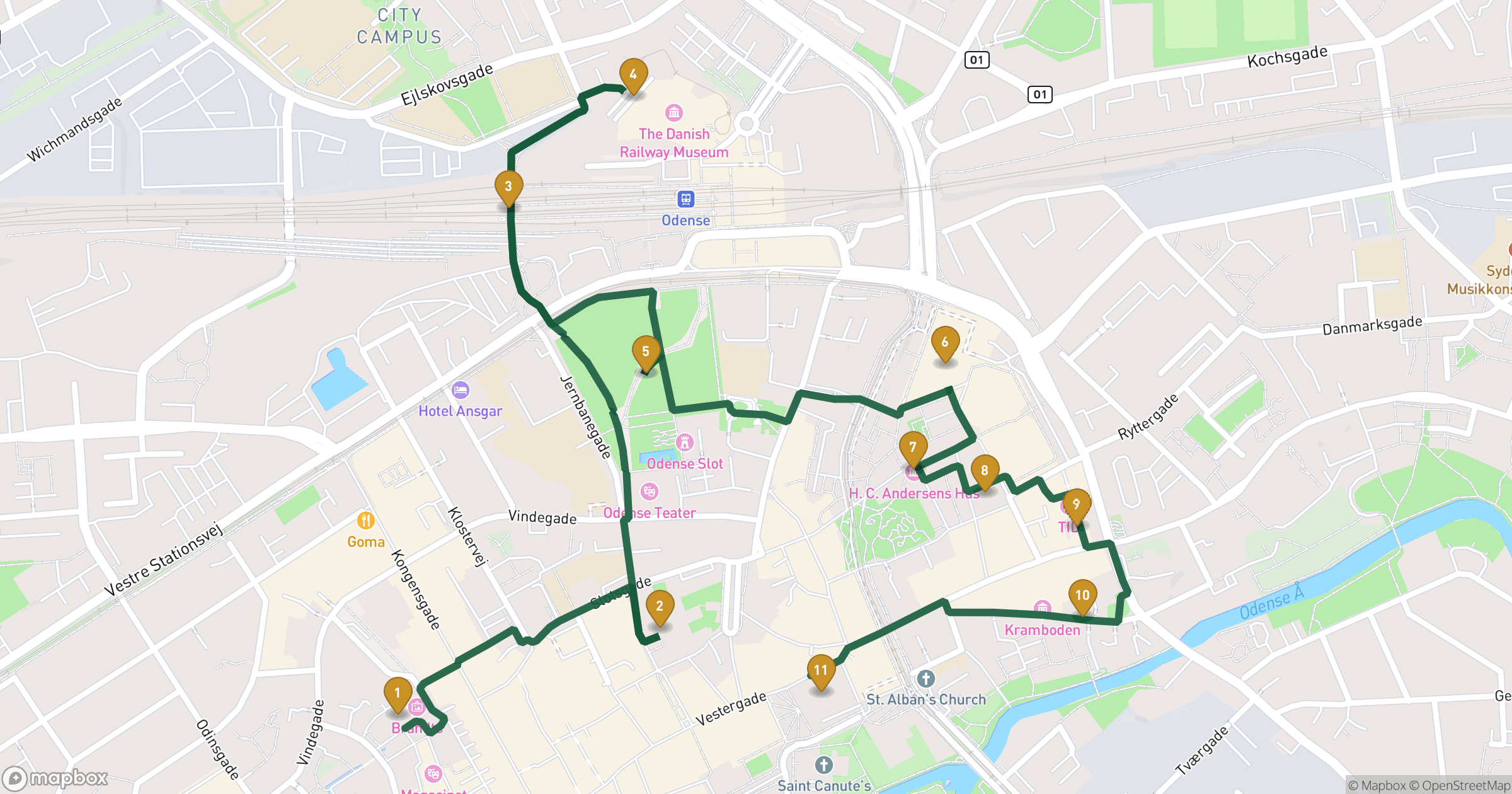
Route map for Odense walking tour

Map for Odense walking tour with 11 stops
The static map shows the tour route with Brandts klædefabrik, Gråbrødre Kloster, Byens Bro, Danmarks Jernbanemuseum, and 7 more stops.

Stops along the route

All stops on this self-guided tour at a glance.

  1. Brandts klædefabrik in Odense
    Marco Kahlund, (Benutzer:mk-sl) / CC BY-SA 2.0 de

    1Brandts klædefabrikBuilding

    Brandts Klædefabrik showcases Odense's shift from a 19th-century industrial powerhouse to a lively cultural center. Søren Christian Brandt took over the wool mill in 1869, building an empire through his obsessive supervision of every loom. Today, a towering chimney and original cast-iron columns still anchor brick galleries filled with modern art.

    Wikidata

  2. Gråbrødre Kloster in Odense
    Kåre Thor Olsen / CC BY-SA 4.0

    2Gråbrødre Kloster

    Gråbrødre Kloster reveals a turbulent evolution from an ascetic Franciscan friary founded in 1279 to a psychiatric asylum. Post-Reformation transformations introduced wooden cage-like cells called Dårekister, where chained inmates were held alongside silent cloisters. Chroniclers even noted one patient singing so loudly that the deceased friars might have covered their ears.

    Built: 1279 · Wikidata

  3. Byens Bro in Odense
    Kåre Thor Olsen / CC BY-SA 4.0

    3Byens BroBridge

    Byens Bro is an ultra-modern steel and glass overpass that reimagines infrastructure above Odense's busy rail network. Designed by Gottlieb Paludan Architects, its striking 40-meter stainless-steel pylon resembles a giant sewing needle stitched into the sky. The 190-meter bridge intentionally sways in strong winds while lifting pedestrians and cyclists directly over the tracks.

    Architect: Anita Jørgensen · Wikidata

  4. Danmarks Jernbanemuseum in Odense
    Kåre Thor Olsen / CC BY-SA 4.0

    4Danmarks Jernbanemuseum

    The Danish Railway Museum brings mechanical history to life inside a working roundhouse from 1954. King Frederik IX loved these massive machines so much that he famously took the controls of the royal train himself across Funen. Locomotives like the massive E 991 can still be viewed revolving atop the authentic central turntable.

    Built: 1975 · Wikidata

  5. Kongens Have in Odense
    Guillaume Baviere from Uppsala, Sweden / CC BY-SA 2.0

    5Kongens HavePark

    Kongens Have offers a glimpse into royal life as the former grounds of a Knights Hospitaller monastery turned royal manor. Hans Christian Andersen's mother worked as a washerwoman inside the palace, and the young boy often watched high society from these lawns. A stern statue of King Christian IX now overlooks the strictly symmetrical baroque park design.

    Built: 1720 · Wikidata

  6. Odeon in Odense
    Charlie Graven / CC BY-SA 4.0

    6OdeonTheatre

    ODEON marks Odense's contemporary cultural resurgence, replacing a four-lane highway that once severed the city. Urban planners filled in Thomas B. Thriges Gade to erect this sweeping glass complex housing a conservatory, theater, and concert hall. Its state-of-the-art acoustic system is engineered to capture sounds as delicate as a turned sheet of sheet music.

    Architect: C. F. Møller Architects · Wikidata

  7. H. C. Andersens Hus in Odense
    Marco Kahlund, (Benutzer:mk-sl) / CC BY-SA 2.0 de

    7H. C. Andersens HusMuseum

    H. C. Andersens Hus explores a subterranean fairy-tale world conceived by Japanese architect Kengo Kuma. The design avoids right angles entirely, using curving Danish larch frames and vast glass panes to bury its main exhibition spaces beneath the local water table. Above ground, precision-engineered roof gardens hold tons of earth directly over the exhibition halls below.

    Built: 1908 · Architect: Kengo Kuma & Associates · Named after: Hans Christian Andersen · Wikidata

  8. Sortebrødre Torv in Odense
    danand / CC0

    8Sortebrødre TorvSquare

    Sortebrødre Torv preserves the site of a 13th-century Dominican friary where silent friars used hand signals during communal meals. The Reformation brought the complete seizure and demolition of the monastic complex, clearing room for civic life. Today, timber-framed houses surround the plaza alongside Denmark's first provincial theater, which opened here in 1795.

    Wikidata

  9. Møntergården in Odense
    Kåre Thor Olsen / CC BY-SA 3.0

    9MøntergårdenAttraction

    Møntergården highlights Renaissance craftsmanship and the early social welfare systems of historic Odense. Nobleman Falk Gøye built the 1646 timber main house, prominently carving his coat of arms into its protective overhangs. Nearby stand the Pernille Lykkes Fattigboliger, almshouses erected in 1617 by a wealthy patron seeking heavenly salvation.

    Wikidata

  10. Nedergade in Odense
    morten.kaplak / CC BY-SA 3.0

    10NedergadeBuilding

    Nedergade showcases crooked merchant houses where tradespeople lived on lower ground than Odense's elite. At Kramboden, a burglar once became trapped in a narrow, twisted chimney and had to be rescued by town guards before mocking onlookers. Intricate wooden carvings intended to ward off evil spirits still mark these cobblestone facades with their low doors.

    Wikidata

  11. Odense Rådhus in Odense
    Kåre Thor Olsen / CC BY-SA 3.0

    11Odense RådhusBuilding

    Odense Rådhus stands as a striking brick monument heavily inspired by the Gothic Palazzo Pubblico in Siena. Architect Helgo Zettervall had to hurriedly strengthen his Italianate roof design to prevent the Danish snow from collapsing it. Out on Flakhaven plaza, Henry Moore's abstract sculpture Oceania once sparked a humorous student ransom demand for free beer.

    Built: 1883 · Architect: Carl Lendorf, Johan Daniel Herholdt · Wikidata

Download the app

This public page shows a preview. The full route, all content, and navigation are available in CityTour AI.

Cities nearby

Discover self-guided tours in nearby cities.

Frequently asked questions

The key answers before you start.

Is this a self-guided audio tour?

Yes. In the CityTour AI app (iOS and Android), this is a self-guided audio tour for Odense — start anytime, at your own pace, with map, stops, and audio narration.

What will you see on this tour?

On this tour you'll see, among others, Brandts klædefabrik, Gråbrødre Kloster, Byens Bro, Danmarks Jernbanemuseum, Kongens Have, Odeon and more sights.

Where does the tour start?

The route starts at Brandts klædefabrik and ends at Odense Rådhus. You can start anytime — the app guides you to the first stop.

How long does the tour take?

About 101 minutes for 11 stops — at your own pace, with breaks whenever you like.

How much does the tour cost?

This tour costs 15 credits. The exact price depends on the pack you buy and your country — roughly $5.

Is it an outdoor tour — are entry tickets included?

Yes, it's an outdoor tour: the sights are viewed from the outside. Entry tickets are not included, and step-free access cannot be guaranteed.

Is the audio guide available in my language?

The tour and audio guide are available in English, Deutsch, Français, Español, Italiano and 9 more languages. You pick your language in the app.

Can I use the tour offline?

Yes. Tours can be used offline.

Can I ask the AI questions along the way?

Yes. At every stop you can ask the AI directly if you want to know more or didn't understand something.