CityTour AI

Odense self-guided walking tour

Odense: From Viking Forts to Fairy Tales

Discover the enchanting evolution of Denmark's third-largest city on this immersive walking tour through Odense's historic core. You'll wander from a UNESCO-listed Viking fortress to the whimsical world of Hans Christian Andersen, exploring hidden medieval courtyards and vibrant industrial spaces along the way. It’s a relaxed journey through a thousand years of Danish history, told through the architecture and stories that define the city today.

Audio tourSelf-guidediOS & Android
104minutes
3.1 kmdistance
13stops
Audio guideFormat
Odense: From Viking Forts to Fairy Tales
Marco Kahlund, (Benutzer:mk-sl) / CC BY-SA 2.0 de

Stops on this route

This tour works well for first-time visitors, weekend trips, and travelers who want to explore Odense without a fixed tour time.

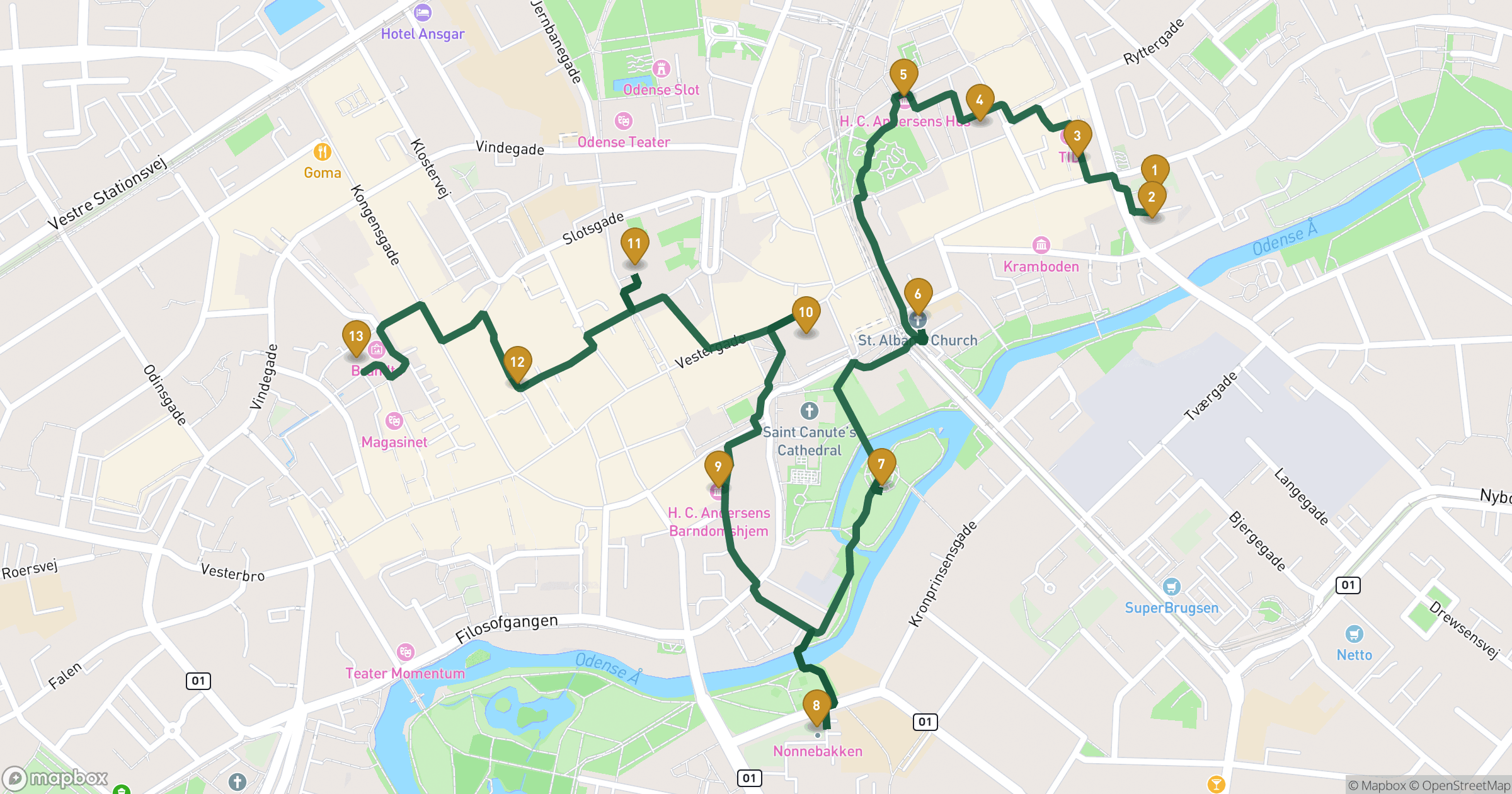
Route map for Odense walking tour

Map for Odense walking tour with 13 stops
The static map shows the tour route with Church of Our Lady, Latinskolen, Møntergården, Sortebrødre Torv, and 9 more stops.

Stops along the route

All stops on this self-guided tour at a glance.

  1. Church of Our Lady in Odense
    No machine-readable author provided. Scm assumed (based on copyright claims). / CC BY-SA 3.0

    1Church of Our Lady

    Odense's oldest church stands as an early spiritual anchor that illustrates the transition from Romanesque rounded arches to Gothic pointed flourishes. Constructed around 1184 out of sturdy red brickwork, the building was dedicated to Mary and served as the primary local parish church for centuries. Despite later renovations, its original 12th-century core and foundations remain intact.

    Built: 1184 · Named after: Mary · Wikidata

  2. 2LatinskolenBuilding

    This small brick building represents the intellectual center of Renaissance Odense and remains one of Denmark's oldest surviving educational structures. Erected in 1528, it served for nearly three centuries as the primary school where elite boys studied Latin, Greek, and theology for government and church careers. Its simple early Renaissance masonry embodies the functional design built to last through generations of scholars.

  3. Møntergården in Odense
    Kåre Thor Olsen / CC BY-SA 3.0

    3MøntergårdenAttraction

    A protected complex of courtyard buildings traces the evolution of Danish urban architecture from the 16th century onward. Its centerpiece is a prominent red-and-black half-timbered house constructed in 1646 by nobleman Falk Gøye. Taking its name from a nearby former mint, the historic property features interlocking timber beams and brick infill that once housed noble residences and workshops.

    Wikidata

  4. Sortebrødre Torv in Odense
    danand / CC0

    4Sortebrødre TorvSquare

    This vibrant market square occupies the site of a former medieval monastery and preserves the intimate scale of early town life. Its name recalls the Dominican monastery where monks wore black cloaks over white habits, earning them the moniker Black Friars. Colorful half-timbered small houses enclose the space, which continues its longstanding tradition as an active venue for farmers selling fresh produce and flowers.

    Wikidata

  5. H. C. Andersens Hus in Odense
    Marco Kahlund, (Benutzer:mk-sl) / CC BY-SA 2.0 de

    5H. C. Andersens HusMuseum

    A modern museum complex celebrates Odense's most famous writer through an organic architectural concept that connects interior spaces directly to nature. Japanese architect Kengo Kuma designed the site in 2021 as a series of circular structures made of curved light-colored timber and glass. Much of the museum sits underground, topped by winding public gardens that visitors can wander through above.

    Built: 1908 · Architect: Kengo Kuma & Associates · Named after: Hans Christian Andersen · Wikidata

  6. St. Alban's Church in Odense
    Charlie Graven / CC BY 4.0

    6St. Alban's Church

    The slender spire of this Roman Catholic parish church defines the city skyline through the sharp lines of Gothic Revival design. Built in 1908 by German architect Ludwig Schneider, the church features interior glass paintings by Georg Schneider and a 1908 altarpiece by Konrad Martiner. The congregation originally served German and Polish immigrants, later joined by a Vietnamese community, while carrying the name of an older priory nearby.

    Built: 1908 · Named after: Saint Alban · Wikidata

  7. Eventyrhaven in Odense
    Jonay CP from Gran Canaria, Spain / CC BY 2.0

    7EventyrhavenPark

    Once the private garden of the Bishop's palace, this peaceful park was redesigned in the 1940s to evoke the charm of a storybook landscape. Louis Hasselriis sculpted the park's bronze statue of Hans Christian Andersen after local townspeople deemed it too grand for the town center. From the riverside paths and bridges crossing the Odense River, the site offers an unobstructed rear view of Saint Canute's Gothic brick cathedral.

    Named after: Hans Christian Andersen · Wikidata

  8. Nonnebakken in Odense
    Kåre Thor Olsen / CC BY-SA 3.0

    8NonnebakkenMonument

    Beneath the modern residential ground of Nun Hill lie the buried remains of a 120-meter-wide circular Viking ring fortress inscribed on the UNESCO World Heritage list in 2023. King Sweyn Forkbeard built the massive stronghold between 980 and 1000 AD to control river navigation after rebelling against his father Harald Bluetooth. The original earthworks and pointed ditches were still recorded in 16th-century maps before being largely leveled in the late 19th century.

    Wikidata

  9. Hans Christian Andersen's Childhood Home in Odense
    Kåre Thor Olsen / CC BY-SA 3.0

    9Hans Christian Andersen's Childhood HomeMuseum

    This tiny yellow corner house on Munkemøllestræde preserves the cramped domestic setting where Hans Christian Andersen lived from age two until fourteen. In 1807, the author shared a modest 42-square-meter apartment and a small hallway with his shoemaker father, his mother Anne Marie, and the neighboring Köcker family. Reconstructed in 1931, the rooms with low ceilings retain the interior appearance of the shoemaker trade that inspired his later stories.

    Built: 1931 · Named after: Hans Christian Andersen · Wikidata

  10. Odense Rådhus in Odense
    Kåre Thor Olsen / CC BY-SA 3.0

    10Odense RådhusBuilding

    Facing the central square, this grand late-19th-century municipal headquarters reflects the growing wealth and administrative ambition of industrial Odense. Architects Mikkel Nielsen and Niels Jacobsen finished the red-brick complex in 1883, drawing heavy inspiration from the Italian Gothic crenelations of Siena's Palazzo Pubblico. In the 1950s, Helge Bojsen-Møller seamlessly integrated a substantial new wing into the historic medievalist structure.

    Built: 1883 · Architect: Carl Lendorf, Johan Daniel Herholdt · Wikidata

  11. Gråbrødre Kloster in Odense
    Kåre Thor Olsen / CC BY-SA 4.0

    11Gråbrødre KlosterBuilding

    Tucked into a quiet urban courtyard, this cloister reflects a centuries-long evolution from a medieval religious retreat into an institution of municipal social care. Established in 1279 by robe-wearing Franciscan friars, the monastery avoided destruction during the 1532 Reformation when the city converted it into a hospital for the elderly and poor. Classic arched brick windows frame the monastic quadrangle, which today provides residential apartments for senior citizens.

    Built: 1279 · Wikidata

  12. Vintapperstræde in Odense
    Kristian Bang / CC0

    12VintapperstrædeSquare

    This 100-meter alleyway creates an intimate pedestrian corridor out of what were once back storage yards for an adjoining historic wine business. The passage takes its name from the Marinus Lytjens Vinhandel, which operated nearby on Slotsgade before the revitalized lane opened to the public in November 1977. Today, old commercial warehouse facades sit alongside modern restaurants, wine bars, and specialty retail shops.

    Wikidata

  13. Brandts klædefabrik in Odense
    Marco Kahlund, (Benutzer:mk-sl) / CC BY-SA 2.0 de

    13Brandts klædefabrikBuilding

    This massive red-brick industrial compound once formed the productive powerhouse of Odense's textile trade before transforming into a modern cultural quarter. Originating as a modest 1796 dye works founded by Morten Panton, the complex expanded dramatically under Søren Christian Brandt from 1869 with the introduction of steam looms. Industrial operations finally ceased in 1977, allowing the old production halls to be converted into the Brandts Museum of Art and Visual Culture.

    Wikidata

Download the app

This public page shows a preview. The full route, all content, and navigation are available in CityTour AI.

Cities nearby

Discover self-guided tours in nearby cities.

Frequently asked questions

The key answers before you start.

Is this a self-guided audio tour?

Yes. In the CityTour AI app (iOS and Android), this is a self-guided audio tour for Odense — start anytime, at your own pace, with map, stops, and audio narration.

What will you see on this tour?

On this tour you'll see, among others, Church of Our Lady, Latinskolen, Møntergården, Sortebrødre Torv, H. C. Andersens Hus, St. Alban's Church and more sights.

Where does the tour start?

The route starts at Church of Our Lady and ends at Brandts klædefabrik. You can start anytime — the app guides you to the first stop.

How long does the tour take?

About 104 minutes for 13 stops — at your own pace, with breaks whenever you like.

How much does the tour cost?

This tour costs 15 credits. The exact price depends on the pack you buy and your country — roughly $5.

Is it an outdoor tour — are entry tickets included?

Yes, it's an outdoor tour: the sights are viewed from the outside. Entry tickets are not included, and step-free access cannot be guaranteed.

Is the audio guide available in my language?

The tour and audio guide are available in English, Deutsch, Français, Español, Italiano and 9 more languages. You pick your language in the app.

Can I use the tour offline?

Yes. Tours can be used offline.

Can I ask the AI questions along the way?

Yes. At every stop you can ask the AI directly if you want to know more or didn't understand something.