CityTour AI

Paris self-guided walking tour

Paris: The Awakening of the City, from Lutetia to the Louvre

Dive into the origins of Paris on this captivating walk between Île de la Cité and the Right Bank palaces. Discover how an ancient settlement became the center of French royal power while admiring Gothic masterpieces and historic fortresses. This relaxed historical immersion is perfect for understanding the capital's soul through its most iconic monuments.

Audio tourSelf-guidediOS & Android
105minutes
4.6 kmdistance
10stops
Audio guideFormat
Paris: The Awakening of the City, from Lutetia to the Louvre
Kurt Raschke / CC BY 2.0

Stops on this route

This tour works well for first-time visitors, weekend trips, and travelers who want to explore Paris without a fixed tour time.

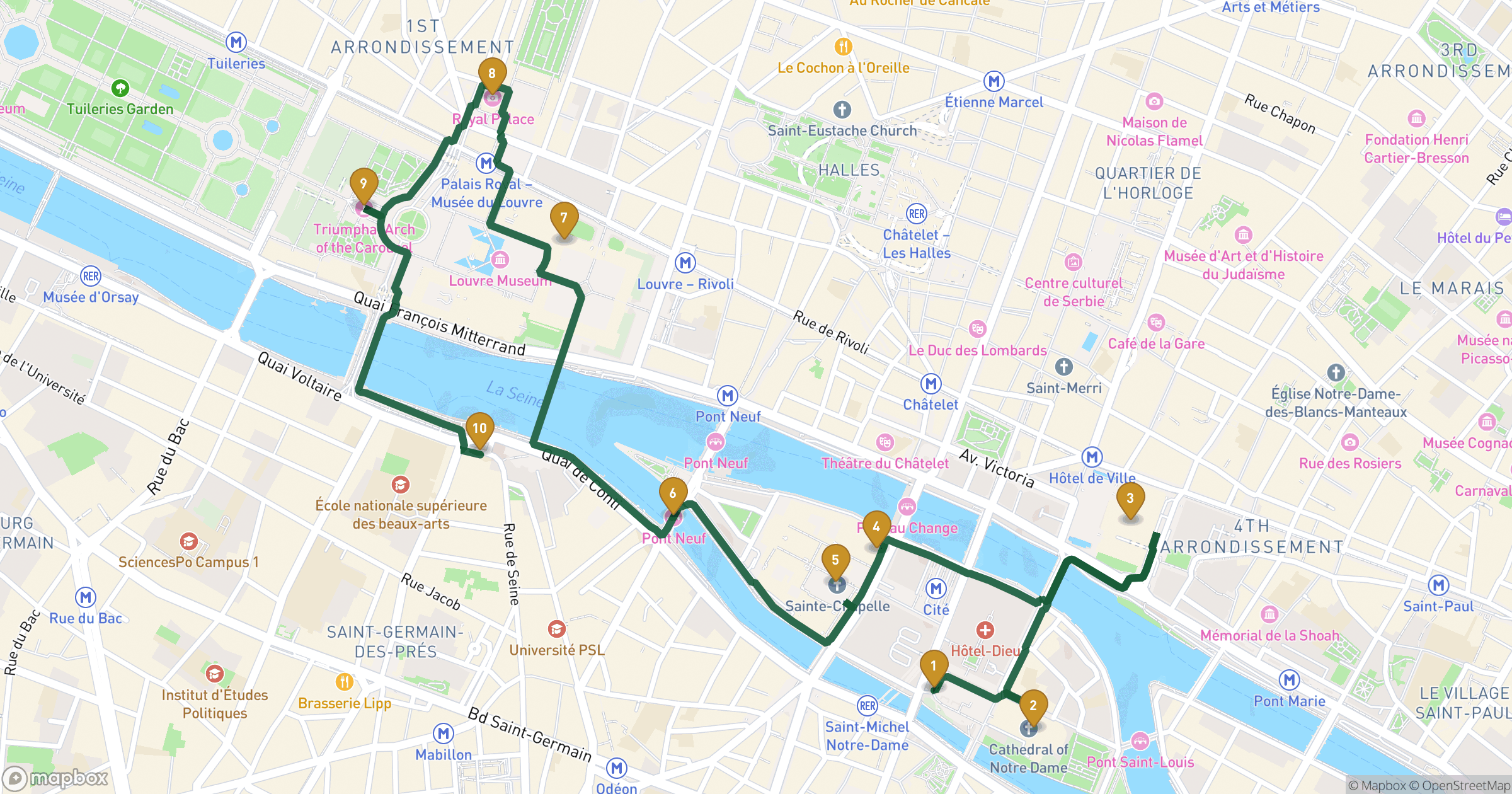
Route map for Paris walking tour

Map for Paris walking tour with 10 stops
The static map shows the tour route with Archaeological Crypt of the Paris Notre-Dame, Cathédrale Notre-Dame de Paris, Hôtel de Ville, Conciergerie, and 6 more stops.

Stops along the route

All stops on this self-guided tour at a glance.

  1. Archaeological Crypt of the Paris Notre-Dame in Paris
    Kurt Raschke / CC BY 2.0

    1Archaeological Crypt of the Paris Notre-DameMuseum

    This underground museum reveals the ancient Roman layers of Lutetia beneath the cathedral forecourt. Workers uncovered Roman walls here in 1965 during excavations for a planned parking garage, which was promptly abandoned. The subterranean circuit preserves foundations of a fourth-century rampart and remains of Gallo-Roman public baths.

    Built: 1980 · Wikidata

  2. Cathédrale Notre-Dame de Paris in Paris
    P e z i / CC BY-SA 3.0

    2Cathédrale Notre-Dame de ParisChurch

    Notre-Dame Cathedral stands as a monumental Gothic structure shaped by centuries of bold construction and historic events. Bishop Maurice de Sully launched its building in 1163, reportedly inspired by a vision sketched in the city dust. Just outside the main portal, a small bronze plaque in the ground marks Point Zéro, the starting point for measuring distances along French roads.

    Built: 1163 · Architect: Pierre de Chelles, Pierre de Montreuil … · Style: classic gothic … · Height: 90 m · Wikidata

  3. Hôtel de Ville in Paris
    Chabe01 / CC BY-SA 4.0

    3Hôtel de VilleAttraction

    The grand municipal palace on the Right Bank traces its civic roots back to the medieval merchant provost Étienne Marcel. Communards burned down the historic structure in 1871, prompting architects Théodore Ballu and Édouard Deperthes to spend ten years rebuilding it in the French Neo-Renaissance style. Its facade displays 108 statues of prominent Paris-born figures such as Molière, Voltaire, and Richelieu.

    Built: 1357 · Architect: Théodore Ballu · Style: Renaissance Revival architecture · Wikidata

  4. Conciergerie in Paris
    xandru / CC BY-SA 4.0

    4ConciergerieCastle

    This riverside fortress preserves the transition from a medieval royal residence to a dreaded Revolutionary prison. Marie-Antoinette spent her final days in 1793 inside these walls, watched constantly by guards placed just behind a simple screen. Outside, its fairy-tale silhouette features the Tour de l'Horloge, which holds the city's very first public clock face.

    Style: Gothic Revival … · Wikidata

  5. Sainte-Chapelle in Paris
    Mathae / CC BY 2.5

    5Sainte-ChapelleChurch

    King Louis IX commissioned this Rayonnant Gothic royal chapel to enshrine the Crown of Thorns, purchased from Constantinople for more than the chapel's entire construction cost. Built in less than seven years, it features an upper sanctuary where stone walls yield almost entirely to fifteen soaring stained-glass windows. These thirteenth-century panels portray 1,113 scenes from the Old and New Testaments.

    Built: 1245 · Architect: Pierre de Montreuil · Style: Rayonnant · Height: 75.8 m · Wikidata

  6. Pont Neuf in Paris
    Szilas / CC BY-SA 4.0

    6Pont NeufBridge

    Despite its deceptive name, the Pont Neuf survives as the oldest standing bridge in the French capital. Inaugurated by King Henri IV in 1607, it broke with tradition by banning houses so pedestrians could enjoy river views, while also introducing raised sidewalks against mud and horses. Along the stone cornices, 381 uniquely carved mascaron heads look down over the water.

    Built: 1578 · Architect: Jean-Baptiste Androuet du Cerceau · Wikidata

  7. Musée du Louvre in Paris
    Benh LIEU SONG (Flickr) / CC BY-SA 3.0

    7Musée du LouvreBuilding

    The Louvre documents eight centuries of transformation, evolving from a medieval defensive fortress into a palatial art museum. In the sixteenth century, King Francis I initiated this Renaissance reinvention by razing the medieval keep and commissioning architect Pierre Lescot's new facade. Deep below, the dry stone moats built under King Philippe Auguste remain visible to visitors.

    Built: 1793 · Architect: I. M. Pei, Pierre Lescot … · Named after: Louvre Palace · Wikidata

  8. Palais-Royal in Paris
    Marie-Lan Nguyen / Public domain

    8Palais-RoyalAttraction

    Cardinal Richelieu built this residence in 1628 as the Palais-Cardinal, where he included a private theater that later hosted Molière's final performances. Revolutionary unrest ignited in its café gardens on July 12, 1789, when lawyer Camille Desmoulins mounted a table with a chestnut leaf in his hat to urge citizens to take up arms. In the main courtyard, Daniel Buren added 260 striped marble columns in 1986.

    Built: 1628 · Architect: Pierre-François-Léonard Fontaine · Style: classical architecture · Wikidata

  9. arc de triomphe du Carrousel in Paris
    Thesupermat / CC BY-SA 3.0

    9arc de triomphe du CarrouselMonument

    Architects Percier and Fontaine completed this neoclassical triumphal arch in 1808 to commemorate Napoleon's victory at the Battle of Austerlitz. Modeled directly on the Arch of Constantine in Rome, the monument features pink marble columns quarried in Languedoc. The crowning bronze chariot is a nineteenth-century replica that replaced the original horses looted from Venice's Saint Mark's Basilica.

    Built: 1808 · Architect: Pierre-François-Léonard Fontaine · Style: Neoclassicism · Named after: Grand Carrousel · Wikidata

  10. Institut de France in Paris
    Guilhem Vellut from Paris, France | Institut de France @ Saint-Germain-des-Près @ Paris / CC BY 2.0

    10Institut de FranceBuilding

    This French baroque palace on the Left Bank was founded through the bequest of Cardinal Mazarin to educate provincial youths. Designed by architect Louis Le Vau, its domed chapel houses the cardinal's elaborate seventeenth-century marble tomb sculpted by Antoine Coysevox. Since 1805, the landmark has served as the working home of the Académie française and its fellow national institutes.

    Wikidata

Download the app

This public page shows a preview. The full route, all content, and navigation are available in CityTour AI.

Cities nearby

Discover self-guided tours in nearby cities.

Frequently asked questions

The key answers before you start.

Is this a self-guided audio tour?

Yes. In the CityTour AI app (iOS and Android), this is a self-guided audio tour for Paris — start anytime, at your own pace, with map, stops, and audio narration.

What will you see on this tour?

On this tour you'll see, among others, Archaeological Crypt of the Paris Notre-Dame, Cathédrale Notre-Dame de Paris, Hôtel de Ville, Conciergerie, Sainte-Chapelle, Pont Neuf and more sights.

Where does the tour start?

The route starts at Archaeological Crypt of the Paris Notre-Dame and ends at Institut de France. You can start anytime — the app guides you to the first stop.

How long does the tour take?

About 105 minutes for 10 stops — at your own pace, with breaks whenever you like.

How much does the tour cost?

This tour costs 15 credits. The exact price depends on the pack you buy and your country — roughly $5.

Is it an outdoor tour — are entry tickets included?

Yes, it's an outdoor tour: the sights are viewed from the outside. Entry tickets are not included, and step-free access cannot be guaranteed.

Is the audio guide available in my language?

The tour and audio guide are available in English, Deutsch, Français, Español, Italiano and 9 more languages. You pick your language in the app.

Can I use the tour offline?

Yes. Tours can be used offline.

Can I ask the AI questions along the way?

Yes. At every stop you can ask the AI directly if you want to know more or didn't understand something.