CityTour AI

Paris self-guided walking tour

Romantic Stroll: Seine Riverbanks & Belle Époque

Discover the romantic soul of Paris on a relaxed walk along the banks of the Seine. Between Belle Époque masterpieces and historic bridges, you will explore the architectural elegance that defines the French capital. It is a gentle immersion into the city's most cinematic setting, enriched by local anecdotes.

Audio tourSelf-guidediOS & Android
104minutes
4.5 kmdistance
9stops
Audio guideFormat
Romantic Stroll: Seine Riverbanks & Belle Époque
Jebulon / CC0

Stops on this route

This tour works well for first-time visitors, weekend trips, and travelers who want to explore Paris without a fixed tour time.

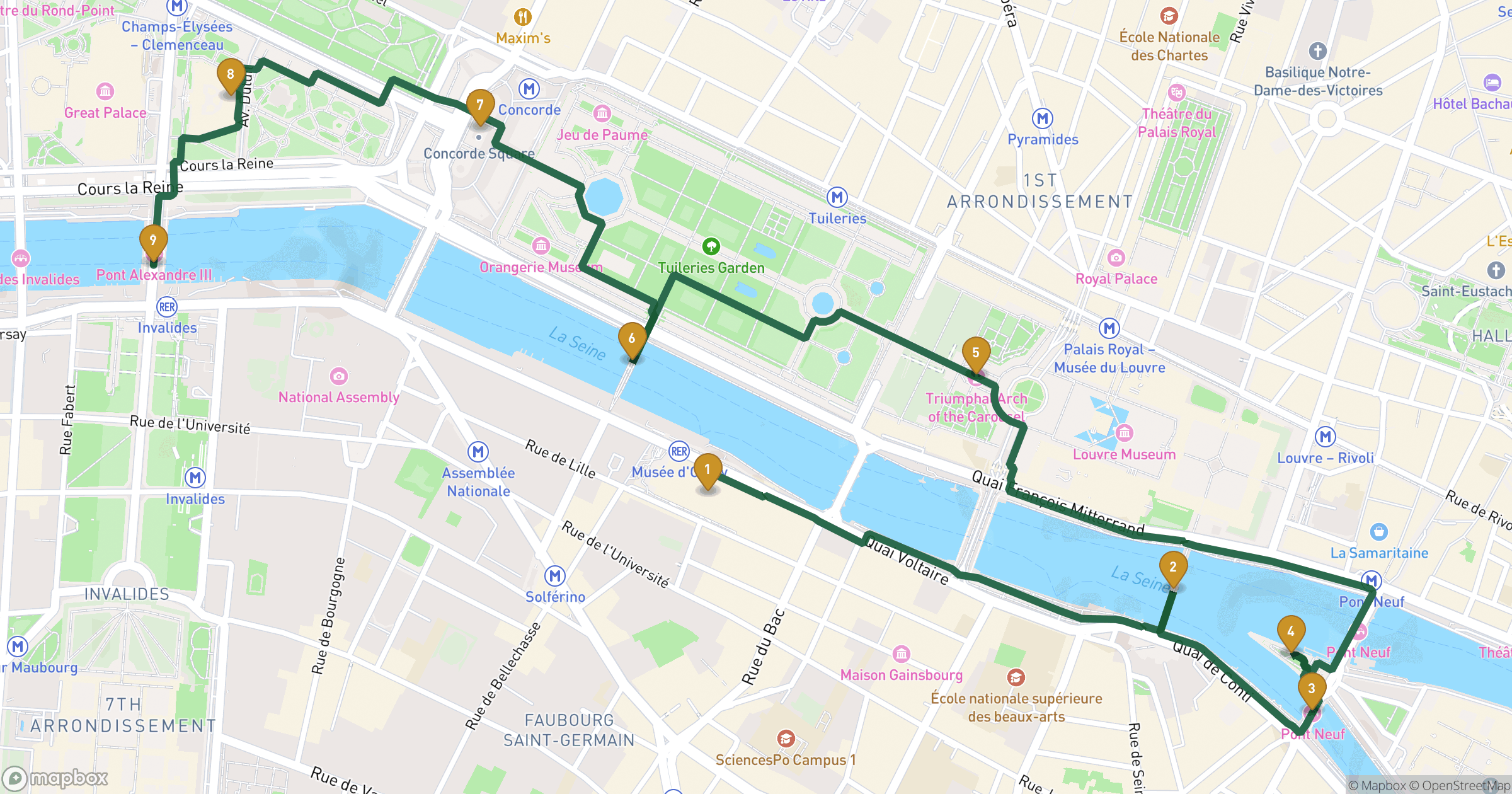
Route map for Paris walking tour

Map for Paris walking tour with 9 stops
The static map shows the tour route with Musée d'Orsay, Pont des Arts, Pont Neuf, Square du Vert Galant, and 5 more stops.

Stops along the route

All stops on this self-guided tour at a glance.

  1. Musée d'Orsay in Paris
    Cheng-en Cheng from Taichung City, Taiwan / CC BY-SA 2.0

    1Musée d'OrsayMuseum

    Musée d'Orsay presents the conversion of a cutting-edge railway terminal into a temple of impressionism. Built by Victor Laloux for the 1900 World's Fair, the industrial iron structure was masked by an opulent Beaux-Arts stone facade to mirror the Louvre. In 1939 its platforms became too short for modern trains, setting off a journey that included serving as a film set for Orson Welles.

    Built: 1986 · Architect: Victor Laloux · Named after: Gare d'Orsay · Wikidata

  2. Pont des Arts in Paris
    Joe deSousa; Pont des Arts, Paris / CC0

    2Pont des ArtsBridge

    Pont des Arts stands as Paris's premier pedestrian crossing, linking the Institut de France directly to the Louvre. Built between 1801 and 1804 under Napoleon, it pioneered the use of cast iron to achieve a light, floating appearance over the Seine. After barge collisions and war bombardments caused a 60-meter collapse in 1979, Louis Arretche rebuilt it in 1984 with seven arches instead of nine.

    Built: 1804 · Named after: arts · Wikidata

  3. Pont Neuf in Paris
    Szilas / CC BY-SA 4.0

    3Pont NeufBridge

    Pont Neuf stands as the oldest surviving bridge in Paris, constructed between 1578 and 1607. Under Henri IV, it revolutionized city design as the first Parisian bridge built without houses and the first fitted with pedestrian sidewalks. Its stone cornices display 381 grotesque mascarons, while the equestrian statue of Henri IV in the center was cast anew and remounted in 1818.

    Built: 1578 · Architect: Jean-Baptiste Androuet du Cerceau · Wikidata

  4. Square du Vert Galant in Paris
    Rafael Garcia-Suarez / CC BY-SA 2.0

    4Square du Vert GalantPark

    Square du Vert Galant sits at the tip of Île de la Cité, named in tribute to the vitality and charms of King Henri IV. This ship-prow park was assembled from small river islands, notably the Île aux Juifs where Jacques de Molay, Grand Master of the Templars, was burned alive in 1314. Stone stairs tucked behind the king's bronze horse lead down to its willows and views over the Louvre.

    Built: 1884 · Named after: Henry IV of France · Wikidata

  5. arc de triomphe du Carrousel in Paris
    Thesupermat / CC BY-SA 3.0

    5arc de triomphe du CarrouselMonument

    The Arc de Triomphe du Carrousel was erected between 1806 and 1808 by Pierre-François-Léonard Fontaine and Charles Percier to honor Napoleon's 1805 campaign. Taking cues from Rome's Arch of Constantine, the neoclassical gate combines Languedoc pink marble columns with pure white stone. The bronze quadriga on top is a replacement by François Joseph Bosio, installed after Venice reclaimed its stolen horses in 1815.

    Built: 1808 · Architect: Pierre-François-Léonard Fontaine · Style: Neoclassicism · Named after: Grand Carrousel · Wikidata

  6. Passerelle Léopold-Sédar-Senghor in Paris
    ignis / CC BY-SA 3.0

    6Passerelle Léopold-Sédar-SenghorBridge

    Passerelle Léopold-Sédar-Senghor is a modern footbridge designed by Marc Mimram that spans the Seine without a single river pier. Built in 1999 to connect the Tuileries Garden with Musée d'Orsay, it features an upper terrace and lower ramps paved in exotic ipé wood. Opening-day crowds caused it to wobble like London's Millennium Bridge, prompting a brief closure to fit vibration dampers.

    Built: 1999 · Architect: Marc Mimram · Named after: Léopold Sédar Senghor · Wikidata

  7. Place de la Concorde in Paris
    Jebulon / CC0

    7Place de la ConcordeBuilding

    Place de la Concorde forms the capital's grandest plaza, centered on the 3,300-year-old pink granite Luxor Obelisk given by Egypt in the 19th century. Architect Ange-Jacques Gabriel laid out the classical perimeter, which became the execution ground for Louis XVI and Marie-Antoinette during the Revolution. The two massive fountains designed by Jacques Hittorff celebrate France's maritime and river waterways.

    Built: 1772 · Architect: Ange-Jacques Gabriel · Named after: Concordia · Wikidata

  8. Petit Palais in Paris
    Chabe01 / CC BY-SA 4.0

    8Petit PalaisMuseum

    The Petit Palais was created for the 1900 World's Fair by architect Charles Girault, pairing Beaux-Arts stone with early reinforced concrete. The permanent museum displays more than 20,000 works donated in 1902 by Auguste Dutuit, spanning Antiquity to Dutch masters. Tucked within its walls lies a quiet semicircular garden edged by Tuscan columns, colorful mosaics, and ceiling frescoes by Paul Baudoüin.

    Built: 1902 · Architect: Charles Girault, François Hennebique · Style: Beaux-Arts · Wikidata

  9. Pont Alexandre III in Paris
    Jean-Pol GRANDMONT / CC BY 4.0

    9Pont Alexandre IIIBridge

    Pont Alexandre III celebrates Franco-Russian ties, commemorated by Czar Nicholas II laying its foundation stone in 1896. Engineers created a remarkably low single steel arch so traffic would not obstruct sightlines between the Champs-Élysées and the Invalides. Four 17-meter pylons crowned with gilded bronzes of Pegasus flank the river, while sculptured Seine and Neva nymphs decorate the bridge edges.

    Built: 1900 · Architect: Joseph Cassien-Bernard · Style: Art Nouveau architecture · Named after: Alexander III of Russia · Wikidata

Download the app

This public page shows a preview. The full route, all content, and navigation are available in CityTour AI.

Cities nearby

Discover self-guided tours in nearby cities.

Frequently asked questions

The key answers before you start.

Is this a self-guided audio tour?

Yes. In the CityTour AI app (iOS and Android), this is a self-guided audio tour for Paris — start anytime, at your own pace, with map, stops, and audio narration.

What will you see on this tour?

On this tour you'll see, among others, Musée d'Orsay, Pont des Arts, Pont Neuf, Square du Vert Galant, arc de triomphe du Carrousel, Passerelle Léopold-Sédar-Senghor and more sights.

Where does the tour start?

The route starts at Musée d'Orsay and ends at Pont Alexandre III. You can start anytime — the app guides you to the first stop.

How long does the tour take?

About 104 minutes for 9 stops — at your own pace, with breaks whenever you like.

How much does the tour cost?

This tour costs 15 credits. The exact price depends on the pack you buy and your country — roughly $5.

Is it an outdoor tour — are entry tickets included?

Yes, it's an outdoor tour: the sights are viewed from the outside. Entry tickets are not included, and step-free access cannot be guaranteed.

Is the audio guide available in my language?

The tour and audio guide are available in English, Deutsch, Français, Español, Italiano and 9 more languages. You pick your language in the app.

Can I use the tour offline?

Yes. Tours can be used offline.

Can I ask the AI questions along the way?

Yes. At every stop you can ask the AI directly if you want to know more or didn't understand something.