CityTour AI

Madrid self-guided walking tour

Madrid’s Grand Evolution: From Hapsburgs to Gran Vía

Experience the dramatic transformation of Spain’s capital as you walk from the monumental Plaza de Cibeles to the bustling energy of Gran Vía. This casual stroll weaves through Hapsburg plazas and royal grounds, offering a local’s perspective on how a medieval town became a world-class metropolis. You’ll discover the stories behind iconic landmarks like the Royal Palace and Puerta del Sol while soaking in the vibrant, 'castizo' atmosphere of the city streets.

Audio tourSelf-guidediOS & Android
104minutes
4.0 kmdistance
10stops
Audio guideFormat
Madrid’s Grand Evolution: From Hapsburgs to Gran Vía
Diego Delso / CC BY-SA 4.0

Stops on this route

This tour works well for first-time visitors, weekend trips, and travelers who want to explore Madrid without a fixed tour time.

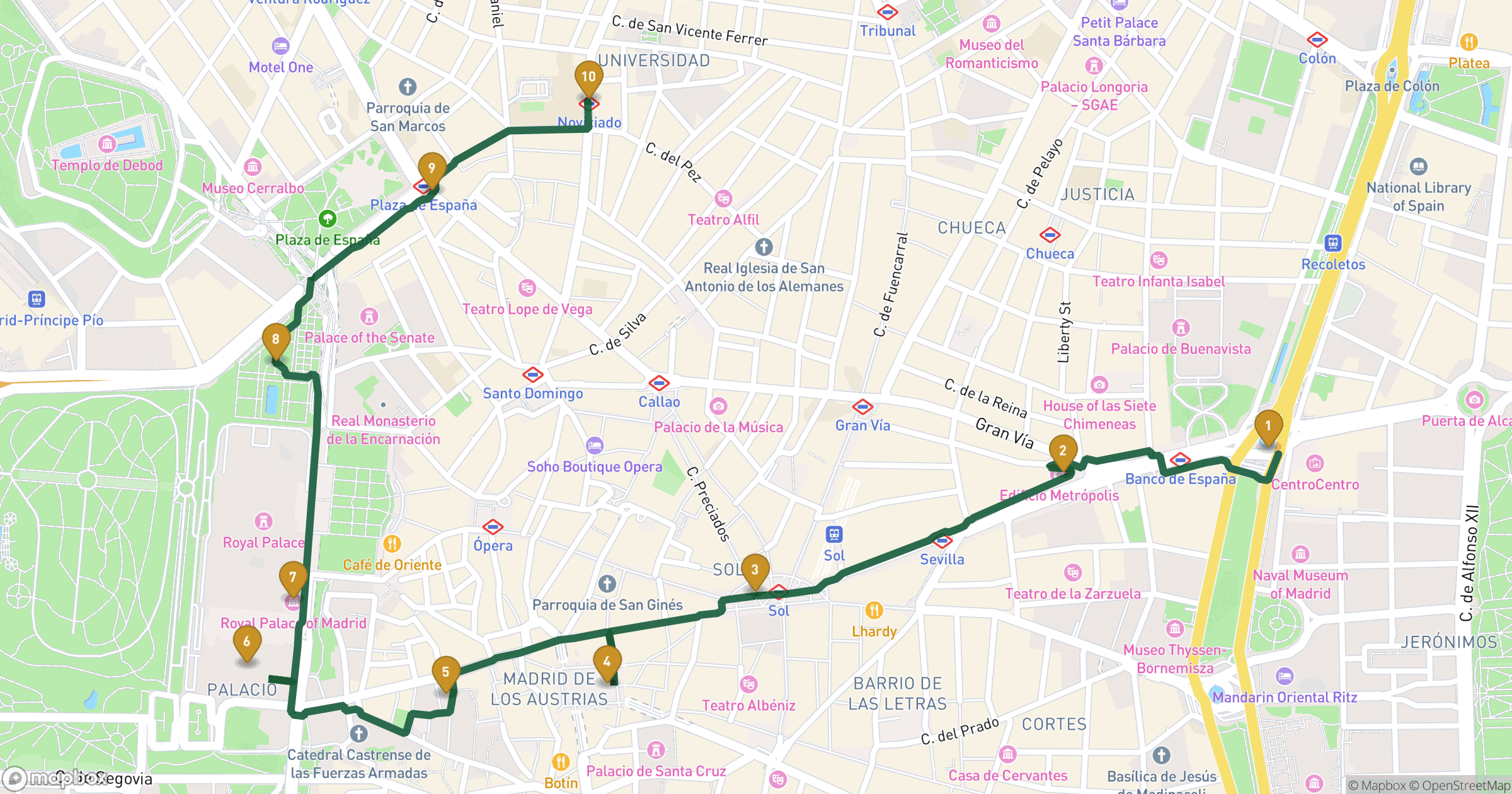
Route map for Madrid walking tour

Map for Madrid walking tour with 10 stops
The static map shows the tour route with plaza de Cibeles, Edificio Metrópolis, Puerta del Sol, Plaza Mayor, and 6 more stops.

Stops along the route

All stops on this self-guided tour at a glance.

  1. plaza de Cibeles in Madrid
    Miguel Diaz from Boadilla del Monte, España-Spain / CC BY-SA 2.0

    1plaza de CibelesBuilding

    Plaza de Cibeles is explored through its monumental architecture and role as a living symbol of Spanish power and civic celebration. At its center stands Ventura Rodríguez's 1782 neoclassical fountain of Cybele in a lion-drawn chariot, which Real Madrid captains scale to place a club scarf after major victories. Around the square, former landmarks like the 1919 Palace of Communication now serve as the City Hall.

    Named after: Cybele · Wikidata

  2. Edificio Metrópolis in Madrid
    Diego Delso / CC BY-SA 4.0

    2Edificio MetrópolisAttraction

    Edificio Metrópolis introduces the Parisian Beaux-Arts glamour marking the start of Madrid's 20th-century Gran Vía expansion. Designed by Jules and Raymond Février and finished in 1911, its dome is gilded with 30,000 leaves of 24-carat gold. The bronze statue of Winged Victory atop the dome replaced the original phoenix when the Metrópolis insurance company took ownership in the 1970s.

    Built: 1911 · Architect: Pierre Barthélemy Victor Jules Février · Style: Beaux-Arts · Wikidata

  3. Puerta del Sol in Madrid
    Tomás Fano / CC BY-SA 2.0

    3Puerta del SolSquare

    Puerta del Sol is presented as Spain's literal and symbolic center, housing the country's Kilometer Zero plaque in front of the Royal Post Office. Commissioned by King Charles III, the building features the famous clock tower whose midnight chimes dictate the New Year's Eve grape-eating tradition. Across the square stands the twenty-ton bronze statue of the Bear and the Strawberry Tree, Madrid's medieval heraldic emblem.

    Wikidata

  4. Plaza Mayor in Madrid
    Draceane / CC BY-SA 4.0

    4Plaza MayorSquare

    Plaza Mayor reflects Hapsburg Madrid's ceremonial grandeur, framed by the Herrerian slate spires designed by Juan de Herrera and Juan Gómez de Mora. The frescoed Casa de la Panadería stands as the lone survivor of the catastrophic 1790 fire. In the center, the equestrian bronze of Philip III had its mouth permanently sealed after a 1930s blast revealed centuries of trapped bird skeletons within its hollow belly.

    Architect: Juan de Herrera · Wikidata

  5. Plaza de la Villa in Madrid
    Anagoria / CC BY 3.0

    5Plaza de la VillaSquare

    Plaza de la Villa reveals Madrid's preserved medieval and Renaissance administrative center, where the city council governed until 2007. Its 15th-century Casa y Torre de los Lujanes famously served as the prison for King Francis I of France after his capture at the Battle of Pavia in 1525. Next door, the 17th-century Casa de la Villa features two matching entrance doors: one for municipal offices, the other for the city jail.

    Wikidata

  6. Catedral de la Almudena in Madrid
    Diego Delso / CC BY-SA 4.0

    6Catedral de la AlmudenaChurch

    Catedral de la Almudena breaks canonical orientation by aligning north-to-south to directly face the Royal Palace. Spanning construction from 1879 to 1993, it became the first cathedral outside Rome consecrated by Pope John Paul II. Inside, the pop-art-styled modern stained glass and colorful ceilings contrast with the ancient legend of a Virgin Mary statue hidden in the citadel walls for three centuries.

    Built: 1883 · Architect: Francisco de Cubas · Style: historicist architecture … · Named after: Virgin of Almudena · Wikidata

  7. Palacio Real in Madrid
    Tim Adams / CC BY-SA 4.0

    7Palacio RealCastle

    Palacio Real illustrates the Bourbon ambition to erect a fireproof palace after a four-day blaze incinerated the wooden Muslim Alcázar on Christmas Eve 1734. King Philip V commissioned a stone and brick structure spanning over 3,400 rooms without timber framing. In Plaza de Oriente, Pietro Tacca's equestrian statue of Philip IV achieved the world's first reared bronze horse with balance advice from Galileo Galilei.

    Built: 1735 · Architect: Francesco Sabatini, Filippo Juvarra … · Style: baroque architecture · Wikidata

  8. Jardines de Sabatini in Madrid
    r0x sm / CC BY-SA 2.0

    8Jardines de SabatiniPark

    Jardines de Sabatini showcases a strictly geometric neoclassical retreat built during the 1930s Second Spanish Republic on the palace's northern flank. Rather than Sabatini's personal design, the park replaces his former royal stables, which once housed hundreds of horses and carriages. Today, manicured hedges and a large rectangular reflecting pool mirror the white stone palace facade.

    Wikidata

  9. Gran Vía in Madrid
    Felipe Gabaldón / CC BY 2.0

    9Gran VíaBuilding

    Gran Vía tracks Madrid's early 20th-century modernization, which carved an American-style boulevard through over 300 demolished houses and 50 medieval streets starting in 1910. The 1929 Telefónica Building stood as Europe's tallest skyscraper and served as a frequent artillery target for foreign press correspondents like Ernest Hemingway. Nearby, Hemingway drank at the Chicote bar, established as Spain's first American cocktail bar.

    Built: 1924 · Wikidata

  10. calle del Noviciado in Madrid
    Nicolas Vigier from Paris, France / CC0

    10calle del NoviciadoBuilding

    Noviciado highlights the academic and political ferment centered on the former Jesuit Novitiate of San Ignacio and the 19th-century Universidad Central. The district erupted during the violent 1865 Night of Saint Daniel protests after the monarchy ousted professor Emilio Castelar for criticizing Queen Isabella II. Its sober red-brick lecture halls along Calle de San Bernardo still house the historic library and university rooms.

    Wikidata

Download the app

This public page shows a preview. The full route, all content, and navigation are available in CityTour AI.

Cities nearby

Discover self-guided tours in nearby cities.

Frequently asked questions

The key answers before you start.

Is this a self-guided audio tour?

Yes. In the CityTour AI app (iOS and Android), this is a self-guided audio tour for Madrid — start anytime, at your own pace, with map, stops, and audio narration.

What will you see on this tour?

On this tour you'll see, among others, plaza de Cibeles, Edificio Metrópolis, Puerta del Sol, Plaza Mayor, Plaza de la Villa, Catedral de la Almudena and more sights.

Where does the tour start?

The route starts at plaza de Cibeles and ends at calle del Noviciado. You can start anytime — the app guides you to the first stop.

How long does the tour take?

About 104 minutes for 10 stops — at your own pace, with breaks whenever you like.

How much does the tour cost?

This tour costs 15 credits. The exact price depends on the pack you buy and your country — roughly $5.

Is it an outdoor tour — are entry tickets included?

Yes, it's an outdoor tour: the sights are viewed from the outside. Entry tickets are not included, and step-free access cannot be guaranteed.

Is the audio guide available in my language?

The tour and audio guide are available in English, Deutsch, Français, Español, Italiano and 9 more languages. You pick your language in the app.

Can I use the tour offline?

Yes. Tours can be used offline.

Can I ask the AI questions along the way?

Yes. At every stop you can ask the AI directly if you want to know more or didn't understand something.