CityTour AI

Madrid self-guided walking tour

Madrid’s Habsburg Heart: Secrets, Sweets, and Scandals

Explore the historic heart of Madrid on a walk that balances royal elegance with the city's darker, tastier secrets. From the world's oldest restaurant to the site of a royal assassination attempt, you will experience the 'Madrid de los Austrias' through its grand plazas, hidden gardens, and legendary churros. It is a witty journey through the eras and appetites that shaped Spain’s spirited capital.

Audio tourSelf-guidediOS & Android
103minutes
3.0 kmdistance
13stops
Audio guideFormat
Madrid’s Habsburg Heart: Secrets, Sweets, and Scandals
Luis García (Zaqarbal) / CC BY-SA 3.0

Stops on this route

This tour works well for first-time visitors, weekend trips, and travelers who want to explore Madrid without a fixed tour time.

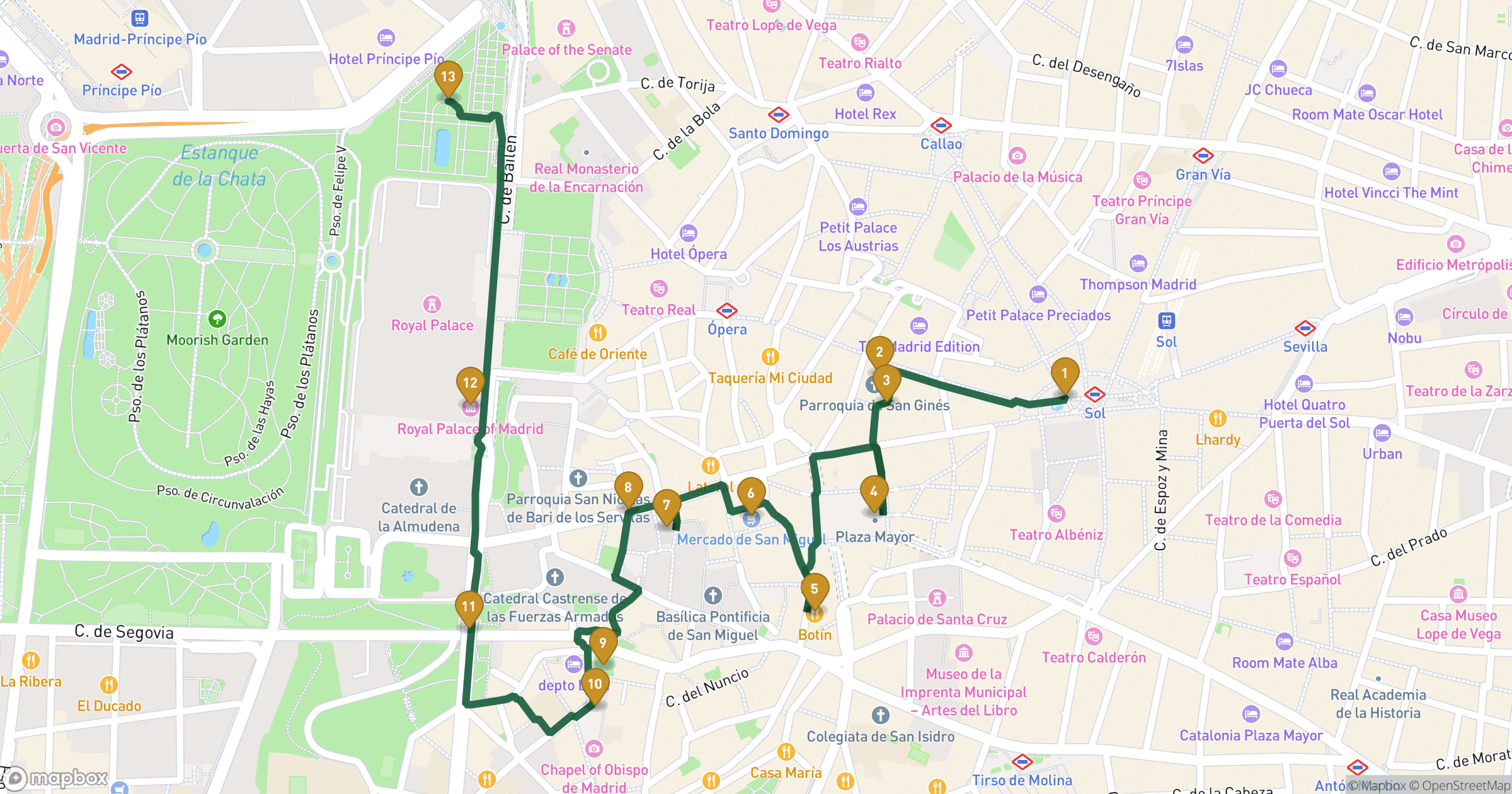
Route map for Madrid walking tour

Map for Madrid walking tour with 13 stops
The static map shows the tour route with Puerta del Sol, Church of San Ginés de Arlés, Chocolatería San Ginés, Plaza Mayor, and 9 more stops.

Stops along the route

All stops on this self-guided tour at a glance.

  1. Puerta del Sol in Madrid
    Tomás Fano / CC BY-SA 2.0

    1Puerta del SolSquare

    This semi-circular plaza marks the literal crossroads of Spain and the starting point for national protests. A stone slab set in the pavement marks Kilometre Zero for the country's six radial highways. Overlooking the space are the 20-ton bronze statue of a bear beside a strawberry tree and the vintage neon Tío Pepe sign atop the rooftops.

    Wikidata

  2. Church of San Ginés de Arlés in Madrid
    Luis García ( Zaqarbal ) | Luis García / CC BY-SA 3.0

    2Church of San Ginés de Arlés

    Tucked away from the main thoroughfare, this medieval parish church is the backdrop for one of the city's most macabre ghost stories. Legend recounts that in 1353, a priest beheaded by thieves inside the sanctuary appeared before King Peter the Cruel to reveal his killers. Today, the interior displays El Greco's The Purification of the Temple alongside a taxidermied crocodile.

    Style: Neo-Plateresque architecture … · Wikidata

  3. Chocolatería San Ginés in Madrid
    ajay_suresh / CC BY 2.0

    3Chocolatería San GinésCafé

    Operating since 1894 in a narrow alleyway, this cafe defines the local tradition of thick hot chocolate and fried dough. Patrons order classic churros or thicker porras with chocolate dense enough to be used as structural grout. Open 24 hours a day, the marble-topped tables have hosted everyone from early-morning regulars to Hollywood celebrities whose portraits line the walls.

    Wikidata

  4. Plaza Mayor in Madrid
    Draceane / CC BY-SA 4.0

    4Plaza MayorSquare

    This grand, symmetrical square completed in 1619 framed historic bullfights, public executions, and Spanish Inquisition trials. The surrounding residential buildings feature exactly 237 balconies that once gave tenants front-row seats to public trials and burnings. In the center, the equestrian statue of Philip III was replaced after birds kept becoming trapped in the original horse's hollow mouth.

    Architect: Juan de Herrera · Wikidata

  5. Sobrino de Botín in Madrid
    Pablo Sanchez from Sunnyvale, CA, USA / CC BY 2.0

    5Sobrino de BotínMonument

    Founded in 1725, this establishment holds the Guinness World Record as the oldest continuously operating restaurant in the world. Its wood-fired oven has reportedly stayed lit for nearly three centuries, roasting suckling pig and lamb inside brick cellars. A young Francisco de Goya once washed dishes here, and Ernest Hemingway later celebrated its roasted pork in The Sun Also Rises.

    Built: 1725 · Wikidata

  6. Mercado de San Miguel in Madrid
    Fernando / CC BY-SA 4.0

    6Mercado de San MiguelMarket

    Dating to 1916, this iron-and-glass market hall is the last preserved structure of its kind in the city. Architect Alfonso Dubé designed its slender iron columns and glass walls to modernize food hygiene for local neighborhood shoppers. Built over the site of a demolished church, the venue operates as a gourmet food hall serving Iberian ham, fresh sea urchins, and artisanal vermouth.

    Built: 1916 · Architect: Alfonso Dubé · Wikidata

  7. Plaza de la Villa in Madrid
    Anagoria / CC BY 3.0

    7Plaza de la VillaSquare

    This compact square preserves three historic civic buildings spanning three different centuries. Legend says Emperor Charles V lowered the door to the 15th-century Torre de los Lujanes so captured French King Francis I had to bow just to enter his cell. Next door stand the Plateresque Casa de Cisneros from 1537 and the old town hall begun by architect Juan Gómez de Mora in 1644.

    Wikidata

  8. Calle Mayor in Madrid
    Carlos Delgado / CC BY-SA 3.0

    8Calle Mayor

    This historic thoroughfare was the site of a deadly royal assassination attempt on May 31, 1906. Anarchist Mateo Morral dropped an Orsini bomb concealed in a bouquet from a balcony at number 88 onto the wedding carriage of King Alfonso XIII and Victoria Eugenie. The blast killed 24 people and splattered the queen's white wedding dress with blood, an event marked by a monument on the street.

    Wikidata

  9. Jardín del Príncipe de Anglona in Madrid
    Concepcion AMAT ORTA… / CC BY 3.0

    9Jardín del Príncipe de AnglonaPark

    Concealed behind a tall stone wall, this 18th-century garden provided a private retreat for the Prince of Anglona. Landscape designer Javier de Winthuysen reconfigured the grounds in 1920 with geometric brick paths, low boxwood hedges, and a central white marble fountain. An artificial embankment elevates the site above the surrounding street traffic, creating the feel of a hanging terrace.

    Wikidata

  10. Plaza de la Paja in Madrid
    rene boulay / CC BY-SA 3.0

    10Plaza de la PajaSquare

    This sloping medieval marketplace took its name from the straw provided to feed the mules of nearby chapel priests. Flanking the square is the 16th-century Capilla del Obispo, which holds the remains of Bishop Gutierre de Vargas Carvajal. The surrounding land once belonged to noble families, including the Vargas household that employed Madrid's patron saint, Isidro, as a laborer.

    Wikidata

  11. Viaducto de Segovia in Madrid
    Metro Centric / CC BY 2.0

    11Viaducto de SegoviaBridge

    Spanning the ravine of Calle de Segovia, this soaring rationalist bridge replaced an earlier 19th-century iron crossing to connect the Royal Palace with southern neighborhoods. The current span was finished in 1942 after sustaining heavy artillery damage during the Civil War. Known locally for suicides, the bridge has thick acrylic glass barriers installed in 1998 along its pedestrian railings.

    Wikidata

  12. Palacio Real in Madrid
    Josefalcaes / CC BY-SA 4.0

    12Palacio RealCastle

    Boasting 3,418 rooms, this massive royal residence replaced a medieval fortress destroyed by a Christmas Eve fire in 1734. King Philip V commissioned Filippo Juvarra and Giambattista Sacchetti to construct a replacement entirely out of stone and brick to prevent future blazes. The interiors house frescoes by Tiepolo, an extensive Royal Armory, and a Throne Room guarded by golden lions.

    Built: 1735 · Architect: Francesco Sabatini, Filippo Juvarra … · Style: baroque architecture · Wikidata

  13. Jardines de Sabatini in Madrid
    r0x sm / CC BY-SA 2.0

    13Jardines de SabatiniPark

    These neoclassical geometric gardens were built in the 1930s on the site of the former Royal Stables. Although named after architect Francesco Sabatini, he actually designed the equestrian stables that were demolished to create the park. The statues of Spanish monarchs scattered across the lawns were originally meant for the palace roof before fears of earthquake damage kept them grounded.

    Wikidata

Download the app

This public page shows a preview. The full route, all content, and navigation are available in CityTour AI.

Cities nearby

Discover self-guided tours in nearby cities.

Frequently asked questions

The key answers before you start.

Is this a self-guided audio tour?

Yes. In the CityTour AI app (iOS and Android), this is a self-guided audio tour for Madrid — start anytime, at your own pace, with map, stops, and audio narration.

What will you see on this tour?

On this tour you'll see, among others, Puerta del Sol, Church of San Ginés de Arlés, Chocolatería San Ginés, Plaza Mayor, Sobrino de Botín, Mercado de San Miguel and more sights.

Where does the tour start?

The route starts at Puerta del Sol and ends at Jardines de Sabatini. You can start anytime — the app guides you to the first stop.

How long does the tour take?

About 103 minutes for 13 stops — at your own pace, with breaks whenever you like.

How much does the tour cost?

This tour costs 15 credits. The exact price depends on the pack you buy and your country — roughly $5.

Is it an outdoor tour — are entry tickets included?

Yes, it's an outdoor tour: the sights are viewed from the outside. Entry tickets are not included, and step-free access cannot be guaranteed.

Is the audio guide available in my language?

The tour and audio guide are available in English, Deutsch, Français, Español, Italiano and 9 more languages. You pick your language in the app.

Can I use the tour offline?

Yes. Tours can be used offline.

Can I ask the AI questions along the way?

Yes. At every stop you can ask the AI directly if you want to know more or didn't understand something.