CityTour AI

Zurich self-guided walking tour

Shadows of the Limmat: Radicals and Martyrs

Step behind the pristine facade of Switzerland’s largest city to discover a landscape of radical dissent and dark legends. This atmospheric walking tour leads you through the medieval heart of Zurich, from the site of Roman executions to the hidden rooms where world-altering revolutions were born. You will experience the tension between the city’s orderly surface and the volatile ideas that have shaped its history.

Audio tourSelf-guidediOS & Android
104minutes
2.7 kmdistance
14stops
Audio guideFormat
Shadows of the Limmat: Radicals and Martyrs
Roland zh / CC BY-SA 3.0

Stops on this route

This tour works well for first-time visitors, weekend trips, and travelers who want to explore Zurich without a fixed tour time.

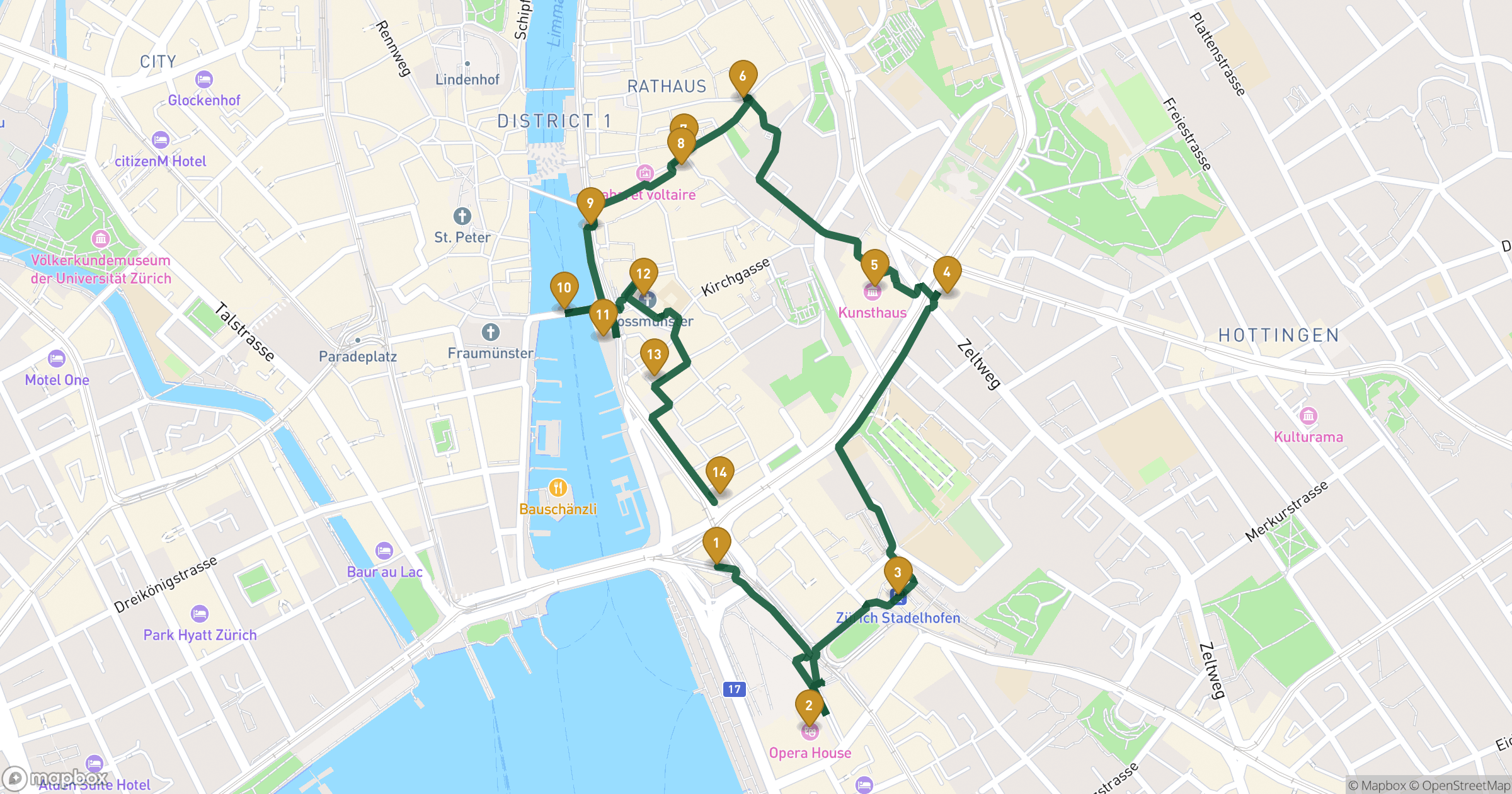
Route map for Zurich walking tour

Map for Zurich walking tour with 14 stops
The static map shows the tour route with Bellevueplatz, Opernhaus, Zürich Stadelhofen railway station, Schauspielhaus Zürich, and 10 more stops.

Stops along the route

All stops on this self-guided tour at a glance.

  1. Bellevueplatz in Zurich
    Roland zh / CC BY-SA 3.0

    1BellevueplatzSquare

    Bellevueplatz marks the threshold where the Limmat leaves Lake Zurich, set against festive folklore and ancient guild traditions. At adjacent Sechseläutenplatz each April, the explosive head of the Böögg snowman is detonated atop a bonfire to forecast the summer weather. The square takes its name from the Grand Hotel Bellevue building, still visible nearby at Limmatquai 1.

    Wikidata

  2. Opernhaus in Zurich
    © Roland Fischer, Zürich (Switzerland) – Mail notification to: roland_zh(at)hispeed(dot)ch / Wikimedia Commons; Roland zh / CC BY-SA 3.0

    2OpernhausTheatre

    The Zurich Opera House was rebuilt after fire, only to find itself at the center of violent social revolt. In May 1980, youth protests against a 60-million-franc renovation credit triggered the citywide Opernhaus-Krawalle under the slogan 'Züri brännt'. The 1891 neo-Baroque facade by Fellner and Helmer replaced the gutted Aktientheater with stone walls and cultural busts.

    Built: 1965 · Architect: Fellner & Helmer · Wikidata

  3. Zürich Stadelhofen railway station in Zurich
    JuergenG / CC BY-SA 3.0

    3Zürich Stadelhofen railway stationBuilding

    Zürich Stadelhofen railway station showcases organic engineering shaped like the skeletal remains of a prehistoric beast. Spanish architect Santiago Calatrava overhauled the site in 1990 with rib-like steel platform canopies and a curving concrete retaining wall. Glass paving stones above allow daylight into the subterranean shopping arcade as trains enter the Limmat-crossing Hirschengraben Tunnel.

    Architect: Santiago Calatrava · Wikidata

  4. Schauspielhaus Zürich in Zurich
    upload by Adrian Michael / CC BY 2.5

    4Schauspielhaus ZürichTheatre

    The Pfauen building of Schauspielhaus Zürich served as an unyielding fortress of free speech amid wartime fascism. During World War II, exiled artists staged works banned across the Third Reich under the helm of Ferdinand Rieser and Oskar Wälterlin. The stage hosted the 1941 premiere of Bertolt Brecht's 'Mother Courage and Her Children' starring Therese Giehse.

    Wikidata

  5. Kunsthaus in Zurich
    Roland zh / CC BY-SA 3.0

    5KunsthausMuseum

    Kunsthaus Zurich connects monumental art collections to the tainted fortune of arms manufacturer Emil Georg Bührle. The 2021 Chipperfield extension houses works acquired by Bührle through wartime sales to both sides and illicit purchases of looted Jewish art. Though some disputed pieces were returned after the war, Bührle repurchased many into his private assembly.

    Built: 1819 · Wikidata

  6. Neumarkt in Zurich
    Roland zh / CC BY-SA 3.0

    6NeumarktSquare

    Neumarkt preserves the cobblestone texture of upper medieval Zurich while remembering the horrific destruction of its Jewish enclave. During the Black Death in February 1349, residents faced false accusations of poisoning city wells, leading to mass torture, exile, and burnings. Today, the somber Grimmenturm tower stands beside the square where the neighborhood synagogue once stood.

    Wikidata

  7. Spiegelgasse in Zurich
    Leonhard Lenz / CC0

    7SpiegelgasseSquare

    Spiegelgasse is a narrow, steep alleyway whose historic residences incubated both political revolutions and artistic rebellions. At number 14, Vladimir Lenin lived in exile between 1916 and 1917, plotting the fall of the Tsars above a smelly sausage factory. Across the lane at number 1, Hugo Ball founded the Cabaret Voltaire that same year to launch Dadaism.

    Wikidata

  8. Rathaus in Zurich
    JoachimKohler-HB / CC BY-SA 4.0

    8Rathaus

    The Rathaus sits directly over the rushing Limmat, linking Zurich's cantonal government to the downfall of a ruthless ruler. In 1489, following a bitter rebellion, the authoritarian mayor and decorated military leader Hans Waldmann was arrested, tortured, and beheaded. The late-17th-century Renaissance edifice was positioned spanning the river to monitor commercial traffic and political dissent.

    Named after: Zürich Town Hall · Wikidata

  9. Limmatquai in Zurich
    Andrew Bossi / CC BY-SA 2.5

    9Limmatquai

    Limmatquai traces the river's eastern bank where Zurich's elite guilds dominated civic politics and riverfront commerce. Between the 12th and 19th centuries, the shoreline was reclaimed from the Limmat, pushing the riverbank outward by as much as 28 meters. Historic guild halls such as the Zunfthaus zur Zimmerleuten still line the route against the rattle of modern trams.

    Wikidata

  10. Münsterbrücke in Zurich
    Jag9889 / CC BY-SA 4.0

    10MünsterbrückeBridge

    Münsterbrücke is an arched stone crossing built in 1838 to link the city's two primary churches. Engineer Alois Negrelli, who later designed the Suez Canal, stabilized the 6,100 tons of granite and sandstone using 472 oak foundation piles. The piers are decorated with black Jura marble slabs, while cast-iron railings were forged in the Grand Duchy of Baden.

    Built: 1838 · Architect: Alois Negrelli · Wikidata

  11. Wasserkirche in Zurich
    Roland zh / CC BY-SA 3.0

    11WasserkircheChurch

    Wasserkirche sits upon a former Limmat river island where the city's patron saints met a gruesome death. According to legend, Felix and Regula were decapitated here by a Roman governor before carrying their heads uphill forty paces. The 1486 late-Gothic building still enshrines the Martyr's Stone, though it was repurposed as a secular library during the Reformation.

    Built: 1100 · Style: Gothic architecture · Wikidata

  12. Grossmünster in Zurich
    JoachimKohler-HB / CC BY-SA 4.0

    12GrossmünsterChurch

    Grossmünster stands on the spot where Charlemagne supposedly knelt when his horse located the graves of decapitated saints. The Swiss Reformation ignited here in 1522 during the Affair of the Sausages, when radicals broke the Lenten fast to rebel against church dogma. Today, Sigmar Polke's sliced-agate windows cast colored light into the stripped, icon-free interior.

    Built: 1201 · Style: Romanesque architecture · Wikidata

  13. Helmhaus in Zurich
    Roland zh , upload on 24. September 2009 / CC BY-SA 3.0

    13Helmhaus

    The Helmhaus marks the riverside site where municipal justice was brutally administered beneath cold stone arches. For centuries, this location housed the Malefizgericht criminal court alongside the city's official public weights and trade scales. Completed in 1794, the present hall stands physically linked to the Wasserkirche, lending divine gravity to its judicial verdicts.

    Wikidata

  14. Grand Café Odeon in Zurich
    Roland zh / CC BY-SA 3.0

    14Grand Café Odeon

    Grand Café Odeon opened on July 1, 1911, saved from bankruptcy when builder Julius Uster won the Spanish National Lottery. Josef Schottenhaml managed the Viennese-style venue as it became a haven for patrons like Vladimir Lenin, James Joyce, and Albert Einstein. In 1967, the café sparked the 'Odéon libre!' protests after staff barred a woman for wearing a miniskirt.

    Wikidata

Download the app

This public page shows a preview. The full route, all content, and navigation are available in CityTour AI.

Cities nearby

Discover self-guided tours in nearby cities.

Frequently asked questions

The key answers before you start.

Is this a self-guided audio tour?

Yes. In the CityTour AI app (iOS and Android), this is a self-guided audio tour for Zurich — start anytime, at your own pace, with map, stops, and audio narration.

What will you see on this tour?

On this tour you'll see, among others, Bellevueplatz, Opernhaus, Zürich Stadelhofen railway station, Schauspielhaus Zürich, Kunsthaus, Neumarkt and more sights.

Where does the tour start?

The route starts at Bellevueplatz and ends at Grand Café Odeon. You can start anytime — the app guides you to the first stop.

How long does the tour take?

About 104 minutes for 14 stops — at your own pace, with breaks whenever you like.

How much does the tour cost?

This tour costs 15 credits. The exact price depends on the pack you buy and your country — roughly $5.

Is it an outdoor tour — are entry tickets included?

Yes, it's an outdoor tour: the sights are viewed from the outside. Entry tickets are not included, and step-free access cannot be guaranteed.

Is the audio guide available in my language?

The tour and audio guide are available in English, Deutsch, Français, Español, Italiano and 9 more languages. You pick your language in the app.

Can I use the tour offline?

Yes. Tours can be used offline.

Can I ask the AI questions along the way?

Yes. At every stop you can ask the AI directly if you want to know more or didn't understand something.