CityTour AI

Zurich self-guided walking tour

Zurich’s Timeless Heart: From Romans to Reformers

Explore the winding alleys and grand squares of Zurich’s Old Town on this relaxed riverside stroll. You’ll discover how a Roman tax station transformed into a medieval guild city and a global financial powerhouse, all while taking in iconic views of the Limmat. It’s the perfect way to see the city’s most famous spires and hidden corners through the eyes of a local.

Audio tourSelf-guidediOS & Android
100minutes
2.5 kmdistance
14stops
Audio guideFormat
Zurich’s Timeless Heart: From Romans to Reformers
Chilimaid / CC BY-SA 4.0

Stops on this route

This tour works well for first-time visitors, weekend trips, and travelers who want to explore Zurich without a fixed tour time.

Route map for Zurich walking tour

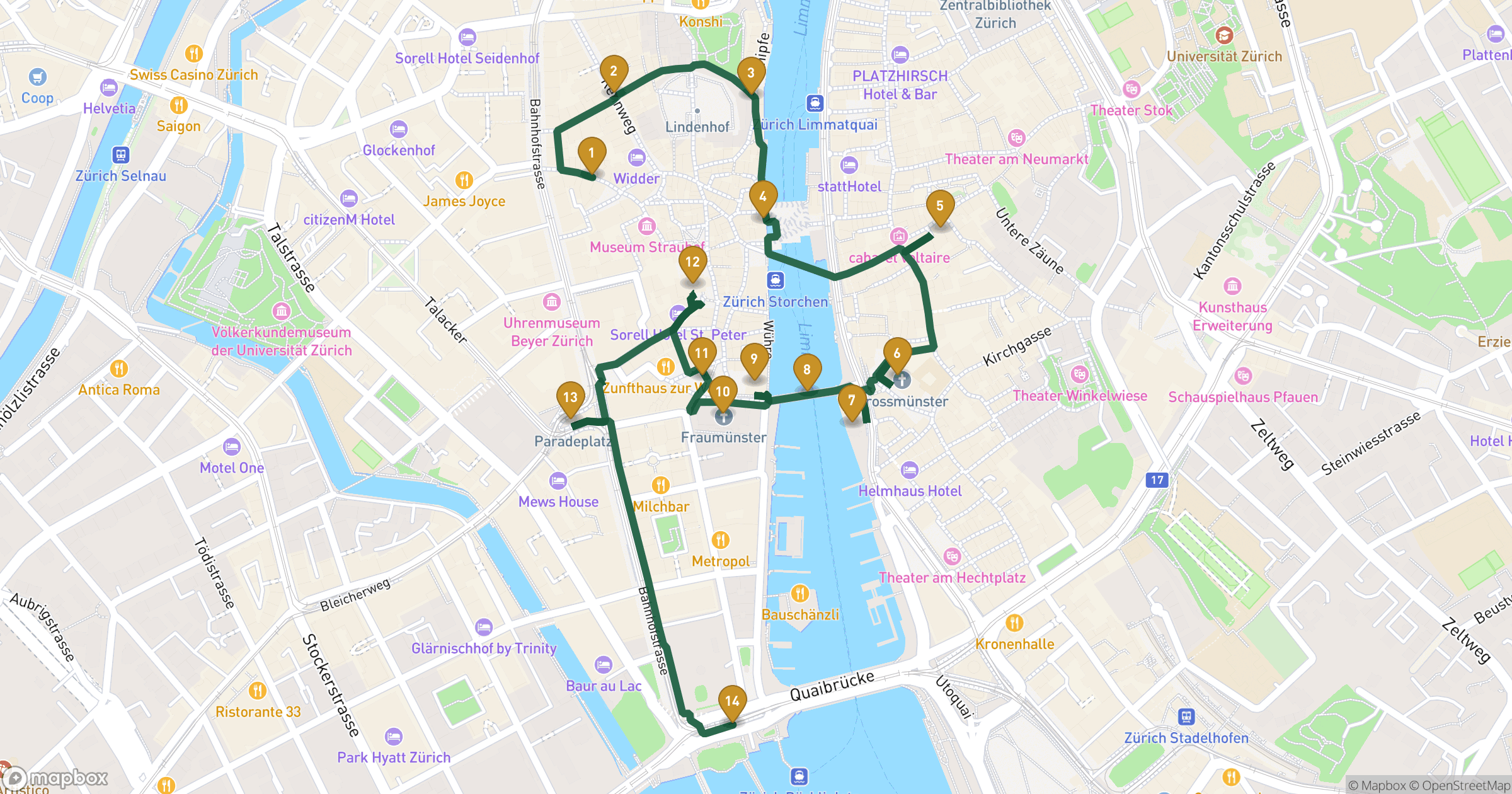
Map for Zurich walking tour with 14 stops
The static map shows the tour route with Augustinergasse, Rennweg, Schipfe, Lindenhof, and 10 more stops.

Stops along the route

All stops on this self-guided tour at a glance.

  1. Augustinergasse in Zurich
    Patrick Nouhailler's… / CC BY-SA 3.0

    1AugustinergasseSquare

    This colorful medieval lane showcases an architectural rivalry among seventeenth-century factory owners competing with ornate oriel windows. These bay windows served as concealed peepholes for residents to inspect callers at the door. Nearby, the choir of the former Augustinian church operated as the city mint from 1596 until 1841, inspiring the name of Münzplatz.

    Named after: Augustinians · Wikidata

  2. Rennweg in Zurich
    Roland zh / CC BY-SA 3.0

    2RennwegSquare

    Once the city's widest medieval thoroughfare for horse tournaments, this gently curving street marks a critical defense point of old Zurich. In July 1443, gatekeeper's wife Anna Ziegler saved the retreating town by dropping the iron portcullis at the Rennweg gate right before enemy troops arrived. Today, the lost gate is replaced by the bustling city tram system.

    Wikidata

  3. Schipfe in Zurich
    Roland zh / CC BY-SA 3.0

    3Schipfe

    This riverside artisan quarter along the Limmat draws its name from the boatmen who pushed their flat-bottomed craft into the river. Archaeologists uncovered a Roman hypocaustum heating system between here and nearby Weinplatz. Medieval silk workshops once thrived beside the Oetenbach nunnery, which was torn down in the early twentieth century for an observatory and police headquarters.

    Wikidata

  4. Lindenhof in Zurich
    Ank Kumar / CC BY-SA 4.0

    4Lindenhof

    Perched above the river, this elevated hilltop plateau preserves the earliest written record of Zurich on a second-century Roman tombstone found in 1747. During a 1292 siege by Duke Albrecht I of Habsburg, local women saved the city by donning full armor and holding spears along the ridge to mimic a massive army. In 1798, citizens gathered here to swear an oath to the Helvetic Republic.

    Named after: Lindenhof · Wikidata

  5. Rathaus in Zurich
    Chilimaid / CC BY-SA 4.0

    5Rathaus

    Erected between 1694 and 1698, this Renaissance town hall spans directly across the Limmat on massive piles driven into the riverbed. Designed to bridge the two halves of the Old Town, it was deliberately styled with dignified republican restraint rather than royal extravagance. Its chambers remain in active use by both the city and cantonal parliaments.

    Named after: Zürich Town Hall · Wikidata

  6. Grossmünster in Zurich
    Andrew Bossi / CC BY-SA 2.5

    6GrossmünsterChurch

    This Romanesque landmark traces its legendary founding to Charlemagne, whose horse fell to its knees over the graves of martyrs Felix and Regula. In 1519, Huldrych Zwingli launched the Swiss-German Reformation from this pulpit, sparking open defiance of church fasting rules during the Affair of the Sausages. The church's distinctive neo-Gothic towers received their domes after an eighteenth-century fire.

    Built: 1201 · Style: Romanesque architecture · Wikidata

  7. Wasserkirche in Zurich
    Roland zh / CC BY-SA 3.0

    7WasserkircheChurch

    This Late Gothic church originally stood on a small island where Roman soldiers beheaded patron saints Felix and Regula in the third century. Legend claims the martyrs miraculously stood up, carried their severed heads forty paces uphill, and chose their burial spot. Secularized during the Reformation, the building served as Zurich's first public library from 1634 for nearly two centuries.

    Built: 1100 · Style: Gothic architecture · Wikidata

  8. Münsterbrücke in Zurich
    Jag9889 / CC BY-SA 4.0

    8MünsterbrückeBridge

    Opened in 1838, this crossing was the city's first flat stone bridge, designed by engineer Alois Negrelli before he planned the Suez Canal. Pillars of St. Gotthard granite are paneled with black Jura marble, supported by 472 oak piles sunk up to fifteen meters into the riverbed. Cast-iron railings imported from the Grand Duchy of Baden finish this link between Zurich's primary minsters.

    Built: 1838 · Architect: Alois Negrelli · Wikidata

  9. Zunfthaus zur Meisen in Zurich
    Roland zh / CC BY-SA 3.0

    9Zunfthaus zur MeisenBuilding

    Completed in 1752 for wine merchants and painters, this French Rococo guild house was constructed under the management of two stonemasons' widows who outbid all male competitors. Its roof initially accommodated Zurich's first public observatory, the Urania Sternwarte. Inside, elaborate stucco ceilings and tiled stoves adorn the halls where guild members have gathered since 1336.

    Wikidata

  10. Fraumünster in Zurich
    -wuppertaler / CC BY 4.0

    10FraumünsterChurch

    Founded in 853 by King Louis the German, this former aristocratic Benedictine abbey once exercised royal powers to collect tolls and mint coins. In 1524, the final abbess, Katharina von Zimmern, peacefully dissolved the convent and surrendered the keys to city authorities to prevent religious bloodshed. Five massive stained-glass windows designed by Marc Chagall were installed in the choir in 1970.

    Built: 853 · Style: Gothic architecture · Named after: virgin birth of Jesus · Wikidata

  11. Münsterhof in Zurich
    -wuppertaler / CC BY 4.0

    11MünsterhofSquare

    The old town's largest square features the 1937 equestrian statue of Hans Waldmann, a Burgundian Wars hero and Zurich mayor who was executed by his own citizens in 1489. Used as a parking lot for decades, the site underwent a major renovation in 2016 to become a pedestrian plaza. Today, the square serves as the staging ground for the traditional costumed guild parades of the Sechseläuten festival.

    Wikidata

  12. St. Peter in Zurich
    -wuppertaler / CC BY 4.0

    12St. PeterChurch

    Built over a Roman temple to Jupiter, this 1706 parish church features Europe's largest clock face, measuring 8.7 meters in diameter. Pastor Leo Jud helped create the first Zurich translation of the Bible here during the early 1500s. A lookout guard lived in the thirteenth-century tower until 1911, blowing a horn and hanging a flag whenever smoke was spotted over the city.

    Built: 1706 · Style: baroque architecture · Named after: Saint Peter · Wikidata

  13. Paradeplatz in Zurich
    Roland zh / CC BY-SA 3.0

    13ParadeplatzSquare

    Now a financial hub, this square served as a seventeenth-century livestock market known as the Säumärt before nineteenth-century banks moved in. In 1839, it became the battlefield of the Züriputsch, when thousands of rural demonstrators marched in and brought down the cantonal administration. Confiserie Sprüngli opened on the corner in 1859, famous for its miniature Luxemburgerli macaroons.

    Built: 1900 · Wikidata

  14. Bürkliplatz in Zurich
    Roland zh / CC BY-SA 3.0

    14BürkliplatzSquare

    Named after city engineer Arnold Bürkli, this lakeside square was created in the 1880s by clearing industrial debris for tree-lined public promenades. The Geiserbrunnen bronze fountain of a bull tamer was funded by a 1909 bequest of 40,000 Swiss francs from former city architect Arnold Geiser. Weekly markets and passenger steamships departing for Rapperswil still animate the lakeside dock.

    Built: 1887 · Named after: Arnold Bürkli · Wikidata

Download the app

This public page shows a preview. The full route, all content, and navigation are available in CityTour AI.

Cities nearby

Discover self-guided tours in nearby cities.

Frequently asked questions

The key answers before you start.

Is this a self-guided audio tour?

Yes. In the CityTour AI app (iOS and Android), this is a self-guided audio tour for Zurich — start anytime, at your own pace, with map, stops, and audio narration.

What will you see on this tour?

On this tour you'll see, among others, Augustinergasse, Rennweg, Schipfe, Lindenhof, Rathaus, Grossmünster and more sights.

Where does the tour start?

The route starts at Augustinergasse and ends at Bürkliplatz. You can start anytime — the app guides you to the first stop.

How long does the tour take?

About 100 minutes for 14 stops — at your own pace, with breaks whenever you like.

How much does the tour cost?

This tour costs 15 credits. The exact price depends on the pack you buy and your country — roughly $5.

Is it an outdoor tour — are entry tickets included?

Yes, it's an outdoor tour: the sights are viewed from the outside. Entry tickets are not included, and step-free access cannot be guaranteed.

Is the audio guide available in my language?

The tour and audio guide are available in English, Deutsch, Français, Español, Italiano and 9 more languages. You pick your language in the app.

Can I use the tour offline?

Yes. Tours can be used offline.

Can I ask the AI questions along the way?

Yes. At every stop you can ask the AI directly if you want to know more or didn't understand something.