CityTour AI

Washington, D.C. self-guided walking tour

Power and Pillars: The Executive Core

Explore the architectural evolution of the American capital on this casual stroll through the city's most famous neighborhood. From the Neoclassical elegance of the White House to the bold French Second Empire style of the Eisenhower building, you'll discover how the skyline reflects the changing face of a nation. It is a perfect mix of grand monuments, hidden historical quirks, and the stories of the people who built them.

Audio tourSelf-guidediOS & Android
100minutes
4.2 kmdistance
10stops
Audio guideFormat
Power and Pillars: The Executive Core
Fuzheado / CC BY-SA 4.0

Stops on this route

This tour works well for first-time visitors, weekend trips, and travelers who want to explore Washington, D.C. without a fixed tour time.

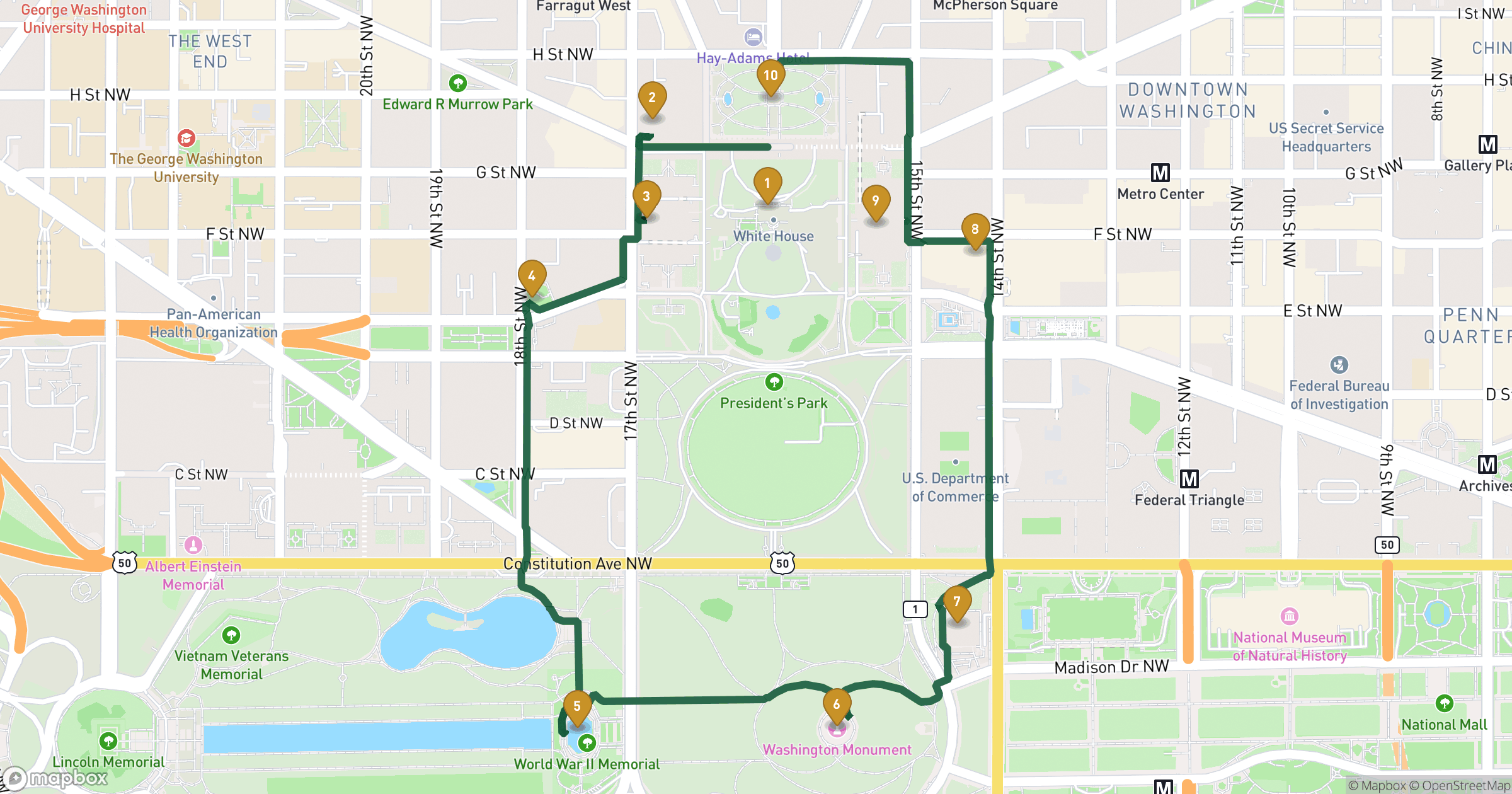
Route map for Washington, D.C. walking tour

Map for Washington, D.C. walking tour with 10 stops
The static map shows the tour route with White House, Renwick Gallery, Eisenhower Executive Office Building, The Octagon House, and 6 more stops.

Stops along the route

All stops on this self-guided tour at a glance.

  1. White House in Washington, D.C.
    This image or media was taken or created by Matt H. Wade. To see his entire portfolio, click here.@thatmattwade This image is protected by copyright! If you would like to use it, please read this first. / CC BY-SA 3.0

    1White HouseBuilding

    The White House stands at 1600 Pennsylvania Avenue as a Neoclassical residence modeled by architect James Hoban after Dublin's Leinster House. Built from naturally grayish Aquia Creek sandstone, it was whitewashed to prevent frost damage and eventually coated in white lead paint after the British set it ablaze in the War of 1812. When John Adams first moved in during 1800, his wife Abigail had to dry their laundry inside the unfinished East Room.

    Built: 1800 · Architect: James Hoban · Style: Neoclassical architecture · Height: 21.3 m · Wikidata

  2. Renwick Gallery in Washington, D.C.
    AgnosticPreachersKid / CC BY-SA 3.0

    2Renwick GalleryMuseum

    The Renwick Gallery was conceived by banker William Wilson Corcoran as the first purpose-built public art museum in the United States. Architect James Renwick Jr. gave it a French Second Empire design, but construction begun in 1859 was halted when the government seized the site as a Civil War quartermaster warehouse. Carved stone lettering beneath the roofline still reads Dedicated to Art.

    Built: 1972 · Architect: James Renwick Jr. · Wikidata

  3. Eisenhower Executive Office Building in Washington, D.C.
    G. Edward Johnson | Own work This photo was taken with Nikon Z 9 / CC BY 4.0

    3Eisenhower Executive Office Building

    The Eisenhower Executive Office Building represents French Second Empire architecture through an ornate granite facade designed by Alfred B. Mullett. Mark Twain once dubbed it the ugliest building in America, while Harry Truman joked it was a white elephant. Inside, the massive structure contains over 1,500 windows, nearly two miles of black-and-white tiled corridors, and the ceremonial office of the Vice President.

    Architect: Alfred B. Mullett · Style: Second Empire style · Named after: Dwight D. Eisenhower · Wikidata

  4. The Octagon House in Washington, D.C.
    Aude / CC BY-SA 2.5

    4The Octagon HouseMuseum

    The Octagon House is a brick residence designed by U.S. Capitol architect William Thornton that is actually hexagonal rather than eight-sided. Following the burning of the White House in 1814, President James Madison and First Lady Dolley Madison moved in, using it as an executive home where Madison signed the Treaty of Ghent. Today, the uniquely angled property belongs to the American Institute of Architects.

    Built: 1799 · Architect: William Thornton · Style: Federal architecture · Wikidata

  5. World War II Memorial in Washington, D.C.
    Christoph Radtke / CC BY 3.0

    5World War II MemorialMonument

    The World War II Memorial serves as a stone plaza between the Washington Monument and the Lincoln Memorial. Architect Friedrich St. Florian framed the space with two triumphal arches marked Atlantic and Pacific alongside 56 granite pillars representing U.S. states and territories. Its Freedom Wall features 4,048 gold stars, with each individual star commemorating 100 Americans who died in the conflict.

    Built: 2004 · Wikidata

  6. Washington Monument in Washington, D.C.
    Victoria Stauffenberg / Public domain

    6Washington Monument

    The Washington Monument rises 555 feet and 5 inches as the world's tallest stone obelisk. A clear shift in marble color about a third of the way up marks a 25-year construction halt that began in 1854, after which engineers under Thomas Lincoln Casey, Sr. could not match the original quarry. Local law still prevents any building in the capital from exceeding the width of its street plus 20 feet.

    Built: 1848 · Architect: Thomas Lincoln Casey, Sr., United States Army Corps of Engineers … · Style: Egyptian Revival architecture · Height: 169 m · Wikidata

  7. National Museum of African American History and Culture in Washington, D.C.
    Frank Schulenburg / CC BY-SA 4.0

    7National Museum of African American History and Culture

    The National Museum of African American History and Culture features a three-tiered corona designed by David Adjaye and Phil Freelon, inspired by West African Yoruban crowns. Its outer skin consists of 3,600 bronze-colored cast-aluminum panels honoring historic ironwork forged by enslaved and free Black artisans in Charleston and New Orleans. The 17-degree slope of its tiers precisely mirrors the capstone of the nearby Washington Monument.

    Built: 2003 · Architect: Phil Freelon, David Adjaye · Style: Postmodernism · Height: 59.5 m · Wikidata

  8. Willard InterContinental Hotel in Washington, D.C.
    Tim1965 / CC BY-SA 3.0

    8Willard InterContinental HotelBuilding

    The Willard InterContinental Hotel is a Beaux-Arts landmark built in 1901 by architect Henry Janeway Hardenbergh on ground used for hospitality since the 1810s. President Ulysses S. Grant regularly fled here for brandy and cigars, growing frustrated with favor-seekers who waited in the lobby and helped cement the term lobbyists. In 1963, Martin Luther King Jr. finalized his I Have a Dream speech within its walls.

  9. United States Department of the Treasury in Washington, D.C.
    Rchuon24 / CC BY-SA 3.0

    9United States Department of the TreasuryBuilding

    The United States Department of the Treasury is a Greek Revival fortress that interrupts the vista of Pennsylvania Avenue between the White House and the Capitol. Legend says President Andrew Jackson ended site debates by thrusting his cane into the ground and ordering construction on that exact spot. Its east wing features 30 monolithic Ionic columns carved from solid granite, with a statue of Alexander Hamilton standing on the south side.

    Built: 1789 · Wikidata

  10. Lafayette Square in Washington, D.C.
    Frypie / CC BY-SA 4.0

    10Lafayette SquarePark

    Lafayette Square serves as the public seven-acre front yard of the White House, landscaped into winding pathways by Andrew Jackson Downing. At its center stands a bronze sculpture of Andrew Jackson, which was the first bronze statue cast in the United States and famously balances its entire weight on the horse's two hind legs. Four corner statues honor foreign Revolutionary War leaders, including Lafayette, Rochambeau, von Steuben, and Kosciuszko.

    Built: 1816 · Architect: Andrew Jackson Downing · Named after: Gilbert du Motier, Marquis de Lafayette · Wikidata

Download the app

This public page shows a preview. The full route, all content, and navigation are available in CityTour AI.

Cities nearby

Discover self-guided tours in nearby cities.

Frequently asked questions

The key answers before you start.

Is this a self-guided audio tour?

Yes. In the CityTour AI app (iOS and Android), this is a self-guided audio tour for Washington, D.C. — start anytime, at your own pace, with map, stops, and audio narration.

What will you see on this tour?

On this tour you'll see, among others, White House, Renwick Gallery, Eisenhower Executive Office Building, The Octagon House, World War II Memorial, Washington Monument and more sights.

Where does the tour start?

The route starts at White House and ends at Lafayette Square. You can start anytime — the app guides you to the first stop.

How long does the tour take?

About 100 minutes for 10 stops — at your own pace, with breaks whenever you like.

How much does the tour cost?

This tour costs 15 credits. The exact price depends on the pack you buy and your country — roughly $5.

Is it an outdoor tour — are entry tickets included?

Yes, it's an outdoor tour: the sights are viewed from the outside. Entry tickets are not included, and step-free access cannot be guaranteed.

Is the audio guide available in my language?

The tour and audio guide are available in English, Deutsch, Français, Español, Italiano and 9 more languages. You pick your language in the app.

Can I use the tour offline?

Yes. Tours can be used offline.

Can I ask the AI questions along the way?

Yes. At every stop you can ask the AI directly if you want to know more or didn't understand something.