CityTour AI

Washington, D.C. self-guided walking tour

Power and Presence: The Heart of Federal Washington

Experience the architectural evolution of the nation's capital on this engaging walk from the grand arches of Union Station to the historic stage of Ford’s Theatre. You'll discover the secrets behind D.C.'s most iconic marble monuments and the intimate stories of the people who shaped American history. It’s a casual yet deep dive into the symbols of power and the human drama that defines the Federal City.

Audio tourSelf-guidediOS & Android
101minutes
4.6 kmdistance
9stops
Audio guideFormat
Power and Presence: The Heart of Federal Washington
Ingfbruno / CC BY-SA 3.0

Stops on this route

This tour works well for first-time visitors, weekend trips, and travelers who want to explore Washington, D.C. without a fixed tour time.
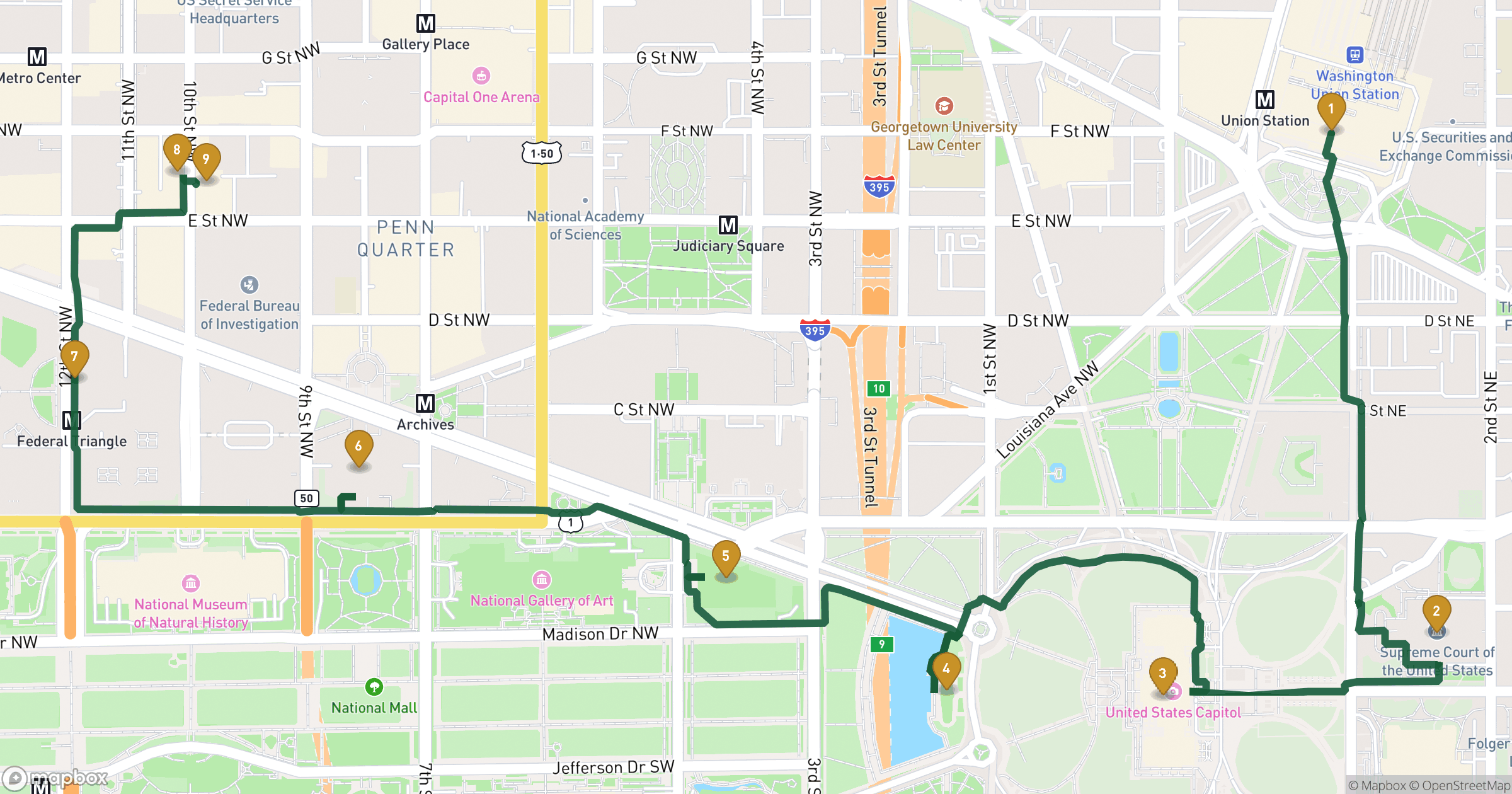
Route map for Washington, D.C. walking tour

Map for Washington, D.C. walking tour with 9 stops
The static map shows the tour route with Washington Union Station, Supreme Court of the United States, United States Capitol, Ulysses S. Grant Memorial, and 5 more stops.

Stops along the route

All stops on this self-guided tour at a glance.

  1. Washington Union Station in Washington, D.C.
    VeggieGarden / CC BY-SA 4.0

    1Washington Union StationBuilding

    Washington Union Station embodies the City Beautiful movement conceived as a monumental Roman palace. Architect Daniel Burnham removed an earlier station cluttering the National Mall and opened this Beaux-Arts gateway in 1907. Its 22-karat gold-leaf barrel vault was restored in the 1980s after being blackened by decades of locomotive soot.

    Built: 1908 · Architect: Daniel Burnham · Style: classical architecture … · Named after: Washington, D.C. · Wikidata

  2. Supreme Court of the United States in Washington, D.C.
    Mathieu Landretti / CC BY-SA 4.0

    2Supreme Court of the United StatesAttraction

    The Supreme Court of the United States finally gained an independent home after meeting inside the Capitol for nearly 150 years. Chief Justice William Howard Taft successfully lobbied Congress for the new building, designed by Cass Gilbert as a Greek temple of white Vermont marble. Both Taft and Gilbert died before the project was finished in 1935.

    Built: 1789 · Wikidata

  3. United States Capitol in Washington, D.C.
    Noclip / Public domain

    3United States CapitolAttraction

    The United States Capitol serves as the legislative center whose initial layout came from physician William Thornton. During the War of 1812, British forces torched the structure until a sudden torrential rainstorm extinguished the flames. Its massive cast-iron dome, designed by Thomas U. Walter, was deliberately kept under construction throughout the Civil War.

    Built: 1793 · Architect: Benjamin Henry Latrobe, James Hoban … · Style: Neoclassical architecture · Height: 88 m · Wikidata

  4. Ulysses S. Grant Memorial in Washington, D.C.
    Farragutful / CC BY-SA 4.0

    4Ulysses S. Grant MemorialMonument

    The Ulysses S. Grant Memorial presents the Civil War general in a weary, rumpled uniform atop his horse Cincinnati. Self-taught sculptor Henry Shrady spent two decades studying horse anatomy at the Bronx Zoo and borrowing Smithsonian uniforms to ensure total accuracy. Shrady died just two weeks before the massive equestrian monument was dedicated in 1922.

    Built: 1919 · Architect: Henry Shrady · Height: 44 m · Wikidata

  5. East Building of the National Gallery of Art in Washington, D.C.
    Difference engine / CC BY-SA 4.0

    5East Building of the National Gallery of ArtMuseum

    The East Building of the National Gallery of Art solved an awkward trapezoidal site through I.M. Pei's sharp triangular geometry. Visitors have smoothed the pink Tennessee marble of its sharp 19.5-degree exterior corner by touching it for decades. Inside the sunlit atrium hangs a 70-foot-wide mobile by Alexander Calder that shifts with slight air currents.

    Built: 1978 · Architect: I. M. Pei · Style: modern architecture · Wikidata

  6. National Archives and Records Administration in Washington, D.C.
    Kurt Kaiser / CC0

    6National Archives and Records AdministrationMuseum

    The U.S. National Archives gathered vulnerable government records scattered across attics into a grand neoclassical repository completed in 1937. Inside the Rotunda for the Charters of Freedom, the original Declaration of Independence and Constitution rest in bronze-and-glass cases filled with argon gas. Six-ton exterior bronze doors open smoothly on precision balances.

    Built: 1934 · Wikidata

  7. Old Post Office in Washington, D.C.
    ajay_suresh | Waldorf Astoria Washington DC - Old Post Office / CC BY 2.0

    7Old Post OfficeBuilding

    The Old Post Office contrasts with its classical neighbors as a dark granite Romanesque fortress completed in 1899. It became Washington's first building with a steel frame and integrated electrical wiring, though critics dismissed it as a cross between a cathedral and a cotton mill. Preservationist Nancy Hanks led a 1970s campaign that halted plans to demolish it.

    Style: Romanesque Revival architecture · Wikidata

  8. Petersen House in Washington, D.C.
    McGhiever / CC BY-SA 3.0

    8Petersen HouseMuseum

    The Petersen House, a modest boarding residence built in 1849 by tailor William Petersen, became Abraham Lincoln's deathbed. Boarder Henry Safford guided the mortally wounded president inside with a candle, where Lincoln had to lie diagonally across a small bed due to his height. Secretary of War Edwin Stanton directed the hunt for the assassins from the back parlor.

    Style: Victorian architecture · Wikidata

  9. Ford's Theatre in Washington, D.C.
    ajay_suresh / CC BY 4.0

    9Ford's Theatre

    Ford's Theatre was a bustling entertainment venue opened by John T. Ford in 1863 before becoming the site of Lincoln's assassination. Assassin John Wilkes Booth was such an established performer there that he even had personal mail delivered to the stage. Following the murder, the building served as a War Department office until an interior collapse killed 22 clerks in 1893.

    Style: Georgian architecture · Wikidata

Download the app

This public page shows a preview. The full route, all content, and navigation are available in CityTour AI.

Cities nearby

Discover self-guided tours in nearby cities.

Frequently asked questions

The key answers before you start.

Is this a self-guided audio tour?

Yes. In the CityTour AI app (iOS and Android), this is a self-guided audio tour for Washington, D.C. — start anytime, at your own pace, with map, stops, and audio narration.

What will you see on this tour?

On this tour you'll see, among others, Washington Union Station, Supreme Court of the United States, United States Capitol, Ulysses S. Grant Memorial, East Building of the National Gallery of Art, National Archives and Records Administration and more sights.

Where does the tour start?

The route starts at Washington Union Station and ends at Ford's Theatre. You can start anytime — the app guides you to the first stop.

How long does the tour take?

About 101 minutes for 9 stops — at your own pace, with breaks whenever you like.

How much does the tour cost?

This tour costs 15 credits. The exact price depends on the pack you buy and your country — roughly $5.

Is it an outdoor tour — are entry tickets included?

Yes, it's an outdoor tour: the sights are viewed from the outside. Entry tickets are not included, and step-free access cannot be guaranteed.

Is the audio guide available in my language?

The tour and audio guide are available in English, Deutsch, Français, Español, Italiano and 9 more languages. You pick your language in the app.

Can I use the tour offline?

Yes. Tours can be used offline.

Can I ask the AI questions along the way?

Yes. At every stop you can ask the AI directly if you want to know more or didn't understand something.